Earlier today we learned of the sad passing of Hungarian violinist György Pauk, at the age of 88. A fitting tribute can be found on the Daily Telegraph website
As that obituary indicates, Pauk was a specialist in the music of fellow-countryman Béla Bartók, whose violin works he recorded for Naxos. The playlist below includes a couple of those recordings, put in context of works by Schubert, Tippett (the Triple Concerto) and Brahms, whose piano trios he recorded for EMI with his regular collaborators, pianist Peter Frankl and cellist Ralph Kirshbaum. You can listen to these recordings below:
Published post no.2,367 – Tuesday 19 November 2024
Expecting the unexpected is the most predictable aspect of a recital from Piotr Anderszewski, tonight’s programme no exception in its juxtaposing collection by Beethoven and Bartók with a selection from Brahms and music by Bach that has long been a cornerstone of his repertoire.
Alive to their iconoclastic flourishes and improvisatory asides, Beethoven’s last bagatelles yet emerged as a cohesive and integrated unity as it ventured through limpid musing and angular playfulness then disarming elegance before arriving at a propulsive take on the B minor Presto muscular or energetic by turns. The final two numbers were of a piece with what went before – the one understated and the other’s ingratiation bookended by outbursts of grating humour. Nothing to be taken for granted in this music, then, as Anderszewski intimated only too well.
Although published as four separate collections, there is no reason why Brahms’s late piano pieces cannot be given separately or in autonomous groupings as here. Starting with Op. 119, Anderszewski brought a confiding touch to the plaintive B minor Intermezzo and rendered the lilting syncopation of that in C with real playfulness. Turning next to Op. 118 and the forlorn quality of its A minor Intermezzo complemented ably that in A, whose new-found popularity need not detract from its harmonic subtlety or soulful poise. From Op. 117, the B flat minor Intermezzo struck note of ingrained fatalism intensified by that in E flat minor from Op. 118 – its ‘mesto’ marking here underlined as the music unfolded toward an endpoint of unforced resignation. Anderszewski looked regretful it should end so before duly leaving the platform.
As his recent recording confirms, Anderszewski has forged unerring identity with the Op. 6 Bagatelles where Bartók gave notice of his fast-emerging individuality. Played with minimal pauses (albeit with a 3-3-2-2-2-2 grouping such as brought these into line with the six pieces in each of those other sets), they offer a conspectus of possibilities over his ensuing creative decade that was to the fore here, alongside a cumulative focus evident less in any increasing technical demands as in a gradual opening-out of their emotional world made explicit in the final two numbers as doubtless stems from Bartók’s unrequited love for violinist Stefi Geyer. Thus, the sombre restlessness of Elle est morte merged directly into the valse Ma mie qui danse – this latter’s vicious irony maintained right through to its almost dismissive pay-off.
Had Bach ever entertained any such feelings, they were certainly far removed from the keen objectivity of his First Partita. A little restive in its Praeludium, Anderszewski hit his stride in its gently eddying Allemande then animated Courante. There was no lack of gravitas in its Sarabande, but this was as deftly inflected as was the elegance of its contrasted Menuet dances, then the Gigue made a dextrous yet assertive conclusion to a sequence where (as in everything heard tonight) what was made possible outweighs what had already been achieved.
It would have been possible to combine these works with other pieces – maybe some or even all of Ligeti’s Musica ricercata that Anderszewski will hopefully play at a future recital. For now, a limpid reading of Chopin’s Mazurka in A flat major (Op.58/2) made for an ideal envoi.
To read more on Piotr Anderszewski, visit his website
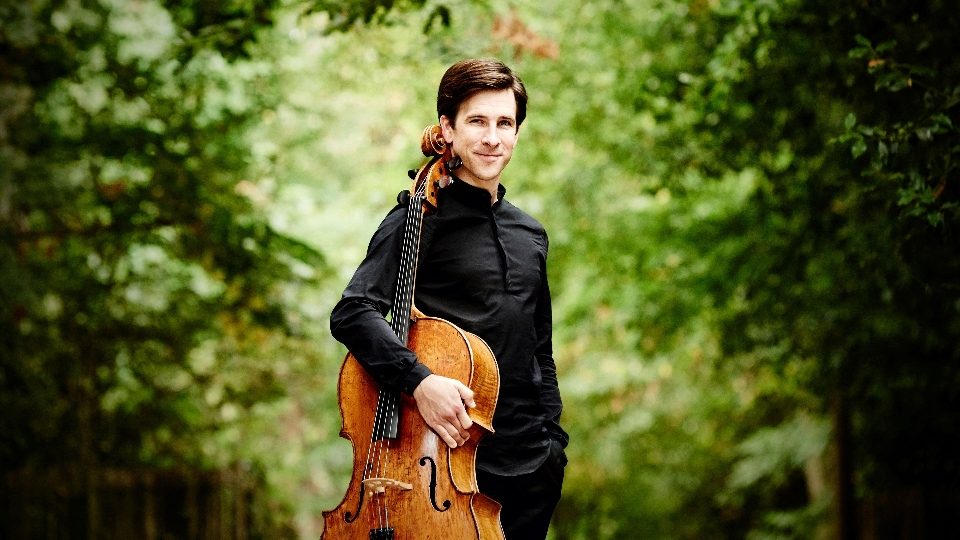
Guy Johnston (cello, above), Britten Sinfonia / Thomas Gould (violin)
Beethoven arr. Weingartner Grosse Fuge Op.133 (1826) Bartók Divertimento for String Orchestra Sz113 (1939) Tavener The Protecting Veil (1988)
Barbican Hall, London Thursday 15 February 2024
Reviewed by Ben Hogwood
The Protecting Veil is a special piece. Written by John Tavener in 1988, this musical meditation for cello and orchestra is based on and inspired by the Greeks resisting Saracen invasion in the early tenth century. They are heartened by a vision of Mary, the Mother of God, surrounded by a host of saints and spreading out her Veil as a protective shelter over the Christians.
In what is effectively a single-movement concerto, the cello represents the Mother of God, leading the string orchestra in eight prayerful chapters that respond to landmark events in which she is present. It may sound elegiac and deeply ambient for much of its duration, but to achieve this elevated state the performers require poise, concentration and inner strength.
It is hard to imagine a better performance than this one experienced at the Barbican. Guy Johnston led us in contemplation, the serenity of his upper register cello line immediately establishing a mood of calm, in complete contrast to the bustling city outside. The Britten Sinfonia responded in kind, conducted where necessary by violinist Thomas Gould but largely following the cello, a congregation responding to his prompting.
In spite of its inner serenity, The Protecting Veil is troubled by the shadows of violence throughout the world. This performance was a stark reminder of how little has changed in eleven centuries, for in the ominous falling motif that recurs for the cello it was impossible not to think of bombs and missiles raining down in the many warzones we see today. The Barbican fell largely silent as those images undoubtedly projected to many listeners, aided by a sympathetic light show that cast the distinctive markings of the back of the stage as a wooden chapel. When Johnston played alone in the central section, The Lament of the Mother of God at the Cross, he could easily have been playing solo Bach, the intimacy of his and Tavener’s thoughts laid bare.
There was, ultimately, consolation and redemption, and the lights burned yellow when the music soared back to the heights with which it began. Feverish anticipation gripped the strings as they responded excitably to the higher cello, and with a surety of tone that never dimmed, Johnston led us to the end. His was a remarkable performance of stamina and poise, those long notes held for what seemed like an eternity, their pure tones never dipping.
The musical contrast with the opening piece, Beethoven’s Grosse Fuge, was notable. Here is a piece that still sounds as new and every bit as challenging as the day it was written, the Everest of fugues. In this arrangement for string orchestra by Felix Weingartner, its angular subject is a touch smoother at the edges, though here the sharp lines were just as clear as in the string quartet original, the fugue subject escaping its restrictions. The Britten Sinfonia found its core in a well-drilled performance.
Bartók’s Divertimento for String Orchestra was lighter in mood to begin with, the ensemble celebrating the great outdoors as the folksy first tune went with a swing. Yet here too there were troubled minds, the slow movement wary of its place in history. Bartók wrote the Divertimento in 1939 in Switzerland, with Europe on the brink of the Second World War. The oppressive approach of the conflict could be felt in a profound slow movement, which began with feathery violas and reached a forbidding climax, emotion wrought from its pages. Those worries were largely banished by the finale, whose powerful unisons were led by Gould as the piece swaggered and bustled to the finish.
Guy Johnston and the Britten Sinfonia continue their tour with The Protecting Veil to Dublin and Manchester – for more details visit the Britten Sinfonia website
Published post no.2,090 – Saturday 17 February 2024
Currently the Arcana household is in the grip of Fargo, Season 5 – and a couple of musical masterpieces have shown their hand already.
We didn’t have to wait long, either – the opening scene (no spoilers!) took place against the magnificent backdrop of All Good People by Yes. The directors used it brilliantly, too – the build up from the massive organ chorale was the centrepiece of the scene, which then dropped off the edge of a cliff and into a completely different sonic world. If you watch it you’ll see exactly what I mean, but for now you can enjoy the song in its entirety:
Then, in episode four, a reappearance for Bartók’s Music for Strings, Percussion and Celesta, specifically the passage from the third movement Adagio which Stanley Kubrick used in The Shining, when Johnny’s descent into insanity was almost complete:
Here the genius is to follow Bartók almost immediately with a polar opposite, The Prodigy’s Smack My Bitch Up. It works a treat, see what happens when you do the same below!
We await the rest of the series with interest…and it goes without saying there is some superb original music from regular composer Jeff Russo to enjoy as well:
Kodály Budavári Te Deum (1936) Psalmus Hungaricus Op.13 (1923) Bartók Transylvanian Dances (Erdély táncok) Sz. 96 (1931) Cantata Profana Sz. 94 (1930)
Luiza Fatyol (soprano, Te Deum), Roxana Constantinescu (mezzo-soprano, Te Deum), Marius Vlad (tenor, Te Deum and Psalmus Hungaricus), Ioan Hotea (tenor, Cantata Profana), Bogdan Baciu (baritone, Te Deum and Cantata Profana), Junior VIP, Children’s Choir (Psalmus Hungaricus), Transylvanian State Philharmonic Choir & Orchestra / Lawrence Foster
Pentatone PTC 5187071 [64’14”] Texts and English translations included
Executive & Recording Producer Job Maarse Balance Engineer & Editing Erdo Groot Engineer Lauran Jurrius Recorded May 2022, Radio Studio of Radio Cluj, Romania
Written by Ben Hogwood
What’s the story?
Here is a chance to gain an insight into the choral music of two 20th century Hungarian composers known predominantly for their orchestral works. Bartók and Kodály were born just a year apart, and while their music is fiercely proud of their heritage their musical trajectories extend well beyond Hungary. Kodály stayed largely within Europe but brought back influences from Paris, while Bartók reluctantly emigrated to the US in late 1940.
Psalmus Hungaricus was Kodály’s first major post-war composition, in 1923. It is a landmark in his output, using for its text a Hungarian paraphrase of Psalm 55. Kodály uses a tenor soloist for the central dramatic role, the choir taking up their position as commentators. The Budavári Te Deum, completed 13 years later, marks the 250th anniversary of the liberation of Buda Castle from the Turks. While referencing Gregorian chant, Kodály incorporates references to Hungarian melodies and ornamentations in a dramatic setting.
In 1930 Bartók completed his first major work for chorus and orchestra. Cantata profana has Transylvanian roots, and Oana Andreica’s booklet note gives the context of its libretto, starting from two Romanian ‘colinde’ – ballads sung during the Christmas season but with a wide range of subjects well beyond the birth of Christ. Such is the case here, Bartók dramatising a myth of nine sons turned into stags. The cantata charts their fate and their father’s conflicting emotions, expressed by a baritone soloists. The Transylvanian Dances are a complementary addition, a short trio of works for small orchestra containing five traditional songs.
What’s the music like?
The Budavári Te Deum is a thrilling start to the album. This is red-blooded choral writing, Kodály diving in headlong to a high octane first section. He challenges choir’s higher sections, who respond admirably to the loud dynamic, retaining impressive clarity in the part writing. The work’s climactic points are notable for their power and passion.
This performance of the Psalmus Hungaricus has the authentic inflections to the melody, its bracing start turning to contemplation. Tenor soloist Marius Vlad inhabits the full tone and strong line demanded by Kodály, and sung so memorably by Ernst Haefliger in the legendary recording with Ferenc Fricsay. This makes for a fine digital alternative, with the choral response both full-bodied and unified. The meaningful counterpoint between Vlad and the Transylvanian woodwind in the middle section (Te azért lelkem) is especially memorable.
Bartók’s Cantata profana starts ominously, with an underlying menace that grows steadily as the hunt in the story progresses. Again the choral passages are well drilled, especially when in league with the percussion. The passionate tenor solo (Ioan Hotea) and fulsome bass (Bogdan Baciu) prove to be ideal foils, alighting on some spicy chords. There is little consolation at the end, in spite of the relative calm this performance leaves.
The Transylvanian Dances are over in a flash but leave a charming impression, with rustic themes. The recording is much closer, taking the action indoors to the tavern rather than outside in the wilds.
Does it all work?
Very much so. There is an adjustment to be made for the Transylvanian Dances, with the smaller ensemble and closer recording, but the performances justify the means. The choral works are a resounding success, brilliantly performed and with electric singing from the Transylvania State Philharmonic Choir, especially in the high passages. The orchestra match them under Lawrence Foster, who secures incisive rhythms and impressive clarity from such large forces.
Is it recommended?
It certainly is. This is an enterprising and very accessible coupling of three thrilling choral works, revealing fresh insights into the Hungarian composers.
Listen
Buy
For more information on this release and for purchase options, visit the Pentatone website