With the UK braced for the arrival of Storm Éowyn today, it got me thinking of successful portrayals of storms in music.
The first piece that came to mind was Sibelius’s masterpiece Tapiola, a remarkable and vivid orchestral poem written late in his compositional career about Tapio, the spirit of the forest. Its depiction of a storm is like no other.
Listen here, in a particularly incendiary account from the Berliner Philharmoniker and Herbert von Karajan, keeping an ear out for the storm as it begins around the 16:50 mark:
Schumann Piano Concerto in A minor Op.54 (1841-5) Smetana Má vlast (1874-9)
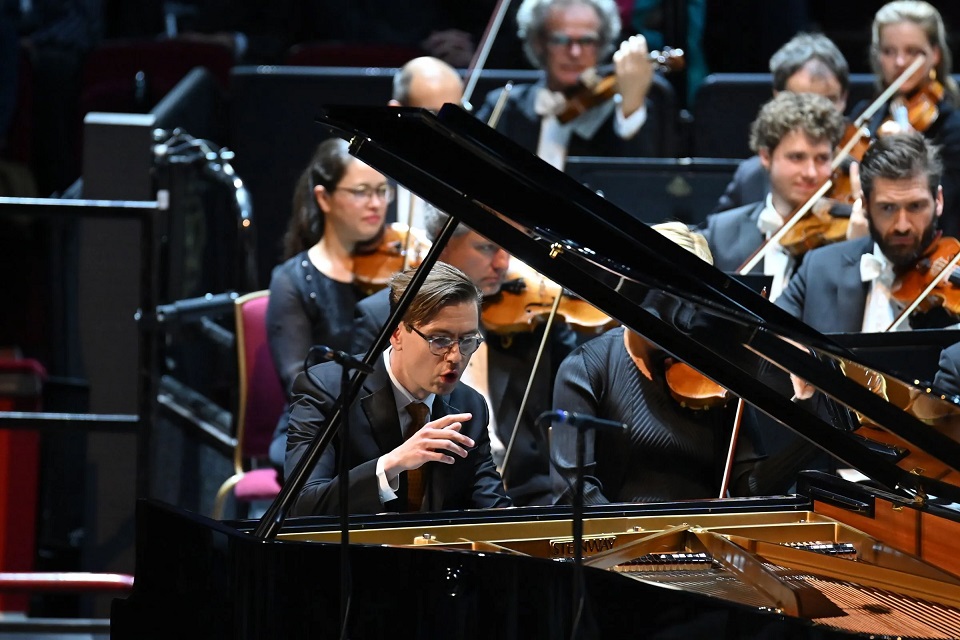
Vikingur Ólafsson (piano), Berliner Philharmoniker / Kirill Petrenko
Royal Albert Hall, London Saturday 31 August 2024
reviewed by Richard Whitehouse Photos (c) Chris Christodoulou
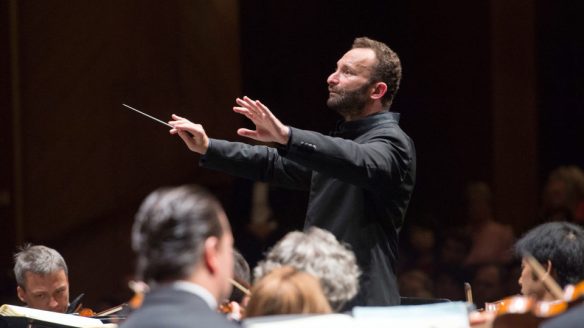
This first concert in its latest Proms visit by the Berliner Philharmoniker and chief conductor Kirill Petrenko featured a complete performance of Smetana’s Má vlast as the second half of a programme that, at barely the length of an average Mahler symphony, need not be unusual.
Few would, in any case, object to Vikingur Ólafsson tackle Schumann’s Piano Concerto in an account as dextrously articulated as it was unerringly proportioned. Not least an initial Allegro such as avoided any tendency to mid-tempo ‘drift’, those subtly contrasted themes building a cumulative impetus carried into the combative cadenza then a coda whose tensile energy was judged to a nicety by Petrenko. Some might have felt the Intermezzo too interventionist in its alternation of capriciousness and pathos, but absence of the cutesiness and cloying was more than its own justification and not least when that transition into the final Allegro had such an expectancy. Rhythmically supple with unwavering focus on its overall continuity, this set the seal on a reading whose technical finesse and interpretative insight ensured a riveting listen.
Ólafsson caused some stir at these concerts three years ago with Bach and Mozart concertos, and it was the former composer who provided the encore: the Adagio from the Fourth Organ Sonata (BWV528), transcribed here by August Stradel and rendered with understated poise.
More Czech music so soon after the Czech Philharmonic’s brace of Proms might have been too much of a good thing, but Petrenko’s Má vlast was very different from Jakub Hrůša’s in its lithe expression and streamlined textures. Nor was there was any lack of emotional depth – hence those earlier stages of Vyšehrad as it emerged eloquently on harps towards a fervent climax, its dramatic central section of a razor-sharp precision before subsiding into the main theme’s moving return. Vltava was scenically evocative and formally cohesive as it took in folk-dance, nocturnal landscape and treacherous rapids prior to its resplendent emergence in Prague, then Šárka unfolded its narrative of a matriarchal icon and her heroic demise with an impulsiveness that went into overdrive – without being overdriven – at its dramatic close.
It may be more generalized as to content, but the initial half of From Bohemia’s Woods and Fields is spellbinding as it conjures a pantheist ecstasy (in the process, anticipating Janáček and Minimalism) to which the BPO players were audibly attuned – Petrenko mindful not to overstate the relative blatancy of what follows. Most impressive, even so, were the final two stages whose gaunt rhetoric and granitic sound-world most often make for uneasy listening. Not here, however, as Petrenko gauged the motivic eddying of Tábor so that its underlying momentum held good through to the inevitable segue into Blaník. Emotional tension here was unremitting, the intensive interplay of Vyšehrad-theme with Hussite-chorale building to an apotheosis of Beethovenian power before letting loose for a coda of visceral exhilaration.
Its composite nature makes Má vlast difficult to sustain in performance, but there could be no doubt Petrenko managed this through his and the BPO’s acute yet never wanton control over every facet of the greater concept. A memorable performance and an impressive achievement.
Michael Spyres (Oedipus), Ekaterina Semenchuk (Jocasta), Andrea Mastroni (Tiresias), Krystian Adam (Shepherd), Derek Welton (Creon, Messenger), Bibiana Beglau (speaker), Men of the Rundfunkchor Berlin, Berliner Philharmoniker / Kirill Petrenko (above)
Weill Symphony no.1 in one movement (1921) Stravinsky Oedipus Rex (1927)
Philharmonie, Berlin Saturday 13 February (review of the online broadcast)
Written by Ben Hogwood
“This is no little hicktown. This is one helluva city!”
The words of Bertolt Brecht, writing about his home city in the song Berlin im Licht, set to music by Kurt Weill. It is a sentiment brought to the front of The Golden Twenties, an online festival from the Berliner Philharmoniker running through February, examining ‘a metropolis of contrasts…the epicentre of artistic modernism’.
The festival’s first concert, streamed from the Philharmonie via the orchestra’s Digital Concert Hall, featured the Berliner Philharmoniker’s first ever performance of Weill’s single-movement Symphony no.1 from 1921. This seems like a remarkable historical oversight, even for a work as little-known, but the performance gave this student piece the best possible platform to reach a new audience.
After a thoughtful and revealing introduction from the orchestra’s concertmaster Noah Bendix-Balgley, the Symphony’s distinctive main motive rang out like an extended peal of bells. With this arresting opening Weill laid out the ambition of his work, writing as a student of Busoni looking to impress. This bold statement was complemented by intricate and intimate solo episodes through the inner workings of the orchestra.
Kirill Petrenko conducted a cohesive and convincing account, making sense of the more congested writing and bringing out the parallels with Hindemith and Schoenberg, which he spoke about in the interval. The work’s fulsome harmonies had plenty of deep colour, and it was revealing to hear the counterpoint in such detail. The double basses made an eerie contribution through a fugal episode which wound its way up through the orchestra at several points in the work, before an impressive climax and a darkly shaded postscript. Petrenko nailed the scope of the piece but ensured there was plenty of room for the phrases to breathe individually.
Stravinsky’s Oedipus Rex could hardly have been a more appropriate counterpart for a concert filmed behind closed doors. With its chilling opening statement, ‘The plague is destroying us!’, sung by a socially distanced male chorus from the choirstalls, it was a stark reminder of our current, locked down predicament – and struck an inevitable parallel with the state of the performing arts currently.
This 50-minute opera / oratorio is one of the most notable achievements in Stravinsky’s so-called ‘neo-classical’ period, a dramatic response to Sophoclese‘s tragedy that is not the easiest to digest but which packs an expressive punch.
Petrenko’s incisive conducting brought its message home with a lasting power, and in the performance he was aided by a strong cast of soloists. Michael Spyres’s tenor dominated in the title role, his ringing tones promising deliverance but ultimately winding up in great anguish before the end. He was given ample support by Creon (bass-baritone Derek Welton) and mezzo-soprano Ekaterina Semenchuk, whose fulsome contribution was made in a bright red dress bringing her into dramatic contrast with the funereal black of chorus and orchestra.
Petrenko kept things moving throughout, with virtuoso contributions from woodwind and percussion in particular. In spite of their social distancing the chorus lost none of their power, playing out the tragic story with detail but an ominous inevitability. Holding the threads together was narrator Bibiana Beglau (above), an excellent choice and with strong proejction in the empty hall.
Highlights could be found in the assertive delivery of Welton in the ‘Avenge Laius’ section, while Spyres gave an impassioned promise that he would solve the riddle of the Sphinx. The chorus alternated between a horror at the plague, a sorrowful realisation of the plight of Oedipus, which was particularly moving, and the cold, regretful end.
This was an auspicious start to what promises to be a revealing celebration of Berlin and particularly Weill in the 1920s. The next concert on 16 February will look at the composer’s better-known Second Symphony, while this and future instalments will include the music of Hindemith, Richard Strauss and Eisler. If the performances are as good as these then online attendance is highly recommended.



 Michael Spyres (Oedipus), Ekaterina Semenchuk (Jocasta), Andrea Mastroni (Tiresias), Krystian Adam (Shepherd), Derek Welton (Creon, Messenger), Bibiana Beglau (speaker), Men of the Rundfunkchor Berlin, Berliner Philharmoniker / Kirill Petrenko (above)
 Petrenko kept things moving throughout, with virtuoso contributions from woodwind and percussion in particular. In spite of their social distancing the chorus lost none of their power, playing out the tragic story with detail but an ominous inevitability. Holding the threads together was narrator Bibiana Beglau (above), an excellent choice and with strong proejction in the empty hall.
 Arcana.fm