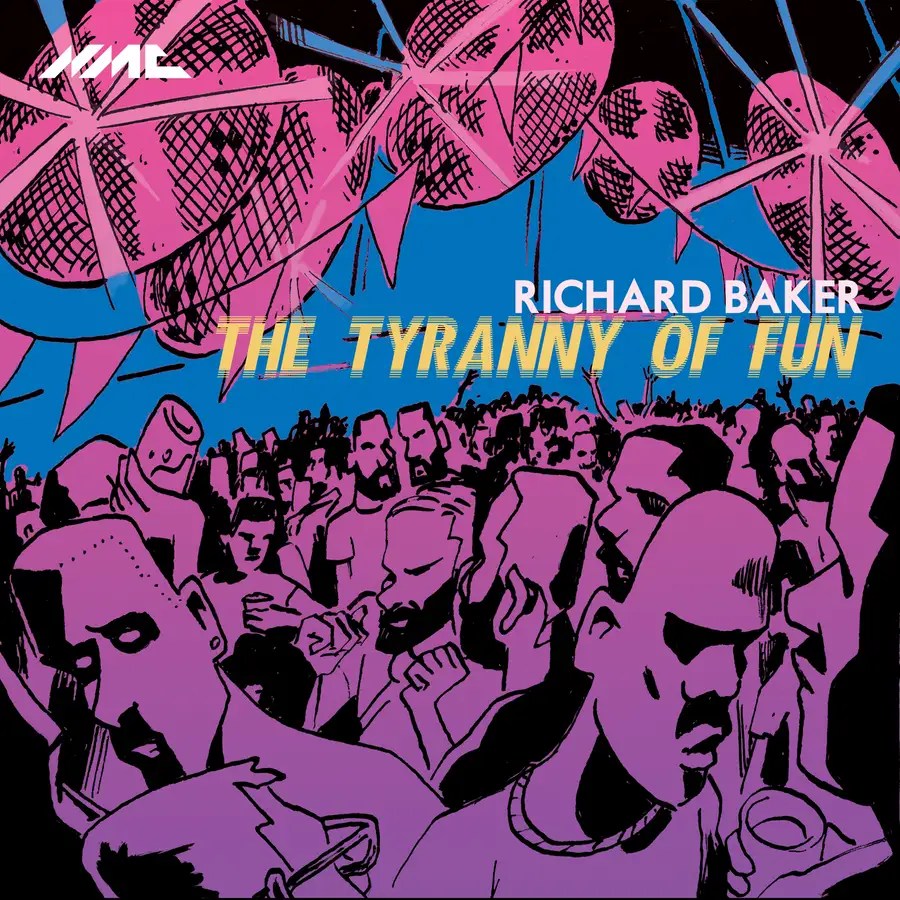
On Record – Richard Baker: The Tyranny of Fun (NMC Recordings)

Richard Baker
Crank (1994)a
Motet II (2020)b
The Tyranny of Fun (2012)c
Angelus (2004)d
Learning to Fly (1999)e
To Keep a True Lent (2001)f
Hommagesquisse (2008)g
Hwyl fawr ffriniau (2016, rev. 2020)h

hMelinda Maxwell (oboe); eOliver Janes (clarinet); bNye Parry (live electronics); aRichard Baker (diatonic music box); dThree Strange Angels (Richard Benjafield and Chris Brannick, percussion); fChoir of King’s College, Cambridge / Stephen Cleobury; bCHROMA Ensemble / Richard Baker; ceghBirmingham Contemporary Music Group / Finnigan Downie Dear

NMC D275 [60’37’’]
Producers/Engineers David Lefeber, fBen Collingwood
Recorded d19 April 2004 at St Giles’s Church, London; f29 February 2004 at Chapel of King’s College, Cambridge; b 4 August 2022 at Menuhin Hall, Cobham; cegh5 & 6 November 2022 at the CBSO Centre, Birmingham; a10 December 2023 at Parry-Williams Building, University of Aberystwyth

Reviewed by Richard Whitehouse

What’s the story?

NMC adds to its invaluable Debut Discs series with this timely release devoted to the music of Richard Baker, expertly realized by ensembles and musicians with which has been associated – not least the Birmingham Contemporary Music Group – whether as composer or conductor.

What’s the music like?

Prominent on the new music scene for over a quarter-century, Baker (b.1972) is equally well regarded as a conductor – notably for the German premiere of Gerald Barry’s The Triumph of Beauty and Deceit or the world premiere of Philip Venable’s 4.48 Psychosis – but he has built a select catalogue (published by Composers Edition), the variety of which is duly in evidence. BCMG has been central to his creative and executive work, so it is good to see this ensemble featured here – not least in two pieces commissioned as part of its Sound Investment scheme.

Baker was among numerous UK figures who undertook their postgraduate studies with Louis Andriessen, Crank being a whimsically oblique tribute in its unfolding of multiple pulses over a consistent tempo. The Dutch composer is also an influence behind Learning to Fly as takes its cue from those novels by Paul Auster for this compact concerto; the tonal range of basset clarinet tellingly to the fore in the eventful interplay of ‘Boisterous’, the subdued acceptance of ‘Somnolent’ and renewed animation of ‘Suddenly awake’ with its epiphanic closing phase.

Choral music features sparingly in Baker’s output, but his motet To Keep a True Lent captures Robert Herrick’s message unerringly. Hardly less affecting is his eliding between anxiety and repose in the dextrous percussion duo Angelus, while the punningly entitled Hommagesquisse serves as a laconic tribute to Pierre Boulez in alluding to his own music and that of others he advocated as conductor. Most substantial work here, The Tyranny of Fun draws on the notion of entertainment as distraction – hence escape – from the ambiguity of existence, along with a homage to Ravel (and Edgar Allen Poe) via Balanchine across two sections whose respective emergence and subsidence, then gradually accumulating energy outline a trajectory in which any tendency towards self-gratification is curtailed by vicissitudes of an encroaching reality.

The other pieces reflect aspects of Wales where Baker now lives. What translates as Goodbye Friends draws Edwin Christy’s song into a resourceful tribute, while Motet II makes reference to Welsh culture ‘then and now’ across six aphoristic movements understated yet provocative.

Does it all work?

Yes, inasmuch as this collection confirms the distinctiveness of Baker’s musical idiom across three decades of his composing. The recordings prove as assured as might be expected given these are artists with whom he has often collaborated, Oliver Janes taking time out as principal clarinettist of City of Birmingham Symphony Orchestra to demonstrate his prowess with the basset instrument, and Melinda Maxwell underlining why she has long been among the UK’s leading oboists. Gratifying too that a reading by the late Stephen Cleobury could be included.

Is it recommended?

Indeed, and those acquiring this release should be encouraged to investigate other of Baker’s works available from NMC – notably his breakthrough piece Los Rabanos (NMCD076), or his four diverse contributions to that label’s extensive download project Digital Discoveries.

Listen & Buy

To explore purchase options, visit the NMC Recordings website – and click on Richard Baker for his own website. Meanwhile for more on the performers, click on the names – Melinda Maxwell, Oliver James, Richard Benjafield, Chris Brannick, Nye Parry, King’s College Choir, Stephen Cleobury, Finnigan Downie Dear, CHROMA and Birmingham Contemporary Music Group

Published post no.2,130 – Wednesday 27 March 2024

In concert – Mimi Doulton, Thando Mjandana, BCMG: Songs at Day, Songs at Night

Mimi Doulton (soprano), Thando Mjandana (tenor), Birmingham Contemporary Music Group / Vimbayi Kaziboni

Kidane Primitive Blaze (2022)
Birtwistle Today Too (2004)
Birtwistle …when falling asleep (2018)
Kendall Tuxedo: Between Carnival and Lent (2022)
Kidane Cradle Song (2023) [BCMG Sound Investment commission: World premiere]
Anderson Mitternachtslied (2020) [UK premiere]
Anderson THUS (2023) [World premiere of final extended version]

Elgar Concert Hall, University of Birmingham
Wednesday 18 October 2023

Reviewed by Richard Whitehouse

A varied programme greeted attendees at tonight’s concert from Birmingham Contemporary Music Group (to be repeated in Bristol on October 29th), consisting largely of vocal pieces and directed with precise assurance by the highly regarded (justifiably so) Vimbayi Kaziboni.

Equally well regarded at present, Daniel Kidane (recently signed to Schott) was represented by two works – of which Primitive Blaze made for an effective curtain-raiser with its array of interlocking rhythmic patterns whose elaboration brought greater emphasis on a linear continuity in its wake. Both the electric guitar and tenor saxophone were prominent within this ensemble – the latter instrument emerging at the forefront in the final stages, when its plangent tones signified a closure as decisive formally as it sounded decidedly equivocal.

Next came settings by Harrison Birtwistle. To a text by the 18th-century Japanese poet Tanko (translated by Joel Hoffman), Today Too found tenor, flute and guitar evoking a twilit scene whose ominous elements are subsumed into an aura of shimmering, even sensuous stillness.

Rehearsal considerations necessitated exclusion of the David Harsent setting From Vanitas (hopefully not in Bristol) but not of …when falling asleep – Birtwistle’s last completed work, which intersperses lines by Rilke (translated by Jochen Voigt) with those by Swinburne in a sequence the more affecting for its understatement. Mimi Doulton brought a keen eloquence to the sung component, though Thando Mjandana seemed a little tentative with those spoken in parallel, and quite why the final lines of his contribution had been excluded was unclear.

Doulton returned for Between Carnival and Lent – one of Hannah Kendall’s ongoing Tuxedo series drawing on the art-print of that name by Jean-Michel Basquiat; abrupt juxtaposition of keening melisma with spoken polemic rather tending to cancel out each other as it proceeded.

Mjandana duly came into his own with the premiere of Cradle Song, Kidane’s setting of verse from the poem by Blake, though an evident desire to avoid the winsomeness associated with ‘innocence’ led to a highly rhetorical vocal line surely at odds with the semantics of this text.

The evening closed with two settings by Julian Anderson, both from his song-cycle In statu nascendi and drawing on a linguistic variety of verse in the context of an ensemble similar in line-up while not in usage to that of Schoenberg’s Pierrot Lunaire. Nietzsche (in the original German) was the basis for Mitternachtslied, familiar lines here exuding an anguished elation wholly different from that encountered in Mahler or Delius. Longfellow at his most visionary was the starting-point for THUS, building gradually from speculative beginnings towards a climactic section whose visceral impact felt less a setting than an intuitive riposte to its text. This premiere of the ‘final extended version’ drew a forceful though slightly self-conscious response from Doulton, in what seems the likely culmination of the song-cycle in question.

It certainly brought to a striking close a programme whose relative short measure was more than outweighed by its variety or its intrinsic interest. Hopefully those who hear it in Bristol will be equally responsive to its enticements as those who were present at Elgar Concert Hall.

For ticket information on the forthcoming Bristol concert on Sunday 29 October, click here, and click here for more information on the Birmingham Contemporary Music Group. Click on the artist names for more information on Vimbayi Kaziboni, Mimi Doulton and Thando Mjandana, and on the composer names for more on Julian Anderson, Harrison Birtwistle, Hannah Kendall and Daniel Kidane

Published post no.1,986 – Sunday 22 October 2023

In concert – BCMG: T R E E Concert

Neue Vocalsolisten [Johanna Vargas (soprano), Truike van der Poel (mezzo-soprano), Martin Nagy (tenor), Guillermo Anzorema (baritone), Andreas Fischer (bass)]; Finchley Children’s Music Group, Birmingham Contemporary Music Group / Michael Wendeberg

Mason The Singing Tree (2020-3) [BCMG Sound Investment commission: World premiere]
Lachenmann Concertini (2005)

Town Hall, Birmingham
Friday 12 May 2023

Reviewed by Richard Whitehouse

Birmingham Contemporary Music Group’s final concert this season also saw the conclusion of Tree City, a 16-year project that has seen Birmingham’s tree coverage increased by some 10% and an occasion marked by this Sound Investment commission from Christian Mason.

Among the leading UK composers, Mason (b1984) has written ambitious works before but none more so than The Singing Tree, a cantata whose seven movements unfold to a suitably arboreal text by Paul Griffiths. Despite its inclusion as an enlarged format in the programme, this was not easily readable under concert conditions (as its author wryly remarked), but of greater concern was its inaudibility during the actual performance; the intricacy of Mason’s writing for solo voices, children’s choir and large ensemble rather offsetting any such clarity.

A pity when Griffiths’ text, growing from the word ‘Tree’ such that each part multiplies by four (thus 1-4-16-64-256-1024), pertinently evokes the growth process alongside temporal and experiential evolution. Not that balance between the five solo voices, positioned centre-right of the platform, a 13-strong choir arrayed in the organ gallery, and an ensemble rich in timbral or textural possibilities seemed at fault, yet any sense of the music gaining gradually in emotional intensity to complement that of its musical complexity felt intermittent at best.

Most absorbing were those movements when Machaut’s rondeau Puis qu’en oubli threaded through the texture with tangible expressive intent, bringing to mind passages of comparable immediacy in seminal choral works by Berio, Kagel or Pousseur. Mason is demonstrably in that European lineage, making it more regrettable when despite its laudable intent – plus the commitment of Neue Vocalsolisten, Finchley Children’s Music Group and BCMG under the assured direction of Michael Wendeberg – his new piece made only an equivocal impression.

What it lacked in overall impact was given context in the second half, with a performance of Concertini by Helmut Lachenmann. Once notorious for (supposedly) predicating the gestural quality of sound, the composer’s more recent larger works exude a determination to align this with a tangible organic development – as heard in those climactic passages when the disparate sources coalesce for music sustained and visceral in its intent. Comparisons with the ataraxic progress of the lengthy final movement from Mason’s work were not to the latter’s advantage.

Once again, BCMG responded with conviction and no little finesse to Wendeberg’s direction – not least in the last third of this piece which had previously seemed to lose focus, but here readily conveyed the ensemble coming together in an audible while, this being Lachenmann, decidedly oblique resolution. Whatever else, the present work confronts and then overcomes those formal and expressive challenges it encounters to a degree that intrigues, frequently provokes but always engages the listener: something that should never be taken for granted. BCMG: NEXT earlier took the stage – pianist Rob Hao evincing due sensitivity in extracts from Lachenmann’s Ein Kinderspiel and in the eddying resonances of Wiegenmusik, before joining with flautist Emily Hicks for the plaintiveness of Mason’s Heaven’s Chimes are Slow.

You can read all about future events at the BCMG website. For more on the composers, visit sites dedicated to Christian Mason and Helmut Lachenmann – and for more on the performers, click on the names to read about Neue Vocalsolisten, Finchley Children’s Music Group and Michael Wendeberg

In concert – Birmingham Contemporary Music Group: Blossoming In Birmingham

Oliver Janes (clarinet), Philip Brett, Stefano Mengoli (violins), David BaMaung (viola), Arthur Boutillier (cello), Birmingham Contemporary Music Group / Otis Lineham, Kazuki Yamada (conductors)

Illean Januaries (2017)
Fujikura Perpetual Spring (2017)
Ligeti String Quartet no.2 (1968)
Hosokawa Blossoming (2007)
Fujikura Secret Forest (2008)

BCMG NEXT [George Blakesley (clarinet), Anna Vaughan (violin), Alma Orr-Ewing (viola), Finley Spathaky (cello), Rob Hao (piano)

Fujikura Scion Stems (2010)
Illean Février (2019)
Fujikura Halcyon (2011)

CBSO Centre, Birmingham
Saturday 29 April 2023 (7pm and 9pm)

Reviewed by Richard Whitehouse

Spring may have arrived tardily this year, but Birmingham Contemporary Music Group was certainly in full bloom with this judiciously balanced and absorbing programme that featured one post-war classic and two pieces by one of the leading composers from the present time.

First, though, the welcome opportunity to hear a work by Lisa Illean, whose understated and fastidiously realized music conceals more than is evident on initial hearing. Such is true of Januaries, inspired by memories of holidays in Queensland together with descriptions of the Australian landscape. Its innate subtlety finding a direct parallel in this composer’s drawing of often ethereal yet always evocative timbres and textures from her 12-strong ensemble; and throughout which BCMG responded with due commitment to the direction of Otis Lineham.

The first of two pieces this evening by Dai Fujikura, Perpetual Spring drew inspiration from the Japanese Garden in Portland (US), notably the idea of growth as a process both ongoing and inexorable. Heard from this vantage, the clarinet represented a conceptual and expressive focal point; around which the string quartet weaved its dense if never claustrophobic texture with audible dexterity. Here, too, the music implied considerably more than was ever stated – no doubt in accord with the ‘‘power of ‘quiet’ nature’’ its composer took as his starting-point.

Although it now tends to be overshadowed by its predecessor, Ligeti’s Second String Quartet remains one of his most significant works – its five movements a compendium of his musical practice during the late 1960s, but with a formal and expressive focus that amply sustains the 20-minute whole. It was a measure of this account that a cumulative impetus carried through not merely to the explosive fourth movement, but also a finale whose textural mirage took in allusions to what went before: the music not so much ceasing as dispersing beyond earshot.

The string quartet was also Toshio Hosokawa’s chosen medium for Blossoming. Taking the image (and most probably its mythical association) of a lotus as its starting-point, the piece opened out in music typical of this composer for its unforced elegance and felicitous aura.

Considerably more engrossing an all-round experience, Fujikura’s Secret Forest is among the most impressive of his ensemble works and not least for its visceral conception. Placed centre-stage, the string nonet was balanced with groups of woodwind and brass either side, and above the auditorium. It was the ensuing interplay between the spatially arrayed sound-sources, strings intense in their eloquence and winds hieratic in their intangibility, that the conductor shaped over its course – not forgetting the solo bassoon, seated in the auditorium, who became a human figure plotting a course through this sonic landscape. The piece was directed with conviction by Kazuki Yamada and promises much for the Fujikura commission Wavering World, which he will premiere with the CBSO in Symphony Hall on January 17th.

A pity not more punters remained for the post-concert performance by musicians of BCMG NEXT, which featured two more works by Fujikura. Scion Stems took string trio as the basis for a wide-ranging discussion of textures made even more immediate by its brevity, whereas Halcyon pursued a more circumspect yet never disengaged interplay between clarinet and string trio. In between, Février found Illean’s writing at its most sensuous in its sequence of exchanges between clarinet, cello and piano to which these players likewise did full justice. The current NEXT line-up performs its final concert on June 11th, while BCMG itself returns to Birmingham Town Hall on May 12th for its TREE Concert featuring a new commission by Christian Mason alongside one of the most impressive compositions by Helmut Lachenmann

For more on future BCMG events, click on the link to visit their website. For more information on the composers featured, click on the names to read about Dai Fujikura, Lisa Illean and Toshio Hosokawa, while you can read about the conductors by clicking on Kazuki Yamada and Otis Lineham

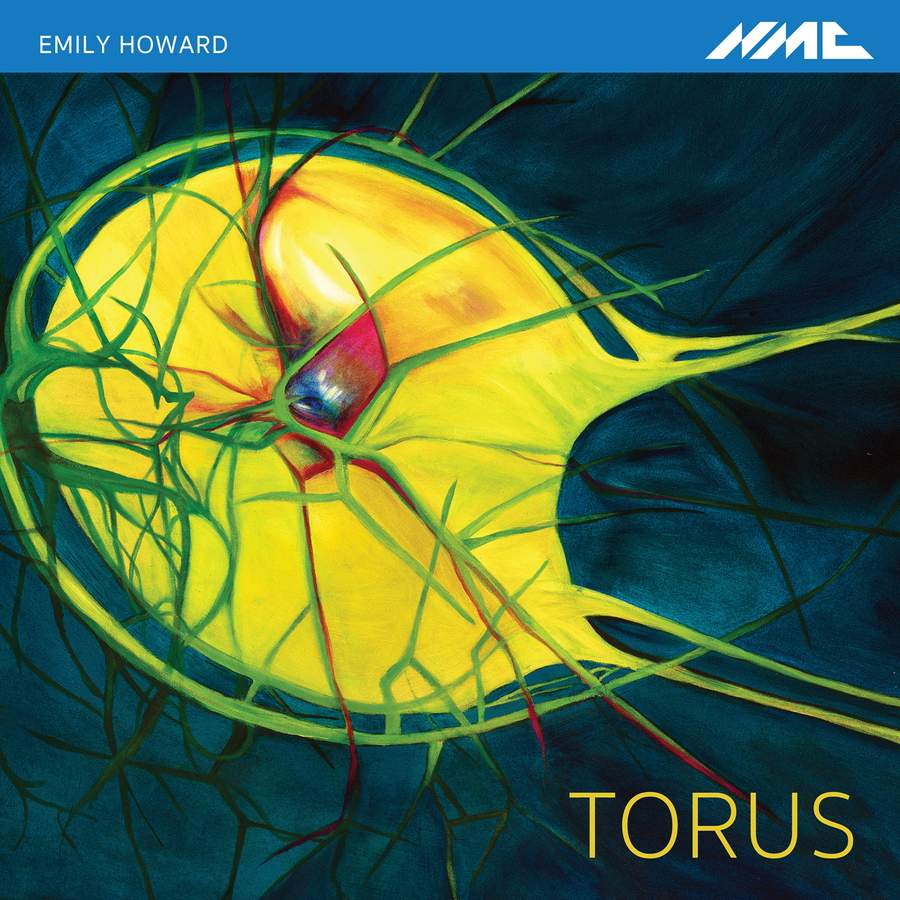
On Record: Emily Howard: Torus (NMC Recordings)

Emily Howard

Antisphere (BBC Philharmonic Orchestra / Vimbayi Kaziboni)
Producer Matthew Bennett, Engineer Stephen Rinker
Recorded 29 November 2022, Bridgewater Hall, Manchester

sphere (BBC National Orchestra of Wales / Mark Wigglesworth)
Producer Dean Craven, Engineer Stephen Rinker
Recorded at the Aldeburgh Festival, 23 June 2018, The Maltings, Snape

Compass (Julian Warburton (percussion), Birmingham Contemporary Music Group / Gabrielle Taychenné)
Producer & Engineer David Lefeber
Recorded 4 December 2022, Royal Northern College of Music, Manchester

Torus (BBC Symphony Orchestra / Martyn Brabbins)
Producer Ann McKay, Engineer Christopher Rouse
Recorded 11 November 2019, Barbican Hall, London

NMC Recordings D274 [68’58″]

Reviewed by Richard Whitehouse

What’s the story?

NMC releases a second collection of music by Emily Howard – now in her early forties and established among the most distinctive while forward-looking composers of her generation, heard in scrupulous performances by a notable line-up of British orchestras and ensembles.

What’s the music like?

Few world premieres from recent years have left an impression comparable to that of Taurus at the Proms in 2016. Its appearance, moreover, marked a further stage in an evolution which had commenced just over a decade earlier and has continued apace, with major commissions from British and European organizations. This has been paralleled by Howard’s commitment into researching the intrinsic properties of sound, most recently via the Centre for Practice & Research in Science and Music (PRiSM) at Manchester’s Royal Northern College of Music.

As it now stands, Torus is the first part in an informal trilogy of pieces collectively entitled Orchestral Geometries. It evolves along the perceived trajectory of a doughnut-shaped ball whose central void is crucial to music evoking absence as much as presence. Not that a work subtitled Concerto for Orchestra could be found lacking in either immediacy of content or virtuosity of gesture, which qualities come demonstrably to the fore as it unfolds and make for a composition involving in its expressive profile and fascinating in its formal process.

By contrast, Sphere is a succinct yet eventful journey through and around the global shape in question and which, in this context, might reasonably be thought an extra-terrestrial interlude – its ideas pithy while exuding enough potential for their development in subsequent pieces.

This is what happens in Antisphere which forms its conceptual opposite though also its aural continuation, the piece gradually encompassing the ‘sound-space’ through an engrossing and imaginative demonstration of orchestral prowess. Evident too is an increased focus upon the visceral nature of the musical content, likely reflecting a form which can precisely be defined in mathematical terms but remains all but intangible as regards human perception. Fortunate, then, that Howard has been able to render this concept as an emotional and affective whole.

Hardly less absorbing is Compass, the most recent of these pieces. This takes the spatial and nautical connotations of its title as the basis for music which unfolds as a cohesive dialogue between string septet and percussion that complements it and offers contrasts at every turn.

Does it all work?

It does, not least for providing an arresting take on that interplay of ‘heart and brain’ that has been a mainstay of Western music. The cerebral basis of all these pieces may be undeniable, though equally so is the precision of their forms and, above all, the allure of their expression judged intrinsically as sound. Much the same could be said of the music of Iannis Xenakis, the centenary of whose birth was commemorated last year, and whose thinking is continued by Howard from a vantage that is inherently personal while being decisively of the present.

Is it recommended?

It is, not least for its excellent performances by three of the BBC orchestras and Birmingham Contemporary Music Group, with booklet notes by Paul Griffiths and mathematician Marcus du Sautoy. This impressive release reinforces Howard’s significance in no uncertain terms.

Listen & Buy

Torus is released on Friday 28 April. You can explore buying options at the NMC Recordings website, and listen to clips from the album at the Presto Music site. You can read Arcana’s interview with Emily Howard by clicking on the link, and click on the names for more on the composer Emily Howard, plus performers Vimbayi Kaziboni, Mark Wigglesworth, Julian Warburton, Gabrielle Teychenné and Martyn Brabbins