
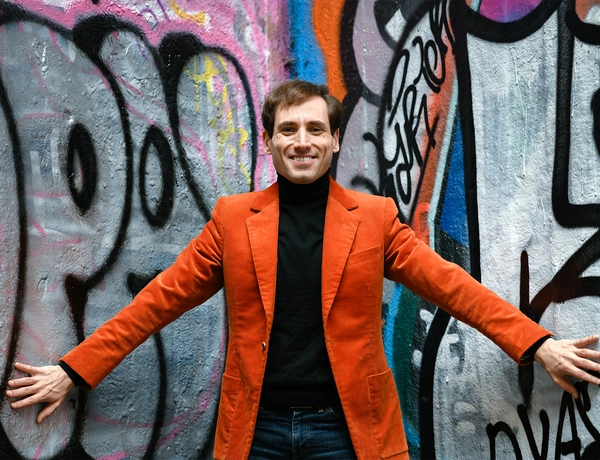
Boris Giltburg (piano, above), City of Birmingham Symphony Orchestra / Michael Seal (below)
Rachmaninoff Rhapsody on a Theme of Paganini Op.43 (1934)
Shostakovich Symphony no.8 in C minor Op.65 (1943)
Symphony Hall, Birmingham
Thursday 28 September 2023
Reviewed by Richard Whitehouse. Pictures (c) Sasha-Gusov (Boris Giltburg), Eric Richmond (Michael Seal)
Now into his 12th season as its associate conductor, Michael Seal appeared this evening with the City of Birmingham Symphony Orchestra in works written before the Second World War and during the middle of a conflict whose consequences seem very far from being played out.
Although present-day ubiquity had rather dulled its more innovative aspects, Rachmaninoff’s Rhapsody on a Theme of Paganini remains a game-changer through the integration of piano with orchestra and conception of just what a piano concerto might be. Taking Paganini’s 24th Caprice for violin as the basis for a continuous sequence of 24 variations barely disguises the three-movement format of an archetypal concerto. Boris Giltburg responded with no lack of flair or panache, while recognizing the formal divisions of 15, three and six variations across which the theme is reconstituted in ever more ingenious and unexpected ways. The evergreen 18th variation saw a heartfelt response from CBSO strings, with the closing sequence finding this theme in pointed conflict with the ‘Dies irae’ chant right up to a perfectly judged pay-off.
An impressive performance and Giltburg (who in appearance and approach bears more than passing resemblance to a young Vladimir Ashkenazy) gave the second from Rachmaninoff’s second set of Études-Tableaux (aka The Sea and the Seagulls) as a limpidly affecting encore.

It may have had several fine performances from the CBSO over the decades (Rudolf Barshai, Maxim Shostakovich and Cristian Măcelaru immediately come to mind), but Shostakovich’s Eighth Symphony remains a testing assignment both for players and listeners – not least in an opening movement whose underlying Adagio tempo and almost unrelieved sombreness seem to override its constant evolving toward a violent then wrathful culmination. Seal (above) paced it all superbly and the CBSO responded with like dedication, but it was Rachel Pankhurst’s take on the plangent cor anglais soliloquy during the reprise that set the seal on a memorable account. Nor did Seal skimp on the satire of the Allegretto, a response to the inanity and idiocy of war where those climactic overlapping woodwind and brass entries emerged with fearsome acuity.
The inevitability with which the final three movements segued one into the other did not belie their disjunctive contrasts. With its overtones of mechanized warfare and martial rallying, the second scherzo powered to a climax as fairly exploded into the ensuing Largo – a passacaglia whose numbed unfolding on strings is offset by solos from horn and clarinet, deftly rendered by Elspeth Dutch and Oliver Janes. Out of such desolation the finale’s seeming promise of a return to innocence cannot be sustained beyond a return of the first movement’s culmination, and if the present account faltered momentarily on its way there, the closing pages – as earlier themes gradually subside into the most resigned of resolutions – were ideally judged. That one could have heard a pin drop in the final minutes says much for their effect on those listening.
An enthusiastic reception could not disguise the less than full house for a piece that is never easy or enjoyable listening, and it would be a tragedy were encroachment of ‘lifestyle’ issues to offset future hearings. This eloquent and insightful reading provided its own justification.
You can read all about the 2023/24 season and book tickets at the CBSO website. Click on the artist names for more information on pianist Boris Giltburg and conductor Michael Seal


 Arcana.fm