Peanuts comic strip, drawn by Charles M. Schulz (c)PNTS
Opferlied WoO 126 for voice and piano (1795, Beethoven aged 24)
Dedication not known
Text Friedrich von Matthisson
Duration 3′
Listen
Background and Critical Reception
Beethoven set the text to Freidrich von Matthisson‘s Opferlied on no fewer than four occasions, and there are signs that he became somewhat obsessed with its text. The ChoralWiki entry for the piece – which was eventually set in a choral version – details how Beethoven included the statement Das Schöne zu dem Guten! (“The beautiful to the good”), in his late manuscripts.
The entry goes on to describe how ‘Matthisson’s text depicts a young man in a oak grove offering a sacrifice to Zeus. The man asks Zeus to be the protector of liberty, and to give him, both now and in his old age, beautiful things, because he is good’.
This first version remained unpublished – but by the time of the fourth version Beethoven was writing for a four-part chorus and orchestra, indicating perhaps how the importance of the text had amplified.
Thoughts
The Opferlied is an invitation to the baritone to sound forth, Beethoven assigning his singer a strong melody which is doubled by the piano almost throughout.
The song is a passionate one, with long notes for the singer that make it sound rather like a hymn – and the the piano responds in reverential kind.
Recordings used
Dietrich Fischer-Dieskau (baritone), Jörg Demus (piano) (Deutsche Grammophon) Hermann Prey (baritone), Leonard Hokanson (piano) (Capriccio) Peter Schreier (tenor), Walter Obertz (piano) (Brilliant Classics)
The two baritone versions are very fine indeed, though Fischer-Dieskau’s tones are perhaps a little more luxurious. The tenor version from Peter Schreier takes the key up into F major (the baritone versions are in D) and his ringing tone is suitably dramatic.
Spotify links
Dietrich Fischer-Dieskau, Jörg Demus
Hermann Prey, Leonard Hokanson
Peter Schreier, Walter Obertz
You can chart the Arcana Beethoven playlist as it grows, with one recommended version of each piece we listen to. Catch up here!
Also written in 1795 Viotti – Violin Concerto no.24 in B minor
Next upTrio for 2 oboes and cor anglais in C major Op.87
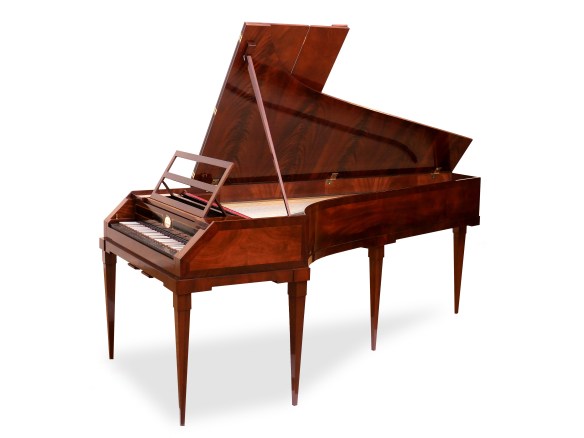
A piano of Aaron Walter, similar to the one Beethoven used after his arrival in Vienna in 1792.
Written by Ben Hogwood
If you’re a regular visitor to these pages – first of all, thank you! – you will have noticed Arcana’s Beethoven project has been picking up some momentum of late. So far it has covered 55 pieces from early on in his careers in Bonn, and has now followed him to Vienna and his first official publications, the three Piano Trios Op.1. That means one very significant body of work is coming into view – the Piano Sonatas.
One of the main attractions to this project was to attempt to fully appreciate this cycle of 32 works, long considered one of the finest achievements in Western music. It means that writing about these amazing pieces is potentially quite intimidating, given the body of work that already exists – and yet the appeal of the music is that anyone at any level can fully enjoy the fruit of Beethoven’s labours.
Amateur pianists – such as yours truly! – can enjoy them too. A couple of the works published as Op.49 are what I would call ‘entry level’, and I had the pleasure of playing one at university, post-Grade 5. Some famous passages are within scope, too – the slow movement of the Moonlight sonata (not the fast one!), the Pathétique (again the slow movement!) and isolated passages of some other works.
There are many, many recorded versions of the sonatas. Most complete cycles – curiously – are by male pianists, so it gives me great pleasure to have interviewed Angela Hewitt about these works, a piece I will publish soon on the site. She has nearly crossed their line with her own cycle, and we will enjoy her versions on the Hyperion label. Other guides I have chosen are ‘classic’ sets from Emil Gilels, Claudio Arrau, Stephen Kovacevich and Alfred Brendel, an older set from Wilhelm Kempff, and one of the newest of all from Igor Levit, released just last year on Sony Classical.
I also felt it important to include a cycle on pianos of Beethoven’s time, so have opted for Paul Badura-Skoda on the Arcana label, ironically, performed on now fewer than seven different fortepianos.
The cycle will start shortly with the three works published as Op.2 and dedicated to Haydn in 1795. It will then set us down in a heap with the final utterance, the C minor sonata Op.111, finished in 1822. By that point we will know an awful lot more about Beethoven, and just how these extraordinary pieces came to be. Hope you can join us for the ride!
You can chart the Arcana Beethoven playlist as it grows, with one recommended version of each piece we listen to. Catch up here:
Beethoven’s first substantial piece for strings alone was not a string quartet. This seems to have been a deliberate plan on his part – just as it was to begin his published output with three piano trios. By doing this he was utilising forms not already comprehensively updated by Haydn and Mozart, giving himself some room for innovation and relieving some of the pressure he undoubtedly experienced on moving to Vienna.
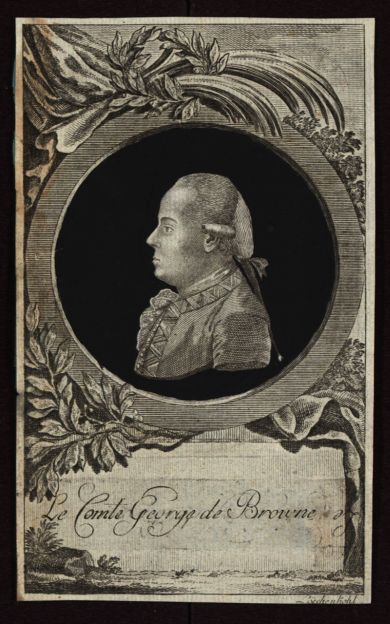
The first of five works for string trio has its roots in Bonn, and appears to have been commissioned for a string quartet, but other than that very little is known or written about its origins. The completion date is also uncertain but has been narrowed down to 1795 – with the certain publication date of 1797 in Vienna. It was dedicated to the Countess of Browne, wife of his patron Count Johann Georg von Browne.
Although Mozart barely used the string trio, his one major work, the Divertimento in E flat major K563, an acknowledged masterpiece, is the stimulus for this piece. Aside from residing in the same key of E flat major, Beethoven’s work also has six movements, with dance forms used, ‘of the serenade type’, as Daniel Heartz notes – not to mention a slow movement in the key of A flat major, again following Mozart’s lead. Beethoven’s innovation is to push the trio’s capabilities even further, with full bodied writing often taking the piece beyond three and even four parts with the use of double stopping (the players using more than one string simultaneously).
Thoughts
Beethoven’s first piece for stringed instruments shows signs of his ever-expanding thinking when it comes to writing major pieces. His structures are getting ever bigger, with the six movements of this piece lasting over 40 minutes.
The parallels to Mozart’s Divertimento, outlined above, are used as a base for Beethoven’s own wholly original writing. The first movement, marked ‘con brio’, tears out of the blocks quickly, its urgency maintained through energetic treatment of its main theme. The second movement is marked Andante but could be interpreted as a slow dance in triple time, the cello setting out the roots of the dance steps while violin and viola shadow each other in their melodies. The third movement is a winsome Minuet built on a minimal theme, Beethoven showing how a very simple two-note motif can power an entire, light hearted dance.
The fourth movement, the slow movement, is charming and quite minimal, not as ‘heavenly’ as Mozart’s but nonetheless suspending thought and providing a sublime eight minutes of music. Just occasionally a hint of a shadow passes over the music towards the end, but Beethoven reaches a serene close. There is a glint in the eye of the fifth movement, another Minuet, before the last movement sets off confidently.
Beethoven’s use of silence is starting to become noticeable here, and the theme feels like it has a couple of notes missing – but this is all part of the personality and slight humour. The virtuosity is more obvious in the string writing, before we reach a sprightly conclusion.
There may be three instruments but with double stopping and close harmonies Beethoven makes the music sound as though there are at least four, projecting well beyond expectations.
This is a wonderful piece for night-time listening, with tunes aplenty, good humoured exchanges and affecting moments of tenderness. In short, it is chamber music using its first principles.
Recordings used and Spotify links
L’Archibudelli (Vera Beths (violin), Juergen Kussmaul (viola), Anner Bylsma (cello) The Grumiaux Trio (Arthur Grumiaux (violin), Georges Janzer (viola), Eva Czako (cello) (Philips) Anne-Sophie Mutter, Bruno Giuranna and Mstislav Rostropovich (Deutsche Grammophon) Leopold String Trio Isabelle Van Keulen (violin), Lawrence Power (viola), Kate Gould (cello) (Hyperion) Trio Zimmermann (Christian Tetzlaff (violin), Antoine Tamestit (viola), Christian Poltéra (cello) (BIS)
You can listen to the versions from L’Archibudelli, the Grumiaux Trio and the Mutter-Giuranna-Rostropovich trio on this playlist:
There are many fine recordings of the Beethoven String Trios. Some are made by starry trios, such as the group of Anne-Sophie Mutter, Bruno Giuranna and Mstislav Rostropovich. Perhaps inevitably these groups play like soloists rather than established group, and these three soloists go for a more luxurious approach.
The recommendations are more group-based, including period instrument group L’Archibudelli, who have an attractive, slightly grainy sound. The Grumiaux Trio have a very roomy recorded sound but the sweetest of tones from lead violinist Arthur Grumiaux, with plenty of warmth and charm on display. The Leopold String Trio on Hyperion give a finely balanced account, but the Trio Zimmermann on BIS are recommended by a nose for their brilliant, highly musical playing.
You can chart the Arcana Beethoven playlist as it grows, with one recommended version of each piece we listen to. Catch up here!
Also written in 1795 Haydn Symphony no.103 in E flat major ‘Drumroll’
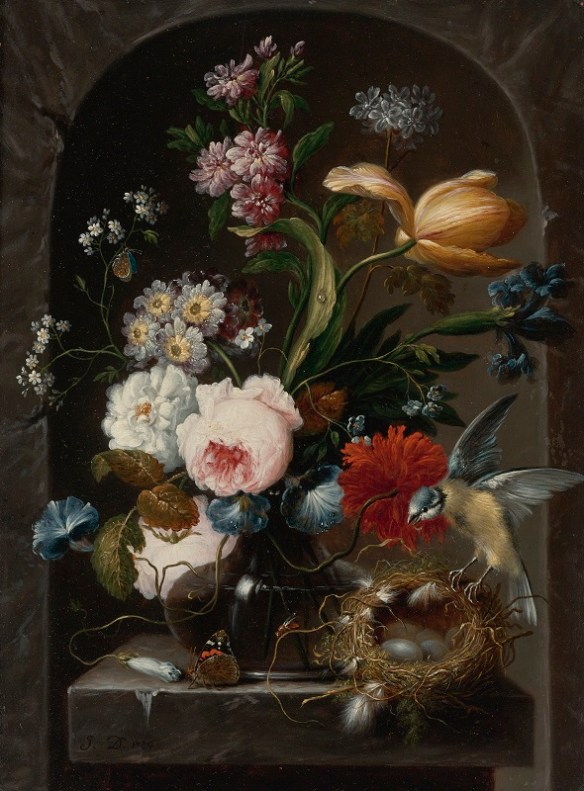
Still life by Viennese artist Johann Baptist Drechsler, 1789
Rondo in G major WoO41 for piano and violin (1794, Beethoven aged 23)
Dedication Elenore von Breuning
Duration 5′
Listen
Background and Critical Reception
Variations and rondos were part of Beethoven’s development as a composer, and this short piece for piano and violin is another example of the composer’s development in the ‘rondo’ form. Traditionally this would involve a main theme (‘A’), a secondary one (‘B’) and a contrasting third section in the middle (‘C’).
Writing in the booklet of the Deutsche Grammophon recording by Wilhelm Kempff and Yehudi Menuhin, Bernhard Uske notes how in writing rondos Beethoven ‘absorbed the pattern of the ‘rondello’ from Italian folk music with its broad appeal into the process of variational development.’
Technically the piece is straightforward, indicating a design for domestic use – and Beethoven thought enough of it to dedicate it to his dear Bonn friend Eleonore von Breuning, along with the Variations on Mozart’s Se Vuol Ballare
Thoughts
The Rondo is easy on the ear. A nice, limpid piano introduction presents the theme, which has a straightforward profile but becomes more memorable with its repetitions in the rondo structure. The violin takes over, and the two instruments are closer together to present the second theme.
The central section (the ‘C’ of the rondo’s A – B – A – C – A – B – A) moves to G minor for a simple triple-time waltz, where a slight shadow falls over the music. It does not last, however, the ‘A’ theme returning to leave us in its warm glow.
Recordings used
Wilhelm Kempff (piano), Yehudi Menuhin (violin) (Deutsche Grammophon) James Lisney (piano), Paul Barritt (violin) (Woodhouse Editions / Regent)
Paul Barritt and James Lisney present quite a nippy account of the Rondo, nicely dovetailed and brightly voiced. Wilhelm Kempff and Yehudi Menuhin proceed at a much more leisurely pace, taking nearly two minutes longer but playing gracefully and evoking a triple-time dance.
Spotify links
Wilhelm Kempff, Yehudi Menuhin
Also written in 1794 Benjamin Carr The Federal Overture
Beethoven stamp, issued in Hungary to mark the bicentenary of the composer’s birth, 1970
Giura il nocchier Hess 230 for four unaccompanied voices (1794, Beethoven aged 23)
Dedication not known
Text Pietro Antonio Domenico Bonaventura Trapassi (1698 – 1782), as Pietro Metastasio
Duration 0’45”
Listen
Background and Critical Reception
Beethoven’s began setting Italian texts in 1793, just as he was beginning to study with Antonio Salieri in a calculated move to bring more operatic elements of composition to his attention. The new teacher would offer his own musical thoughts which the composer kept for posterity.
This particular text, setting Pietro Metastasio, has no fewer than three version – of which this is the first. The translated first verse of two reads, ‘The helmsman swears that he will no longer trust the ocean, but if he sees it calm, he hastens to set sail again’.
Thoughts
This song feels like an exercise, as though Beethoven were feeling his way back into choral composition, after his only previous settings in the big cantatas of the Bonn days.
This setting is foursquare, close harmonies between the voices in the purity of C major – and a very straightforward piece of writing.
Recordings used
Cantus Novus Wien (Naxos)
This recently released version is nicely sung in quite a reverberant setting. It is part of a valuable recent release from Naxos bringing together Beethoven’s secular works for voice. Recorded in Vienna, it highlights the more ‘functional’ side of his writing, with pieces for weddings, name days or departures of a friend.
Spotify links
Cantus Novus Wien
You can chart the Arcana Beethoven playlist as it grows, with one recommended version of each piece we listen to. Catch up here!
Also written in 1794 William BillingsThe Continental Harmony
Next upRondo for piano and violin in G major WoO 41



 Arcana.fm