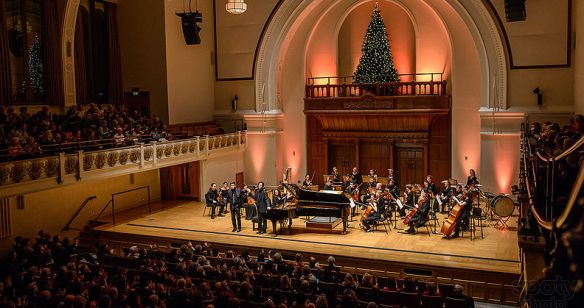
BBC Proms 2016 – Louis Lortie: Venezia e Napoli

louis-lortie

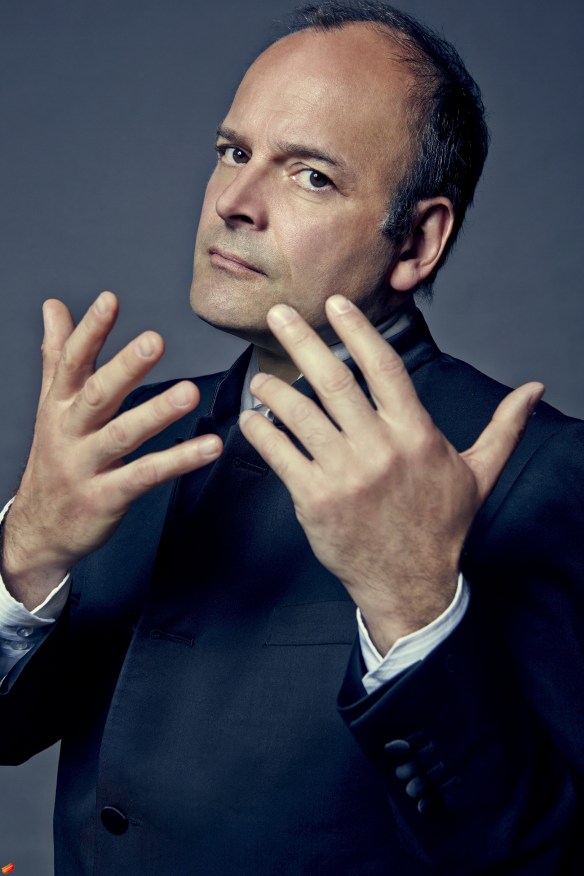
Louis Lortie (piano) © Elias

Rossini, transcribed Liszt La regata veneziana; La danza (1830-35, transcr. 1837)

Poulenc Napoli (1925)

Fauré Barcarolle no.5 in F sharp minor Op.66 (1894); Barcarolle no.7 in D minor Op.90 (1905)

Liszt Venezia e Napoli (1859)

Cadogan Hall, Monday 22 August 2016

Listen to this concert on the BBC iPlayer

For an hour Louis Lortie managed to transport the Cadogan Hall audience to even sunnier climes – to Venice and Napoli, to be exact. He did this through a well constructed program painting pictures of the Italian cities and regions from afar, for none of the chosen composers were Italian.

All except Rossini, that is – though the two Soirées Musicales chosen for this concert were given in arrangements made by Liszt. Typically these were hyped up for concert audiences, but as in most of Liszt’s transcriptions there is a sensitive side staying true to the original, and Lortie found that unerringly in the humour of La danza.

We transferred from Venice to Naples for Francis Poulenc’s brief but vivid three-movement portrait. The central Nocturne was the great find here, a really lovely bit of descriptive music bookended by two fast movements typical of Poulenc in their wit and, in the Caprice italien, a deceptively soft heart that Lortie delighted in showing us.

It was especially good to hear two of Fauré’s Barcarolles included, especially as Louis Lortie has realised his love of the composer’s music in a new disc from Chandos. The Barcarolles are real diamonds, perfect for listening at either end of the day, and are highly original in their elevation of an older art form all but ignored by other composers. Lortie showed concert audiences need not be dissuaded by them either, with a darkly shaded Barcarolle no.7, which found some of the Fauré’s shadowy writing encroaching from the edges like the approach of night. Meanwhile the distinctive motif of the Barcarolle no.5 was ever-present, though towards the end of this the pianist was too full with his volume at the bell-like top end of the register.

That said, his playing throughout was remarkably accurate and expressive, and both qualities were evident in a superb performance of Venezia e Napoli, the epilogue to part two of Liszt’s piano travelogue Années de Pèlerinage. The virtuosity on show was breathtaking in the final Tarantella, but it was the poetic depiction of the gondola and the slower Canzone, with its majestic interpretation of Rossini’s Otello, that really hit home.

Ben Hogwood

BBC Proms 2016 – Håkan Hardenberger and HK Gruber perform Kurt Weill & Kurt Schwertsik at Cadogan Hall

Håkan Hardenberger (trumpet), HK Gruber (chansonnier, above), Helen Crayford (piano), Mats Bergström (banjo & guitar), Claudia Buder (accordion), Academy of St Martin in the Fields

Broström Sputnik (2015)

Lundgren arr. Pöntinen The Seagull (2007)

Weill Speak Low (arr. Pöntinen) (1943); Songs from The Threepenny Opera (1928); Der Song von Mandelay (1929); Song of the Rhineland (1944)

Schwertsik Adieu Satie – Gymopédie; Clownerie acrobatique (2002, arr. 2010)

HK Gruber 3 MOB Pieces (1968, rev.1977)

Brahms arr. Broström Hungarian Dance no.6 (1869 / 2016)

Cadogan Hall, Monday 8 August 2016

Listen to this concert on the BBC iPlayer

After A Satie Cabaret the BBC Proms chamber music series at Cadogan Hall continued in mischievous mood, this time bringing Kurt Weill and his associates centre stage. In doing so they managed to include another tribute to Satie, courtesy of Kurt Schwertsik, a member of the unofficial Third Viennese School with composers Friedrich Cerha and HK Gruber.

The three were responsible for the creation of MOB-art, in Gruber’s words ‘a celebration of enjoyment and invention’. The approach, enjoying tonal music but pushing boundaries and frequently encroaching on jazz and musical genres, was explored here by Gruber with good friends and long-time musical collaborators, trumpeter Håkan Hardenberger and Swedish composer Tobias Bröstrom.

As well as being a composer of some repute Gruber is an excellent conductor and vocalist into the bargain, and with Hardenberger he brought Weill’s music fair off the page, not to mention the words of his collaborators, Brecht and Ira Gershwin.

The concert began with Broström and a celebration of space travel, Sputnik. This completed one bumpy orbit of the Cadogan Hall, a lively and enjoyably syncopated curtain raiser. After this Jan Lundgren’s The Seagull was a mournful companion, beautifully observed by the muted trumpet.

hardenberger

Håkan Hardenberger (trumpet)

Neither principal performer could stay quiet for long however, and we swiftly moved to the music of Weill. This was in the form of an attractive selection that showed not just the importance of the trumpet in the composer’s work, but also his chemistry with the acerbic wit and poignant observations in the text of Bertolt Brecht. These were given out by Hardenberger himself, revealing unexpected gifts for vocalising in Song of the Insufficiency of Human Behaviour, but also HK Gruber, surely without parallel in this music. There was a glint in his eye as he characterised the selections from The Threepenny Opera, One Touch of Venus, Happy End and Where Do We Go From Here?

They were superbly accompanied by accordionist Claudia Buder and Mats Bergström on guitar and banjo, both stylish players, while pianist Helen Crayford enjoyed the colourful harmonies and spiky rhythms. The string players of the Academy of St Martin in the Fields supplied extra body and impetus, clearly enjoying themselves.

After the Weill came two movements from Schwertsik’s suite Adieu Satie. The first of these was a lovely piece of expanded pastiche in the form of a Gymnopédie, led by Buder and supplemented by the strings, before the irreverent Clownerie acrobatique took enjoyable liberties with syncopations and melodic figures.

This led us to Gruber’s flagship work, the 3 MOB Pieces, where chamber ensemble and drum kit team up neatly with humour and touching asides. Composer Broström was now required to play drums, and did so with aplomb.

Finally all the performers were united for Broström’s mischievous but rather brilliant arrangement of Brahms’s Hungarian Dance no.6, which called on Hardenberger to play at dizzying speed – and found him unexpectedly overshooting his final note. If anything this added to the enjoyment, for it was an occasion where spirit and humour were to the fore, with the distinctive colours of accordion, banjo and piano adding to the already ebullient strings.

The BBC Proms have delivered several imaginative chamber concerts this year, and this one was an excellent introduction to the music and world of HK Gruber ahead of a performance of Busking in Prom 34, where Buder, Bergström, Hardenberger and Gruber will once again join forces.

Ben Hogwood

BBC Proms 2016 – A Satie Cabaret with Alistair McGowan

alistair-mcgowan

Alistair McGowan as Erik Satie, BBC Proms 2016 (c) Chris Christodoulou

A Satie Cabaret, Cadogan Hall, Monday 1 August 2016

Who was Erik Satie?

Or, come to think of it, who is Alistair McGowan?

Clues to the answers of both questions were on hand at this stimulating Proms Chamber Music concert, where the ‘bright, airy interior’ of Cadogan Hall, celebrated as such by Proms director David Pickard, became dark as night for an hour, the curtains drawn so we could enjoy A Satie Cabaret.

Listen to A Satie Cabaret on the BBC iPlayer

McGowan has already presented a concert in similar form this year, for Satie is one of his obsessions – and it is 150 years since the birth of the composer. Ever the arch impressionist (not in a French sense!) McGowan took on Satie’s character, dressed in a trademark suit and bowler hat, even managing to grow the composer’s facial hair – or at least don a very convincing disguise!

He chose a set of autobiographical readings that captured the French composer’s irreverence, his unique approach to making music and his oblique sense of humour, one that could often have you scratching your head in wonder after the laughs had died away.

Providing the musical entertainment – with some laughs, too – were pianist Alexandre Tharaud and tenor Jean Delescluse. Their mix of piano music and song was very well chosen. In the ambient balm of his piano writing we saw how Satie used simplicity in a very original way, and how he has gone on to influence generations of disciples, Ludovico Einaudi and Michael Nyman two obvious recent examples.

http://www.bbc.co.uk/programmes/p04388h5/player

The songs were much less inhibited, with the riotous Allons-y Chochotte (Let’s do it, Chochotte) bringing the house down near the end. We also had brief illustrations of ‘furniture music’ from Tharaud – music for solicitors to listen to, for instance! – which found Satie a century ahead of his time, predicting the environment where we would be treated to music on hold or in a dentists’ waiting room.

McGowan was funny but also completely respectful, and was the first to appreciate Tharaud’s control and beauty of tone, as well as Delescluse’s brilliant send-ups of songs like La diva de l’Empire (The Diva of the Empire) and La grenouille américaine (The American Frog).

delescluse-tharaud

In all this was a highly entertaining hour, given in a spirit the composer would surely have enjoyed. Would that he knew his influence has been so far reaching – and even now is not fully appreciated.

Ben Hogwood

Calin Huma – ‘Carpatica’ Symphony World Premiere

philharmonic-orchestra-london

Richard Whitehouse on the London premiere of a new work from Romanian composer Calin Huma from the Philharmonic Chamber Orchestra of London under Christopher Petrie, with Leslie Howard joining them for Rachmaninov’s Second Piano Concerto

Cadogan Hall, London on Thursday 17 December

Rachmaninov: Piano Concerto no.2 (1901)

Enescu: Romanian Rhapsody no.2 (1901)

Calin Huma: Symphony, ‘Carpatica’ (London premiere) (2015)

Leslie Howard (piano), Philharmonic Chamber Orchestra of London / Christopher Petrie

The Philharmonic Chamber Orchestra of London has demonstrably established itself on the London calendar over its two years of existence, with tonight’s programme surely the most enterprising yet. Leslie Howard was on hand for Rachmaninov’s Second Piano Concerto – and a reading which, while offering little in the way of a fresh perspective, was for the most part finely articulated and well-coordinated. The opening Moderato was a touch stolid in its earlier stages, though the second theme was raptly conveyed on its return, then the central Adagio had pathos and, in its scherzo section, deftness to spare. The twin themes of the final Allegro were pointedly contrasted, the PCO nimbly negotiating the fugato at its centre, and the return of the ‘big tune’ capping the whole in a generous yet not over-bearing peroration.

Music by Romanian composers followed in the second half, which began with the welcome revival of Enescu’s Second Romanian Rhapsody. While its predecessor has latterly regained much of its former popularity, this piece is heard but seldom – its melodic eloquence at one with its largely ruminative persona. Christopher Petrie assuredly had its measure – whether in the soulful expression of its initial pages (Enescu’s deployment of traditional melodies at its most alluring), cumulative build-up to its fervent central climax, then the gradual ebbing away of emotion towards its close; a sense of place fleetingly if tangibly evoked. Hopefully this orchestra will go on to perform other works by Enescu – not least the First Orchestral Suite, whose mesmerising unison ‘Prelude’ would doubtless be relished by the PCO strings.

For now, listeners were treated to the London premiere (and only the second performance)   of the ‘Carpatica’ Symphony by Calin Huma (b 1965), the Romanian entrepreneur who has been based in Hampshire these past two decades. Huma has professed himself an avowed neo-Romantic in terms of aesthetic, and the present piece looks back beyond Enescu to the Romantic nationalism of Eduard Caudella (1841-1924) while evincing the melodic directness of more recent figures as Nicolae Kirculescu (1903-85), whose Moment Muzical (or at least its main theme) was well known to Romanian listeners in the 1960s and ‘70s. Huma’s work shared something of its unabashed nostalgia, yet whether the three movements of this half-hour piece amounted to anything which approaches a cohesive conception is open to doubt.

That it failed to do so was hardly the fault of the PCO, whose strings played with lustre, or of Petrie – who directed with sure conviction of where this rhapsodic music ought to be headed. Not that this prevented the lengthy first movement from losing focus before its final climax, while its successor – more a slow intermezzo than a slow movement – would have benefitted from a more flowing tempo. The finale brought a welcome degree of energy, its main theme capping the whole with a decisiveness in which the ends came closest to justifying the means.

A section from Petrie’s own Fantasia on Christmas Carols made for a winsome and appealing encore. More Romanian music from this source would be most welcome: the 90th birthday of Pascal Bentoiu, doyen of post-war composers, in April 2017 provides just such an opportunity.

You can listen to more music from the Philharmonic Chamber Orchestra of London on their website

Proms premiere – Colin Matthews: String Quartet no.5

colin-matthews

String Quartet no.5 by Colin Matthews

Apollon Musagète Quartet (Paweł Zalejski & Bartosz Zachłod (violins), Piotr Szumieł (viola) & Piotr Skweres (cello)) (Proms Chamber Music 3)

Duration: 12 minutes

BBC iPlayer link

http://www.bbc.co.uk/events/ecq5v2#b06402nt (Matthews begins talking at 13:19, then the piece at 15:34 and ends at 27:36)

What’s the story behind the piece?

In conversation with Petroc Trelawny before the performance, Matthews reveals that his string quartet rate of composition has been approximately one every ten years, but that the gap is now narrowing.

This work was written for the 75th anniversary of the Tanglewood Festival and is conceived in a single movement. “I wanted to do something very different from the others”, he says, and the silences are a starting point. “The work begins very hesitantly”, he explains, and works up to only one big climax.

Did you know?

Colin Matthews worked as Britten’s assistant in the last few years of his life, and was essentially his right hand man for proof reading and even composition. You can read an interview about his exploits here

Initial verdict

It is possible to detect the hand of a mature composer at work here. So many new pieces rely on shock tactics and volume to make themselves heard, but Colin Matthews shuns all of that with an economic approach that actually brings forward greater emotion.

The faltering start from the quartet, together, becomes a distinctive motif that runs through the piece, and although the music does indeed build and get to a more secure footing, it never fully shakes off the uneasy start from the muted quartet. It is at times reminiscent of a Bartók quartet slow movement, or even Britten, in the intensity of its expression, though it never fully sounds like those composers. The Fifth Quartet says a lot in a relatively short duration, convincing in spite of its emotional doubt, as it retreats into the shadows at the end.

Second hearing

tbc!

Where can I hear more?

Colin has a BBC page devoted to him here