
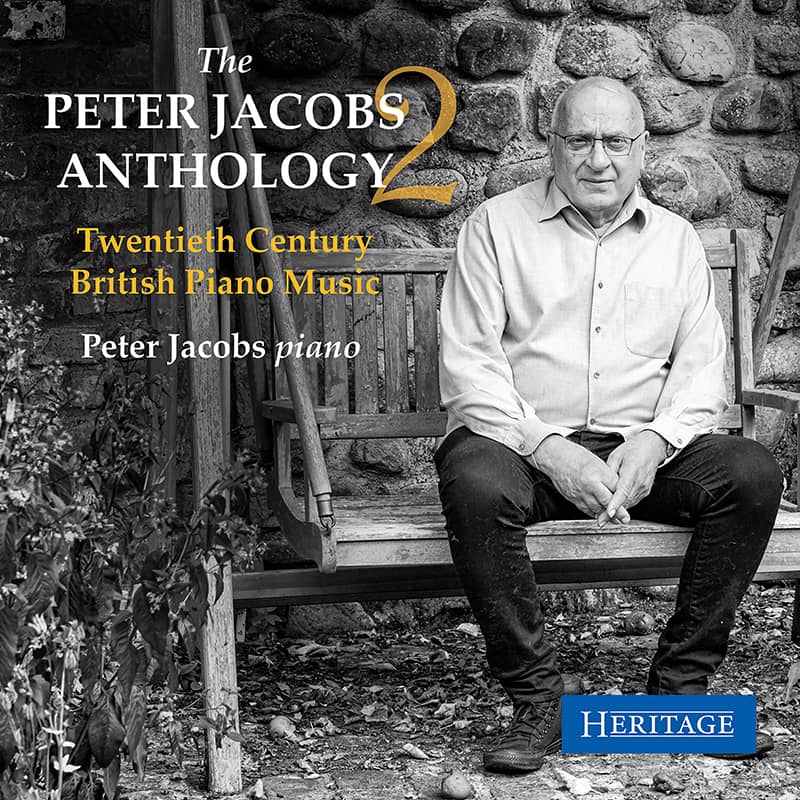
On Record – The Peter Jacobs Anthology Vol. 2 – Twentieth Century British Piano Music (Heritage)

Coleridge-Taylor Petite Suite de Concert Op.77 (1911)
Cooke High Marley Rest (1933)
Delius Mazurka and Waltz for a Little Girl RTIX/7, 1 & 2 (1922-3)
Headington Toccata (1963)
Rubbra Eight Preludes Op.131 (1967)
Scott Lotus Land Op.47/1 (1905)
Armstrong Gibbs Lakeland Pictures Op.98 (1940) – no.2, After Rain (Rydal Beck); no.8, Quiet Water (Tarn Howe)
Baumer Idyll (1935)
Mayer Calcutta-Nagar (1993)

Peter Jacobs (piano)

Heritage HTGCD131 [73’30″]
Producer & Engineer Paul Arden-Taylor

Recorded 14 & 16 September 2014 at Wyastone Concert Hall, Wyastone Leys, Monmouth

Reviewed by Richard Whitehouse

What’s the story?

Heritage extends an already extensive discography of British music with its follow-up to the Peter Jacobs Anthology, a further volume featuring collections of or standalone miniatures with a wide range of musical idioms given focus through the persuasiveness of the pianism.

What’s the music like?

Among the miscellaneous pieces included here are Greville Cooke’s ruminative ‘portrait’ of the home of pianist (and his former teacher) Tobias Matthay, Delius’s respectively pert and fey offerings, or Christopher Headington’s scintillating study for John Ogdon. Cyril Scott’s evergreen is treated to a subtly understated reading, while two out of a set of eight by Cecil Armstrong Gibbs provide enticing evocations of Rydal Beck then Tarn Howe – their innate Englishness sounding removed from the overtly Russian manner of that from Cecil Baumer.

Forming the backbone of this collection are three sets that in themselves attest to the variety of the music featured. Best known in its orchestral guise (a recording of which can be found on Heritage HTGCD249), Samuel Coleridge-Taylor’s Petite Suite de Concert is light music of a superior kind – witness its flighty initial Caprice, its ingratiating Sonnet or its lively closing Tarantelle, though its ostensible highlight is Demande et Réponse whose alluring sentiment helped with keeping the composer’s memory alive prior to his belated rediscovery.

Other than figuring among its composer’s later works, the Eight Preludes by Edmund Rubbra could hardly have been more different. As with his Eighth Symphony written soon afterward, these short while arresting pieces likewise focus on specific musical intervals rather than any overall key scheme, though their cohesiveness heard as an integral sequence could never be in doubt. Introspective without being inscrutable, this is wholly absorbing music and Jacobs accords ample justice to what is only the second complete recording this set has yet received.

As the most unlikely inclusion, John Mayer’s Calcutta-Nagar proves nothing less than a total delight. Known primarily for his syntheses of Indian and European elements, notably through the group Indo-Jazz Fusions, Mayer wrote extensively for Western media with this collection a notable instance. Only two of its 18 pieces last over a minute, yet their capturing of places recalled from the Calcutta of the composer’s youth is absolute. Jacobs notes his favourite as being the 13th (Kali Temple), but listeners will doubtless come up with their own favourites.

Does it all work?

Yes, whether as a judiciously planned collection or an anthology from which one can select individual items as preferred. The three collections are each among the most distinctive of its kind, while they and the various individual pieces provide ready-made encores in recital. Evidently this is music which Jacobs has long included in his repertoire, the performances exuding that combination of technical finesse allied to a probing insight as have long been hallmarks of his interpretations. Those who are unfamiliar with this music are in for a treat.

Is it recommended?

Indeed, not least as the sound has a combination of clarity and warmth ideal for piano music. The pianist pens informative notes, and one hopes that there will be further such anthologies. Meanwhile, Jacobs approaches his 80th birthday (this August) with his pianism undimmed.

Listen & Buy

For purchase options, you can visit the Heritage Records website

Published post no.2,448 – Monday 17 February 2025
On record – Duncan Honeybourne: De Profundis Clamavi (EM Records)

de-profundis-clamavi

Armstrong Gibbs An Essex Rhapsody Op.36 (1921); Ballade in D flat (1940)
Bainton Variations and Fugue in B minor Op.1 (1898); The Making of the Nightingale (1921); Willows (1927)
Bridge Piano Sonata H160 (1921-4)
Britten Night Piece ‘Notturno’ (1963)
Edmunds Piano Sonata in B minor (1938)
Pantscheff Nocturnus V: Wing oor die Branders (2015); Piano Sonata (2017)
Parry Shulbrede Tunes (1914)

Duncan Honeybourne (piano)

EM Records EMRCD070-71 [two discs, 156’46”]

Producer Oscar Torres & Richard Pantcheff
Engineer Oscar Torres

Recorded 20 & 21 August 2020 at Potton Hall, Westleton, Suffolk

Written by Richard Whitehouse

What’s the story?

Never a pianist to pull his punches, Duncan Honeybourne adds to his expanding discography with this extensive survey of British piano music which, written across almost 120 years and evincing a range of styles, more than reinforces the descriptive heading of the overall project.

What’s the music like?

The first disc begins with the Piano Sonata by Christopher Edmunds. Birmingham-born and long active at the School of Music there, he left a sizable output from which the present work impresses through its wide expressive range within modest formal dimensions. The opening Allegro recalls Medtner in its pivoting between fervency and repose, then the Lento strikes a note of heartfelt emotion underlined by its ‘mesto’ marking. Utilizing aspects of scherzo and finale, the closing Allegro returns to more extrovert concerns as it arrives at a virtuosic close.

Edgar Bainton was still in his teens when composing the Variations and Fugue which became his first acknowledged work. Brahms is a key influence, but the music’s motivic and textural discipline ensures a formal focus throughout the nine deftly contrasted variations then into a tensile and vividly cumulative fugue. Remembered primarily for his songs, Cecil Armstrong Gibbs wrote idiomatically for the piano as is demonstrated by the intricate passagework and often bravura writing of An Essex Rhapsody, while the later Ballade exudes deeper emotion – not least an ominous central section with undeniable overtones of war. Part of a compendious sequence exploring different aspects of night, Richard Pantcheff’s Nocturnus V: Wind on the Waves follows a trajectory of impending marine turbulence that duly regains its earlier calm.

Written at the home of his daughter’s family, Shulbrede Tunes finds Hubert Parry reflecting on domestic environs in a methodically constructed cycle – the 10 pieces taking in evocations of the priory and people within. A lively humour informs Bogies and Sprites that Gambol by Nights, with a ruminative pathos to the fore in Prior’s Chamber by Firelight. Here, as in the exuberant Father Playmate, the aging composer’s devotion to Austro-German romanticism results in music which is as affecting as Parry’s orchestral and choral works from this period.

The second disc opens with two further pieces by Bainton. From among his many miniatures, Willow is a limpidly impressionist album-leaf of no mean poignancy, then The Making of the Nightingale evokes this bird’s creation in imaginative terms that are appealingly realized here. Written for the first Leeds International Piano Competition, Benjamin Britten’s Night Piece is the only acknowledged piano work from his maturity – a study in dynamic and timbral nuance of a finesse as to make one regret his stated antipathy for the modern piano on its own terms.

It is the Piano Sonata by Frank Bridge (placed before the Britten) which inevitably dominates this collection, not least as this recording is among the finest from recent years. Testimony to the composer’s response to the carnage of war as well as its impact on his evolving idiom, the three movements unfold as a single cumulative entity – the sizable opening Allegro preceded by a slow introduction whose main motivic elements are gradually elaborated for the ensuing opposition between anguish and eloquence. The savage rhetoric of its close makes the contrast with the Andante’s consoling rumination more acute, the music as if surveying a landscape of memories which elides straight into the final Allegro with its renewed confrontation of earlier motifs – on the way to a stark denouement then a resigned and almost confessional epilogue.

Pantcheff’s almost contemporary Piano Sonata rounds off this collection. Its three movements each carries an inscription from the epic poem The Axion Esti by Odysseus Elytis that sets the tone for a restive and increasingly tumultuous Inquieto, followed by an Elegia whose sombre imagery might feel almost nihilistic were it not for the plaintive expression that emerges in its latter stages, then a finale whose Alla Vortice marking aptly indicates the gradual intensifying of mood which carries this movement – and the work as a whole – towards its explosive close.

Does it all work?

Undoubtedly, when heard as a collection. Honeybourne has been astute in his planning so that each disc can be appreciated as a stand-alone recital in its own right, or as independent halves of an ‘uber-recital’ which even he would be unlikely to undertake in a live context. All except the Bridge, Britten and Parry are receiving their first recordings, and it would be surprising if some pieces did not enjoy greater exposure in future. For his dedication in championing them, and for putting together such an ambitious anthology, Honeybourne can only be commended.

Is it recommended?

Very much so. The piano sound is a shade hard at climaxes, while spacious and wide-ranging elsewhere, with detailed notes on each work and composer from various sources including the pianist. It adds up to an impressive release and a highlight of the EM Records catalogue so far.

Listen & Buy

You can discover more about this release and listen to clips at the EM Records website, where you can also purchase the recording. For more on Duncan Honeybourne, visit his website – and for more on Richard Pantcheff click here