
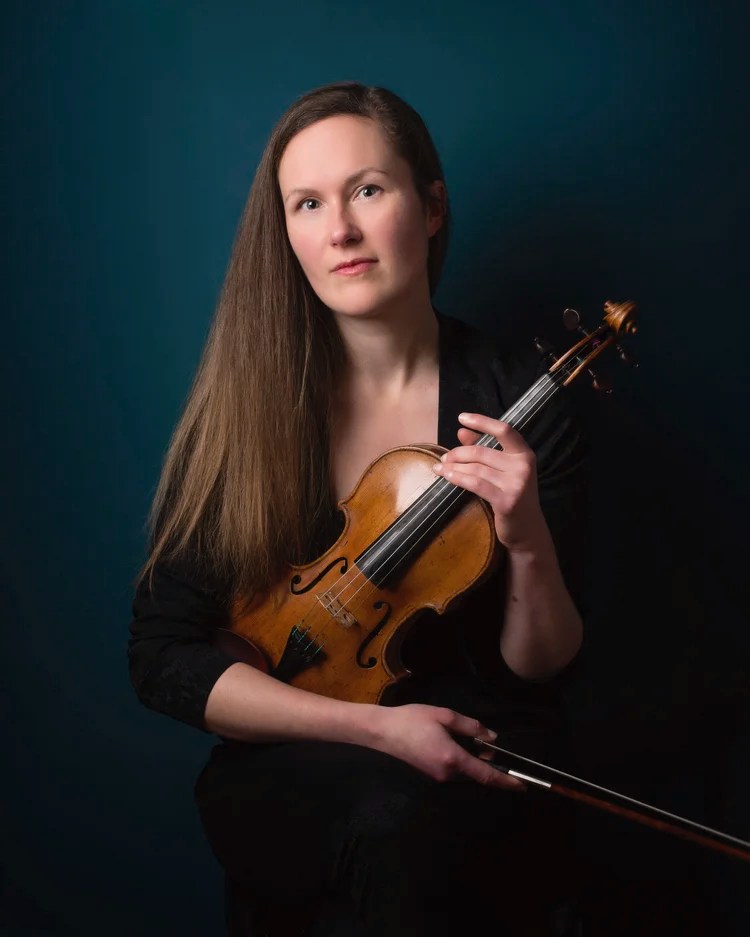
Zoë Beyers (violin, above), English Symphony Orchestra / Kenneth Woods
Vaughan Williams The Wasps (1909) – Overture
Sawyers Symphony no.6 ‘A Pastoral’ (2022) [World Premiere]
Elgar Violin Concerto in B minor Op.61 (1909-10)
Town Hall, Cheltenham
Sunday 1 February 2026
Reviewed by Richard Whitehouse Photo of Zoë Beyers (c) Bill Leighton
This afternoon’s concert in the second season of its Cheltenham residency found the English Symphony Orchestra tackling, appropriately enough, an all-English programme; the Overture from Vaughan Williams’s incidental music to The Wasps being an ideal curtain-raiser with its interplay of incisiveness and eloquence ideally judged. The performance was enhanced by an unerring balance that allowed such as Rita Schindler’s dextrous harp playing to register with real clarity. Hopefully the whole suite will appear at an ESO concert sometime in the future.
The music of Philip Sawyers has appeared frequently on ESO programmes this past decade, with his Third Symphony launching the orchestra’s 21st Century Symphony Project back in 2016. A decade on bought the premiere of his Sixth Symphony – less epic in scope than the Third or Fourth in this cycle and without the searching ambiguities of the Fifth, but a piece whose modest length (30 minutes) or forces (double woodwind, horns and trumpets) likely belie the emotional range of what is being played out across these four compact movements.
Its subtitle evidently an afterthought, ‘A Pastoral’ deftly characterizes this symphony audibly influenced by if never beholden to that by Beethoven. Hence the opening Moderato implies a journey whose destination seems at best uncertain, its accumulating tension carried over into an Andante where scenic aspect is countered with more subjective preoccupations. Nor is the Allegro of an unchecked jollity, the insistent rhythmic profile accumulating an impetus such as takes on more elemental qualities in its visceral latter stages. The final Allegretto surveys all that went before (whether motivically or emotionally) through a process of clarifying and honing earlier ideas towards an ending which, with its evocation of birdsong, affords closure but not catharsis. An ambivalence Sawyers will hopefully address in his Seventh Symphony.
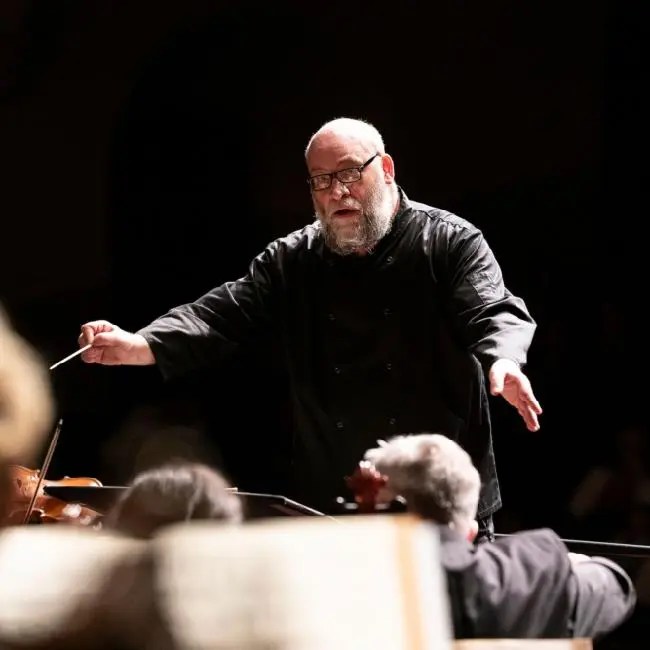
Assuredly directed by Kenneth Woods (below), this first performance was almost all that could have been wished as to accuracy of ensemble or interpretive insight. Good to hear it was recorded for future release, and hopefully Sawyers’s Sixth will receive more hearings before too long.
After the interval, Zoë Beyers repeated what was a well-received account of Elgar’s Violin Concerto from last year’s Elgar Festival. With its opulent scale and solo part that had been conceived for Fritz Kreisler, this could never be other than a testing proposition but Beyers succeeded admirably in conveying that formal intricacy and expressive force which typify this work. The opening Allegro was rarely other than cohesive, thanks not least to Woods’s astute accompanying, and the Andante radiated an emotional warmth with no risk of undue emoting. Beyers had the measure of the lengthy finale, duly coming into her own with that accompanied cadenza such as reviews previous themes at an emotional remove and whose ambivalence resonated long after activity had been resumed on the way to a decisive close.
An engrossing performance which concluded this concert in impressive fashion. Woods and the ESO return to Cheltenham Town Hall next month with a new piece by David Matthews, alongside Mozart’s Sinfonia Concertante (for strings) and Beethoven’s Seventh Symphony.
To read more about the orchestra’s 2025/26 season, visit the English Symphony Orchestra website. Click on the names for more on violinist Zoë Beyers, conductor Kenneth Woods and composer Philip Sawyers
Published post no.2,786 – Monday 2 February 2026
 Arcana.fm