
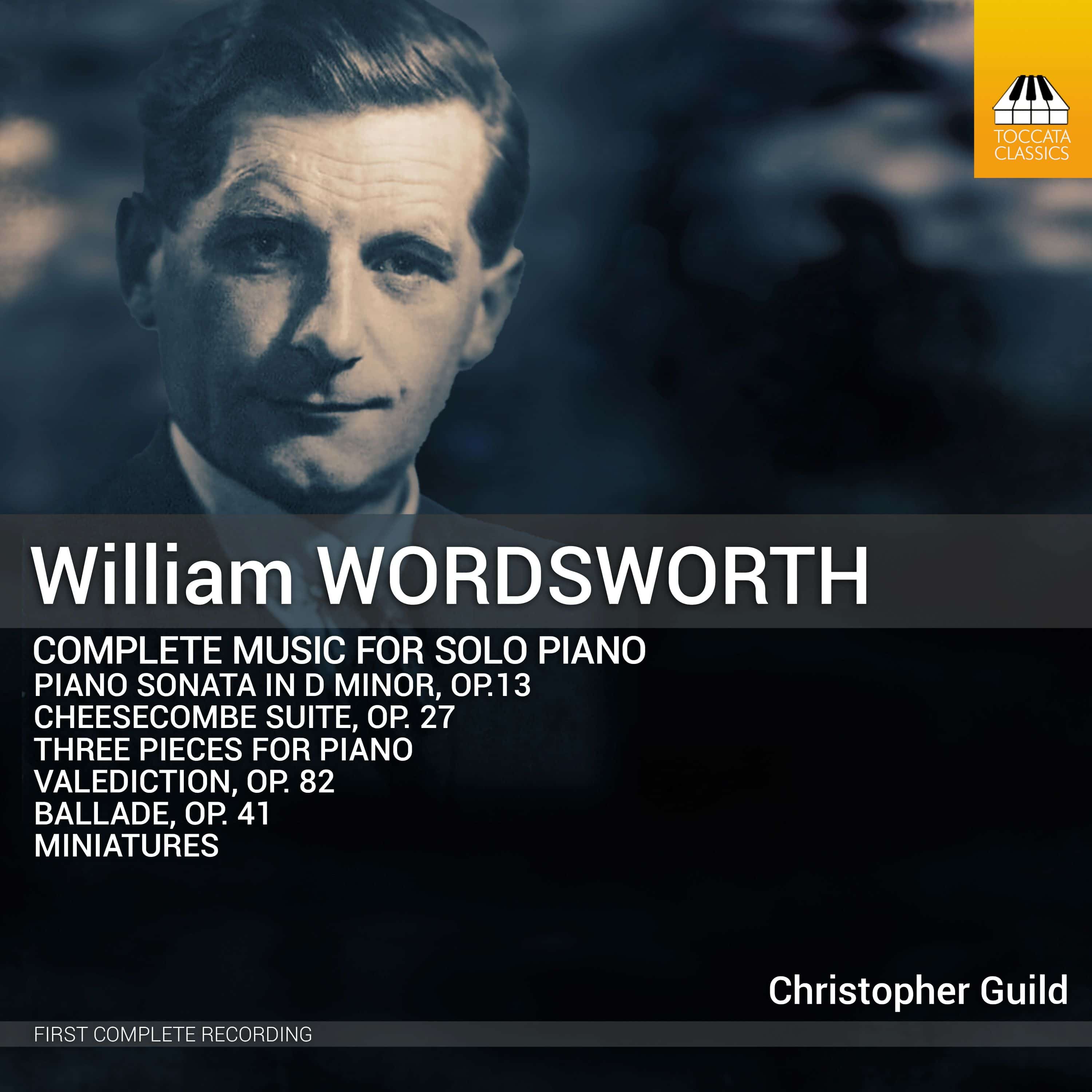
On Record – William Wordsworth: Complete Piano Music (Christopher Guild) (Toccata Classics)

William Wordsworth
Piano Sonata in D minor Op.13 (1938-9)
Three Pieces (1932-4)
Cheesecombe Suite Op.27 (1945)
Ballade Op.41 (1949)
Eight Pieces (all publ. 1952)
Valediction Op.82 (1967)

Christopher Guild (piano)

Toccata Classics TOCC0697 [81’08”]
Producer and Engineer Adaq Khan

Recorded 13 April, 29 May 2022 at Old Granary Studios, Beccles, 2 April 2023, Wyastone Hall, Monmouthshire (Three Pieces)

Reviewed by Richard Whitehouse

What’s the story?

Toccata Classics intersperses its continuing survey of William Wordsworth’s orchestral music with a release devoted to that for solo piano, including several works not otherwise recorded and all ably performed by Christopher Guild, who already features prominently on this label.

What’s the music like?

Although not a large part of his catalogue, piano music features prominently in Wordsworth’s earlier output – notably a Piano Sonata that ranks among the finest of the inter-war period. Its first movement is introduced by a Maestoso whose baleful tone informs the impetuous while expressively volatile Allegro. The central Largamente probes more equivocal and ambivalent emotion before leading into the final Allegro, its declamatory and martial character offset by the plangent recall of earlier material prior to a denouement of surging and inexorable power.

His status as conscientious objector found Wordsworth engaged in farm-work in wartime, the experience duly being commemorated in his Cheesecombe Suite whose pensive Prelude and dextrous Fughetta frame a quizzical Scherzo then a Nocturne of affecting pathos. Written for Clifford Curzon, Ballade is a methodical study in contrasts which makes an ideal encore; as, too, might Valediction – though here the emotions run deeper and more obliquely, as befits this inward memorial to a lifelong friend from comparatively late in its composer’s creativity.

This release rounds out our knowledge of Wordsworth’s piano music with two collections not previously recorded. Among his earliest surviving works, the Three Pieces comprise a taciturn Prelude, fleeting Scherzo then soulful Rhapsody which between them find the composer trying out whole-tone figuration with resourcefulness but also a self-consciousness that might have decided him against publishing. Published by Alfred Lengnick as part of its five-volume educational series Five by Ten, the eight miniatures wear their didactic intention lightly; only one of these exceeding two minutes, yet all evince a technical skill that is never facile along with a pertinent sense of evocation that should commend them to amateurs and professionals alike. Here, as often elsewhere, Wordsworth proves a ‘less is more’ composer of distinction.

Does it all work?

Very much so and Christopher Guild, with admirable surveys of Ronald Stevenson (Toccata) and Bernard Van Dieren (Piano Classics) to his credit, is a natural interpreter of often elusive yet always rewarding music. His charged and often impetuous take on the Sonata has more in common with the pioneering account by Margaret Kitchin (Lyrita) than the overtly rhetorical one by Richard Deering (Heritage). Similarly, his approach to the Cheesecombe Suite and the Ballade draws out their depths if occasionally at the expense of their expressive immediacy. Interestingly, Valediction is played from a copy by Stevenson that alters aspects of keyboard layout or pedalling if not the notes themselves; resulting in a greater emotional ambivalence and textural intricacy which Wordsworth, had he heard it, would most likely have endorsed.

Is it recommended?

Indeed, not least when the sound of both Steinway D’s are so faithfully conveyed and Guild’s annotations are so perceptive. Those who have the Deering release should consider acquiring this one also, while those new to this music need not hesitate in making this their first choice.

Listen & Buy

For purchase options, you can visit the Toccata Classics website. Click on the names to read more about pianist Christopher Guild and composer William Wordsworth.

Published post no.2,500 – Thursday 10 April 2025

On record – Ronald Stevenson: Piano Music Volume Five: Transcriptions of Purcell, Delius and Van Dieren (Christopher Guild) (Toccata Classics)

stevenson-5

Delius The Young Pianist’s Delius (1962, rev. 2005)
Purcell Toccata (1955); The Queen’s Dolour – A Farewell (1959); Hornpipe (1995); Three Grounds (1995)
Stevenson Little Jazz Variations on Purcell’s ‘New Scotch Tune’ (1964, rev ’75)
Van Dieren String Quartet No. 5 (c1925, rev. 1931; transcr. c1948-1987); Weep You No More, Sad Fountains (1925, transcr, 1951); Spring Song of the Birds (1925, transcr. 1987)

Christopher Guild (piano)

Toccata Classics TOCC0605 [80’57”]

Producer / Engineer Adaq Khan

Recorded 5 – 6 September 2020, 5 January 2021 at the Old Granary Studio, Toft Monks, Norfolk

Written by Richard Whitehouse

What’s the story?

Christopher Guild continues his survey of Ronald Stevenson’s piano music with this volume comprising transcriptions of Purcell, Delius and Van Dieren – the latter’s Fifth Quartet fairly exemplifying Stevenson’s dedication to the spirit as much as the letter of the music at hand.

What’s the music like?

The essence of Stevenson’s re-creative approach is evident in his Purcell transcriptions, not least the Toccata with its deft changes of register and tensile rhetoric where Busoni’s benign presence can be felt. A lighter and more playful manner is evident in the Hornpipe, whereas the Three Grounds point up conceptual as well as musical links with Bach and, through their forming a ‘sonatina’ of unlikely cohesion, Beethoven. Greater license is demonstrated in the Little Jazz Variations, surely among Stevenson’s most delightful pieces in its blurring of the ‘boundary’ between transcription and composition and enhanced by its discreet take on pre-bop jazz idioms. The Queen’s Dolour looks to the poignant final aria from Dido and Aeneas for what is one of the most characteristic and, moreover, affecting Stevenson transcriptions.

All these pieces have been previously recorded, but not the remainder of this programme. A pity that The Young Pianist’s Delius is not more widely known, as this cycle of 10 miniatures drawn from across the composer’s output is a gift to pianists who have little original Delius to work with, whereas listeners who are unfamiliar with or deterred from investigating this easily misunderstood figure could hardly hope for a more representative or appealing breviary of his music. It helps that Stevenson’s transcriptions are straightforward but not in the least didactic.

Two songs by Bernard van Dieren – gravely eloquent as regards Weep You No More or deftly effervescent in Spring Song of the Birds – have secured a measure of familiarity when heard as encores. Not so the Fifth Quartet, never recorded in its original guise, whose transcription occupied Stevenson over almost four decades. Premiered in its revision in 1931, this work is among the most substantial from its composer’s later years as it unfolds from a discursive (if never rhapsodic) sonata design, via circumspect and headlong intermezzi, to a lively scherzo then soulful Adagio – before a resolute finale offers closure. Tonal ambivalence and textural intricacy are borne out in this recasting in terms of piano which lasts five minutes longer than the Allegri Quartet’s 1988 broadcast; not that Guild’s reading seems to lose focus in any way.

Does it all work?

Yes, given Stevenson’s command of keyboard technique and, moreover, his placing of this at the service of the piece in question. To paraphrase his comments on Liszt – were the classical repertoire suddenly to disappear, much it could still be accessed through those transcriptions that he made over the greater part of his career. Nor is the technique required of a consistently advanced degree, with the Delius and several of the Purcell pieces accessible to most capable pianists, though the Van Diren quartet necessitates an ability not far short of the transcriber!

Is it recommended?

Indeed. Christopher Guild is a resourceful and probing guide to Stevenson’s art; his Steinway D heard to advantage and his booklet notes readably informative. One final thought – the Van Dieren Quartets positively cry out for an integral recording: how about it, Toccata Classics?

Listen

https://open.spotify.com/album/6EDUvp6G1WYgOY3yIHegtF

Buy

You can discover more about this release at the Toccata Classics website, where you can also purchase the recording. To find out more about the composer, visit the Ronald Stevenson Society, while for more on Christopher Guild, click here