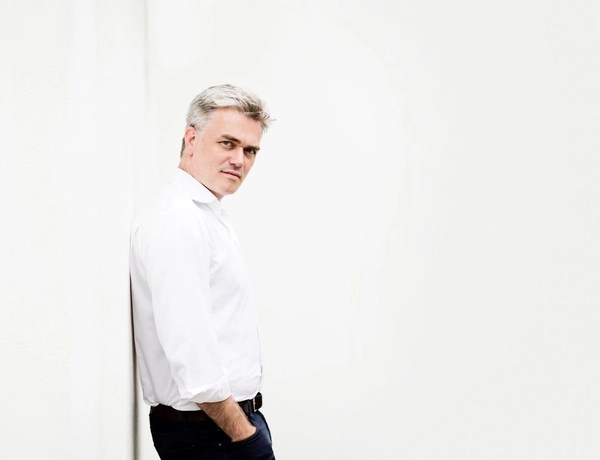
In concert – Mary Bevan, CBSO / Edward Gardner: Schubert – Symphony no.9 & Songs

Mary Bevan (soprano), City of Birmingham Symphony Orchestra / Edward Gardner

Schubert
Rosamunde D797 – No. 3b, Romanze (1823)
Der Erlkönig D328 (1815, orch. Berlioz 1860)
Die Forelle D550 (1816, orch. Britten 1942)
Im Abendrot D799 (1825, orch. Reger 1914)
Geheimes D719 (1821, orch. Brahms, 1862)
Symphony no.9 in C major D944 ‘Great’ (1825-6, rev. 1828)

Symphony Hall, Birmingham
Wednesday 17 May 2024

Reviewed by Richard Whitehouse Pictures by Benjamin Ealovega (Ed Gardner), Victoria Cadisch (Mary Bevan)

July concerts no longer a consistent fixture in the City of Birmingham Symphony Orchestra’s schedule, it made sense to end the current season with the intended programme for the fourth and final volume of this orchestra’s Schubert cycle with former chief guest conductor Edward Gardner.

If not his final such project, the ‘Great’ was the final symphony that Schubert finished and the culminating orchestral work of his last decade. Now, as almost two centuries ago, it is not an easy work to being off – but this account hit the ground running with a flowing yet purposeful introduction that elided seamlessly with the initial Allegro. Gardner kept momentum on a sure yet flexible rein over those impetuous and capricious themes of its exposition; underlining the subtly eddying tension of its development and a propulsive coda whose link-up with the tempo of that introduction was marred only by the too emphatic final gesture. Respectively plaintive or consoling, the Andante’s alternate episodes were brought into eloquent accord – the fanfare -riven anguish at its climax then the stark fatalism towards its close being especial highlights.

The essential link between the scherzos of Beethoven and Bruckner, the third movement had the right buoyancy but also a suavity in keeping with the Viennese character of its dance-like themes, and complemented by those of its trio whose lilting elegance were tinged by wistful regret. Launched with a commanding call-to-attention, the Finale did not lack for vigour but, unlike so many performances, Gardner was mindful not to rush either here or in the capering second theme whose relentless string accompaniment was vividly rendered. The development more than fulfilled its purpose as an extended transition into the reprise, then the coda opened with a frisson of anticipation such as underpinned the closing pages as they powered towards the decisive but never headlong close to what was a convincing and engrossing performance.

Regarding repeats, Gardner observed that of the first movement’s exposition but not those in the second half during either scherzo or trio, and that of the finale’s exposition. This at least made matters easier for the players, and left options open for their inclusion in the recording.

That forthcoming release on Chandos will hopefully find room for the five songs that formed the first half of this concert, with each of them arranged by a different composer. The pensive Romanze from Schubert’s incidental music to Rosamunde was heard in the composer’s own orchestration, with the compact psychodrama of Der Erlkōnig in a resourceful and nowadays overlooked orchestration by Berlioz. The looping but not always ingratiating playfulness of Die Forelle was expertly attended to by Britten, while the pensive soulfulness of Im Abendrot summoned an appropriate response from Reger; the sombre resignation of Geheimnis making for a welcome encore in its orchestration by Brahms. Throughout the selection, Mary Bevan’s veracity of emotional response and her clarity of enunciation were qualities worth savouring.

This programme may have concluded the Schubert cycle by Gardner and the CBSO, though hopefully it will not see of this partnership in recorded terms – the symphonies of Schumann, and maybe Brahms, being well worth considering as additions to the orchestra’s discography.

For details on the 2024-25 season A Season of Joy, head to the City of Birmingham Symphony Orchestra website. Click on the names to read more about soprano Mary Bevan and conductor Edward Gardner

Published post no.2,243 – Thursday 18 July 2024

Arcana at the opera: New Year @ Birmingham Opera Company

New Year (1985-88)

Opera in Three Acts

Music and libretto by Sir Michael Tippett
Sung in English with English surtitles

Jo Ann – Francesca Chiejina (soprano), Donny – Sakiwe Mkosana (baritone), Nan – Sarah Pring (mezzo-soprano), Merlin – Lucia Lucas (baritone), Pelegrin – Joshua Stewart (tenor), Regan – Samantha Crawford (soprano), Presenters – Grace Durham (mezzo-soprano), Oskar McCarthy (baritone)

Keith Warner (director), Michael Hunt (associate designer), Mariana Rosas (chorus director), Nicky Shaw (designer), Simone Sandrini (choreographer), John Bishop (lighting designer), Matt Powell (video designer)

Birmingham Opera Company Chorus, Actors and Dancers, City of Birmingham Symphony Orchestra / Alpesh Chauhan

The Dream Tent @ Smithfield, Birmingham
Sunday 7 July 2024

reviewed by Richard Whitehouse Photos (c) Adam Fradgley

Around a decade ago, Birmingham Opera Company mounted a production of Tippett’s opera The Ice Break which vindicated this opera as a dramatic entity, so making its composer’s fifth and final opera New Year a logical further step in the rehabilitation of a latterly neglected and frequently derided dramatist. What was seen and heard tonight was typical of BOC only in its playing fast and loose with a work that, far from representing a creative decline, finds Tippett pushing – unequivocally even if erratically – against the boundaries of what may be feasible.

Since its staging at Houston in 1989 then at Glyndebourne the following summer, New Year has barely surfaced in considering what was a productive and diverse era for opera in the UK – occasional revivals of its suite a reminder of those riches that more than outweigh any dross. Much of the problem lies in just what this work is – a masque whose ‘‘primary metaphor’’ is dance. What better than to locate it in a ‘Dream Tent’, which here functions as the scenic and sonic environment where ‘‘Somewhere and Today’’ collides with ‘‘Nowhere and Tomorrow’’?

Keith Warner’s direction makes resourceful use of the space therein. At its centre, a circular platform enables the presenters to comment on the action, as well as a means of bringing its climactic aspects into acute focus. At either end are a house where the humans are domiciled, then a white cube that opens-up to reveal a spaceship from where the time-travellers emerge. Along either side are gantries for chorus and orchestra – the former as volatile in its comings and goings as the latter is inevitably static, but their synchronization was hardly ever at fault.

Above all, such an array allows free rein to Simone Sandroni’s choreography – as animated or visceral as the scenario demands and abetting a sense of the opera playing out in real-time to onlookers either side of the dramatic divide, which duly blurs in consequence. Both Nicky Shaw’s designs and Matt Powell’s video make acknowledgement of that period from which New Year emerged, while John Bishop’s lighting comes decisively through the haze of ‘dry ice’ to illumine the production and denote the proximity of this opera to the heyday of MTV.

Vocally there was little to fault. As the reluctant heroine Jo Ann, Francesca Chiejina overcame initial uncertainty for a rendition affecting in its vulnerability; to which the Donny of Sakiwe Mkosana was a telling foil in its reckless self-confidence and excess of adrenalin. They were well complemented by the Merlin of Lucia Lucas, duly conveying hubris poised on the brink of disaster, and the Pelegrin of Joshua Stewart whose growing desire to bring together these separate but not thereby competing worlds bore eloquent fruit in his love-duet with Jo Ann.

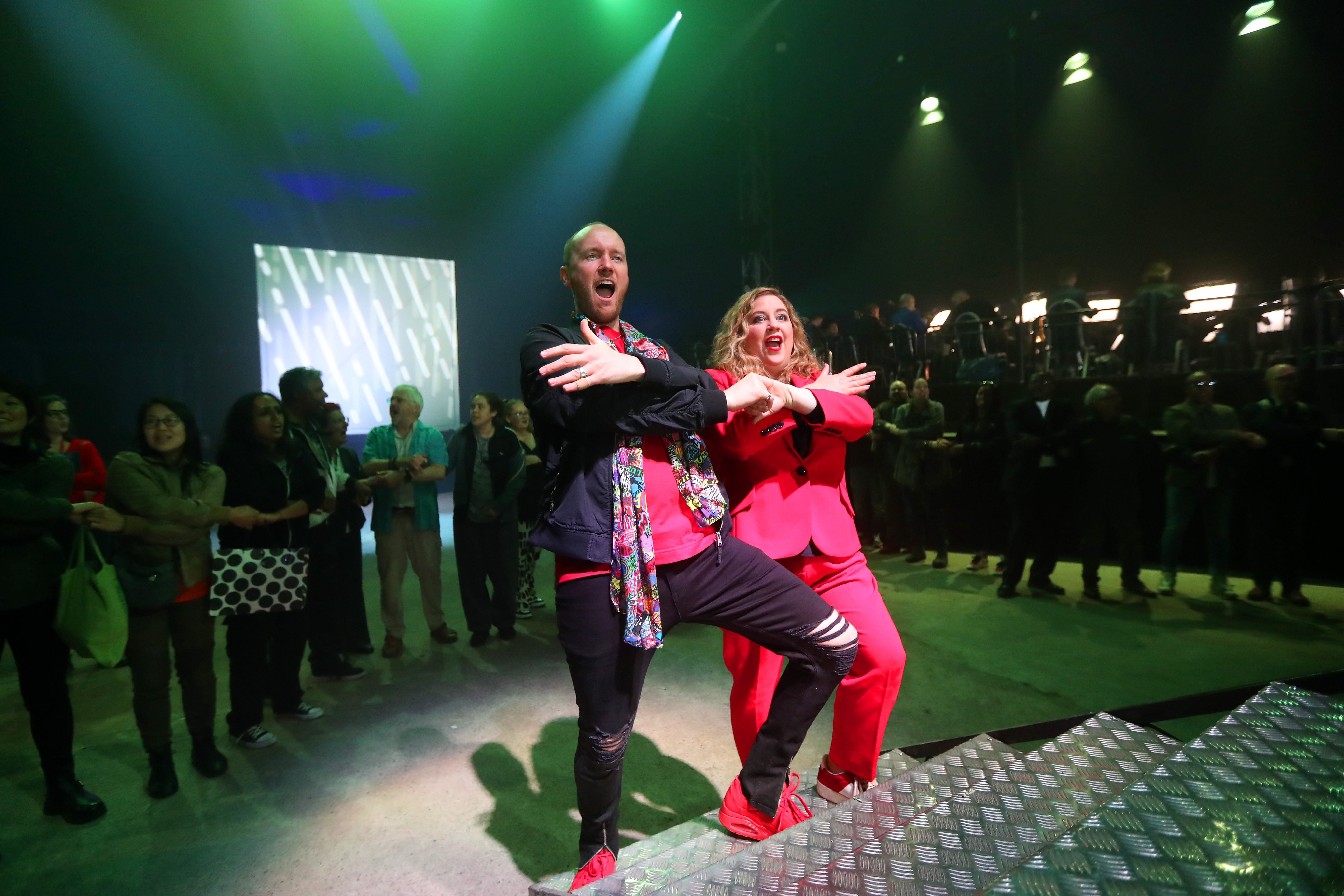
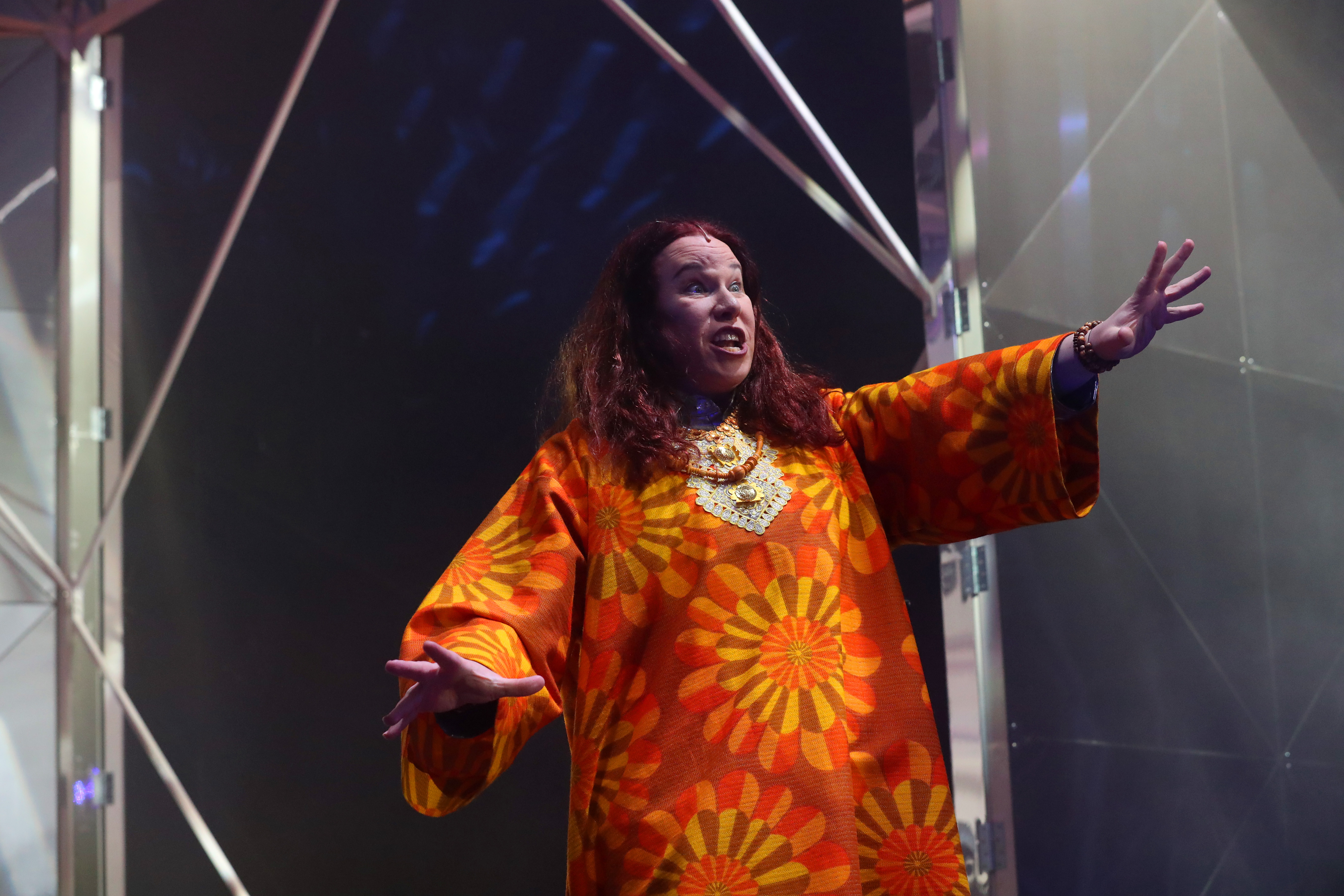
It was those other two main roles, however, that dominated proceedings. Sarah Pring gave a powerful while never inflexible portrayal of Nan, her innate fervency in contrast to the steely authority of Samantha Crawford (above) whose Regan approaches the human world with something between trepidation and disdain – not least in her confrontation with Donny, where Tippett’s would-be rap provoked some amusement. Splitting the role of Presenter worked effectively, Grace Durham and Oskar McCarthy (below) duly enhancing the stage-action with no little panache.

Not for the first time, BOC Chorus came into its own for what is among the most extensive and immediate of Tippett’s choral contributions to opera – the oft-favoured device of Greek Chorus afforded a visceral twist as it conveys the ominous and often violent attitudes of ‘the crowd’. That many of those involved have signed-up specifically for the occasion only adds to the rawness and physicality of its collective presence: something that the composer was at pains to capture, and which could not have been realized this directly in earlier productions.

Conducting the City of Birmingham Symphony Orchestra with typical discipline and energy, Alpesh Chauhan brought requisite vibrancy and clarity to Tippett’s writing. Less purposefully wrought than in his previous operas, there is no lack of subtlety or imagination – the frequent reliance on percussive sonorities to sustain the overall texture hardly an issue when so deftly realized as here. Is there a more moving passage in his output than the dance for Jo Ann and Pelegrin after their duet – Tippett’s musical past and present brought into disarming accord.

Playing for around 105 minutes, New Year is relatively expansive next to Tippett’s preceding two stage-works so that certain aspects of those outer acts do verge on diffuseness. That this hardly came to mind on the opening night was tribute to the conviction of those involved in seeking to reassess what this opera might be and, moreover, what it is there to do. Far from having run out of ideas, Tippett had a surfeit of these that he struggled to make cohere but in which he so nearly succeeded. Do see this engaging and enlightening production from BOC.

Further performances on 9, 10, 12 & 13 July – for more information head to the Birmingham Opera Company website

Published post no.2,233 – Monday 8 July 2024

In concert – Katie Trethewey, University of Birmingham Voices, CBSO Chorus & Orchestra / Ludovic Morlot: John Luther Adams – Vespers of the Blessed Earth; Sibelius

Katie Tretheway (soprano), CBSO Chorus, University of Birmingham Voices, City of Birmingham Symphony Orchestra / Ludovic Morlot

John Luther Adams Vespers of the Blessed Earth (2021) [CBSO co-commission: UK premiere]
Sibelius Symphony no.2 in D major Op.43 (1901-02)

Symphony Hall, Birmingham
Thursday 9 May 2024

Reviewed by Richard Whitehouse

Almost eight years ago, the City of Birmingham Symphony Orchestra and Ludovic Morlot gave the UK premiere of John Luther Adams’ Become Ocean. Tonight they, with the CBSO Chorus and University of Birmingham Voices, gave that of his most recent large-scale work.

It may have been obliquely inspired by Monteverdi, but Vespers of the Blessed Earth is very much a humanist response to those ecological challenges of the present and, to this end, its texts have a concreteness and functionality which is wholly at the service of the music. Thus A Brief Descent into Deep Time sets words as depict the (reverse) geological evolution of the Grand Canyon, its emotional matter-of-factness in contrast to A Weeping of Doves with its unaccompanied setting of the call of the Papuan fruit dove in what is one of Adams’ most ravishing inspirations. Hardly less affecting is Night-Shining Clouds – an interlude, in the form of a chaconne, for strings that follows what the composer calls a ‘sub-harmonic’ series with its slowly spiralling descent to the depths for a graphic evocation of cloudly pollutants.

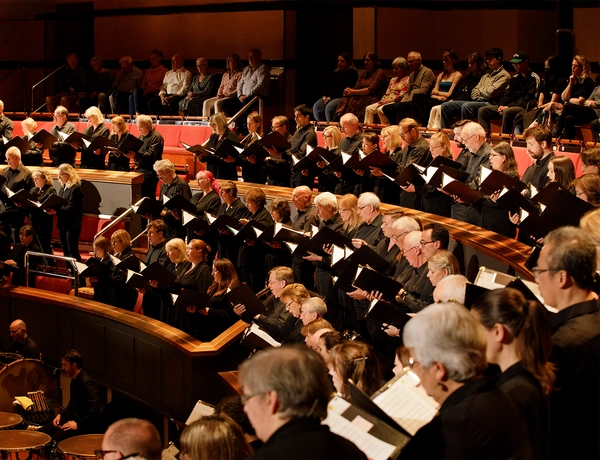
The fourth and climactic section, Litanies of the Sixth Extinction divides the choruses into four parts which between them chant the names of species in the process of or likely to face extinction – closing ominously with Homo Sapiens. It was here that an antiphonal placing of strings and percussion, along with choirs of woodwind and brass placed along either side of the upper circle, came into its own but, typically for Adams, the effect was one of cumulative if not intensifying emotion. Aria of the Ghost Bird followed with its transcribed rendering of the call from the now-extinct Kaua’i O’ō, tonight taken by Katie Tretheway (above) in what was a finale of the gentlest eloquence. It duly remained for offstage flute and chimes, here placed up in the grand tier, to see this inconsistent while always absorbing work to its wistful close.

In his thoughtful introductory remarks, Morlot spoke of the appositeness when juxtaposing Adams with Sibelius and the latter’s Second Symphony, which followed the interval, made his point admirably. Once the most popular such piece by Sibelius (and, indeed, of the last century), latter-day performances too often fight shy of its innate rhetoric or overt emotion. Without being disengaged, this account succeeded because of its methodical trajectory, not least a first movement whose restraint was never at the expense of its overall incisiveness.

With its stark contrast between conflict and consolation, the slow movement can easily fall into overkill but not here – Morlot evincing a keen sense of cohesion through to its baleful ending. The scherzo likewise secured keen cohesion from its alternate energy and raptness, then its surging transition into the finale brought an emotional frisson maintained through to an apotheosis whose grandeur never felt self-conscious or overbearing. Whether the triumph expressed is cultural or personal, the underlying essence of its affirmation was not in doubt.

It certainly set the seal on a memorable evening – one that confirmed the undoubted rapport between orchestra and conductor, while bridging the conceptual divide and almost 120 years between these pieces. Hopefully the CBSO and Morlot will be working together again soon.

Click on the link to read more on the current CBSO concert season, and on the names for more on soprano Katie Trethewey, conductor Ludovic Morlot, the University of Birmingham Voices and the CBSO Chorus. Meanwhile you can click on the name for more on composer John Luther Adams

Published post no.2,203 – Saturday 8 June 2024

In concert – CBSO Chorus & Orchestra / Joshua Weilerstein: Haas, Bernstein, Shaw & Dvořak

Michael Mulroy (treble), CBSO Chorus, City of Birmingham Symphony Orchestra / Joshua Weilerstein

Haas Study for Strings (1943)
Bernstein Chichester Psalms (1965)
Shaw Music in Common Time (2014)
Dvořak Symphony no.9 in E minor Op.95 ‘From the New World’ (1893)

Symphony Hall, Birmingham
Wednesday 15 May 2024

Reviewed by Richard Whitehouse Picture (c) Yuri Pires Tavares

In recent seasons, Joshua Weilerstein has presided over several of the City of Birmingham Symphony Orchestra’s most thought-provoking concerts and tonight’s programme was no exception in its potent mix of the recent and unfamiliar, alongside a symphonic evergreen.

It was thanks to the conductor and Auschwitz survivor Karel Ančerl that Study for Strings by Pavel Haas survived its immediate context, as propaganda for a Nazi documentary on cultural activity at the Theresienstadt transit-camp, to become one of this composer’s defining works. Felicitously combining Czech folk music with traditional Jewish inflections and (in its central section) more expressionist undertones, alongside a compact and quasi-symphonic design, it is a potent indication as to where post-war Czech music might conceivably have been headed.

It duly brought a vivid and energetic response from the CBSO strings, who were then joined by brass and percussion in Bernstein’s Chichester Psalms. Commissioned by the Dean of the city’s cathedral, it enabled the composer to pull together a number of earlier or aborted ideas in three Psalm-settings given focus by being heard in Hebrew translation with an authentic (if impractical as regards the percussion) scoring. Weilerstein drew the requisite verve from its initial setting, and if Michael Mulroy seemed tentative in its successor (discreet amplification might have helped), the contrast between his plaintiveness and edginess of the male-chorus interludes was pertinently drawn. Its anguished prelude for strings powerfully rendered, the final setting had an affecting eloquence through to the serene unaccompanied closing chorus.

After the interval, the CBSO Chorus was heard in rather more restrained guise with Music in Common Time by Caroline Shaw. Its brief and oblique text might have come from a late song by Talk Talk, but it yet provides the framework for a cannily unfolding fantasia in which the eddying textures of John Adams frame a speculative section with its string writing more than a little redolent of early Penderecki. Throughout, voices and instruments were finely melded in a composition that certainly suggests a plausible way out of any post-minimalist impasse.

What to say about the New World Symphony? Firstly, that it fitted judiciously into the overall programme as to conception; secondly, that it brought out the best in this partnership. Right from its evocative introduction, Weilerstein was alive to those many expressive ambiguities in the initial Allegro (a pity, though, that he omitted the exposition repeat as this undermines the formal balance overall), then drew a rapt and often searching response from the CBSO in the Largo – Rachel Pankhurst making the most of its indelible cor anglais melody. Nor was there any lack of bite or (in its trio section) gracefulness in the scherzo; such incisiveness of ensemble consistent throughout the finale, whose rhythmic impetus ensured the coda was not merely decisive but crowned the whole work in an apotheosis as conclusive as it was joyous. In his thoughtful initial remarks, Weilerstein spoke of this programme as being defined by its complexity, nuance and confrontation: qualities not always evident in present-day music, or in present-day discourse, but whose absence is our loss – as this concert eloquently confirmed.

Click on the link to read more on the current CBSO concert season, and on this link to read about the CBSO’s 2024/25 season. Click on the names for more on conductor Joshua Weilerstein, the CBSO Chorus and composer Caroline Shaw

Published post no.2,181 – Friday 17 May 2024

In concert – Elizabeth Llewellyn, CBSO Youth Chorus & Orchestra / Jérémie Rhorer: Debussy, Ravel & Stravinsky

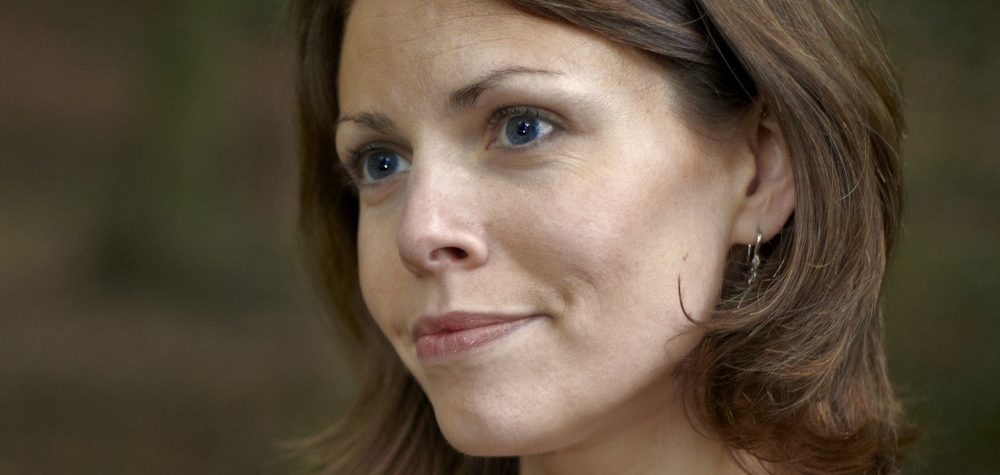
Elizabeth Llewellyn (soprano, below), CBSO Youth Chorus (chorus-master, Julian Wilkins), City of Birmingham Symphony Orchestra / Jérémie Rhorer

Debussy Nocturnes L98 (1899)
Ravel Shéhêrazade M41 (1903)
Debussy Prélude à l’après-midi d’un faune L86 (1894)
Stravinsky Symphony in Three Movements (1945)

Symphony Hall, Birmingham
Thursday 9 May 2024

Reviewed by Richard Whitehouse Picture of Jérémie Rhorer (c) Caroline Doutre, Elizabeth Llewellyn (c) Frances Marshall

Programmes featuring no Austro-German content are rarer than might be thought these days, so making this evening’s concert from the City of Birmingham Symphony Orchestra with the highly regarded conductor Jérémie Rhorer not only more unexpected but also more welcome.

There could be few more understated openings to such a programme than the Nocturnes that Debussy completed near the start of the 20th century, when the ‘impressionist’ tag randomly applied to his music was at its most relevant. Without denying its essentially rarified quality, Rhorer brought out the ominous undercurrents in Nuages, its emotional eddying abetted by Rachel Pankhurst’s soulful cor anglais while duly complemented by those fervid imaginings of Fêtes, where the central processional felt tangible in its implacability. Nor was there any undue reticence in Sirènes, the CBSO Youth Chorus here repeating its contribution from a couple of seasons ago with a response whose androgynous sound-world did not preclude an expressive poise coming to the fore through the remote ecstasy of this piece’s closing pages.

Among the most potent expressions from its composer’s early maturity, Ravel’s Shéhêrazade made for a natural follow-on. Less a cycle than a sequence of songs, it tends to be dominated by its initial Asie, which made Elizabeth Llewellyn’s performance the more admirable. Not that she ever under-characterized the images of wonder and terror such as pervade the poem’s ‘‘outdated language and cultural depictions’’ (to quote the rider in tonight’s programme), but these were harnessed to a cumulative build-up of intensity that held good over the capricious elegance of La Flûte enchantée, as enhanced by the artful finesse of flautist Marie-Christine Zupancic, then on to the sensuous ambiguity of L’Indifférent with its predictably equivocal close. Rhorer secured playing of subtlety and refinement throughout this memorable reading.

A suitably enervated if never flaccid account of Debussy’s Prélude à l’après-midi d’un faune launched the second half. Distinguished once more by Zupancic’s playing as well as an airily euphonious response by CBSO woodwind, Rhorer teased out the purpose behind any inertia.

Although it could not have made other than a jarring impression in this context, Stravinsky’s Symphony in Three Movements provided an instructive contrast (Roussel’s Third Symphony would have been more apposite – maybe another time?) in its presaging of rhythmic tensility over harmonic langour. Rhorer had the measure of the opening’s movement’s animation, for the most part simmering rather than overt (and some not quite spot-on entries a reminder that this music remains a stern test of technical accuracy), but the highlight was a central Andante whose alternating between the whimsical and beatific confirmed the film-world’s loss as the concert-hall’s gain. The transition into the finale saw a frisson of expectancy, duly confirmed by its remorseless progress toward what is the most visceral outcome in latter-day Stravinsky.

A fine showing, then, from the CBSO and a notable appearance by Rhorer who will hopefully return soon. Next week sees a welcome reappearance by Joshua Weilerstein, major works by Bernstein and Dvořák being set in relief with shorter pieces by Pavel Haas and Caroline Shaw.

Click on the link to read more on the current CBSO concert season, and on the names for more on soprano Elizabeth Llewellyn, conductor Jérémie Rhorer and the CBSO Youth Chorus

Published post no.2,177 – Monday 13 May 2024