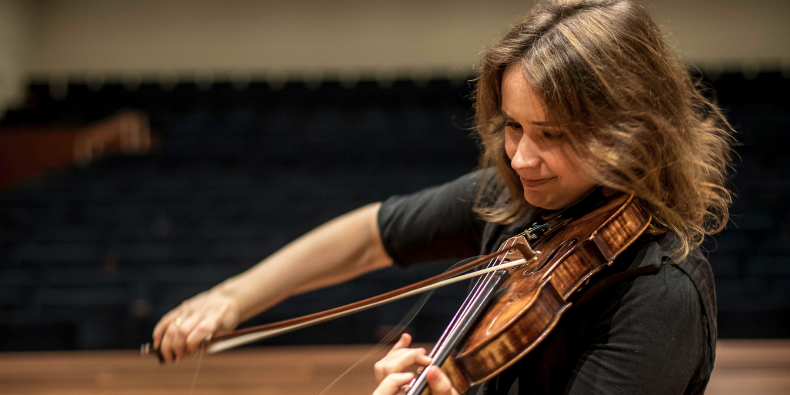
In concert – Patricia Kopatchinskaja, CBSO / Ludovic Morlot: Britten & Shostakovich

patricia-kopatchinskaja-2

Britten Gloriana – Symphonic Suite, Op. 53a (1954)
Shostakovich Violin Concerto No. 1 in A minor, Op. 77 (1947-8)
Britten Peter Grimes – Four Sea Interludes, Op. 33a (1945)

Patricia Kopatchinskaja (violin, above), City of Birmingham Symphony Orchestra / Ludovic Morlot (below)

Symphony Hall, Birmingham
Thursday 16 June 2022, 2.15pm

Written by Richard Whitehouse

This afternoon’s concert by the City of Birmingham Symphony Orchestra might largely have repeated that of the previous evening, but its inclusion of Shostakovich’s most wide-ranging concerto with suites which Britten devised from two of his operas ensured an absorbing listen.

In Shostakovich’s First Violin Concerto, it helped to have Patricia Kopatchinskaja at her most combative. Admittedly the opening Nocturne took time to come into focus, though its latter stages were powerfully shaped and with the sombre foreboding of the main climax gradually fading into silence. The Scherzo was distinguished by incisive repartee between soloist and orchestra, along with the vivid pointing up of those Jewish-derived elements which give this music a sardonic quality as becomes increasingly frenetic as the movement reaches its close.

The Passacaglia depends for so much of its emotional impact on its inexorable cumulative motion, and here Ludovic Morlot was at one with Kopatchinskaja in projecting the anguish – without undue vehemence – at its apex then forlorn manner of the soloist’s musing soliloquy. The Cadenza emerged methodically but with no lack of spontaneous expression, creating an impetus that the final Burlesque fulfilled in ample measure as it careered onwards – soloist and orchestra keeping enough in reserve for the coda fully to register its desperate defiance.

A pity last night’s UK premiere of Anna Thorvaldsdottir’s Catamorphosis (a co-commission for the CBSO’s centenary) could not be repeated, but that concert is being broadcast on BBC Radio 3 at a later date. Moreover, Kopatchinskaja had music of her own to perform when she returned to the platform for a duet with principal bassoonist Nikolaj Henriques in what was a repost to the authoritarian leaders who curtail creative expression, as have their predecessors before and after Stalin. Suffice to add that this piece made its point in notably visceral terms.

Opening the concert, Britten’s Symphonic Suite from his opera Gloriana made for a short if eventful first half – moving from the imperiousness of The Tournament, via the eloquence of The Lute Song (the tenor line of the original plaintively taken by oboist Emmet Byrne) and inspired pastiche of The Courtly Dances with its felicitous writing for woodwind and percussion, to the powerful apotheosis that is Gloriana moritura with its baleful brass and burnished strings. Not often revived, it made a suitably thoughtful impression this evening.

The Four Sea Interludes from Britten’s earlier opera Peter Grimes is more frequently heard in concert, with Morlot clearly relishing the stark timbral contrasts of Dawn as much as the scenic and temporal interplay in Sunday Morning. The highlight, though, was Moonlight whose sustained intensity and encroaching harmonic dissonance were palpably conveyed – after which, Storm concluded the sequence in vividly dramatic terms while not excluding that element of weary soul-searching as briefly ‘takes the stage’ before the dramatic close.

A distinctive programme with performances to match. Morlot is a conductor not seen often enough in the UK, and the same might be said for Markus Stenz who will be appearing with the CBSO next Thursday and Saturday in performances of Mahler’s Resurrection Symphony.

For more information on the CBSO, visit their website, and for details on the newly announced 2022/23 season click here. Meanwhile for more information on the artists, click on the names to access the websites of Patricia Kopatchinskaja and Ludovic Morlot

In concert – Soloists, CBSO Chorus & CBSO / John Butt: Handel’s Messiah

John-Butt

Handel Messiah HWV56 (1741)

Mary Bevan (soprano), Reginald Mobley (countertenor), James Gilchrist (tenor), Christopher Purves (baritone), CBSO Chorus, City of Birmingham Symphony Orchestra / John Butt (harpsichord)

Symphony Hall, Birmingham
Wednesday 8 June 2022

Written by Richard Whitehouse

Unlikely as it might seem, the CBSO Chorus had never given Handel’s Messiah before this evening – the regular stream of performances by choral societies or the City of Birmingham Symphony Orchestra having other priorities putting paid to any such intention until tonight.

Not that Messiah has ever lacked for performances since its Dublin premiere in April 1742 – after which, it soon became recognized as, if not necessarily the finest of Handel’s numerous oratorios, then certainly the most representative; a template for the genre such as dominated music-making in Britain over the next 175 years. His text drawn freely from the Old and New Testaments, Charles Jennens relates Christ’s birth, death and resurrection then triumph of the Christian gospel in meaningful while not profound terms as were bound to strike a resonance.

Formerly the work falls into three parts of 16 scenes and 53 individual (not always separate) numbers, ranging from brief solo recitatives to lengthy arias and extended choruses in what became a blueprint for those oratorios as followed apace over the next decade. Although all four soloists share in relating aspects of the narrative, there is no division into specific roles as in Passion settings; itself a sure means of conveying a dramatic scenario without the need to endow musical content with an overly theatrical aspect as might have become distracting.

Tonight’s soloists evidently had no lack of familiarity with the work. For all their individual excellence, the deftness of Reginald Mobley’s lightly inflected alto, mellifluousness of James Gilchrist’s high tenor and elegance of Christopher Purves’s lyric baritone perhaps limited the emotional contrast possible between solo items. This was hardly the case with Mary Bevan (above), whose eloquent assumption of the soprano numbers, not least an I know that my Redeemer liveth as brought out the pathos of music that long ago seemed to have become its own stereotype.

Otherwise (not unreasonably) it was the choral items which really hit home. Enthused by the chance to sing this work the CBSO Chorus gave its collective all: whether in those energetic earlier choruses, fervent anticipation of Glory to God in the highest, contrapuntal vigour of Hallelujah or the majestic accumulation of Worthy is the Lamb, whose elaborate ‘Amen’ was powerfully rendered. Simon Halsey and Julian Wilkins (behind the organ manual) had evidently ensured that, for the CBSOC’s rare outing in this work, nothing was left to chance.

Not that the CBSO’s contribution was found at all wanting. Avoiding a temptation to try out one of the latter-day orchestrations, the string sections were modest (10.8.6.4.2) while almost always achieving a viable balance with the chorus. Bassoon, theorbo and organ constituted a discreet continuo, Matthew Hardy’s timpani underpinned the final choruses and Gwyn Owen was superb in the concertante role of The trumpet shall sound. Directing at the harpsichord, John Butt secured playing of incisiveness and depth with no recourse to specious authenticity. Given that the CBSO Chorus celebrate its half-century next year, it might have been thought advisable to schedule this performance during 2023. No matter – tonight proved a memorable occasion and it seems highly unlikely that a repeat account will have to wait another 49 years.

For more information on the CBSO’s 2021/22 season, visit their website, and for details on the newly announced 2022/23 season click here. Meanwhile for more information on the artists, click on the names to access the websites of John Butt, Mary Bevan, Reginald Mobley, James Gilchrist and Christopher Purves

In concert – Gabriela Montero, CBSO / Mirga Gražinytė-Tyla: Tchaikovsky & Bruckner

Gabreila-Montero

Tchaikovsky Piano Concerto No. 1 in B flat minor Op.23 (1874-5)
Bruckner
Symphony no.6 in A major (1879-81)

Gabriela Montero (piano), City of Birmingham Symphony Orchestra / Mirga Gražinytė-Tyla

Symphony Hall, Birmingham
Wednesday 11 May 2022

Written by Richard Whitehouse

Tchaikovsky and Bruckner might not be the likeliest coupling, but this evening’s programme by the City of Birmingham Symphony Orchestra juxtaposed two works of less than a decade apart to arresting and even thought-provoking effect under the baton of Mirga Gražinytė-Tyla.

Gabriela Montero can almost always be relied upon to ring the changes in standard repertoire, as it proved in this account of Tchaikovsky’s First Piano Concerto. Its introduction opulent if not unduly grandiloquent, the opening movement proceeded securely and often imaginatively – Montero unafraid to tackle the orchestra head on in this most elemental confrontation, even while her tone was not free of clatter on occasion. Powerfully shaped and incisively rendered, the cadenza brought forth a spontaneous response to this composer at his most imaginative.

At less than half the length of their predecessor, the remaining movements can feel almost an afterthought, though Montero had the measure of the Andantino with its winsome main theme (elegantly phrased by flautist Marie-Christine Zupancic) with its capricious central section incisively fleet of foot. Heading straight into the final Allegro con fuoco (mention of which was omitted from the programme), she duly balanced pianistic fireworks with tangible pathos on the way to an apotheosis with piano and orchestra at one in conveying the music’s unchecked elation.

From the outset of her career, Montero has advocated the almost lost art (with pianists if not organists) of improvisation, and her encore duly took the title-theme from Ennio Morricone’s score to Cinema Paradiso as basis for an engaging workout along the lines of a Bach fugue.

It was Bruckner’s Sixth that MG-T should have conducted (replaced by Omer Meir-Wellber) at what proved the CBSO’s last ‘home’ concert prior to the corona virus ushering in the first lockdown. Good she has been able to reschedule it, even if the overall result was inconsistent. The initial Majestoso was mostly well judged, even if her modification of tempo between its first and second themes then her hairpin crescendos towards the apexes of the development and coda – the latter being one of Bruckner’s finest inspirations – impeded formal continuity. No such issues affected the Adagio, its ineffable expanse guided with assurance and no little insight towards those climaxes supporting the structure as though pillars of an ecclesiastical edifice – the coda ensuring a benediction whose repose remained after this music had ceased.

Nor was there anything to take issue in a Scherzo whose outer sections had all the requisite verve and wit, with the insouciance of its trio ideally judged. A pity when things rather fell apart in the Finale – its genial second theme just avoiding sentimentality at this halting pace, but whose development unfolded at so inhibited a tempo as to become parenthetical to the movement overall. By the time the coda emerged, any consistency of pulse had long been sacrificed so not even the splendour of the CBSO’s collective response could save the day.

Hopefully MG-T will be able to tackle this recalcitrant work again soon, though tomorrow sees the Tchaikovsky paired with Brahms’s Third Symphony. The CBSO then embarks on another European tour before returning for a History of Soul event at the end of this month.

For more information on the CBSO’s 2021/22 season, visit their website, and for details on the newly announced 2022/23 season click here. Meanwhile for more information on the artists, click on the names to access the websites of Gabriela Montero and Mirga Gražinytė-Tyla

In concert – CBSO Centre Stage: Beethoven & Schumann string quartets

Schumann String Quartet no.3 in A major, Op.41 No. 3 (1842)
Beethoven
String Quartet no.11 in F minor, Op.95 ‘Serioso’ (1810-11)

CBSO Soloists [Jonathan Martindale and Stefano Mengoli (violins), Christopher Yates (viola), Helen Edgar (cello)]

CBSO Centre, Birmingham
Friday 6 May 2022

Written by Richard Whitehouse

The Centre Stage series, featuring members of the City of Birmingham Symphony Orchestra, continued this afternoon with a coupling of string quartets which, written just three decades apart, could hardly be more contrasted in terms of their aesthetic stance or emotional impact.

It made sense to reverse the advertised playing order. Schumann’s Third Quartet may be the last of his trilogy, but the initial movement is an ideal means of ushering in any programme – its gentle introduction then ruminative Allegro segueing with an unforced eloquence amply conveyed by these players. Most impressive was the ensuing scherzo – its variations on an agitated theme maintaining impetus right through to the restive closing bars. In his opening remarks, Jonathan Martindale spoke of the anguish beneath this music’s seeming sanguinity as is confirmed by those stealthy episodes that twice disrupt the Adagio’s repose before its main ideas find uneasy accord. No such issue affects the final Allegro, its rhythmic dexterity faltering a little but its determined progress towards an affirmative outcome never in doubt.

Whereas Schumann’s quartet typifies the mid-Romantic zeitgeist, Beethoven’s Serioso finds the latter composer’s late-Classicism at its most provocative – not least in terms of a formal concentration that barely exceeds 20 minutes. The present account underlined this in a lithe take on the opening Allegro which exuded a volatility such as (rightly) carried over into the next movement – its Allegretto marking indicative of a restlessness made more poignant by the extended coda’s burgeoning lyricism. Yet, as the ambiguous final cadence attests, there can be no let-up with a scherzo whose ‘serioso’ marking reinforces this as music-making in earnest. Its tense angularity is hardly less evident in the lurching progress of a finale whose breezily nonchalant conclusion is as unexpected as it was vividly realized on this occasion.

An arresting and persuasive juxtaposition which will hopefully be evident (if a little less starkly) in the next Centre Stage concert just over a month from now, when several of this afternoon’s players reassemble for early chamber works by Vaughan Williams and Fauré.

You can find further information on CBSO Centre Stage concerts on the CBSO website

In concert – Daishin Kashimoto, CBSO / Kazuki Yamada: Prokofiev, Bruch & Mendelssohn

kazuki-yamada-2

Prokofiev Symphony no.1 in D major Op.25 ‘Classical’ (1916-17)
Bruch
Violin Concerto no.1 in G minor Op.26 (1866-8)
Mendelssohn
Symphony no.3 in A minor Op.56 ‘Scottish’ (1829-42)

Daishin Kashimoto (violin, below), City of Birmingham Symphony Orchestra / Kazuki Yamada (above)

Symphony Hall, Birmingham
Wednesday 4 May 2022, 2.15pm

Written by Richard Whitehouse

Just under a year before he becomes chief conductor, Kazuki Yamada was back with the City of Birmingham Symphony Orchestra for a programme of well-established favourites, which no doubt accounted for the gratifyingly full house that duly greeted his arrival on the podium.

There was humour aplenty in this account of Prokofiev’s Classical Symphony – not least with Yamada almost acting out the initial Allegro’s whimsical second theme, but the highlight was a Larghetto whose sometimes disjunct episodes came together effortlessly. The outer sections of the ensuing Gavotte seemed a little too mannered to be convincing, but the Finale found conductor and orchestra at one in conveying the scintillating wit but also winsome pathos of its main themes, with a pointing of incidental detail then audible ‘lift off’ to the closing bars.

His decade as first concert-master of the Berlin Philharmonic likely accorded him less profile as a soloist, but his take on Bruch’s First Violin Concerto confirmed Daishin Kashimoto as a force to be reckoned with. Determined not to undersell the Prelude, he and Yamada brought out this music’s sombreness as keenly as its lyricism and, at its climax, a tempestuous energy that found the CBSO at its collective best. Nor was there any lack of emotional gravitas in the Adagio, Kashimoto drawing out its rapturous lyricism without neglecting those more intimate asides which resonate long after the music ceases. Emerging with real anticipation, the final Allegro had no lack of underlying impetus and, in its second theme, a high-flown eloquence that set the seal on this movement, and this piece overall, going into the decisive closing bars.

If the second-half performance of Mendelssohn’s Scottish Symphony was not so consistently satisfying, it reaffirmed just why this work (and this composer) has remained a favourite of Birmingham audiences over the decades. Many latter-day accounts tend toward a decidedly Classical brusqueness, but Yamada chose never to rush the opening movement such that the poignancy of its introduction (rightly) persisted through those agitated contrasts of its main Allegro – the absence of an exposition repeat barely detracting from the music’s emotional weight. Effervescent without being overdriven, the scherzo provided ideal contrast between this and an Adagio whose alternate fervour and rhetoric never skirted that sentimentality as was once all too familiar – with Yamada ensuring clarity through even the densest textures.

As in the Bruch, this performance adhered to the ‘attacca’ indications by which Mendelssohn helps to maintain long-term cohesion. That into the finale launched this movement in bracing fashion and if impetus marginally faltered over the latter stages, the pathos at the outset of its coda made for an ideal transition into the peroration which, uplifting or grandstanding as one hears it, ensures a rousing conclusion that seldom fails to bring the house down. Which it did at the close of a reading that found the burgeoning CBSO/Yamada partnership in fine fettle.

Yamada will be back with this orchestra for the start of the 2022/23 season (details of which have just been announced), while next week brings the season’s last appearances with Mirga Gražinytė-Tyla for a brace of programmes that feature Tchaikovsky, Bruckner and Brahms.

For more information on the CBSO’s 2021/22 season, visit their website, and for details on the newly announced 2022/23 season click here. Meanwhile for more information on the artists, click on the names to access the websites of Kazuki Yamada and Daishin Kashimoto