Live review – Patricia Kopatchinskaja, CBSO / Mirga Gražinytė-Tyla: Tchaikovsky: Violin Concerto; Stravinsky: The Firebird

Patricia Kopatchinskaja (violin), City of Birmingham Symphony OrchestraMirga Gražinytė-Tyla

Symphony Hall, Birmingham
Thursday 2 May 2019

Weinberg Rhapsody on Moldavian Themes Op.47/1 (1949)
Tchaikovsky Violin Concerto in D major Op.35 (1878)
Stravinsky The Firebird – complete ballet (1910)

Written by Richard Whitehouse

With a European tour imminent and details of next season just out, the City of Birmingham Symphony Orchestra and music director Mirga Gražinytė-Tyla was evidently on a high when tackling this afternoon’s programme of contrasted works by Russian and Soviet composers.

His centenary may not fall until December, but Mieczysław Weinberg has been a mainstay of the CBSO’s current season (with the Third Symphony to follow at this year’s Proms), and the Rhapsody on Moldavian Themes was a welcome addition. At a time when Soviet composers were under intense pressure to write music of an inherently populist nature, its deployment of melodies from the territory of Bessarabia (from where his parents hailed, but not the Warsaw-born composer) draws unashamedly on a lineage from Liszt to Bartók – Weinberg’s handling of these, in what is a subtle take on the slow-fast archetype, being a stylish and personal one. Gražinytė-Tyla duly had its measure, whether in the ruminative opening with its plangent solo woodwind or the boisterous later stages when brass comes vividly and irresistibly to the fore.

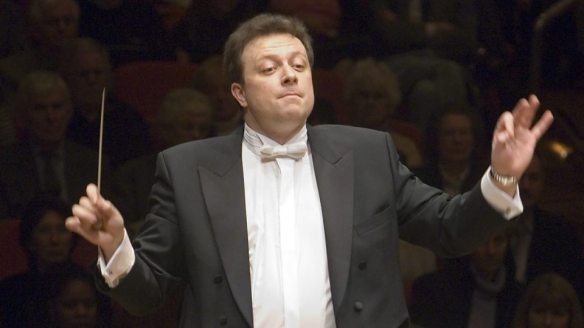
An evergreen such as Tchaikovsky’s Violin Concerto should have presented no surprises, but that was to bargain without Patricia Kopatchinskaja (above) as soloist. Incapable of giving a routine performance, her sometimes reckless while always compulsive account of the first movement left little doubt as to her ringing of the changes – above all, in a spontaneous rendering of the cadenza such as convincingly brought out its improvisatory nature. Not was there any lack of inwardness in the Canzonetta, its chamber-like textures delectably drawn, and though tempi in the finale were almost self-consciously extreme, the frisson as generated by its ever-faster refrain seemed all but tangible. Gražinytė-Tyla drew an alert and attentive response from the CBSO, consistently making the most of Tchaikovsky’s delicate yet also incisive orchestration.

Only Kopatchinskaja could have come up with an encore where she, the conductor, violinist Kate Suthers and cellist Eduardo Vassallo engaged in something between a Ligeti madrigal and a Cathy Berberian improv. Something about the planet being round? It hardly mattered.

Stravinsky’s The Firebird is a piece of which all recent CBSO chief conductors have made a virtue, with Gražinytė-Tyla no exception. Perhaps surprisingly, this was an interpretation that emphasized the score’s formal unity and motivic ingenuity rather than any overly illustrative aspect; not least in the lengthy sequence between the Khorovod and Infernal Dance as can often seem to mark time judged purely as music.

Conversely, there was on occasion a lack of theatrical immediacy or evocative poise needed if the full ballet is to convince away from the stage. Highlights were a Supplication with the Firebird’s entreaties were alternately soulful and alluring, then a Berceuse whose rapt response from muted strings held the periodically restive audience in its thrall prior to an energetic while slightly matter-of-fact Apotheosis.

Any imprecisions will doubtless be ironed-out during the repeat performance on Saturday. A reminder, too, that Gražinytė-Tyla’s memorable reading of Weinberg’s 21st Symphony with the CBSO has just been released as the first fruit of her contract with Deutsche Grammophon.

Further information on this concert can be found at the CBSO website, and on the Weinberg release over at Deutsche Grammophon

Further listening

You can hear a playlist of the pieces heard on Spotify below, including Patricia Kopatchinskaja’s recording of the Tchaikovsky and the CBSO in The Firebird under Sir Simon Rattle:

Live review – CBSO & Ilan Volkov: Mahler Symphony no.9, Krása & Klein

City of Birmingham Symphony Orchestra / Ilan Volkov (above)

Symphony Hall, Birmingham
Thursday 25 April 2019

Krása Overture for small orchestra (1944)
Klein arr. Saudek Partita for strings (1944)
Mahler Symphony no.9 (1909)

Written by Richard Whitehouse

Photo of Ilan Volkov (c) Astrid Ackermann

Pursuing one of the more eventful conducting careers of his generation, Ilan Volkov returned to Birmingham for this pertinent juxtaposition of music by composers who numbered among countless Nazi atrocities next to what is arguably Mahler’s greatest symphonic achievement.

Mahler has long been central Volkov’s programming (performances of the Sixth and Seventh Symphonies when principal conductor of the BBC Scottish Symphony Orchestra resonate in the memory), and this evening’s account of the Symphony no.9 exuded conviction borne of long familiarity.

Even now, it is uncommon to hear a reading of the expansive first movement which unfolded with such unforced inevitability; those extremes of anguish and introspection finding seamless accord within the composer’s most elaborate formal design. Nor was there any lack of contrast with what follows – the ‘fantasia’ on ländler rhythms whose symmetrical elegance is constantly undercut by that glancing irony at its most acute during the final pages, when the texture appears to disintegrate out of weariness then from any more rational intent.

Excellent as was the City of Birmingham Symphony’s playing thus far, it raised its game for the third movement – the Rondo-Burleske whose contrapuntal intricacy can become turgid at too stolid a tempo and lose definition at too rapid a pace. Not that this fazed Volkov, who duly steered a secure course across what is tonally and emotionally Mahler’s most fractious statement – the soulful strains of its trio section allowing for precious little repose before the initial music returns in an explosive denouement. After this, the closing Adagio emerged as long-breathed yet never flaccid as it accumulated gravitas through to a fervent climax, then subsided into a coda shorn of false emoting or affectation – the CBSO strings all the while maintaining focus as Mahler’s silence-riven gestures seemingly attained the desired closure.

The brief though worthwhile first half had featured a brace of works by Czech composer who both flourished in the Nazi transit camp at Terezin before being murdered at Auschwitz. Not that there is any sense of encroaching dread in the Overture by Hans Krása – its purposeful elision of traits drawn from Stravinsky and Hindemith abetted by scoring as economical as it is characterful. Volkov secured an incisive rendering, only easing up for the final bars whose sense of suddenly opening-out onto new and unforeseen vistas was palpably conveyed here.

Even more engaging was the Partita by Gideon Klein. An arrangement – by Vojtěch Saudek (1951-2003) – of the String Trio that proved to be Klein’s last completed work, it features at its centre a sequence of variations on a Moravian folksong in which elements derived from Janáček take on a distinctive and undeniably personal guise at the hands of one who would have surely found a defining role in post-war Czech music. If the vigorous outer movements seem less individual, they are none the less effective within the context of this piece overall.

In both these works, Volkov secured a spirited response from the CBSO strings (perhaps a little too dogged in the Klein). Hopefully he will return to this orchestra during the 2019/20 season, and hopefully include further pieces by the ‘Terezin generation’ in his programmes.

For further information on the City of Birmingham Symphony Orchestra’s 2018-19 season click here

Further listening

This concert will be broadcast as part of ‘Radio 3 in Concert’ on Friday 3rd May. To access that concert click on this link

Ilan Volkov is yet to record a Mahler symphony, but for a leading version of the Symphony no.9 from the Berliner Philharmoniker and Herbert von Karajan you can listen on Spotify below:

Live review – Christopher Maltman & CBSO / Michael Seal perform Mahler, Sibelius & Nielsen

Christopher Maltman (baritone), City of Birmingham Symphony Orchestra / Michael Seal (above)

Symphony Hall, Birmingham
Wednesday 10 April 2019

Sibelius Symphony no.3 in C major Op.52 (1907)
Mahler Songs from Des Knaben Wunderhorn
Nielsen Symphony no.5 FS97 (1922)

Written by Richard Whitehouse

Photo of Christopher Maltman (c) Pia Clodi

Michael Seal’s concerts as Associate Conductor of the City of Birmingham Symphony are seldom without interest and tonight’s programme featured a typically bold juxtaposition of Nordic symphonies from the early twentieth century, alongside orchestral songs by Mahler.

Time was when Sibelius’s Symphony no.3 was overlooked even by his keenest advocates, but it has long since become a regular fixture and this account doubtless benefited from the CBSO’s lengthy association with the piece under Sir Simon Rattle and Sakari Oramo. That said, Seal had ideas of his own to impart – most evident with the gradually intensifying curve of momentum over the first movement’s development into the reprise, then close alignment of tempo between its successor’s diverse episodes and the lilting main theme so it elided deftly between slow movement and intermezzo. The finale was a slight disappointment – lacking that ominous mystery in its initial ‘scherzo’ phase, with the closing pages a little provisional in their affirmation – though there was no mistaking the unanimity of response on the way.

After the interval, Seal set a notably swift tempo for the first phase in the opening movement of Nielsen’s Fifth Symphony, though this was never at the expense of ongoing incident or the music’s questing ambivalence. The ensuing Adagio was eloquently projected, building to an apotheosis more powerful for Adrian Spillett’s bravura rendering of its side-drum cadenza – subsiding into a rapt though never somnolent coda where the receding presence of offstage side-drum was ideally offset by Oliver Janes’s limpid clarinet solo at the rear of the platform.

There was nothing anticlimactic about the second movement, its four-sections-in-one design itself amounting to a cohesive entity such as Seal recognized in his taut yet flexible handling of the initial Allegro – tapering away seamlessly into a Presto whose surging energy poses a challenge to ensemble that was confidently met here. The yearning polyphony of the Adagio was finely sustained by strings and woodwind, and if the notoriously tricky final pages felt a shade reined-in, their clinching of the tonal and emotional argument could hardly be gainsaid.

Between these imposing symphonies, a selection from Mahler’s song-sequence Des Knaben Wunderhorn. Christopher Maltman was the persuasive guide through their evocations of life in all its manifestations – beginning with the guileless exchanges of soldier and lover in Der Schwildwache Nachtlied (1892), before bringing a suave nonchalance to the ruminations of Rheinlegendchen (1893) then an ominous sense of dread from amid the sombre fanfares of Wo die schönen Trompeten bläsen (1898). A brief though pertinent interlude was provided by the droll moralizing of Lob des hohen Verstandes (1896), then the selection was rounded off by the stark processional of Der Tamboursg’sell (1901) with its anticipations of the Fifth Symphony then in progress. Maltman once again proved a sensitive and insightful exponent.

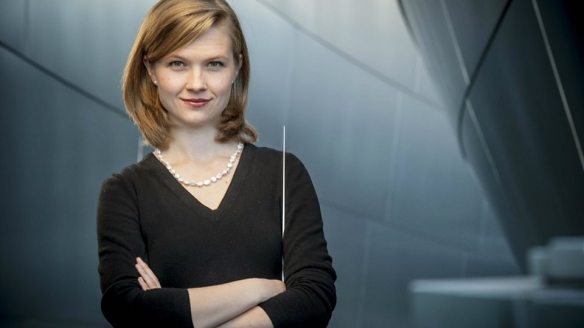
Throughout the selection, Seal drew playing of refinement and finesse from the CBSO which seems never to have given this sequence as an integral whole. The orchestra will, however, be returning to Mahler with Ilan Volkov when they perform the Ninth Symphony on April 23rd.

For further information on the City of Birmingham Symphony Orchestra’s 2018-19 season click here You can read about the forthcoming Mahler Ninth Symphony concert here

Further listening

Unfortunately the concert was not recorded for broadcast, but you can hear a playlist of the pieces heard on Spotify below on leading versions:

Live review – Anna Vinnitskaya & CBSO / Mirga Gražinytė-Tyla perform Shostakovich

Anna Vinnitskaya (piano, above), Jonathan Holland (trumpet), City of Birmingham Symphony Orchestra / Mirga Gražinytė-Tyla (below)

Symphony Hall, Birmingham
Saturday 16 March 2019

Shostakovich
The Limpid Stream: Suite Op.39a (1935)
Piano Concerto no.1 in C minor Op.35 (1933)
Symphony no.5 in D minor Op.47 (1937)

Written by Richard Whitehouse

Photo of Anna Vinnitskaya (c) Gela Megrelidze

With Birmingham Opera Company’s staging of Lady Macbeth of Mtsensk having finished its run, an all-Shostakovich concert by the City of Birmingham Symphony was not just apposite but underlined the rapport between the orchestra and its music director Mirga Gražinytė-Tyla.

The programme centred on Shostakovich’s music before and after an infamous Pravda article irrevocably altered the composer’s evolution. Attacks on The Limpid Stream were admittedly gratuitous; this last of his ballets finds Shostakovich at his most accessible – as witnessed by the suite devised several years later. Starting with a suave Waltz (which found fame as title-music for Stanley Kubrick’s Eyes Wide Shut), this continues with a vigorous Russian Dance then breezy Galop. The highlight is an Adagio whose soulful cello melody was eloquently rendered by Eduardo Vassallo. A deft pizzicato Polka was a rather inconclusive ending: the uproarious final dance (which follows-on almost continuously) would have made for a more decisive conclusion. No matter, this was still an engaging sequence and captivatingly played.

Shostakovich conceived his First Piano Concerto for his own pianism. Influences derive more from stage and screen than any earlier concertos, but its formal ingenuity is undeniable. Anna Vinnitskaya gauged ideally the first movement’s volatile tempo changes, while the Lento had poignancy and no mean vehemence at its climax; the ensuing intermezzo an upbeat to a finale whose high-jinx were teasingly held in check. Jonathan Holland was engaging in the obligato trumpet part, and the CBSO strings retained their articulation even in the hectic closing pages.

Whether or not an explicit response to that condemnatory Pravda article of January 1936, the Fifth Symphony is crucially important for moving the emphasis within Shostakovich’s output away from the theatrical. Nothing reinforces this more than the opening Moderato, with its individual take on sonata design that Gražinytė-Tyla handled with real assurance – keeping the exposition in motion with a fleeter than usual second subject, before eliding seamlessly into a purposeful development then an anguished reprise and desolate coda. The Scherzo had ironic wit without heaviness, whereas the slow movement impressed through its inevitability of progress towards a central episode of rapt inwardness; after which, the searing climax did not pre-empt the coda with its musing interplay of harp and celesta against suspended strings.

The finale offers the greatest challenges but Gražinytė-Tyla had its measure too, her fast yet never inflexible tempo for the surging initial stages segueing into the central episode with its heartfelt recall of earlier ideas then ethereal searching towards a crowning peroration. Neither wantonly triumphal nor turgidly defeatist, this was a thoughtful yet decisive conclusion to the overall emotional trajectory; maybe those searching trumpet dissonances could have sounded even more baleful, though a sense of coming through against the odds was never in doubt.

This was an impressive account of a symphony which has been much harder to interpret once its ultimate ‘message’ became a matter for debate. Gražinytė-Tyla provided no easy answers; instead, her presenting the work as a cohesive and integral whole was its own justification.

For further information on the City of Birmingham Symphony Orchestra’s 2018-19 season click here

Further listening

Unfortunately the concert was not recorded for broadcast, but you can hear a playlist of the pieces heard on Spotify below, including Anna Vinnitskaya‘s recording of the Shostakovich with Kremerata Baltica:

Live review – City of Birmingham Symphony Orchestra / Mirga Gražinytė-Tyla: Grieg Peer Gynt; Sibelius, Rautavaara & Salonen

Klara Ek (soprano), CBSO Youth Chorus, CBSO Chorus, City of Birmingham Symphony Orchestra / Mirga Gražinytė-Tyla

Symphony Hall, Birmingham
Thursday 14 February 2019

Salonen Dona nobis pacem (2010)
Rautavaara Cantus Arcticus (1972)
Sibelius Rakastava Op.14 (1893/8)
Sibelius En Saga Op.9 (1892/1902)
Grieg Peer Gynt – incidental music (selection), Op.23 (1875)

Written by Richard Whitehouse

You can listen to the concert as broadcast on BBC Radio 3 by clicking on this link

It may not have been a typical Valentine’s Day concert, but this evening’s programme from the City of Birmingham Symphony Orchestra certainly had an abundance of rapture and wonder.

Not least in its welcome revival of Cantus Arcticus, the ‘Concerto for Birds and Orchestra’ with which Einojuhani Rautavaara had confirmed a decisive turning away from the twelve-note procedures of the previous decade. Its utilizing his recordings of birdsong from the Finnish marshland may be nearer conceptually to Respighi’s Pini di Roma than Messiaen’s Oiseaux éxotiques, but the interplay with orchestra is deftly and poetically carried through – from the stark backdrop of The Bog, through the searching poise of Melancholy then to the gradual build-up of Swans Migrating, its hymnic apotheosis duly becoming a Rautavaara hallmark.

Mirga Gražinytė-Tyla secured a warm and euphonious response from the CBSO, which was no less attuned to the emergent drama of Sibelius’s En Saga. After an atmospheric opening, the ensuing episodes unfolded a little sectionally for momentum to be gauged consistently, though the magical passage with solo strings before the climactic section was spellbindingly delivered – then, after a suitably fraught culmination, the closing pages affectingly mingled poignancy and resignation; qualities evident not least in the clarinet playing of Oliver Janes.

Prefacing each of these works were short but pertinent a-cappella choral pieces. The upward striving of Esa-Pekka Salonen’s Dona nobis pacem gave the CBSO Youth Chorus its chance to shine, while a rare hearing for Sibelius’s The Lover brought the CBSO Chorus to the fore for a melting account of three settings from the Kanteletar – their tales of yearning, encounter then farewell between lover and beloved eloquently rendered with no trace of false sentiment. Maybe Gražinytė-Tyla will tackle the almost as seldom heard version for strings before long?

After the interval, Grieg’s incidental music for Ibsen’s Peer Gynt. What to include became far less straightforward after publication of the complete score, but tonight’s selection centred on the familiar two suites and three additional items. Gražinytė-Tyla secured a lively response in the Overture, then brought out the pathos of ‘Ingrid’s Lament’ and encroaching menace of In the Hall of the Mountain King. The influence upon Sibelius of The Death of Åse was no less evident than that of Morning on Debussy, while the Arabian Dance had nonchalance to spare and Anitra’s Dance an alluring poise. Peer Gynt’s Homecoming sounded suitably windswept, and inclusion of the soulful Whitsun Hymn gave the CBSO Chorus its moment in the spotlight. Klara Ek was soloist in Solveig’s Song and Solveig’s Cradle Song, both of which she sang simply and affectingly, avoiding the operatic overkill often encountered. A pity the grotesquely comical Dance of the Mountain King’s Daughter was not included, but what remained was a more than plausible overview – skilfully and evocatively rendered.

It more than set the seal on this well planned and rewarding concert, some of whose relative unfamiliarity was outweighed by its undoubted appeal. The Peer Gynt selection can be heard again on Saturday on BBC Radio 3, alongside the UK premiere of tone poem The Sea by Mikalojus Čiurlionis.

Further listening

Here is a Spotify playlist of music from the concert, including the whole incidental music to Peer Gynt (with the exception of the Salonen, which has not yet been recorded):

Further information on this concert can be found here