Small Treasures presents a typically inventive programme compiled by pianist Sarah Beth Briggs. In it she presents works by a trio of inseparable Romantic composers, with late-ish Robert Schumann, lesser-heard Clara Schumann and very late Brahms, his final compositions for solo piano.
Complementing these are thoughts from two members of Les Six, Germaine Tailleferre and Francis Poulenc – with the bonus of a cheeky encore from Mozart.
What’s the music like?
In a word, lovely. Briggs is a strong communicator, and finds the personal heart of Schumann’s Waldszenen – which is actually quite a Christmassy set of pieces. She particularly enjoys the intimacy of character pieces like Einsame Blumen (Lonely Flowers) and the delicate but rather haunting Vogel als Prophet(The Prophet Bird), beautifully played here.
A tender account of Robert’s Arabeske is a welcome bonus, an intimate counterpart to the more extrovert Impromptu of Clara. Written in c1844, the piece floats freely on the air in Briggs’s hands. By contrast the Larghetto, first of the Quatre Pièces Fugitives, inhabits a more confidential world, one furthered by a restless ‘un poco agitato’. The Andante espressivo, easily the most substantial of the four, is more serene, and it is tempting to draw a link between this and the mood of Robert’s Traumerei, from Kinderszenen. The Scherzo with which the quartet finishes is charmingly elusive, with clarity the watchword of this interpretation,
Poulenc’s Trois Novelettes are typically mischievous and elegant by turn, spicy harmonies and bittersweet melodies complementing each other, before Tailleferre’s Sicilienne, a charming triple-time excursion with a bittersweet edge.
The Brahms Op.119 pieces are serious but have plenty of air too, and the final majestic Rhapsody is grand but not over-imposing, Briggs resisting the temptation to go for volume over expression.
Does it all work?
It does – and the album is easy to listen to the whole way through, the lightness of the Mozart Eine Kleine Gigue complementing the Brahms at the end. Some of the classic recordings of the Brahms and Schumann pieces arguably find more angst, but these finely played accounts are a treat, especially in context.
Is it recommended?
It is. Rather than visit a playlist on your go-to streaming service, you can just put this album on to create a very satisfying recital. Small Treasures, indeed – as is Sarah’s dog, who joins her on the album artwork!
Listen / Buy
You can listen to Small Treasures on Tidal here, while you can explore purchase options on the Presto website
Program including songs by Robert and Clara Schumann, Richard Strauss. Full repertoire list at the bottom of this review
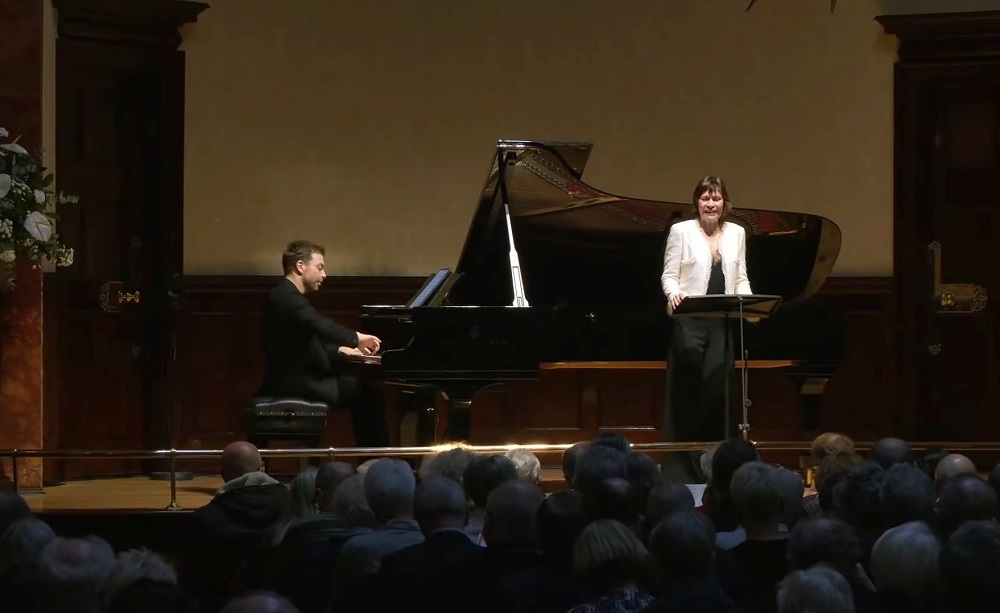
Bechstein Hall, London, 28 March 2025
by John Earls. Photo credit below (c) John Earls
Scottish tenor Matthew McKinney is the winner of the 2024 Kathleen Ferrier Awards and there was quite a sense of anticipation for this recital with pianist Roelof Temmingh at the suitably intimate Bechstein Hall.
Performance is of course the key element in voice and piano recitals such as this. But it is also exciting to be presented with a programme that has clearly been put together with such thought and care. Under the theme of Finding Freedom this programme consisted of two parts. The first was an alternating Clara and Robert Schumann affair, the second a more eclectic but no less engaging mix.
The Schumanns’ set consisted of rotating Clara and Robert Schumann songs neatly threaded together in a lovers’ exchange. It demonstrated not only the consideration and skill of the programming but the quality of Clara’s as well as Robert’s songwriting. McKinney’s singing was beautiful throughout.
The set also included two pieces of recited poetry, Afrikaans poet Breyten Breytenbach’s Red-breasted Dove and Rabindranath Tagore’s Unending Love, both of which deftly complimented the sentiment.
For the first half the audience was requested to save applause until the end of the set, entirely appropriate for the mood and respectfully observed. For the second half however McKinney advised “please do clap any time you want to”. And just as well as this was a much more varied affair including a couple of Robert Schumann solo piano pieces for Temmingh to shine.
Opening with Frank Bridge’s Love Went A-Riding it also included two Benjamin Britten songs, a forceful Batter My Heart (from The Holy Sonnets of John Donne) immediately followed by a tender Sonnetto XXX (from Seven Sonnets of Michelangelo), and a rendition of Tosti’s Marechiare that was full of brio and panache.
There then followed a lovely and affecting sequence. Rebecca Clarke’s I’ll Bid My Heart Be Still (originally composed for viola but ‘reimagined’ here for voice), Robbie Burns’ Ae Fond Kiss (McKinney unaccompanied) and Temmingh’s own Verjaarsdagbrief (Birthday Letter) based on a letter written by his grandfather to his grandmother and sang in Afrikaans by McKinney who then looped back to Ae Fond Kiss. The audience silence afterwards was marked and sincere.
The set concluded with a couple of well delivered Richard Strauss songs which led to the inevitable and deserved calls for an encore which McKinney admitted they didn’t have so we got a repeat of the magnificent Marechiare which was gratefully received.
Matthew McKinney and Roelof Temmingh performed the following repertoire:
Breytenbach Red-breasted dove Clara Schumann and Robert Schumann songs interspersed: Clara Ich stand in dunkeln Träumen Op.13/1, Liebeszauber Op.13/3, Volkslied, Lorelei, Robert Der Nussbaum Op.25/3, Volksliedchen Op.51/2, Zwielicht Op.39/10, Kreisleriana Op.16/8 (solo piano), Mondnacht Op.39/5 Tagore Unending love Clara Der Mond kommt still gegangen Op.13/4, Die stille Lotosblume Op.13/6 Robert Die Lotosblume Op.25/7, Widmung Op.25/1
Bridge Love went a-riding H.114 Weir Sweet Little Red Feet (from The Voice of Desire) Robert Schumann Ritter vom Steckenpferd Op.15/9 Auden What’s in your mind, my dove, my coney? Britten Batter my heart Op.35/2, Sonnetto XXX Op.22/3 Robert Schumann Vogel als Prophet Op.82/7 Tosti Marechiare Clarke I’ll bid my heart be still (reimagined); Trad Scots Ae fond kiss Temmingh Verjaarsdagbrief Richard Strauss Befreit Op.39/4, Zueignung Op.10/1
John Earls is Director of Research at Unite the Union. He posts on Bluesky and tweets / updates his ‘X’ content at @john_earls
Carolyn Sampson (soprano, above), Joseph Middleton (piano, below)
Songs and piano music by Robert and Clara Schumann – full list at bottom of review
Wigmore Hall, London Wednesday 14 February 2024
by Ben Hogwood Photos by Marco Borggreve (Carolyn Sampson) and Sussie Ahlberg (Joseph Middleton)
This was a Valentine’s Day concert with a difference. No orchestra, no Romeo & Juliet – but rather an intimate presentation of a musical marriage, that of composer / pianists Robert and Clara Schumann, whose relationship has been increasingly under the microscope in the past few years.
This is a good thing, for when Robert and Clara married on 12 September 1840 the concept of equality within marriage, let alone classical music, was very different indeed. Robert, in the outpouring of song that he experienced in that year, completed the song cycle Frauenliebe und -leben, to poetry by Adelbert von Chamisso attempting a depiction of marriage from a woman’s perspective. It is certainly not how we recognise the institution of marriage today, which soprano Carolyn Sampson acknowledged in a Guardian article around the release of herAlbum für die Frau, the title of this concert, in 2021. In that article she put forward a strong case for continuing to sing the cycle, identifying with a good deal of the verse and even more of the music – but with her musical partner, pianist Joseph Middleton, she has recast the cycle.
Now the Schumanns’ marriage is given in four parts – love, marriage, parenthood and death – viewed through the prism of Frauenliebe but balanced through songs by Clara and Robert, or one of the latter’s piano pieces. Each song from the cycle had two accomplices, the context achieved through what must have been a painstaking selection process that, in this concert, bore much fruit. The coherent end piece was bisected by well-chosen text from the couple’s diaries and more.
With sadness inevitably looming towards the end it was a difficult structure for the duo to pitch, but they made it work through selections that made emotional sense and which, crucially, were harmonically linked. Sampson’s clarity of line was the clincher, her ability to carry not just a melody but the words with great diction, while the same could be said of Middleton’s phrasing, which as Sampson said in the introduction ‘could express what words cannot’. The postlude from Frauenliebe was the keenest example, exquisitely played.
The song cycle itself contained a great deal of emotion, especially in Du Ring an meinem Finger (You ring on my finger), where Sampson’s powerful crescendo was all-consuming. Clara’s songs proved the ideal complement, a little more Schubertian in style perhaps but harmonically more daring, often ending in suspension.
The first half included five settings of Rückert and felt slightly giddy in the intoxication of falling in love and wedded bliss, almost too good to be true – and so it proved, with the settings of Heinrich Heine bringing with them furrowed brows and family responsibilities, the music increasingly worrisome. Robert and Clara had eight children in all, and this section gave a glimpse of the weight of responsibility that would surely have left.
The masterstroke of this program, however, was not to finish with the end of the song cycle but to offer Robert’s Requiem, from his 6 Gedichte von N Laneu und Requiem Op.90, as a much-needed consolation, then the piano piece Winterzeit I, from the Album für die Jugend. Finally, as an encore, Clara’s Abendstern, a beautiful postscript with her love taken up to the stars, turned our gaze upwards once more.
It capped an unexpectedly moving account of two lives intertwined, offering a timely reminder of Clara’s torment at her husband’s untimely demise. One of the power couples of 19th century music they must have been, but this was a tender account of two lives entwined and enriched by beautiful song.
You can hear Album für die Frau, as released on BIS, below:
Carolyn Sampson and Joseph Middleton performed the following music:
Robert Schumann Langsam und mit Ausdruck zu spielen from Album für die Jugend Op. 68 (piano, 1848) Clara Schumann Liebst du um Schönheit Op. 12 No. 2 (1841) Robert Schumann Seit ich ihn gesehen from Frauenliebe und -leben Op. 42 (1840) Volksliedchen Op. 51 No. 2 (1840) Clara Schumann Liebeszauber Op. 13 No. 3 (1840-3) Robert Schumann Er, der Herrlichste von allen from Frauenliebe und -leben Op. 42 Clara Schumann An einem lichten Morgen from 6 Lieder aus Jucunde Op. 23 (1853) Warum willst du and’re fragen Op. 12 No. 3 (1841) Robert Schumann Ich kann’s nicht fassen, nicht glauben from Frauenliebe und -leben Op. 42 Clara Schumann Die stille Lotosblume Op. 13 No. 6 (1840-3) Robert Schumann Du Ring an meinem Finger from Frauenliebe und -leben Op. 42 From Myrthen Op. 25 (1840): Lied der Braut I • Lied der Braut II Glückes genug from Kinderszenen Op. 15 (piano, 1838) Interval Robert Schumann Helft mir, ihr Schwestern from Frauenliebe und -leben Op. 42 Die Lotosblume from Myrthen Op. 25 Lust der Sturmnacht from Kerner Lieder Op. 35 (1840) Süsser Freund, du blickest from Frauenliebe und -leben Op. 42 Hochländisches Wiegenlied from Myrthen Op. 25 Der Sandmann from Lieder-Album für die Jugend Op. 79 (1849) Kind im Einschlummern from Kinderszenen Op. 15 (piano) An meinem Herzen, an meiner Brust from Frauenliebe und -leben Op. 42 Ritter vom Steckenpferd from Kinderszenen Op. 15 (piano) Dein Angesicht Op. 127 No. 2 (1840) Nun hast du mir den ersten Schmerz getan from Frauenliebe und -leben Op. 42 Requiem from 6 Gedichte von N Lenau und Requiem Op. 90 (1850) Winterzeit I from Album für die Jugend Op. 68 (piano) Clara Schumann Abendstern
Published post no.2,088 – Thursday 15 February 2024
Louise Alder (soprano, above), Joseph Middleton (piano, below)
Beach 3 Browning Songs Op. 44 (1889-1900) Clara Schumann Er ist gekommen Op. 12 No. 1; Warum willst du and’re fragen Op. 12 No. 3; Liebst du um Schönheit Op. 12 No. 2 (1841) Lili Boulanger Clairières dans le ciel (excerpts): Elle était descendue au bas de la prairie; Vous m’avez regardé avec toute votre âme; Au pied de mon lit; Nous nous aimerons; Si tout ceci n’est qu’un pauvre rêve (1913-14) Alma Mahler Laue Sommernacht (1910); Ich wandle unter Blumen (1910); Licht in der Nacht (1915) Libby Larsen Try Me, Good King: Last Words of the Wives of Henry VIII (2000)
Wigmore Hall, London, 21 March 2022
Watch and listen
review of online broadcast by Ben Hogwood Picture of Louise Alder (c) Gerard Collett
Soprano Louise Alder and pianist Joseph Middleton are renowned for consistently original programming, and this recital for a BBC Radio 3 Lunchtime Concert at the Wigmore Hall recital was no exception. Assembling songs by five women composers, they offered a fascinating juxtaposition of style and text setting, offering further proof that the music of Clara Schumann and Alma Mahler need no longer operate in the shadows of their husbands.
Given the freshness of the air in Southern England it was entirely appropriate that the pair should begin with a vibrant song from Amy Beach, The year’s at the spring. The first in a trio of Robert Browning settings, it had a sprightly tread, in contrast to the Ah, Love, but a day! of Beach’s short cycle, where ‘summer has stopped’, which found the singer in a worrisome state but easily negotiating her higher range. The third song, I send my heart up to thee, was subtly prompted by Middleton’s arpeggiated piano
The Schumanns’ year of song was not just exclusive to Robert, with Clara publishing three settings of Friedrich Rückert that year. They made a powerful impact in this concert, with a tempestuous account of Er ist gekommen (He came in storm and rain). There was an intimate air to Warum willst du and’re fragen (Why enquire of others), tinged with longing and sung by Alder with a beautiful, natural tone. Liebst du um Schönheit (If you love for beauty) was lost in love, prompted by Middleton’s easily flowing piano.
In her all too brief life, Lili Boulanger gained for herself a reputation as a vocal composer of impressive standing, a view boosted by this quintet taken from Clairières dans le ciel, settings of 13 poems by Francis Jammes. When singing of the ‘girls who are too tall’ in Elle était descendue au bas de la prairie (She had reached the low-lying meadow), Alder soared to the heights, while the pair enjoyed Boulanger’s harmonically elusive writing, Middleton upholding the tension beautifully in Vous m’avez regardé avec toute votre âme (You gazed at me with all your soul).
Au pied de mon lit (At the foot of my bed) stood out as one of the most memorable songs of the recital. A character picture, it was vividly painted by the pair before a turbulent and passionate episode, notable for Alder’s sublime vibrato control at the end. The anticipation of Nous nous aimerons (We shall love each other) hung heavy on the air, with appropriately rich harmonies, before the singer’s lower range brought rich colour and notable control to the slow Si tout ceci n’est qu’un pauvre rêve (If all this is but a poor dream).
We then heard a trio of Alma Mahler settings, strongly chromatic and – in the case of Laue sommernacht (Mild summer night) – particularly sultry. The Heine setting Ich wandle unter Blumen ( I wander among flowers) was short but urgent, before a second setting of Bierbaum, Licht in der Nacht (A nocturnal light) brought us back to earth for deep contemplation. The song rose briefly to acknowledge the rapturous brightness of the star ‘above the house of our Lord Jesus Christ’ before sinking into the dark lower end of the piano once again.
Libby Larsen’s song cycle Try Me, Good King took as its inspiration the last words of the five executed wives of Henry VIII, giving Alder the opportunity to characterise each of the fated women. She did so with impressive power and guile, Katherine of Aragon hanging on high above a worrisome chord, with Anne Boleyn then fraught with trouble. As with the earlier songs Alder’s body language was a powerful visual aid, taking Boleyn’s words ‘Try me’ up to the very skies above. Larsen’s setting for Jane Seymour exhibited a special radiance, while Anne of Cleves was given a resolute if ultimately skewed march. The final Katherine Howard proclaiming her innocence to ultimately deaf ears, insisting her innocence before really scaling the heights of anguish.
As an encore, Alder and Middleton gave us Florence Price’s Night, a chance for the soprano to spread her wings with longer phrases. Perhaps surprisingly there was a hint of Richard Strauss here, enjoyed in the piano part by Middleton – the song capping an hour of discovery and vivid storytelling.
For information on Louise and Joseph’s album of French song on Chandos Records, Chère Nuit, click here
Schubert Mignon (Kennst du das Land) D321 (1815), Gesänge aus Wilhelm Meister D877: Heiss mich nicht reden; Nur wer die Sehnsucht kennt (1826) Clara Schumann Er ist gekommen Op. 12 No. 1 (1841); Sie liebten sich beide Op. 13 No. 2 (1842); Lorelei (1843) Robert Schumann Lieder und Gesänge aus Wilhelm Meister Op. 98a: Kennst du das Land (1849) Duparc La vie antérieure (1884); L’invitation au voyage (1870) Lili Boulanger Clairières dans le ciel (1913-14): Si tout ceci n’est qu’un pauvre rêve; Je garde une médaille d’elle; Vous m’avez regardé avec toute votre âme Debussy Les soirs illuminés par l’ardeur du charbon (1917); 5 poèmes de Baudelaire (1890): Le jet d’eau; Recueillement; La mort des amants
Wigmore Hall, London, 17 January 2022
reviewed by Ben Hogwood from the online broadcast
It was heartening indeed to see the Wigmore Hall at capacity for the visit of soprano Sandrine Piau and pianist David Kadouch, bringing with them a new program with the theme of Journeys: Longing and Leaving.
They delivered the songs in two ‘halves’, one of German Lieder drawn from the first half of the 19th century, the other of French song from the late 19th and early 20th centuries, giving us a smooth trajectory from Schubert to Debussy.
Refreshingly the journey took in substantial contributions from Clara Schumann and Lili Boulanger, three songs from each – as well as showing the increasing influence of Wagner on even the smallest forms of vocal music as the century turned.
Singing from a tablet, Sandrine Piau gave heartfelt performances and had the ideal foil in David Kadouch, whose brushstrokes on the piano were immediately telling. His chilly introduction to the third song in the Schubert group, Nur wer die Sehnsucht kennt, set the tone after a characterful first song and a sorrowful second, with a soaring vocal line from the soprano. Piau sang with arms outstretched, expressively capturing all the ornamentation and hitting the depths of the song’s turbulent middle section.
The Clara Schumann selection was fascinating, especially given the context of husband Robert’s well-known productivity in the years 1841-1843. The urgent Er ist gekommen was first, a heady song sitting high in the range, before a setting of Heine from just after Schumann’s celebrated year of song, a yearning and ultimately tragic number with a limpid commentary from the piano. The Loreley started in the same key, pushing restlessly forward. The only Schumann song in the program retained its intensity despite a noisy mobile phone introduction, a very different setting to the same text as tackled by Schubert at the start.
Turning to France, we heard two from the small output of Henri Duparc, whose entire output barely covers the length of a single concert. There is quality rather than quantity, however, and we heard the celebrated L’invitation au voyage, sumptuously performed with great poise. The two found the ideal pacing for La vie antérieure before it, solemn but quite open, and building to a powerful declamation.
Lili Boulanger wrote powerfully original music before her tragic death at the age of 24. Her orchestral tone poems have received greater exposure of late but the songs have remained relatively hidden. Piau and Kadouch put that to rights with three songs drawn from the wartime collection Clairières dans le ciel. They found an ominous tone in the lower vocal register from Piau, all the more so given the retrospective knowledge that Boulanger would only live for another three years from when the songs were written. The pained complexion at the end of Si tout ceci n’est qu’un pauvre rêve from Piau was profoundly affecting, then a slightly more optimistic Je garde une médaille d’elle led to the purity of Vous m’avez regardé avec toute votre âme.
Finally a selection from Debussy, prefaced by his final published piano piece Les soirs illumines par l’ardeur du charbon. This was a nice touch as an interlude, and was beautifully played. by Kadouch, We then heard three of the five Baudelaire poèmes, beginning with a babbling fountain shaded by Kadouch as Piau’s voice floated easily above. Recueillement (Meditation) found stillness initially but with the poet, distracted by darker thoughts, was mirrored by the music breaking from its reverie. Piau judged the awkward intervals perfectly, especially the final words with their harmonic transformation. The ultimate farewell was saved for last, La mort des amants quite a complex song. As with much early Debussy the harmonies travelled far but arrived at a strangely logical end point, both performers exhibiting exceptional control at journey’s end.
Piau spoke of the program giving ‘therapy after these two long years’, after which Beau Soir – one of Debussy’s celebrated songs – proved the ideal encore, though as the soprano warned, it was essentially saying, “Look at these beautiful things, because everybody goes in the same direction – death!”




 Arcana.fm