City of Birmingham Symphony Orchestra – Debussy Festival: Second Weekend

Symphony Hall, Birmingham; Saturday 24 & Sunday 25 March 2018

Written by Richard Whitehouse

This second weekend of the Debussy Festival featured a similar mix of orchestral, song and instrumental events, held at various venues in Birmingham in addition to Symphony Hall and extending over the broad spectrum of Debussy’s music to include several less familiar items.

Saturday evening focussed on ‘Sacred Debussy’, and opened with his prelude La Cathédrale engloutie (1910) in an orchestration by Colin Matthews faithful to its spirit. The CBSO then vacated the platform for Messiaen’s motet O sacrum convivium (1937), fervently sung by the CBSO Chorus under Simon Halsey and preceded by Bach’s Dorian Toccata and Fugue. Its methodical progress was ideally complemented by Dieu parmi nous, concluding Messiaen’s large-scale cycle La Nativité du Seigneur (1935) with a panache to which Thomas Trotter was no less responsive. Debussy’s Danse sacrée et danse profane (1904) ended the first half with an allure and poise that Suzy Wilkinson-Kawalec conveyed in full measure; CBSO assistant conductor Jonathan Bloxham securing an elegant and fastidious response from the strings.

After the interval, a rare chance to hear virtually the whole of Debussy’s incidental music for Gabriele D’Annunzio’s play La Martyre de Saint Sébastien (1911). Not, then, the 20-minute ‘symphonic fragments’ arranged by André Caplet (who also undertook much of the original orchestration) or the hour-long complete score with narration, but a 35-minute hybrid where the music for the five acts was amalgamated into a four-movement ‘choral symphony’. With its hieratic modality and austere if never merely archaic polyphony, this is arguably the most emotionally affecting of Debussy’s later works and was superbly sung by the CBSO Chorus. Sopranos Ilse Eerens and Katja Stuber were effortless in their solo parts and Mirga Graźinytė-Tyla (below) drawing an eloquent response from the CBSO. Undoubtedly a highlight of this festival.

On to Sunday and an early afternoon concert of ‘Exotic Debussy’, opening with another three Preludes (1913) – the ironic wit of Minstrels, Mussorgskian heft of La puerta del vino and the bracing humour of General Lavine – Eccentric – once again heard in orchestrations by Colin Matthews responsive more to the images being evoked than the music as conceived for piano. Bloxham led the CBSO in a spirited account of the ‘Pas de six’ from Britten’s The Prince of the Pagodas (1956), then Graźinytė-Tyla presided over two sections from Ravel’s Ma Mère l’Oye (1910) – the piquant Orientalism of Laideronette and the encroaching rapture of Le jardin féerique, both enticingly rendered yet an unsatisfying close to a rather piecemeal first half. A shame the Ravel ballet was not heard in full, as this has long been a CBSO speciality.

There was nothing piecemeal about the second half, with Graźinytė-Tyla taking charge of the CBSO Youth Orchestra for a complete rendering of Debussy’s Images. His largest orchestral work when heard complete, this is difficult to bring off as a totality though this account came close. The ominous understatement of Gigues was well conveyed despite an occasional lack of subtlety, then the central triptych that is Ibéria gave this capable and enthusiastic outfit its head in the traversal from sultry street-life, through nocturnal rumination, to festal celebration – the overall sequence being projected with verve and immediacy. Yet the closing Rondes de printemps was even more successful, its oblique evocation of rural revelry given cumulative impetus such as made for a more than usually conclusive end to this wide-ranging sequence.
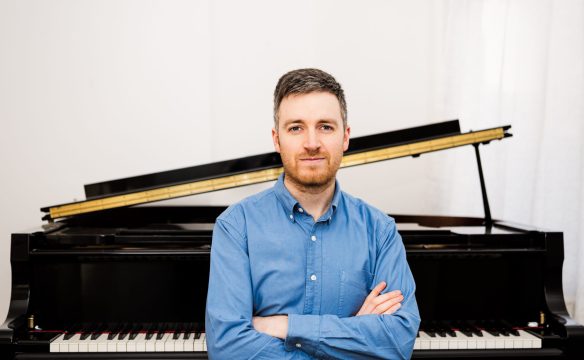
The mid-afternoon ‘Tombeau de Debussy’ juxtaposed pieces from the supplement published by La Revue musicale in 1920 with commissions under BCMG’s Sound Investment Scheme. Jungeun Park’s Tombeau de Claude Debussy found violinist Alexandra Wood, cellist Ulrich Heinen and pianist Richard Uttley (above) evoking the composer’s death in darkly ironic terms, then the oblique tonality of Dukas’s La plainte, au loin, du faune … seemed as much a memorial to the creative impasse as to its passing. Highly sensitive here, Uttley was no less probing in the moody ‘Sostenuto rubato’ that Bartók incorporated into his Eight Improvisations; soprano Ruby Hughes joining him for the whimsical profundity of Satie’s setting of Lamartine in En souvenir. Sinta Wallur’s Tagore Fireflies sets three brief verses by the Indian poet in music whose ornamented vocal was complemented by the piano’s gamelan-like patterning. Wood and Heinen found requisite plangency in the first movement of Ravel’s Duo; then cellist and soprano took on engaging theatricality for Frédéric Pattar’s setting of Maeterlinck in (… de qui parlez-vous?). Uttley captured the bluesy elegance of Goossens’s Pièce, before Julian Anderson’s Tombeau united the musicians in a setting of Mallarmé’s tribute to Edgar Allen Poe whose chiselled vocal writing and guitar-like sonorities made for a provocative ending.

The early-evening programme of ‘Natural Debussy’ commenced with the arresting cameo of flautist Marie-Christine Zupancic playing Debussy’s plaintive Syrinx (1913) at the rear of the auditorium; overhead lights gradually raised on the platform from where Bloxham directed the CBSO in an engaging account of Printemps (1887). Whatever its formal inelegance and stylistic derivativeness, this two-movement piece has an insouciance and extroversion which Debussy only occasionally re-captured – enhanced by the knowing sophistication of Caplet’s orchestration a quarter-century later. Graźinytė-Tyla returned for George Benjamin’s Ringed by the Flat Horizon (1980), its evocation of desert storms rendered with a graphic immediacy and sure sense of purpose to make one regret that an unfortunate accident onstage meant the performance had to be curtailed before the close. The orchestra reassembled after a break for La Mer (1905) – emotional contrasts stressed a little too readily in ‘Jeux de vagues’, but with the outer movements bracingly projected to round off this final concert in impressive fashion.

Even on the basis of these Symphony Hall concerts, this Debussy Festival did its composer proud by conveying the sheer variety of his output and also its relevance to Western music during the century since his death. Omissions were few – of which the most significant, his full-length opera Pelléas et Mélisande, will be redressed with a concert performance on the 23rd June. For now, Graźinytė-Tyla deserves full credit for having initiated this ambitious festival: its orchestral events leaving no doubt as to the rapport between her and the CBSO.

For more information on the CBSO Debussy Festival, you can visit the event’s website

City of Birmingham Symphony Orchestra – Debussy Festival: First Weekend

Symphony Hall, Birmingham; Saturday 17 & Sunday 18 March 2018

Written by Richard Whitehouse

There are numerous commemorations this month of the centenary of Debussy’s death, but the Debussy Festival taking place in Birmingham over the weekends of 17/18 and 24/25 March is likely the most extensive mounted in the UK.

Together with chamber and song recitals, films and talks, there is a series of concerts by the City of Birmingham Symphony Orchestra, as well as its related orchestras and ensembles, which between them offer an overview not only of Debussy’s major works but also those who influenced him and those who have been influenced by him in their turn.

Saturday evening focussed on Sensual Debussy, opening with the piece in which the composer effectively became himself. Prélude à L’après-midi d’un faune (1894) began proceedings, its pervasive sensation of lazy eroticism palpably conveyed. This segued into Trois Chansons de Charles d’Orléans (1898/1908) – a rare instance of Debussy’s acappella writing, its lithe alternation of solo and ensemble voices enticingly conveyed by the Birmingham University Singers. Mirga Graźinytė-Tyla (above) then directed a perceptive account of La Damoiselle élue (1888), its Rossetti text inspiring a cantata whose luminous modality and ecstatic lyricism fairly define musical pre-Raphaelitism. Soprano Ilse Eerens was eloquent in the ‘title-role’ and mezzo Aga Mikolaj (below) searching in her narrative, with the CBSO Youth Chorus’s singing ethereal but never cloying.

Mikolaj returned for three of Szymanowski’s Love Songs of Hafiz (1914) and captured their capricious flights of fancy as made one wish the whole cycle of eight could have been given. This might have been preferable to the Prelude and Liebestod from Wagner’s Tristan und Isolde (1859) that rounded-off the concert – finely played and convincingly directed, save for a rather jarring accelerando toward the climax of the Prelude, but whose emotional intensity was rationalized by Debussy into something more oblique and understated. As had just been heard in the latter’s Nocturnes (1899), first of his orchestral triptychs and a marvel of shifting textures in Nuages, then ominous evocation in Fêtes. The diaphanous yearning of Sirènes was hardly less evident; less than perfect integration with its female voices the only real flaw.

Sunday afternoon brought Birmingham Contemporary Music Group in a programme devoted to Debussy’s Legacy. Boulez’s Dérive 1 (1984) set the scene with its wave-like eddying of pithy motifs, then the music of Tristan Murail (above) took centre-stage with pieces from across three decades of his career. Treize Couleurs du soleil couchant (1978) is a reminder of how radical yet understated (à la Debussy) his music must have sounded in a French scene dominated by Boulezian serialism, harmonic overtones a constant around which the ensemble inhales then exhales its glistening timbres. How Murail got there was duly underlined by Couleur de mer (1969): almost his first acknowledged work, its five sections pit serial constructions against a more intuitive take on harmony and texture in music whose eruptive central span is almost as startling as its cadential sense of closure. Between these, Feuilles à travers les cloches (1998) is an evocative and eventful miniature anticipating the stark post-impressionism of Murail’s more recent music. Fastidious playing from BCMG, and perceptive direction by Julien Leroy.

The CBSO returned that Sunday evening for Modern Debussy, another hour-long sequence opening with a further account of Prélude à L’après-midi d’un faune in the arrangement that Schoenberg’s pupil Benno Sachs made in 1921. With flute, oboe and antique cymbals left in place, and harmonium ingeniously filling-out the ensemble, this proved an appealing novelty and ideal complement to the Première Rapsodie (1910) in which Debussy transformed a test-piece into a minor masterpiece – CBSO principal clarinettist Oliver Janes as responsive to its melodic elegance as to its deft virtuosity.

Responsive in support, Graźinytė-Tyla then directed a bracing account of Stravinsky’s Symphonies of Wind Instruments (1921) where some refined playing toned down the 1947 revision’s asperities. A pity Takemitsu’s exquisite Green had to be dropped (were the parts not received in time?), but Michael Seal presently took charge for a characterful reading of Jeux (1913) – confirming Debussy’s developing variation as no less crucial than Stravinsky’s mosaic-like construction to the evolution of music this past century.

Food for thought, indeed, over the course of this first weekend – not least for reminding one of just how central to modern Western music Debussy’s presence has been. Hopefully, too, the overall quality of interpretation will be maintained throughout next weekend’s concerts.

For more information on the CBSO Debussy Festival, you can visit the event’s website
 

On record: Stephen Hough – Debussy: Piano Music (Hyperion)

Debussy Piano Music Stephen Hough (piano)

Debussy
Estampes (1903)
Images Set I (1905)
Images Set II (1907)
Children’s Corner (1906/8)
La plus que lente (1910)
L’isle joyeuse (1903/4)

Reviewed by Ben Hogwood

What’s the story?

This centenary-year collection from Stephen Hough takes in Debussy’s best-known suites for piano, simultaneously offering an ideal introduction to the composer’s music.

What’s the music like?

This disc is a great illustration of the strides Debussy made in piano music in the first decade of the 20th century. Starting with Estampes, Stephen Hough immediately shows the listener how the added note chords, elusive melodic figures and watery textures still create pictures of deep emotional substance. Every note counts with Debussy, and his music uses some particularly alluring chord progressions, creating pictures and moods unlike any composer of the day.

So too with both books of Images, the style further developed, while making more obvious references to the composers influential in Debussy’s development (the Hommage a Rameau for instance). The mood becomes more playful with Children’s Corner, much loved for its characterisations of infant toys. The Golliwogg’s Cake Walk is a big part of this, its winsome syncopations and catchy tune both reasons for its place as one of the composer’s best-loved pieces. It is a great example of a tricky piece made to sound simple.

Does it all work?

Very much so. Stephen Hough clearly loves these pieces; he knows just how he wants them to go, and in Children’s Corner he is not afraid to bring out the inner infant. Estampes and Images are richly coloured and commandingly played, the piano sound offering clean and precisely shaded pictures. Hough’s masterly command of the phrasing in La soirée dans Grenade is especially impressive, while Jardins sons la pluie is also brilliantly played.

The Images are lovely. Reflets d’ans l’eau melts under Hough’s soft touch, while Mouvements shows off the technical ability he has in spades, with flawless octave playing giving clarity above the whirl of notes beneath. By contrast Et la lune descend sur le temple qui fut is exquisitely restrained, Hough paying particular attention to the colour realised in his slow picture painting.

The addition of short pieces La plus que lente and L’isle joyeuse offer great space and colour, the icing on the cake of this recital.

Is it recommended?

Yes. If Debussy’s piano music is new to you, let this be the way in. If it is already familiar then these interpretations will bring it to life once more, exploring the composer’s love of the dance and also his ability to create sounds and textures placing the piano in a whole new context. Buy it and be transported away.

Wigmore Mondays: Apollon Musagète Quartet play Grieg, Puccini & Sibelius

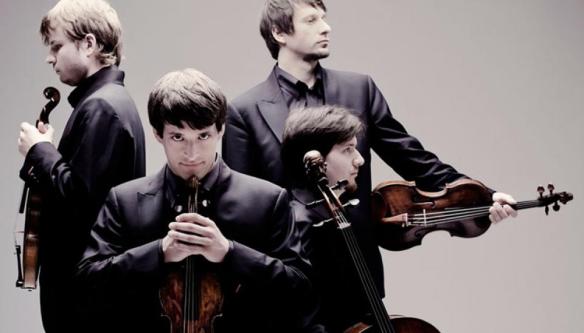
Apollon Musagète Quartet [Paweł Zalejski, Bartosz Zachłod (violins), Piotr Szumieł (viola), Piotr Skweres (cello)]

Sibelius Andante Festivo (1922) (1:55 – 6:00 on the broadcast link below)
Puccini I Crisantemi (1890) (6:25 – 13:45)
Grieg String Quartet in G minor Op.27 (1877) (16:00 – 52:46)

Wigmore Hall, London; Monday 29 January 2018

You can listen to the BBC Radio 3 broadcast by clicking here

Written by Ben Hogwood

This was a well thought out and brilliantly played concert from the Apollon Musagète Quartet, bringing together three composers not normally associated with the idiom of the string quartet, and making a very strong case for their efforts.

The Andante Festivo dates from a period when Sibelius was struggling, inspiration arriving at the Finnish composer’s house only fitfully. This piece was written on one such day, with the same luminous scoring that would characterise the Sixth Symphony. Here it was given an appropriate, ceremonial air – apt given that it was written for the 25th anniversary of the Säynätsalo sawmills. The full chords were deeply resonant here, hinting at a suitability realised by the composer’s later arrangement for string orchestra.

Puccini‘s I crisantemi is if anything more familiar in the composer’s arrangement for larger forces, but it was also very affecting here. The recurring harmonies have a strong, nostalgic tug at the heart strings, and again the Apollon Musagète were as one, skilfully putting deep feeling over sentimentality.

Grieg’s String Quartet in G minor is, in my opinion, a neglected masterpiece. That is a phrase you will of course read all too often in reviews, but in my defence I have no less a figure than the composer Franz Liszt to back me up!

“It is a long time since I have encountered a new composition, especially a string quartet, which has intrigued me as greatly as this distinctive and admirable work by Grieg.”

In this performance (from 16:00) on the broadcast link) the bold, solemn introduction quickly yielded to a fast movement that meant business and was already digging deep. Frequently the string writing is beefed up, and the impressive volume of this performance was balanced by a cleanliness of ensemble and attack. At 23:44, a brief pause between a big, sweeping statement and a very small response felt like the start of a new movement, so pronounced were the four players in their response.

From 28:56 the charming second movement Romanze made great appeal, with a lovely warm solo from cellist Piotr Skweres. The third movement Intermezzo (36:45) returned to the bold, assertive outlines of the first movement, resolutely sticking to a minor key – until, that is, its rustic second theme gave a jaunty alternative. This introduced a tension to the performance, as though Grieg himself was flitting between the two moods and unable to settle.

This battle of wills continued into the finale (from 43:59), the twisting lines of its brief introduction led by first violinist Paweł Zalejski until a nervy fast theme took hold. The quartet made much of Grieg’s daring harmonies, with some surprisingly bold dissonances, until finally the refuge of a major key was reached (from 51:46) Now the struggle – for performers as well as composer! – was more emphatically won, putting the seal on a really fine account of a piece that should be heard far more often.

As an encore the Apollon Musagète gave us a string quartet arrangement of Osvaldo Fresedo’s Vida mía (from 54:39), one of the Argentinian composer’s best-loved tangos.

Further listening

You can listen to recordings of the music from this concert on the Spotify playlist below:

Grieg’s String Quartet had a profound influence on Debussy, when he came to write his only work in the form sixteen years later. It is paired in a playlist here with Sibelius’ best known work in the form, his quartet known as Voces intimae:

Interview: James Heather

Stories From Far Away is James Heather’s debut album, a set of piano pieces documenting his emotional and musical response to contemporary news stories. It brings out the pianist’s more ‘classical’ side, a complement to the work he does heading up the communications team at Ninja Tune, where for the last 15 years he has supported the label’s output of pioneering electronic and experimental music. In this chat with Arcana he talks about how the two strands unite for powerful musical impact, and his hopes for the future as a performer. But first…

Can you remember your first encounter with classical music?

The most powerful memory is of a subscription we had to a magazine called The Great Composers Of Our Lives. It was a monthly, with 40 or 50 issues in a binder, and they were different colours for different composers. It started off with the big hitters, like Beethoven, Mozart and Schubert, but it was aimed at kids really. It was quite thin and picture-heavy, but it had as much about the academic aspects of the music as it had about their life story. It added a more emotional side, and that seeped in at an early age. It showed me that behind these complicated pieces of work there is a human story. I collected each one in a binder and became obsessed with it!

On top of that my grandparents were very in to classical music. When they came round my dad would like to choose a piece and put it on at just the right level, and sometimes my role was to get the ambience just right with the classical music in the background. My granddad was into classical – personally I am more into the romantic era. My granny was also into Schubert and Schumann, and both of them used to come round and jump on the piano in our house. My granddad was good; he played in the Second World War when he and his colleagues had an off moment – playing in a hotel in Italy. That’s where he met my granny, who I think was a nurse out there. He was playing the piano and she fell in love with him!

My other granny played piano and had a tendency to go off on a mad one, which sounded like Debussy on drugs – quite wayward but had a very distinctive style, quite madcap. I think you can hear that somewhere in my style of piano playing. I used to love listening to them play, and my dad also sent me to blues piano lessons. We had a honky-tonk piano initially, and I learnt the boogie-woogie scales. I can still play them, though they are not what I’ve chosen to put on record so far!

A year or two later I did the classical grades, and got to about Grade Six before going on my own path. That was really good because I learnt some key skills, the scales and theory around it all. What I was most passionate about from 11 or 12 was playing my latest compositions. My teacher was patient with me, and I used to play my new songs for five or ten minutes before the standard lesson.

Even at that age I was composing. I learned to play Beethoven’s Für elise, the Moonlight Sonata, the more simple Rachmaninov stuff, but I wanted to do my own thing. Once a week I would go to my granddad’s house, and he taught me the simple rules of composition – how to change key into another key, the chord sequences – and I was faithful to the rules he taught me but then later on in life I bent them a bit. I always thought he was a stickler for some composition rules. He used to detune his piano so that it was equal temperament; we used to spend hours doing that, and it was really interesting.

How has your style evolved in that time?

Initially I was just improvising, so I would sit down and play for two or three hours, just going off on one, and just play. I loved getting totally immersed, and subconsciously I was training, going off on different tangents of scales and learning what was working. I think I have become more refined, as before I hadn’t worked out introductions and endings. This came later when I started to listen to popular music, and learnt tricks about recurring motifs / hooks, and having a proper end! My early stuff as a young teenager was too repetitive and loop-heavy. The loud bits got loud without a progression to the loud, it wasn’t subtle enough. Now I think I’ve found my style and a way to deliver it in a way that people might appreciate more. I think when playing live it’s good to have a good moment where you improvise, and show that side of you. As you mature as a person your sound evolves of course.

Do you find playing the piano cathartic?

In the early times it was primal; I would just get up and do it. Some people use yoga and meditation but for me if I’m going home and I know I’ve got time to step on to the keyboard I’m excited, because I know I’m going to be relaxed. It calms my centre, and for me that’s what it’s all about. It’s nice to share, and I never assumed that anybody would like it. That’s great, but I’m also sensitive that you should remember the struggle, that for many years nobody seemed to care. Just because people care now, you’ve got to keep it on a level plain.

Given your family history, that must bring an extra personal edge to what you do?

Yes. I do think of my family, and certain chord sequences my grandparents played that seeped into me, and my late Dad’s unparalleled enthusiasm for music. It’s a shame they never saw me have any sort of proper success, but I wanted to protect myself in my teenage years. Everyone heard me play at family gatherings, but I never opened myself up to a wider audience. I didn’t want to be criticised, but you get over that!

Was that partly because your work at Ninja Tune deals with the reception of records and music?

I did become acutely aware of that one, and maybe I was overanalysing what people might think of my stuff – but also I don’t think it was quite ready. I was so busy doing my job that I knew I would get round to it. Who knows why we do things in certain orders?! In the ‘electronic’ and ‘hip hop’ networks I was in a 23-year old classical pianist was slightly odd, but as you get older you find people becoming more responsive to it. I love a rave as much as the next person, but I also have this other side. People knew about it but I do believe in organic stuff, and don’t want to push things down people’s throats. If they want to hear it, then great!

I think it’s good I’ve left it late to let myself ‘out’, because there are intricacies in all composition, and I hope that mine sounds like ‘me’ now. I would hate to just be adding to things. As a solo instrumentalist it’s harder, because if you’re a producer you’re working with hundreds of different sounds. I think I had to find my ‘person’, what made me ‘me’, and sometimes you don’t know that until you’re older.

One angle I would like to potentially go down eventually is that I’d like to do a piano album with a grime MC. I listen to classical music, new classical musicians – maybe 10% – but I listen to all of Wiley and Skepta’s catalogue. Stormzy at Glastonbury was amazing! I don’t just want to put on a bow tie and play a classical gig. I would like to do that as well but it’s all about the flexibility.

There is a certain element of classical music that is very upper class and perhaps more elitist, but then you’ve got all the new people coming through like Nils Frahm, and earlier on artists like Amon Tobin and Cinematic Orchestra opening things up more from the indie world. Now you look at 6Music with the Proms, and people like A Winged Victory for The Sullen, it’s inspiring. There’s not really an obvious place for my current sound as a solo pianist whose brain is more in the electronic world, so I’m going to try and find that. Where I have to add other instruments, why not do more young facing, risky things? I don’t want it to be seen as elevator music!
.

Have the artists you work with at Ninja influence you musically at all?

Before I was at Ninja I had a keyboard in my room at university I was very passionate about what I did, but I had no idea how I could make it successful – a few friends liked some songs. Before that I tried to be in a band,  and also make electronic music with friends, but it was hard to get off the ground for various reasons. Then at Ninja I started to get a feel for how the industry worked. I think I’m a very loyal and hard working person, and I was surprised to get the job with no experience – but was in the right place at the right time. For many years I was very focused on not fucking it up, doing well in my position, and became very passionate about promoting the artists and was blown away by their music. Piano remained a hobby, and in London I was in small flats so had a keyboard, which wasn’t the real deal. I kept it going, and what it did for me was realising I had to up my game. Hearing Bonobo and Cinematic Orchestra, and then hearing one of my piano tracks, I was thinking that I need to up it somehow.

That’s how it influenced me, and I guess Ninja has given me a knowledge of how the industry works. I got signed kind of by accident, but had this network of people and could lean on a few for help. I never particularly sent it to the artists, I didn’t want to be the person who had a self-agenda. It made me more ambitious, because I see the ambition in our office. For the foreseeable I think I can put both hats on. Solo piano music is pretty different to what I’m doing at Ninja Tune. I’m going with the flow really, and I don’t pr myself, i got the great Duncan Clark @ 9PR for that – that would be slightly strange and not particularly healthy for me to promote me!

You played at Glastonbury this year – how was that?

It was a random one, because it was a connection through Greenpeace. I know the booker there, and he asked me to play – but there was no piano there, so I had to take my USB keyboard. It’s not my perfect performing situation, but I’m a believer in Greenpeace, so I wanted to help them. It’s also pretty cool to have said that’s my first ever gig! I’ve done Sofar Sounds and random singer-songwriter nights on the piano as a teenager, but it was my first real gig. The scheduling wasn’t perfect for my music, because the act before was a vocal-techno set, and before that there was a very upbeat brass band! Then I was playing my style of piano music, which is on one level very chilled but there are things going on in it. It was a small stage with 30-40 people but then lots on the perimeter. It was Sunday, around 5pm, the sun had just come out – and Shaggy was on the other stage, there was a skateboarding competition – lots of distractions. I had to keep going, and couldn’t hear myself properly, but did a 45-minute set and didn’t bugger it up. Some people zoned into it and contacted me afterwards. It’s not something I would rush into again but it’s an early sign of me not doing what’s expected.

I have a Solidarity of Arts Festival gig coming up in Gdansk, with Johann Johannsson, Kaitlyn Aurelia Smith and Penguin Café. It’s like a Barbican vibe, I’m playing a 400 capacity room on a grand piano. I’m also playing at the National Concert Hall in Dublin, not in the main room but the equivalent of the Elgar Room at the Royal Albert Hall. I’m going to be the first gig in that room, and I’m really looking forward to it. Hopefully that will open up a new world. After 25 years of composing I’ll believe it when I see it, but hopefully those gigs will be the true James Heather experience!

Does the classical music you listened to growing up still resonate now?

Of course, yes. I grew up with Beethoven’s Pathétique Piano Sonata, and the whole grandiosity of it – but then it gets so quiet. Debussy, I have his ‘best of’ – and I just love it. The other day I was listening to the John Cage piece Landscapes, one of the first example of classical music and turntables, and loops. Then I put on a Gangstarr record – which shows how anything goes!

Finally, what does classical music mean to you?

It’s very hard to articulate in words. When classical music hits me in the right way it’s very profound, a transcendent experience. I think it means independence. In indie music you have bands, and in electronic music you often have duos, if you have an orchestra a lot of the time it’s coming from one composer, and it feels like a staunchly independent thing. This is the vision of one composer, and it’s like a big statement, and here are 50 musicians playing it. I think you possibly get less ‘bands’ or ‘duos’ in classical music so for me classical music means Independence. That’s a random on the spot theory!

James Heather’s album Stories From Far Away is out now on Ahead Of Our Time. For more information on James Heather, head to his artist website