On Record – MahlerFest 36 & 37: Mahler & The Mountains: Kenneth Woods conducts Symphony no.4 & selections from Des Knaben Wunderhorn

April Fredrick (soprano), Brennen Guillory (tenor – Trost im Unglück, Der Tambourg’ sell; Revelge), Colorado MahlerFest Orchestra / Kenneth Woods

Mahler
Symphony no.4 in G major (1892; 1899-1900)
Des Knaben Wunderhorn: Lied des Verfolgten im Turm; Des Antonius von Padua; Fischpredigt; Trost im Unglück; Rheinlegendchen; Der Schildwache Nachtlied; Der Tambourg’sell; Revelge

Colorado MahlerFest 195269364564 [two discs, 89’22”]
Producer Jonathan Galle Engineer Tim Burton
Live performances at Macky Auditorium, Boulder, Colorado, 20 May 2023 (Des Knaben Wunderhorn), 19 May 2024 (symphony no.4)

Reviewed by Richard Whitehouse

What’s the story?

Recorded coverage of Colorado’s MahlerFest continues with these performances taken from the past two editions, duly confirming the significance of this event in the annals of Mahler interpretation and the increasing excellence of the orchestral playing under Kenneth Woods.

What are the performances like?

It may be the shortest of his cycle and the one which initially gained his music acceptance in the UK and US, but Mahler’s Fourth Symphony received as rough a reception as any of his premieres and it remains a difficult work fully to make cohere. While he undoubtedly has its measure, Woods might have pointed up those expressive contrasts in its opening movement a little more directly; the music only finding focus with a development where the emotional perspective opens out to reveal an unforeseen ambiguity. The remainder is unfailingly well judged, while the scherzo impresses through a seamless transition between the sardonic and the elegance of its trio sections. Alan Snow sounds just a little tentative with his ‘mistuned’ violin, but the unexpected panorama of enchantment prior to its coda is meltingly realized.

At just over 20 minutes, the Adagio feels relatively swift (surprisingly so), even if Woods is mindful never to rush its unfolding double variations and what becomes a contrast between intensifying expressive states whose Beethovenian antecedent is not hard to discern. If the climactic ‘portal to heaven’ lacks little in resplendence, it is that hushed inwardness either side such as sets the seal on a reading of this movement to rank among the finest in recent years. Nor is its segue into the finale other than seamless – Mahler having realized that an earlier vocal setting was the natural culmination to where his symphony had been headed. Suffice to add that April Fredrick’s contribution is of a piece with Woods’s conception in its canny mingling of innocence and experience prior to an ending of deep-seated repose.

The second disc features seven songs taken from Mahler’s settings of folk-inspired anthology Des Knaben Wunderhorn. April Fredrick is truly in her element with a Rheinlegendchen of winning insouciance and a Des Antonius von Padua Fischpredigt of deftest irony. Brennen Guillory comes into his own with the final two numbers, Der Tamboursg’sell distilling the darkest humour as surely as Revelge conveys that innate fatalism behind the resolve with which the soldier meets his destiny. Woods provides an astute and sensitive accompaniment.

Does it all work?

Yes, insofar as the collection of folk-inspired poetry proved central to Mahler’s evolution as both a song and symphonic composer. It might have been worthwhile to include the original version of Das himmlische Leben, not least as its appreciably different orchestration shows just how far the composer’s thinking had come during eight years, but the present selection is nothing if not representative. Hopefully those Wunderhorn songs not featured will appear on a future issue from this source, maybe in tandem with the Rückert songs of the next decade.

Is it recommended?

Yes it is. The symphonic cycle emerging from MahlerFest is shaping up to be a significant addition to the Mahler discography, with the latest instalment no exception. Hopefully this year’s account of the Sixth Symphony will find its way to commercial release before long.

Listen / Buy

For further purchase options, visit the MahlerFest website – and for more information on the festival itself, click here. Click on the names for further information on conductor Kenneth Woods, soprano April Fredrick and tenor Brennen Guillory

Published post no.2,681 – Wednesday 8 October 2025

On Record – MahlerFest XXXVII: Kenneth Woods conducts Richard Strauss: Eine Alpensinfonie

Colorado MahlerFest Orchestra / Kenneth Woods

Richard Strauss Eine Alpensinfonie Op.64 (1911-15)

Colorado MahlerFest 195269359249 [49’47”]
Producer Jonathan Galle Engineer Tim Burton
Live performance at Macky Auditorium, Boulder, Colorado, 18 May 2024

Reviewed by Richard Whitehouse

What’s the story?

With its underlying concept that of Mahler and the Mountains, this 37th edition of Colorado MahlerFest was probably the most ambitious yet. As was reflected in those works featured at its main orchestral concerts, and not least this performance of Richard Strauss’s An Alpine Symphony.

What’s the music like?

This being its composer’s final large-scale orchestral piece is not fortuitous, as it concludes a sequence of symphonic works stretching back some 35 years to his Symphony in D minor. Strauss may subsequently have abandoned the symphony for the tone poem, but these latter became increasingly symphonic in formal scope or expressive density with the present work bringing full circle a process as could hardly be resumed given the tonal retrenchment of his idiom henceforth. An Alpine Symphony represents an impressive and a defining culmination.

Although it nominally outlines a day’s ascent then descent in the Bavarian Alps (actually the Heimgarten), this work is equally the ‘journey of a life’ duly articulated through an extended sonata-form design. It is this latter aspect which emerges at the forefront of Kenneth Woods’ interpretation – one which unfolds cohesively and, most important of all, organically out of then back to its evoking of Night. The crescendo of activity through to Sunrise then The Ascent is keenly maintained, with those expository episodes that follow not lacking scenic immediacy or formal impetus. Neither is the ensuing developmental sequence underplayed on route to the emotional crux of On the Summit then Vision: music, it might be added, whose grandiloquent expression is shot through with a knowledge of its imminent demise.

What goes up must inevitably come down: the transition into the reprise is finely handled in terms of its encroaching Elegy, though momentum does falter slightly in the recapitulatory phase of Storm and Descent. Not that the Colorado MahlerFest Orchestra is found wanting as regards its commitment; more likely, the clear if somewhat confined acoustic of Boulder’s Macky Auditorium is not able to encompass the sheer volume of sound effected in this phase. Woods nevertheless heads into Sunset with requisite poise and if the coda that is Ausklang – a term more or less untranslatable but which approximates to ‘catharsis’ – is just a little too passive, its rapt recollections of Wagner and Mahler are eloquently inferred. As is the return to Night, audibly linking into that from the opening for what becomes an indissoluble unity.

Does it all work?

Pretty much throughout. Once a piece reserved for special occasions, An Alpine Symphony is now among the most often recorded of Strauss’s orchestral works but while this performance cedes to others in terms of tonal opulence and visceral impact, it has relatively few peers as regards its symphonic credentials. A pity, incidentally, the performance of Schubert’s Death and the Maiden quartet from the first half, which Woods has elaborated from Mahler’s often sketchy arrangement for strings, could not have been included as to make this a two-disc set.

Is it recommended?

It is. The CD comes with a full listing of personnel on its rear inlay, and you can scan the QR code or click here for Kelly Dean Hansen’s detailed notes. Mahler’s Fourth Symphony from this edition will be issued separately.

Listen / Buy

For further purchase options, visit the MahlerFest website – and for more information on the festival itself, click here. Click on the name for further information on conductor Kenneth Woods

Published post no.2,665 – Monday 22 September 2025

On Record – MahlerFest XXXII: Joshua DeVane sings Lieder eines fahrenden Gesellen, Kenneth Woods conducts Symphony no.1

Joshua DeVane (baritone); Colorado MahlerFest Chamber Orchestra (Lieder eines fahrenden Gesellen), Colorado MahlerFest Orchestra / Kenneth Woods

Mahler Symphony no.1 in D major (1887-8, rev, 1898)
Mahler arr. Schoenberg Lieder eines fahrenden Gesellen (1884-5, arr. 1920)
Mahler Blumine (1884, rev. 1889)

Colorado MahlerFest 195269164287 [79’02”]
Live performances on 18 May 2019 (Lieder eines fahrenden Gesellen), 19 May 2019, Macky Auditorium, Boulder, Colorado

Reviewed by Richard Whitehouse

What’s the story?

Recorded representation of the current MahlerFest era continues to grow with this release on CD (previously available as a download) of the First Symphony with related pieces, given at its 32nd edition and what was the fourth such event with Kenneth Woods as artistic director.

What’s the music like?

What was doubtless intended to inaugurate a chronological traversal began in 2019 with this performance of the First Symphony, the first to be heard in the critical edition published that year by Breitkopf & Härtel. Woods has written about this extensively at his website [Ken on the Great Mahler Debate of 2019 | Kenneth Woods – conductor]: suffice to add the numerous corrections and textural amendments enhance that fuller and more stratified orchestral sound such as Mahler favoured in 1899 when compared with earlier versions from 1889 and 1893.

Interpretatively, this performance is a satisfying one with few overt surprises but no obvious idiosyncrasies. Any lack of atmosphere during the first movement’s mesmeric introduction is offset by its easeful if never uneventful continuation – thus a subtly differentiated exposition repeat, then stealthy marshalling of expressive tension to a coda whose joyousness is rightly kept within limits. The scherzo is robust yet propulsive and the trio even finer in its unforced suavity, while the funeral march never over-inflects its Klezmer elements unfolding from the ominous and ironic, via gentle repose, to a closing fatalism. Woods succeeds better than most in holding together the unwieldy finale, allowing due emotional space for the recall of initial ideas that is its sure highlight, and the ensuing apotheosis lacks nothing in blazing affirmation.

Included as an encore is Blumine, the ‘romance’ salvaged from earlier incidental music which formed part of this symphony until being jettisoned in 1894 – here emerging with its elegance and pathos devoid of wanton sentiment. The actual concert continued with Korngold’s Violin Concerto then Beethoven’s Third Leonora Overture reorchestrated by Mahler, but the present release opens with a performance from the previous day’s concert of Lieder eines fahrenden Gesellen. This is heard in a chamber arrangement as supervised by Schoenberg for the 1920 season of his Society for Private Musical Performances, its textural transparency underlining the soulfulness then buoyancy of its opening two songs. If the (over-wrought?) drama of the third song is under-projected, the wistful radiance of its successor comes across unimpeded.

Does it all work?

Indeed it does, overall. Mahler symphonies may have been performed and recorded by a host of international orchestras, but that of the Colorado MahlerFest lacks nothing in commitment or tenacity; any lack of atmosphere and finesse owes more to the clear if confined acoustic of Macky Auditorium than absence of quiet playing or overriding of dynamics. Joshua DeVane is a thoughtful exponent of the song-cycle, at his best in the restrained inwardness of its outer numbers, while the ensemble drawn from the CMO makes a persuasive case for this reduction.

Is it recommended?

It is. The orchestral playing may have grown in conviction with each new instalment, but this is a notable statement of intent for MahlerFest under Woods’s direction. That the 33rd edition had to be scaled down then presented online had little effect on the resolve of those involved.

Buy

For further purchase options, visit the MahlerFest website – and for more information on the festival itself, click here. Click on the names for further information on conductor Kenneth Woods and soloist Joshua DeVane

Published post no.2,247 – Monday 22 July 2024

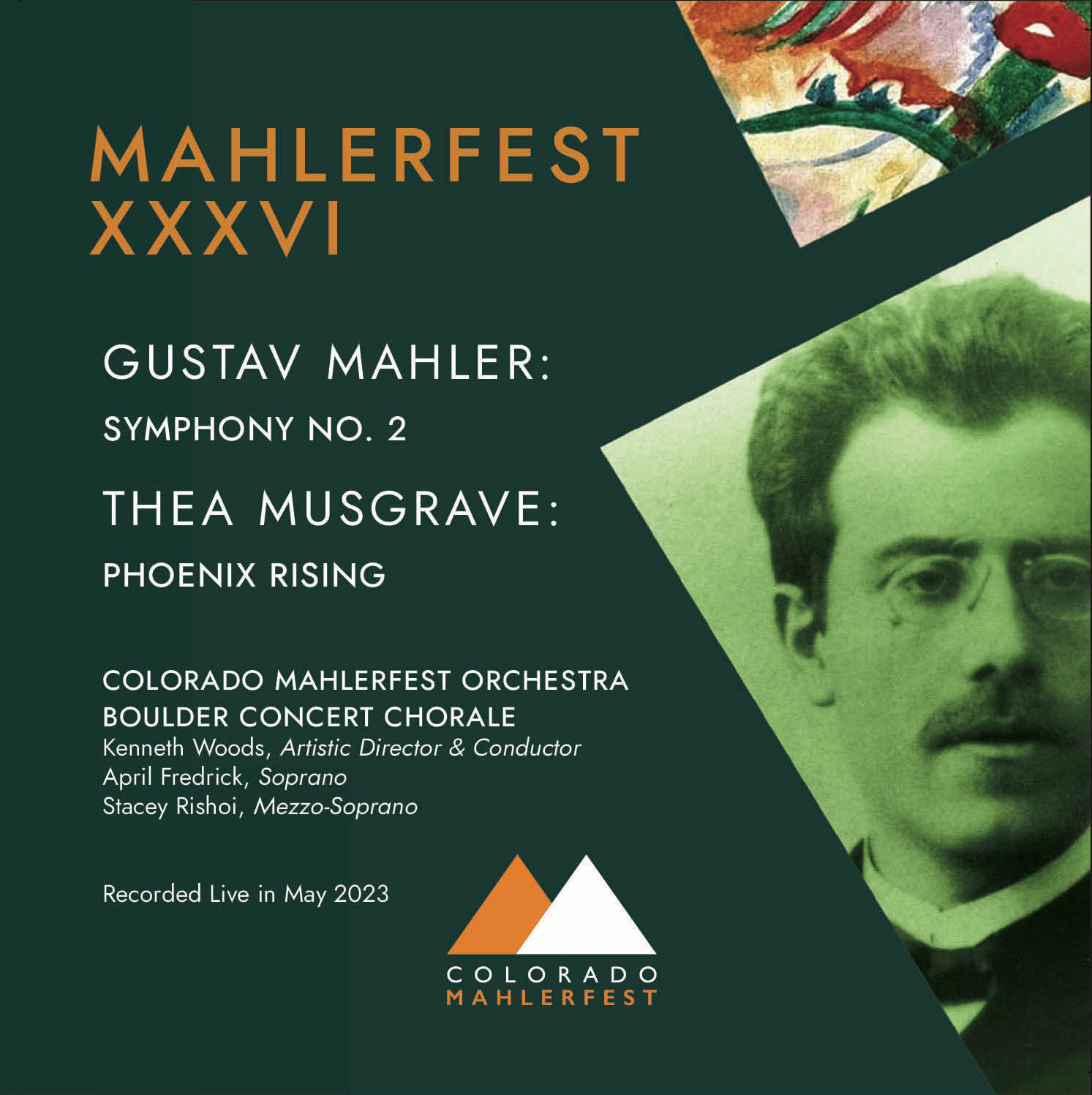
On Record – MahlerFest XXXVI: Kenneth Woods conducts ‘Resurrection’ Symphony & Musgrave’s Phoenix Rising

April Fredrick (soprano), Stacey Rishoi (mezzo-soprano), Boulder Concert Chorale, Colorado MahlerFest Orchestra / Kenneth Woods

Musgrave Phoenix Rising (1997)
Mahler Symphony no.2 in C minor ‘Resurrection’ (1888-94)

Colorado MahlerFest 195269301194 [two discs, 104’02”]
Live performances on 21 May 2023, Macky Auditorium, Boulder, Colorado

Reviewed by Richard Whitehouse

What’s the story?

Last year’s edition of MahlerFest continued its latest, not-quite-chronological traversal of the symphonies with the Second – appropriately coupled on this release (as in the concert) with a work such as considers ‘resurrection’ from a very different while no less relevant perspective.

What’s the music like?

Six years in the writing, Mahler’s Second Symphony fairly laid the basis for his reputation as a composer at its Berlin premiere in 1895. It is a measure of this performance that it captures something of the shock or excitement no doubt in evidence back then, not least in an opening movement with Kenneth Woods notably more interventionist tempo-wise as compared to that of the Third Symphony a year before. What emerges is imposing but never diffuse, at its most gripping in that baleful lead-in to a development whose terseness duly accentuates its impact, with the pathos of the second subject on its reprise making the coda’s sardonic recessional the more acute. After which, the second movement feels the more enticing through its alternation of warm sentiment with capering animation while heading to a conclusion of beatific repose.

There is no lack of incident in a scherzo whose glancing irony is leavened yet not lessened by its trios, the first as soulful with its lilting trumpets as the second is ominous in its import; but not before Stacey Rishoi has characterized the Urlicht setting with rapt inwardness. What to say about the finale other than, while this may not be the most overwhelming take on its vast fresco, it is matched by relatively few as regards an organic unfolding that sees the movement whole. Its contrasting elements here fuse with unforced cohesion to a fervent rendering of the chorale episode then on to a surging Toten-marsch – the kinetic momentum carried through to a methodical reprise of earlier ideas, then a rendering of Klopstock’s text (much altered by the composer) as only grows in intensity before the majestic affirmation of its closing pages.

As the ‘first half’, Thea Musgrave’s Phoenix Rising provides an ideal complement. The much esteemed (latterly more in the US than the UK) nonagenarian has written often for orchestra, but seldom with such immediacy than in a piece whose formal and expressive trajectory feels nothing if not symphonic in its progress. Comparison with the 2016 studio recording by BBC National Orchestra of Wales and William Boughton (Lyrita SRCD372) confirms that, passing tentativeness in ensemble excepted, Woods’s reading demonstrably makes more of this aspect.

Does it all work?

Yes, pretty much always. As on previous releases in this ongoing Mahler cycle, the Colorado MahlerFest Orchestra punches appreciably above its weight in music which should never fall prey to wanton virtuosity. The unyielding acoustic of Macky Auditorium is less an issue than before, with the finale’s offstage brass adeptly managed. April Fredrick brings her customary eloquence to bear on this movement, and the Boulder Concert Chorale – as prepared by Vicki Burrichter – rises to the occasion with notable fervency as this work reaches an ecstatic close.

Is it recommended?

It is. There have been too many superfluous Mahler cycles, but this traversal is shaping up as one of the most worthwhile and more than the memento of a memorable occasion. Hopefully such standards will be maintained by the Sixth Symphony as part of next year’s 37th edition.

Buy

For further purchase options, visit the MahlerFest website – and for more information on the festival itself, click here. Click on the names for further information on conductor Kenneth Woods, soloists April Fredrick, Stacey Rishoi and composer Thea Musgrave

Published post no.2,244 – Friday 19 July 2024

Online Concert – April Fredrick, Stacey Rishoi, Brennen Guillory, Gustav Andreasson, Colorado MahlerFest Orchestra / Kenneth Woods: Mahler’s Liederabend

Mahler’s Liederabend: A Recreation of Mahler’s Concert in Vienna on 29th January 1905

Mahler
Des Knaben Wunderhorn – selection (1892-1901)
Kindertotenlieder (1901-4)
Vier Rückert-Lieder (1901)

April Fredrick (soprano), Stacey Rishoi (mezzo-soprano), Brennen Guillory (tenor), Gustav Andreasson (bass), Colorado MahlerFest Orchestra / Kenneth Woods

Macky Auditorium, 1595 Pleasant Street, Boulder CO (Links to concert sections embedded below)
Saturday 20th May 2023

by Richard Whitehouse

In an event as inclusive as Colorado’s MahlerFest, it was happily inevitable the Liederaband Mahler gave in Vienna on 29th January 1905 be recreated and, while the decision to distribute these songs between four singers was not strictly ‘authentic’, it yet emphasized their variety of thought and expression more readily than had one vocalist been present throughout. What remained consistent was the creative zeal of Mahler at a crucial juncture in his composing, as he left behind the fantastic realm of his earlier music for greater realism and even abstraction.

The first half was of seven songs from Des Knaben Wunderhorn, which collection dominated Mahler’s thinking the previous quarter-century. Two of them are ostensibly dialogues, but the absence of a second singer mattered little when April Fredrick rendered that interaction of the yearning woman with her condemned lover in Lied des Verfolgten im Turm so graphically; as too the more wistful imaginings of separated lovers in Der Schildwache Nachtlied. She also underlined the glancing irony of Des Antonius von Padua Fischpredigt and the playful whimsy of Rheinlegendchen with understated assurance. Brennen Guillory pointed up the deadpan humour of Trost im Unglück and if Der Tamboursg’sell felt a little too earnest, the stridency that increasingly borders on aggression of Revelge was bracingly delivered.

Here, as elsewhere, adherence to Mahler’s scoring, with its emphasis on woodwind and brass, brought out its evocative quality which outweighed any passing thinness of tone in the strings. This was even less of an issue during the sparser textures of Kindertotenlieder, whose songs find universal truths in Friedrich Rückert’s intimate ruminations. Gustav Andreasson seemed a little raw of timbre in Nun will die Sonn’ so hell aufgeh’n, though the yearning fatalism of Nun seh’ ich wohl, warun so dunkel Flammen was tangibly conveyed, as too was the aching poignancy of Wenn dein Mütterlein. The bittersweet elegance of Oft denk’ ich, sie sind nur ausgegangen felt slightly undersold, but not those contrasts of In diesem Wetter as this final heads from fraught anguish toward a repose from which all dread has been wholly eradicated.

Kenneth Woods directed the Colorado MahlerFest Orchestra with that unforced rightness evident from his earlier Mahler performances. Never more so than the four Rückert-Lieder which ended this programme – albeit in a discreet but effective reordering from that of 118 years before. Thus, the capricious whimsy of Blicke mir nicht in die Lieder! preceded the deft enchantment of Ich atmet einen Linden duft; Stacey Rishoi proving as responsive to these as to Um Mitternacht, with its crepuscular winds and majestic climax with swirling arpeggios on harp and piano. Fittingly, the sequence closed with Ich bin der Welt abhanden gekommen – the finest of Mahler’s orchestral songs in its rapt serenity, Rishoi’s conveying of Rückert’s otherworldly sentiments more than abetted by Lisa Read’s eloquent cor anglais. If recreating the Liederabend meant no place for Liebst du um Schönheit (now available in a far more idiomatic orchestration by David Matthews), which might have made a pertinent encore), its absence did not lessen the attractions of this enterprising and successful concert.

Click on the name for more information on Colorado MahlerFest 2024, and on the artist names for more on Kenneth Woods, April Fredrick, Stacey Rishoi, Brennen Guillory and Gustav Andreasson