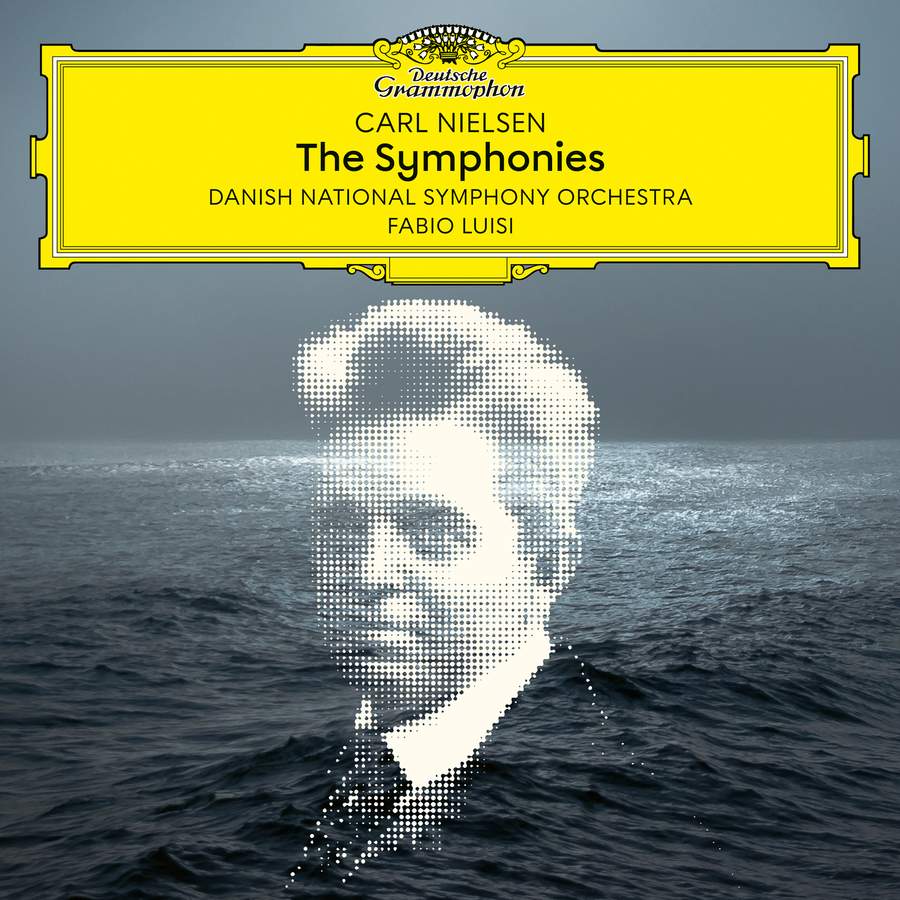
Yesterday we marvelled in the wonder of John Cage’s writing for choir, as highlighted in the Gramophone Awards on Wednesday. At the ceremony the magazine also named its Recording Of The Year, choosing Nielsen’s Symphony no.4 (the Inextinguishable) and no.5, as played by the Danish National Symphony Orchestra conducted by Fabio Luisi.
The choice is further evidence that Nielsen’s symphony cycle is acknowledged as one of the finest of the 20th century, having perhaps taken longer to reach its standing than other more immediate successes. You can listen to the recording below – while reading Richard Whitehouse’s verdict on all six symphonies, recorded by the same forces and reviewed on these pages.
British producer and composer Roger Eno has hit a rich vein of form in recent years – and his prolific writing period continues with the The skies, they shift like chords…, due to be released on Deutsche Grammophon on 13 October.
On the press release for The skies, they shift like chords… Eno describes the world in a dozen musical watercolours based on spontaneous sketches, tracing an evocative and thought-provoking path through sound and silence. “I think of music in visual terms. Perhaps here the chords could be the earth, the melody the trees rising above ground, and the atmosphere of floating guitar could be the sky. These three elements are different but interconnected.” He adds, “Most of my pieces are snapshots of things that were experienced in the moment,” says Eno. “How do you describe the world unless it’s in an instant? You can’t fix anything because everything is in flux, it’s changing and mutable.”
Here is the first excerpt from the album, Tidescape, in the form of a visualizer:
Danish National Symphony Orchestra / Fabio Luisi with Fatma Said (soprano), Palle Knudsen (baritone) (Symphony no.3)
Nielsen Symphonies: no.1 in G minor FS16a; no.2 FS29 ‘The Four Temperaments’b no.3 FS60 ‘Sinfonia espansiva’c; no.4 FS76 ‘The Inextinguishable’d; no.5 FS97e; no.6 FS116 ‘Sinfonia semplice’f
Deutsche Grammophon 4863471 [3 hours 36 minutes] Producer Bernhard Güttler; Engineers Mikkel Nymand, Christoph Stickel
Recorded in live performances at Koncertsalen, DR Koncerthuset, Copenhagen: 1 February (no.4), 3 February (no.2), 3 June (no.6), 17 June (no.1), 26 November (no.3), 28 November (no.5)
Written by Richard Whitehouse
What’s the story?
Deutsche Grammophon continues its latest generation of symphonic cycles (following those first-time traversals of Franz Schmidt and Charles Ives) with that from Carl Nielsen, performed by the Danish National Symphony Orchestra and its incumbent principal conductor Fabio Luisi.
Almost 50 years after the first integral recording of these symphonies (Ole Schmidt with the London Symphony Orchestra on Unicorn/Alto), there are at least 20 such cycles available so that any newcomer needs to bring a fresh perspective on Nielsen’s always distinctive though increasingly unpredictable fusion of innovation with tradition. This pairing of orchestra and conductor is intriguing insofar that the DNSO has been associated with these works from the outset, while Luisi is a musician of broad sympathies with cycles of symphonies by Schmidt (Querstand) and Schumann (Orfeo) plus an incomplete one of tone poems by Strauss (Sony). The result is a Nielsen cycle at times impressive in its conviction if at others dismaying in its inconsistency, and not always in those works or for those reasons one might have expected.
What’s the music like?
Luisi makes his intentions plain at the start of the First Symphony, its initial Allegro launched via an emphatic C major whose impetus is sustained through an impetuous development, with a remorseless acceleration into the implacable coda. Even finer is an Andante by turns elegant and eloquent, strings coming into their own, while only a marginal hesitancy as to the elision between scherzo and intermezzo affects its successor’s stealthy progress. Taut if not inflexible, the final Allegro has innate buoyancy capped with the uninhibited verve generated at its close.
If the Second Symphony is less successful, this is because Luisi does not transcend its status as a symphonic suite. The ‘choleric’ element of the opening Allegro verges on the histrionic, with the humour of the following intermezzo deadpan rather than ‘phlegmatic’. The Andante, though, is superbly sustained over its airily pastoral interlude towards an intensified recall of its ‘melancholic’ opening and coda of fatalistic poise. The ‘sanguine’ trait of the final Allegro is deftly undercut by musing uncertainty, but this yields a slightly tepid resolution in its coda.
Nothing comparable affects the Third Symphony, the ‘expansiveness’ of its opening Allegro abetted by visceral drive in its outer paragraphs and nuanced subtlety in its more speculative passages. The Andante’s interplay of the pastoral and emotional sees a rapturous apotheosis, soprano and baritone vocalises beguilingly intertwined, then the scherzo generates no mean energy prior to its restive ending. Luisi’s steady overall tempo for the final Allegro avoids sluggishness, and not least a coda the more conclusive for its eschewal of wanton triumph.
Despite a properly blazing start to the Fourth Symphony, its opening Allegro emerges as no more than the sum of some admittedly fine parts, with the charm of the ensuing intermezzo just a little too ‘knowing’. The highlight here is a slow movement of real fervency, its dense textures clearly articulated and a transition of simmering intensity into the finale’s headlong fugato on strings. Tension here is ably maintained, but Luisi’s holding back in its peroration replaces that striving onwards Nielsen surely intended with a more generalized affirmation.
This take on the Fifth Symphony is very much a tale of two parts. Luisi audibly locates the ‘tempo giusto’ for the first movement’s opening half – its increasingly ominous expectancy fulfilled in an Adagio of great pathos, albeit with a side-drum cadenza overly reined-in both texturally and emotionally. Too stolid a tempo for the second movement’s initial Allegro is exacerbated by its inhibited Presto, and though Luisi renders its Andante with compassion, his broadening towards the close of the final Allegro is too self-conscious to be convincing.
Is it surprising that the Sixth Symphony rounds off this cycle so perceptively? The complex array of emotions found in its opening movement yields the right ‘innocence to experience’ trajectory, with both the sardonic humour of its Humoreske and the fractured eloquence of its Proposta seria palpably conveyed. Above all, the finale’s outwardly fractious variations unfold with a seamlessness and an inevitability that makes of the coda a culmination whose outcome is held in check until the last bar. A still disputed masterpiece is hereby vindicated.
Does it all work?
Swings and roundabouts. There could be no doubt as to the seriousness with which Luisi has taken on this project, nor of the overall excellence of the DNSO’s playing. Where this cycle falls down is in a lack of focus across the whole, to the extent that there could have been two or even three conductors involved here. Moreover the orchestral sound, warm and immediate but often lacking definition or a consistent balance, feels appreciably different from what this ensemble produces in its home venue – leading one to suspect a modicum of post-production.
For CD adherents the fold-out triple pack is eminently stylish and straightforward, while Jens Cornelius’ note sets the scene adequately enough. The cycle is also available as three separate couplings of Nos. 4 and 5, Nos. 2 and 6 then Nos. 1 and 3 – with the three concertos to follow.
Is it recommended?
Yes, with qualifications. Prospective purchasers are advised to sample the cycle via streaming then proceed accordingly. Certainly, the Third and Sixth Symphonies rank with the finest now available, and listeners should form their own judgement as to the merits of this cycle overall.
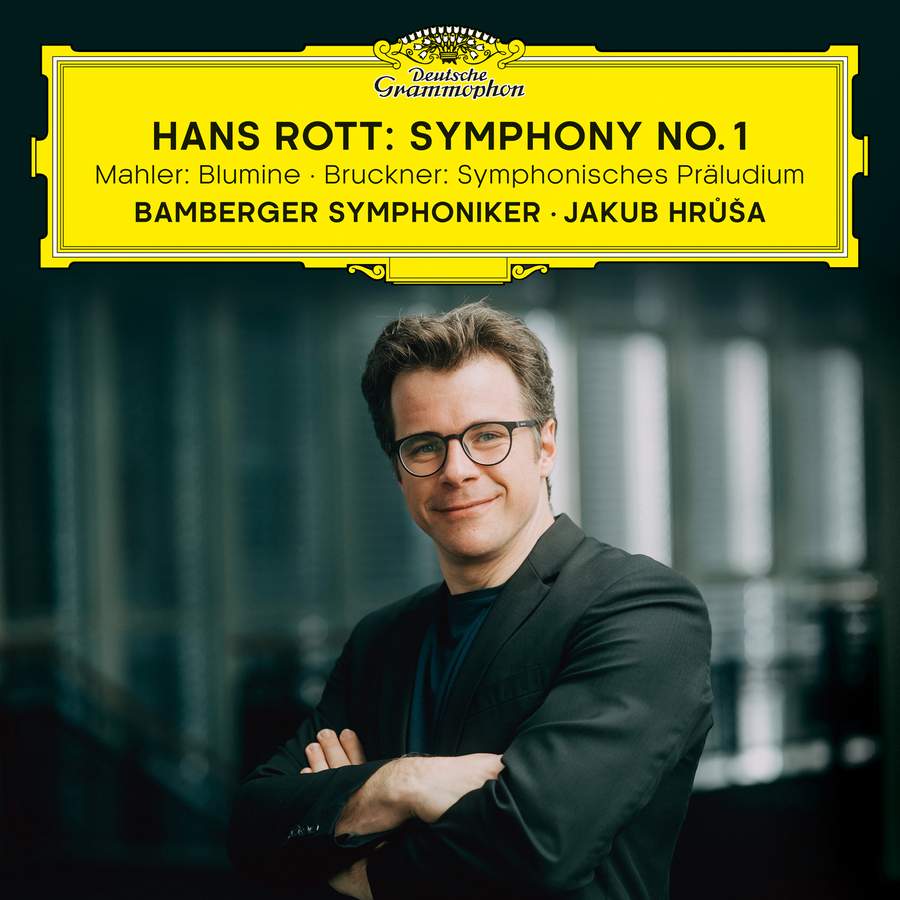
Rott Symphony [no.1] in E major (1878-80) Mahler Andante allegretto in C major ‘Blumine’ (1884) Bruckner Symphonic Prelude in C minor WAB297 (1876)
Bamberger Symphoniker / Jakub Hrúša
DG 486 2932 [70’11”]
ProducersSebastian Braun (Rott, Bruckner), Johannes Gleim (Mahler) EngineersMarkus Spatz (Rott), Christian Jaeger (Mahler), Thorsten Kuhn (Bruckner)
Recorded September and October 2021 (Rott), December 2021 (Mahler), March 2022 (Bruckner) at Joseph-Keilberth-Saal, Konzerthalle, Bamberg
reviewed by Richard Whitehouse
What’s the story?
Jakub Hrúša makes its debut on Deutsche Grammophon with a new account of the Symphony by Hans Rott (1858-84), whose belated premiere some 33 years ago prompted a reassessment (still ongoing) as to the evolution of this genre during those final decades of the 19th century.
What’s the music like?
Much time and space has been expended on the indebtedness (or otherwise) of Mahler to this work – elements from which can be found in at least five the younger composer’s symphonies – yet equally fascinating is the audible influence it had upon those who came before and after; hence the first movement from Bruckner’s Seventh and the second movement from Schmidt’s First – both of which are similarly grounded in E major). Without seeking to present it as an unalloyed masterpiece, Hrúša makes a persuasive case for a piece that Rott would doubtless have overhauled had his mental state not deteriorated soon after its completion. He finds the right balance between grandeur and introspection in the preludial Alle breve, as between that raptness which briefly though pointedly erupts into anguish in the Sehr langsam that follows.
The Scherzo is the most convincingly realized movement and Hrúša has the measure of its animated main theme with undertones of polka, broadening into the ländler-derived suavity of its trio before regaining its earlier vigour vis an ostinato-like impetus barely held in check – the accelerando not necessary in this instance. Nor does he disappoint in the finale. Much the longest movement, this is easily criticized for diffuseness but, as Hrúša makes plain, the formal ground-plan – prelude-chorale-fantasia-fugue-stretto-postlude – (such as the organist Rott likely extemporized before committing to paper) is readily perceivable and is invested with cumulative momentum sustained to the beatific concluding bars. That the composer so nearly brought off this ambitious conception is surely more significant than any shortcoming.
Couplings have been judiciously chosen to open-out the context of the main work. Included in early hearings of his First Symphony, Blumine is a remnant from Mahler’s early orchestral projects lost to history and Hrúša brings out those expressive ambiguities as offset the lilting trumpet melody. Once attributed to Mahler, Symphonic Prelude is now believed an exercise from Bruckner’s composition class and Hrúša, adhering to the original orchestration rather than that by Albrecht Gürsching, duly makes the most of its ominous and plaintive musings.
Does it all work?
It does. In his accompanying booklet observation, Hrúša reflects on the musical and historical relevance of Rott’s Symphony and there can be little doubt that, among the dozen or so other recordings of this piece, this is the most convincing in terms of all-round cohesion as also the excellence of the playing by the Bamberg Symphony (whose chief conductor Hrúša has been since 2018). A little too forwardly balanced in tuttis, sound otherwise reflects the excellence of the orchestra’s home-venue – Rott’s extensive use of triangle kept within sensible bounds.
Is it recommended?
It is. Those coming to the main work for the first time should certainly makes its latest release their first port-of-call, and it would be worthwhile DG continuing this association with Hrúša and the Bamberg in other mid-European music from the late Romantic and early Modern era.
Roger Eno has been recording music for nearly 40 years. We first heard from him in the form of a shared credit with brother Brian and Daniel Lanois in their Apollo soundtrack, after which he wrote a series of albums for the revered All Saints Records, either in a solo capacity, in collaboration with the likes of Kate St John or Peter Hammill, or as part of ambient supergroup Channel Light Vessel.
Now he has moved to Deutsche Grammophon, Eno is taking the chance to assess some of his solo work while making new compositions too. He describes The Turning Year as, “A collection of short stories or photographs of individual scenes, each with its own character but somehow closely related to the other”. It is an album of observation, describing a natural cycle but also effectively documenting his own musical evolution. For example the oldest work, Stars and Wheels, is a solo organ piece of 20+ years, but was re-imagined for this album as Roger worked with producer Christian Badzura.
What’s the music like?
Eno is a consistent composer, and his brand of pastoral ambience is very easy on the ear but surprisingly difficult to imitate. The Turning Year captures his voice beautifully, unfolding at an easy pace. The creation of mood takes greater importance than that of melody, but the two nonetheless work closely together, with simple phrases that undergo development to produce music of subtly powerful feeling.
It is to Eno’s credit that he never crosses the line into sugary sentiment. Right from the start, the evocative A Place We Once Walked is attractively coloured and slightly wistful in its contemplation. The title track has a greater sense of purpose, while Bells is deeply personal, its slow piano revealing intimate thoughts and designs. On The Horizon is notable for a really nice clarinet colouring, while a slight chill lies in store on the autumnal Something Made Out Of Nothing.
Stars and Wheels is rather beautiful in its new clothing, panning out with some remote sounds that at the same time are extremely comforting, recreating the feeling Apollo gave of travelling slowly through deep space.
Does it all work?
Yes. Eno really flourishes in this company, and the scoring really does his keyboard-sourced music a good deal of favours.
Is it recommended?
It is. Although arguably Roger Eno’s best work remains in his earlier albums for All Saints, the move to Deutsche Grammophon has really given him the opportunity to blossom, a chance he is taking with both hands.
Listen
Buy
There are several options for purchasing and streaming The Turning Year, which you can explore here



 Arcana.fm