
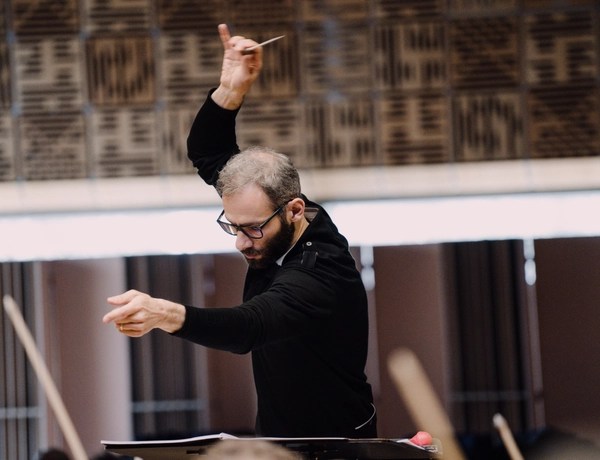
Inmo Yang (violin), City of Birmingham Symphony Orchestra / Dima Slobodeniouk (above)
Martinů Memorial to Lidice H296 (1943)
Tchaikovsky Violin Concerto in D, Op. 35 (1878)
Prokofiev Symphony no.6 in E flat minor Op.111 (1945-47)
Symphony Hall, Birmingham
Thursday 18 June 2026 2:15pm
Reviewed by Richard Whitehouse Picture of Dima Slobodeniouk (c) Marco Borggreve
If not quite an all-Russian sequence or, indeed, one centred on the Second World War, this was still a cohesive and satisfying programme that played to the collective strengths of the City of Birmingham Symphony Orchestra along with this afternoon’s conductor Dima Slobodeniouk.
Just over eight decades since a first hearing in Prague (83 years following its premiere in New York), Memorial to Lidice has lost little of its fervency and pathos – qualities often present in the music of Martinů’s maturity yet seldom so graphically as here. The CBSO’s playing duly ensured a performance of sustained eloquence, with Slobodeniouk lightening the mood in its central section so that the return of the opening music – with its allusions to the St Wenceslas Chorale and the motto of Beethoven’s Fifth Symphony – left a tangibly cathartic impression.
Tchaikovsky’s Violin Concerto received a far less cordial reception at its premiere in Vienna, but soon afterwards established a place in the repertoire as has never been challenged. Early audience may have found its first movement protracted, but Immo Yang ensured a seamless follow-though with due characterization of its subtly contrasted main themes. Imaginatively articulated, the cadenza was pointedly developmental as to make the wistful reappearance of the first theme the more affecting. Nor was there any lack of emotional depth in the ensuing Canzonetta – its musing uncertainty the counterweight to a finale which, after its (rightly) jarring introduction, found the right balance between impetuosity and plaintiveness on route to a coda no less uproarious for all its knife-edge coordination between soloist and orchestra.
Acclaimed at its Leningrad premiere, Prokofiev’s Sixth Symphony was a victim of political intrigues such as hampered any wider dissemination (its first hearing in Birmingham came as late as 1980) or recognition as its composer’s finest and most finely achieved such piece. Slobodeniouk undoubtedly had its measure, not least that opening Allegro moderato whose diverse and even disparate ideas – which might be described as speculative, mesmeric then desperate – melded with an assured sense of where this disquieting movement was headed. In particular, the lengthy development proceeded with truly remorseless intensity toward a pulverizing climax – one whose bitter after-tones persisted through a summary reprise then on to a conclusion whose embrace of the major key could hardly have felt less affirmative.
If this movement finds Prokofiev at his most questing, then the Largo finds him at his most empathetic such as its searing introductory bars then heartfelt main theme are drawn into a powerfully focussed design leaving no doubt as to its composer’s awareness of the ‘human cost’ or this conductor’s conveying of what was at stake. Not that the final Vivace was at all pre-empted, the forced jocularity of its main theme offset by ambivalent episodes prior to a coda whose teetering on catastrophe seemed hardly allayed by those fateful closing gestures.
Taken as a whole, this proved an impressive conceived and realized performance that, having occurred ‘‘many years since my last visit’’ (to quote the conductor), was such as to make one hope that Slobodeniouk’s next appearance with this orchestra might not be so long in coming.
To read more about the CBSO’s 2026/27 season, visit the CBSO website. Click on the name to read more on conductor Dima Slobodeniouk and violinist Inmo Yang
Published post no.2,925 – Monday 22 June 2026

