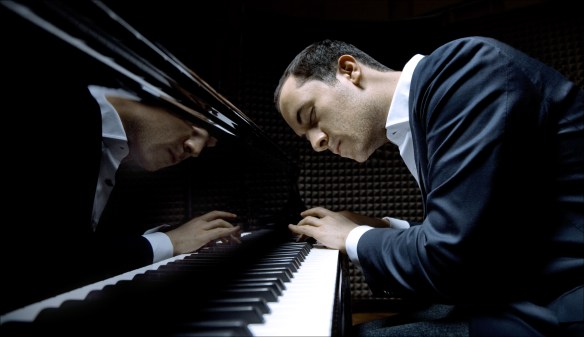
Igor Levit at the Wigmore Hall

igor-levit
Igor Levit

Richard Whitehouse on another enterprising program from the Wigmore Hall
Wigmore Hall, London Thursday 5 November

Muffat: Passacaglia in G minor (pub 1690)

Shostakovich: Piano Sonata no.2 in B minor (1943)

Beethoven: Diabelli Variations (1819-23)

Igor Levit (piano)

Make no mistake, Igor Levit is among the most questing and (executively speaking) creative of younger pianists and it was an astute move by Wigmore Hall to make him a featured artist this coming season – Igor Levit Perspectives taking in a range of solo and chamber projects.

Levit’s latest recording comprises no less than three variation cycles by Bach, Beethoven and Rzewski (about which you can learn more by watching the video below). Avoiding any temptation to programme them as a single ‘marathon’ recital, tonight’s recital placed the Beethoven within a stimulating context. This opened with the Passacaglia from Georg Muffat’s Apparatus musico-organisticus, whose five variations on a deceptively functional theme were a blueprint for increasingly elaborate such sequences over the next two centuries. Levit’s account did not want for expressive depth or technical finesse.

A conceptual link between this piece and the finale of Shostakovich’s Piano Sonata no.2 was not hard to discern. Despite advocacy from such pianists as Emil Gilels, this latter work remains neglected compared to the composer’s orchestral and chamber music; its essentially introspective manner evident in an initial Allegretto whose respectively furtive and sardonic themes were delineated with simmering volatility. Nor was the central Largo lacking in that anguished restraint which Shostakovich was to mine extensively in his later string quartets; the (11) variations of the final Moderato unfolding with a cumulative intensity capped by the penultimate one in which Levit’s daringly slow tempo was justified by the desolation thereby conveyed, its successor then bringing this work full-circle to a decisive yet fatalistic degree.

After the interval, Beethoven’s Diabelli Variations and a performance that underlined the breathtaking imagination of a piece whose overall cohesion is afforded precisely through its sheer unpredictability. Not that Levit shied away from such disjunctiveness – witness the frequent and often lengthy pauses between groups of variations (which, interestingly enough, were by no means the customary or expected ones) – yet there was rarely, if ever, any feeling that this follow-through was governed other than by deep-seated formal logic and expressive conviction. Qualities equally true of the 10 additional variations that Beethoven inserted late in the work’s gestation, and which between them further point up the audacity of the overall concept as one in which Diabelli’s jejune theme is respected for all its intensive dismantling.

The biggest change came (as most often) with the modulation into C minor for variations 29-31, and a sequence that occupies a similar emotional domain to that of the ‘Arietta’ from the final piano sonata – though here the outcome is not transfiguration but the careering velocity of a double fugue in E flat; its progress finely articulated by Levit, who was nonetheless at pains to ensure its apex came with that credential interlude into the final variation – a minuet whose lucid poise brings with it a measure of calm then, at the close, bestows a benediction.

A pity the audience betrayed frequent signs of restlessness as the performance unfolded, but. Levit made no concessions to his listeners; any more than does Beethoven to his exponents – between them confirming a level of artistic integrity that should never be taken for granted.

The Oberon Symphony Orchestra play Beethoven and Shostakovich

oberon-so
Picture (c) Alexander Robinson

Richard Whitehouse on the young, thriving Oberon Symphony Orchestra‘s latest concert, pairing Beethoven with Shostakovich at their home of St James’s, Sussex Gardens, London on Saturday 26 September

Beethoven: Piano Concerto no.4 (1806)

Shostakovich: Symphony no.5 (1937)

Jean Paul Ekins (piano), Oberon Symphony Orchestra / Samuel Draper

This evening’s concert given by the Oberon Symphony, the orchestra’s tenth such event since its inception, brought together a concerto which is poised expressively between Classical and Romantic eras, then a symphony bridging the divide between personal and public expression.

For all its popularity, Beethoven’s Piano Concerto no.4 remains a tough challenge in terms of its emotional understatement and often elusive interplay of soloist and orchestra. There was no denying Jean Paul Ekins’ technical adroitness, his crystalline tone and limpid passage work being rarely in doubt, but equally a lack of expressive variety and a degree of preciousness in terms of phrasing that gave the opening movement – steady if by no means stolid in its underlying tempo – a uniform and even unyielding profile; the highlight being a cadenza that dovetailed ideally into the surging coda. Not so a rather prosaic transition from slow movement into finale, yet the dialogue of the former was (rightly) one of stark contrast and the latter exuded ample impetus through to its rather awkwardly negotiated final chords.

Throughout this reading, Samuel Draper proved an astute and attentive accompanist – before he and the orchestra came into their own with Shostakovich’s Symphony no.5. Still the most often heard of what is now among the most familiar of symphonic cycles, its performance has grown more difficult over time given those extra-musical ‘interpretations’ to have been foisted on its musical content. Having steered an involving course between its yearning and plaintive main themes, Draper infused the first movement’s development with a purposeful momentum so that the climactic reprise unfolded as an arc of decreasing intensity towards a coda of aching suspense. Trenchant in forward motion, the scherzo was dispatched with a keen irony and, in its trio, appealingly deadpan playing from leader Richard Gratwick.

A degree of thinness in string tone was by no means to the disadvantage of a slow movement which eschewed widescreen emotional expression for intense inwardness, not least with the chorale-like transformation of its initial theme in a central passage of real eloquence. Nor was the ensuing climax found wanting, as Draper secured a searing clarity across the strings prior to a wistfully resigned close. Even finer was the finale: the hardest movement to bring off, its tempo changes worked ably in terms of a cumulative overall structure – making nonsense of any claim it lacks formal focus; with a palpable emergence from the restless searching at its centre towards an apotheosis which evinced the fraught inevitability that was surely intended. The closing bars then drove home the work’s defiantly individual stance with bracing resolve.

A gripping account of a piece which should never be taken for granted, not least in its knife-edge ambivalence, and that found the Oberon SO at its most committed. Draper had begun by noting the 75th anniversary on this day of the suicide of philosopher Walter Benjamin – the victim of a political and cultural intolerance that has by no means abated, and to whose memory this performance was dedicated. Such a procedure can risk indulgence, though here the sincerity of his remarks was more than matched by the conviction of the music-making.

The next Oberon concert takes place on 5th December 2015, where the orchestra will play Tchaikovsky’s Pathetique Symphony. Here they are in the composer’s Fifth:

Further information can be found at the orchestra’s website

Under the surface – Shostakovich Cantatas

shostakovich-cantatas

Composer: Dmitri Shostakovich (1906-1975)

Nationality: Russian

What did he write? Shostakovich is best known for his output of symphonies (15) and string quartets (also 15) as well as popular concertos, two each, for piano, violin and cello. Yet a relatively large amount of his output remains unexplored, especially his vocal work.

What are the works on this new recording? There are three cantatas for chorus, published relatively late in Shostakovich’s career. The Execution of Stepan Razin is the best known of the three, and certainly the most accomplished, being also the closest we get to the real composer on this recording, as it was written ten years after the death of Stalin and was free of his decrees on musical direction. The Sun Shines on the Motherland and Song of the Forests are different, being works in praise of his authority and the forests of Russia, so they are by nature more celebratory. All three works are performed in this new recording from Warner Classics by the Estonian Concert Choir and National Symphony Orchestra, conducted by Paavo Järvi, with soloists Alexei Tanovitski (bass) and Konstantin Andreyev (tenor).

Why aren’t these works more popular? That’s an easy one – in the case of The Sun Shines on the Motherland and Song of the Forests the texts are pro-Stalin and completely of their time. Even when recording, Järvi had to contend with demonstrations outside the Estonia Concert Hall in Tallinn, with people aghast at his idea of recording the original texts. Yet this recording is an extremely valuable illustration of music Shostakovich had to write against his will – and, if you look closely, how he managed to keep in a number of sardonic and witty references.

What is the music like? Despite the bombast of the two obviously pro-Stalin works, there is a curious emptiness to their celebrations, the sense of duty paid. Far more substantial and lasting in its impact, The Execution of Stepan Razin leaves a very strong impression of a hero in extreme adversity, cutting frequently to the bone emotionally – and is described by Paavo Järvi as ‘a critical work of the Soviet regime’.

After a bombastic opening the music remains powerfully driven, reaching a tremendous climax around 21’30”, which may be after the moment of execution itself – though unfortunately we do not have texts here.

The Sun Shines on the Motherland is immediately brighter in tone with the Narva Boys Choir, and leads to a positive but musically telegraphed high point. It is very well written and brilliantly performed, but has little substance emotionally other than empty celebration.

The Song of the Forests  begins in soft reverence but then there is a resonant solo from bass Konstantin Andreyev. The harmonies Shostakovich uses often lead to the same, deliberately hackneyed progression – effective but ultimately strangely wearing. The first part ends with a pure and peaceful low ‘C’ from the basses in the choir – peace at the end of the war, though not for the composer.

What’s the verdict? This is a fascinating and extremely valuable disc that adds another dimension to your collection if you know Shostakovich just through the orchestral works and string quartets. The ferocity of the singing is striking, especially from the choir, and the standard of performance is consistently high.

One serious drawback here is a lack of texts in the booklet, especially given the use of the original pro-Stalin material. Fortunately Shostakovich’s means of expression is direct enough to bring them straight off the page.

Spotify

You can hear the Shostakovich cantatas here:

If this appeals, a very strong recommendation goes to this double album, as reissued by EMI, of Rachmaninov and Prokofiev masterpieces with André Previn (The Bells by the former and Alexander Nevsky by the latter), together with the sharply toned Ivan the Terrible in a pioneering version conducted by Riccardo Muti.

Musorgsky – Pictures at an Exhibition, Songs and Dances of Death / Gergiev

Featured recording: Musorgsky – Pictures at an Exhibition, Night on Bare Mountain, Songs and Dances of Death (Ferruccio Furlanetto (baritone), Mariinsky Orchestra / Valery Gergiev (Mariinsky)

musorgsky-gergiev

A new all-Musorgsky disc by Valery Gergiev and his Russian charges, returning to the composer whose operas Gergiev has recorded with great success.

What’s the music like?

On paper this release is a brilliant way to start a Musorgsky collection, because it contains his two best loved works. Pictures at an Exhibition, appearing in its celebrated orchestration by Ravel, is a wonderful set of character pieces that fully captures an artistic exhibition and the viewer’s response to it. Night on Bare Mountain is equally vivid in its portrayal of a witches’ sabbath, and the right performance can strike genuine fear into the heart. Finally the Songs and Dances of Death for baritone and orchestra (not as depressing as they sound through opportunities taken for gallows humour!) appear in the orchestral version made by Shostakovich.

Does it all work?

It should do – because this is surely a home banker for Valery Gergiev, conducting both the music of his homeland and a composer in whose music he specialises. Yet something is awry, for two of the three live performances feel routine at best.

Pictures lacks spark and feels very polite, taking its time to reveal plenty of things in the score but rarely getting out of second gear, as though the exhibition has only a few days left to run. There is no edge to Gnomus, which should ideally be unhinged, and no sense of culmination in The Great Gate of Kiev, the work’s crowning glory. The Old Castle, while suitably mournful and featuring a lovely saxophone solo, drags its feet, while Bydlo, the old cart whose machinery lumbers down the track, has a disarmingly smooth passage here.

There are a few exceptions. The characterisation of Samuel Goldenberg and Schmuÿle is brilliant, thanks to a sharp trumpet portraying the latter character, while the clucking of The Ballet of Unhatched Chicks in their Shells is winsome. But overall this version lacks real excitement.

Sadly Night on Bare Mountain is little better, and sounds like a version going through the motions, with an incredibly limp final chord. There are moments where the electric charge is more pronounced, especially when the dance music comes in around 1’45”, but otherwise this is disappointing fayre with little sense of terror.

All this is redeemed by Ferruccio Furlanetto, the commanding singer chosen for Songs and Dances of Death. There is an incredibly strong resonance to his voice, effortlessly taking charge of the Lullaby, while hurling his all into the end of the Serenade and the fatal triumphalism of The Field Marshal. Gopak, the third song, starts with threadbare bass sounding appropriately ghoulish, the sentiments of the poem laid as bare as the orchestration. Gergiev is inspired here, completing a version that stands tall alongside any competition.

Is it recommended?

Overall, no – unless you are desperate for a recording of the Songs and Dances of Death. For Pictures, alternative versions include those conducted by Claudio Abbado and Carlo Maria Giulini, with Abbado again the choice for Night on Bare Mountain.

Listen on Spotify

You can judge for yourself by hearing the album on Spotify here

Danish String Quartet – Haydn and Shostakovich

The Danish String Quartet play works by Haydn and Shostakovich at Wigmore Hall

danish-string-quartet
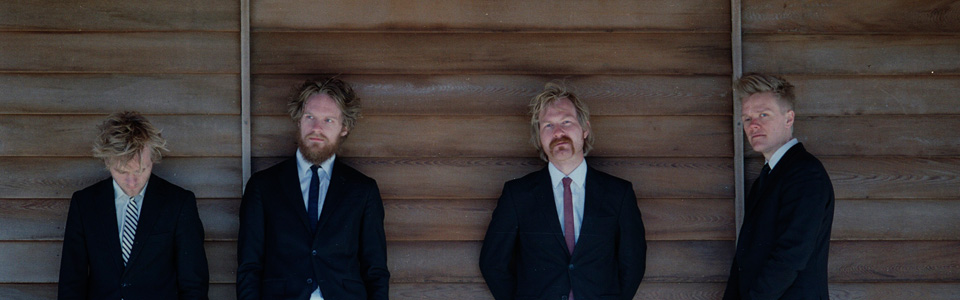
Danish String Quartet (Frederik Øland, Rune Tonsgaard Sørensen (violins), Asbjørn Nørgaard (viola), Fredrik Sjølin (cello)) – Wigmore Hall, live on BBC Radio 3, 23 March 2015.

Listening link (opens in a new window):

http://www.bbc.co.uk/programmes/b05mqmkv

on the iPlayer until 22 April

Spotify

The Danish Quartet are yet to record either of these pieces, so for listeners unable to hear the BBC audio here is a Spotify playlist of the same works from the Lindsay Quartet (Haydn) and the Aviv Quartet (Shostakovich) – two fine versions:

What’s the music?

HaydnString Quartet in C major Op.54/2 (1788) (20 minutes)

Shostakovich String Quartet no.9 (1964) (25 minutes)

What about the music?

[PIC]

As my concert-going companion remarked, Haydn string quartets are always used as curtain openers, which can be something of a shame, as they are always performed when the quartet is at its ‘coldest’. This particular work, seemingly written for the violinist Johann Tost in 1788, can not be allowed to fall into that category, for the first violinist has a lot of demands made on him right from the start.

As with many Haydn works this quartet is deceptive, for it has the routine layout – yet tinkers with the overall design of a conventional string quartet. The first movement is a lot faster than it would be normally, while the second movement (the slow movement here) runs straight into the third (a minuet), a tactic very seldom witnessed. Not only that, the last of the four movements is predominantly slow.

Shostakovich’s most private thoughts went into his string quartets, which often convey the intense fear and claustrophobia he felt with the authorities seemingly poised to knock on his door in the middle of the night, ready to remove him forever for his supposedly rebellious musical tendencies. Ultimately he found ways of expressing himself in a private musical code, and the string quartets were especially vivid at using that.

Yet his ninth published string quartet is much more positive in mood than most, seemingly gathering itself to renounce the fear and stand confidently on two feet. As the Wigmore Hall program note states, this may have been due to the composer’s recent marriage – his third – and the slight ‘thaw’ in relations that was allowing him to revive the previously out-of-bounds opera Lady Macbet of the Mtsensk District.

Performance verdict

How refreshing to hear Haydn played with the energy the Danish String Quartet gave it in this performance. All too often these quartets sound too polite, but this account was a good reminder of Haydn’s innovations in the form, and in the way he makes this piece sound a bit like a miniature violin concerto. First violinist Frederik Øland was up to the job.

The Shostakovich was even better, given a depth of feeling and range of colour that suited the piece perfectly. Whereas some of the composer’s quartets are very closed in this felt like a positive, outgoing experience, standing tall in the face of the horrors of the time. Particularly effective was the Rossini-like polka that danced manically, while the slower sections – and in particular the quotes from Musorgsky’s Boris Godunov – were beautifully handled.

The quartet’s ensemble playing was superb, and their togetherness and positivity were two standout features of a superb concert.

What should I listen out for?

Haydn

1:49 – the first movement, unusual in the composer’s output for being marked Vivace (lively). The Danish Quartet enjoy its contours – particularly first violinist Frederik Øland, who has a challenging part!

8:14 – the mood turns sombre (and the key changes from C major to C minor) for the slow movement. Again the first violin starts to take the lead but sounds a bit absentminded against the long, slow chords from the other three instruments. This moves straight into…

11:27 – the Menuetto, an injection of pace and poise, with a typically upbeat theme from the composer. This is in direct contrast to the Trio section, from 13:03, with its discords. The texture is surprisingly full here for four instruments. The Menuetto reappears to put things right at 14:01, as though nothing had happened!

15:06 – a solemn introductory theme, which turns into a thoughtful and deeply felt Adagio. Very unusual for a slow movement to appear last in a typical four-movement quartet structure in the eighteenth century…and yet there is fast music to come, from 19:54 as the music scampers away…only to return to its previous slow tempo, on which it ends at 22:12.

Shostakovich

This quartet runs continuously but is in five distinct sections / movements:

24:48 – an airy beginning, with hints of unease from the inner and lower parts. The second violin is playing a theme associated with Pimen in Musorgsky’s opera Boris Godunov. A light dance is played out and an air of tranquillity takes over. Yet even here, as the upper parts circle, nervy thoughts lurk in the shadows. Then we move to the second ‘movement’…

…at 29:05. A romance in all but name with happier thoughts, possibly inspired by the composer’s recent marriage (his third). The harmonies are lush here, and after some thought the tempo begins to increase…

..to 33:24, where a polka starts up, and the rat-a-tat rat-a-tat rhythm – a quotation from Rossini’s William Tell Overture­ – begins to obsessively take hold.  A furious energy is unleashed, brilliantly captured by the Danish Quartet, who keep an appealing roughness around the edges when the music is most fractious. The instruments converse with some of these melodic figures.

37:13 – the music takes on a mood of deep thought, but is wrenched from its reverie by violent pizzicato (38:09), a tactic used several times to unsettle the listener, before a piercing and unnerving violin cadenza briefly takes centre stage.

40:38 – the substantial final movement starts with a jolt, the music thrown forwards like a car starting suddenly. Having started this mad push forwards Shostakovich has to keep it going, and does to with some emphatic and blustery unison passages for two or more instruments of the quartet. Powerful lines on the cello are compromised by what can only be described as ‘scrubbing’ from the persistent second violin. Shostakovich’s sardonic humour makes itself known through ‘glissandi’ (where a note slides in pitch, mostly upwards in this case!), before an emphatic finish.

Encore – NielsenMit hjerte altid vanker arranged by the Danish String Quartet second violinist Rune Tonsgaard Sørensen

52:40 – Chosen to celebrate 150 years since the Danish composer’s birth, this is a short but sweetly voiced chorale lasting just under two minutes.

Want to hear more?

As the Danish Quartet mentioned, their compatriot Carl Nielsen is in an anniversary year, born 150 years ago – and the foursome have recorded his complete string quartets, not often heard but here on this album on Spotify:

For more concerts click here