
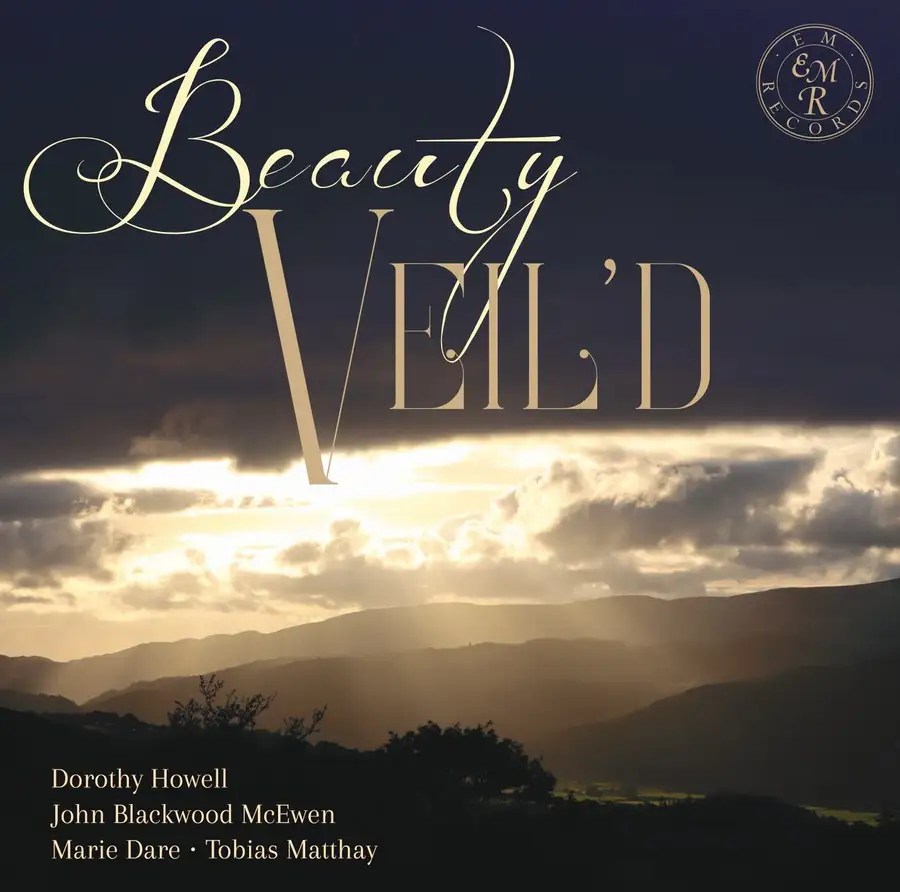
On Record – Berkeley Ensemble: Beauty Veil’d (EM Records)

Berkeley Ensemble [Sophie McQueen, Francesca Barritt (violins), Dan Shilladay (viola), Gemma Wareham (cello)] with Tom Wraith (cello, Dare), Simon Callaghan (piano – Dare, Howell Adagio and Caprice, Matthay)

Dare Phantasy Quintet (1933-4)
Howell Adagio and Caprice (1955); String Quartet in D minor (1933)
Matthay Piano Quartet in C major Op.20 (1882, rev.1905)
McEwan Nugae (1912)

EM Records EMRCD091 [58’13”]
Producer Matthew Bennett Engineer Dave Rowell

Recorded 28-30 August 2024 at St John the Evangelist, Oxford

Reviewed by Richard Whitehouse

What’s the story?

EM Records continues its in-depth exploration of neglected music with these first recordings by proceeding generations of British composers, superbly realized by the Berkeley Ensemble which has made it its mission to revive such works for the enjoyment of present-day listeners.

What’s the music like?

Remembered mainly for miniatures still featuring on Associated Board examinations, Marie Dare (1902-76) wrote several larger chamber works. The (not quite) symmetrical form of her Phantasy Quintet is adeptly handled, and if this piece does not quite maintain the expressive intensity of its initial section, the elaboration of its themes ensures a satisfying overall design. The presence of two cellos yields a burnished eloquence to the musical textures, and interest is sufficiently aroused to make a hearing of her String Quartet in G minor worth considering.

More striking are the two works by Dorothy Howell (1898-1982), the revival of whose music has centred on her orchestral output. Deftly scored for violin and piano, Adagio and Caprice moves between reticence and impulsiveness with a seamless cohesion. If the String Quartet is slightly less well integrated, it is also more questing harmonically with its opening section distilling a keen atmosphere that persists right through to a lively close. A pity Howell never wrote a full-length quartet, but the present pieces deserves their place on recital programmes.

His not uncontroversial reputation as piano pedagogue having overshadowed his legacy as a composer, Tobias Matthay (1958-1945) left a handful of chamber works of which the Piano Quartet prefigures the ‘phantasy’ concept in its single movement of interrelated sections that, between them, outline a formal design whose thematic elements are evolving right up to the resolute close. Worth hearing, but a complete recording of 31 Variations and Derivations on an Original Theme for piano is needed for a fuller reassessment of Matthay’s creative worth.

Ironic that Matthay’s Piano Quartet should have been dedicated to John Blackwood McEwan, whose subsequent condemnation of his teaching led to the former’s departure from the Royal Academy. Subtitled Seven Bagatelles and actually the fifth of his 17 string quartets, Nugae evokes various aspects of that Scottish landscape central to his thinking (notably the Solway Symphony) – its characterful alternation between brooding and animated vignettes making a cohesive sequence whose components would be equally worth hearing as separate encores.

Does it all work?

Pretty much always. There are no overlooked masterpieces here, though the works by Howell and McEwan certainly warrant regular hearings. That these are all premiere recordings makes this release a mandatory purchase for anyone interested in British music of the period and the Berkeley Ensemble, alongside Tom Wraith and Simon Callaghan, do them proud. The sound could hardly be improved on for clarity and definition, while Dan Shilladay’s annotations are informative and not unduly partisan in their making a case for the dissemination of this music.

Is it recommended?

It is indeed. Those who have the Chilingirian Quartet’s three volumes of McEwan’s quartets (Chandos) will welcome acquiring the present piece as a supplement, and one looks forward to further recordings of chamber works by Dare and Howell from these inquiring musicians.

Listen / Buy

You can hear excerpts from the album at the EM Records website, and explore purchase options at the Presto website. Click on the names to read more about the Berkeley Ensemble, Simon Callaghan and Tim Wraith, and composers Marie Dare, Dorothy Howell, Tobias Matthay and John Blackwood McEwan

Published post no.2,801 – Tuesday 17 February 2026

In concert – Southbank Sinfonia / Rebecca Miller: Discovering Dorothy Howell

Southbank Sinfonia / Rebecca Miller

St John’s, Waterloo, London
Thursday 19 September 2019

Dorothy Howell
The Rock Overture (1928)
Divertissements (1950)
Humoresque (1919)
Koong Shee Ballet (1921)

reviewed by Ben Hogwood
photo credit (Rebecca Miller) Richard Haughton

It remains an acute embarrassment to classical music that even today it is still so male-orientated when it comes to composers and conductors in particular. Happily measures are in place to address the imbalance, which means that not before time Dorothy Howell (1898-1982) gets some of the attention her music should have been getting 100 years ago. Great credit for this should go to the Southbank Sinfonia and their associate conductor Rebecca Miller, a devotee of the composer who had led the orchestra in a week-long exploration of her music, working with members of Howell’s family.

The result was an hour of music making that everyone enjoyed. It has been a while since I have watched an orchestra with so many smiles, yet still on their game. There were many smiles as Miller teased the syncopated dance rhythms out of the music, revelling in the composer’s nickname of ‘the English Strauss’.

Such a nickname is a little dangerous, as it immediately brings parallels to the waltz, and a tendency toward lighter entertainment rather than anything substantial. With that in mind it should be pointed out that Howell’s output of 150+ works includes a Piano Concerto (recorded by Miller and her husband, pianist Danny Driver, for Hyperion) and some substantial chamber music.

Dorothy Howell (above)

This ‘rush hour’ concert began with an overture / tone poem. The Rock, contrasting with Rachmaninov’s moody symphonic work of the same name, still felt like a place for nature to let itself go. Bright woodwind and an expansive orchestral picture transported us out onto the windswept coast, where attractive flute melodies and tonal harmonies combined to give a breezy outlook. There were a few pitfalls below the surface, Howell occasionally hinting at something darker in the lower strings, but this was a persuasive and energetic account.

Next we heard the Three Divertissements, a short but appealing work with its roots in the dance. Published as Howell’s last orchestral work, its three movements are each in triple time, furthering the Strauss connections – but in the first one working a nice line in syncopation to make the beat elusive for even the keenest of dancers. Rebecca Miller (below) enjoyed these, dancing on the podium herself, and the players clearly did too, with the heat haze created by the strings in the slow second dance particularly memorable. Clarinet, flute, oboe and cor anglais once again excelled, with a special mention for triangle and tambourine, putting the finishing touches to a performance with a smile on its face and a spring in its step.

The short Humoresque was cut from the same cloth, but the Koong Chee ballet felt much more substantial. Based on a Chinese crockery pattern, the work derived from a plot in a lush garden, with a lake populated by pelicans and flamingos, and with the daughter of the owner promised in marriage falling instead for the gardener. Lovestruck, she was swept away – or not, as the case may be, for Howell left an elusive ending.

The colours of this work would have resonated with those who enjoy the Eastern-leaning orchestral works of Holst or John Foulds, but again Howell’s edge could be felt with the light rhythmic touch she was capable of adding. In Miller she had the most passionate advocate, the conductor admitting in her introduction that it is an ambition to stage the work with dancers one day.

That would be an enjoyable experience, for her introduction was ideal and gave us helpful pointers for the point in the story where the woman is imprisoned (Rebecca Watt’s cor anglais solo was heartfelt here) or when the woman’s father shoots at the gardener, his two arrows hitting their target where the percussion were concerned.

My interpretation of the ending would be that it was bittersweet, the father regretting his decision to shoot the arrows but exonerated as the gardener did not die. At least, that’s what the music told me – for once again it was a colourful and committed account that fired the imagination.

The Southbank Sinfonia should be applauded for their dedication to Howell’s cause, their dedication and enthusiasm creating a wholly enjoyable concert. The welcome to audience members should also be praised, creating an environment where concert-goers new and old are equally welcome. More power to their elbows!

Danny Driver and Rebecca Miller recently released their recording of Dorothy Howell’s Piano Concerto on Hyperion, with more details below: