Online concert – Daniel Rowland, Maja Bogdanović, English Symphony Orchestra / Kenneth Woods: Sawyers: Concerti

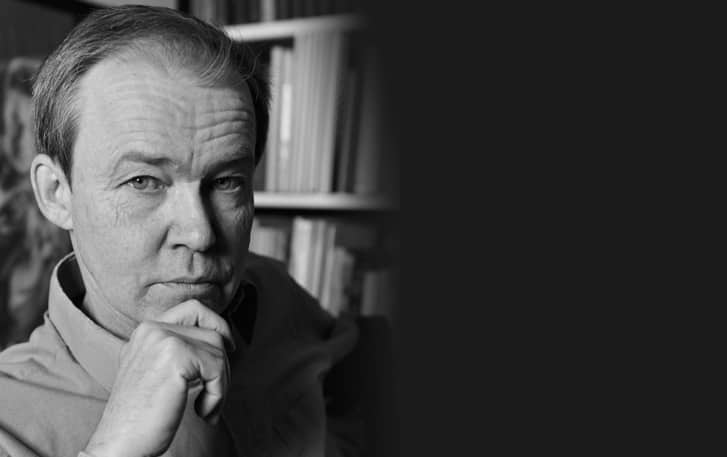
Philip Sawyers (above)
Double Concerto for Violin and Cello (2020)
Viola Concerto (2020)

Daniel Rowland (violin, viola), Maja Bogdanović (cello), English Symphony Orchestra / Kenneth Woods

Filmed at the Wyastone Concert Hall, Monmouth, Thursday 3 March 2022. Producer Phil Rowlands / Videographer Tim Burton

by Richard Whitehouse. Photo of Daniel Rowland and Maja Bogdanović (c) Stefan Bremer

Since returning to composition with a vengeance almost two decades ago, Philip Sawyers has created a varied output dominated by six symphonies along with five concertos that between them confirm the professionalism of his writing and a sensitivity to the instrument(s) at hand. Two of them were written, one after the other, in 2020 and received their public premieres at Hereford and Great Malvern in March last year.

Daniel Rowland (violin), Maja Bogdanović (cello)

Before that, they were recorded at one of the English Symphony Orchestra’s Wyastone sessions and it is these accounts which feature here. The live performances were covered when part of their respective concerts (see the reviews of the Double Concerto and Viola Concerto respectively), hence it only needs to be added that the studio recordings more than compensate for any lack of spontaneity with what they gain in subtlety of characterization.

The conviction of these readings should only be abetted when they are commercially issued on 6th March, as part of the ESO’s latest Sawyers release which also features his Octet for ensemble and Remembrance for strings (its public premiere to be given by the Leamington Chamber Orchestra at Holy Trinity Church, Leamington Spa on Sunday March 26th). Good news, moreover, that his oratorio Mayflower on the Sea of Time, whose premiere at the 2020 Three Choirs Festival fell victim to the pandemic, is to receive its first hearing later this year.

This concert can be accessed free until 28 February 2023 at the English Symphony Orchestra website, but remains available through ESO Digital by way of a subscription. Meanwhile click on the names for more on the English Symphony Orchestra and Kenneth Woods, or on composer Philip Sawyers. Meanwhile the new recording release mentioned above can be viewed and purchased in advance here

In concert – English Symphony Orchestra / Kenneth Woods – American & Canadian Sounds 2

Roman Kosyakov (piano), Rebecca Wood (cor anglais), Stuart Essenhigh (trumpet), English String Orchestra / Kenneth Woods

Barber Adagio for strings Op.11a (1936)
Still (arr. Zur) Dismal Swamp (1935)
Gershwin (arr. Farrington) Rhapsody in Blue (1924)
Copland Quiet City (1941); Appalachian Spring (1945)

Kings Place, London
Sunday 19 February 2022

Reviewed by Richard Whitehouse

London appearances by the English Symphony Orchestra being so infrequent, it was good to see an (understandably) scaled-down orchestra returning to Kings Place for the series American & Canadian Sounds that is taking place under the auspices of London Chamber Music Society.

The ubiquitous Adagio that Samuel Barber arranged from his only string quartet almost had to feature here, but that was no hardship given the excellence of the ESO’s playing – the silence after its climax rightly made the focal-point around which this whole performance revolved.

Although his music never entirely went away, the extent of William Grant Still’s output has barely been explored so all credit to Kenneth Woods for championing Dismal Swamp (heard here in an effective reduction by Noam Zur). Taking its cue from a short yet intense poem by playwright Verna Arvey (Still’s second wife), this 15-minute tone poem evokes the no-man’s land between Virginia and North Carolina across which escaped slaves once fled to freedom. Its concertante role for piano subtly embedded into the orchestral texture, the music charts a progression from sombre desperation to outward elation through a subtly extended tonality (Still having studied with composers as distinct as Chadwick and Varèse) whose apotheosis elides resolve and equivocation with a fervency which was tangibly in evidence.

Roman Kosyakov was the admirable pianist here as in George Gershwin’s Rhapsody in Blue. This also was heard in reduction, Iain Farrington’s arrangement combining the immediacy of Ferde Grofé’s original scoring with the Europeanized grandeur of his later orchestration. Placing the piano rear-centre of the platform likely accounted for any occasional failings of coordination, but Kosyakov’s characterful playing – not least in the lengthy developmental cadenza and ensuing ‘big tune’ – held one’s attention through to the indelible closing bars.

The play by Irwin Shaw for which he wrote incidental music might have passed into history, but Quiet City is among Aaron Copland’s most effective shorter pieces – its halting dialogue between cor anglais (Rebecca Wood) and trumpet (Stuart Essenhigh) given context by the modal plangency of its string writing.

The programme ended with Copland’s Appalachian Spring – heard here in the familiar suite but in the original orchestration with its prominent part for piano, along with solo woodwind contributions that stand out more clearly against the string nonet. Familiar as this music may be, its understated harmonic shadings and keen rhythmic ingenuity are never easily realized in performance, and it was testament to the ESO’s playing that the piece emerged as vividly and as cohesively as it did. In particular, the penultimate sequence of variations on ‘Simple Gifts’ had an unforced eloquence (the last statement of the Shaker hymn eschewing any hint of bathos) which carried through into the coda – its evocation of community no less affecting for being so idealized, and in music such as more than warrants that misused term ‘iconic’.

A rewarding programme and a welcome London appearance by the ESO, which will be back in action next month with (inter alia) a concert at Oxford’s Sheldonian Theatre that features a major new work by Robert Saxton as part of the orchestra’s ‘21st Century Symphony Project’

For more information on the artists in this concert, click on the links to read about Roman Kosyakov, Kenneth Woods and the English Symphony Orchestra. For more on the London Chamber Music Society, click here – and for more on composer William Grant Still, click here

Online concert – Zoë Beyers, English Symphony Orchestra / Kenneth Woods: Elcock: Violin Concerto

Elcock Violin Concerto Op.13 (1996-2006)

Zoë Beyers (violin), English Symphony Orchestra / Kenneth Woods

Filmed at the Wyastone Concert Hall, Monmouth, Thursday 26 May 2022. Producer Phil Rowlands / Videographer Tim Burton

by Richard Whitehouse

The English Symphony Orchestra’s online schedule got off to a fine start for this year with a studio account of the Violin Concerto by composer-in-association Steve Elcock. It may have taken shape across nearly a decade, but the work is no less impressive for that. It also marks something of a transition from less ambitious pieces, often conceived with local musicians in mind, to the symphonic works as have recently been performed and recorded to great acclaim – whose formal as well as expressive concerns it anticipates and shares in various instances.

The concerto opens with an Allegro vivo whose rhythmic energy is maintained throughout, yet with sufficient contrast for its second theme to assume greater emotional emphasis in the reprise, prior to a forceful conclusion. The undoubted highlight is a Molto tranquillo whose haunting main theme, first unfolded by the soloist over undulating upper strings in a texture evidently inspired by change-ringing techniques, is a memorable inspiration. A pavane-like idea latterly comes into focus and the closing stage, which opens onto an eloquent plateau before evanescing almost regretfully into silence, lingers long in the memory. The finale is a relatively taut passacaglia whose theme accelerates through five variations from Andante to Presto, culminating in a combative ‘cadenza’ for violin and timpani then a decisive pay-off.

A tough challenge, indeed, for any soloist and one such as Zoë Beyers and the ESO, under Kenneth Woods, met with assurance over its 33 minutes. Aside from its sheer velocity, the first movement is notable for a close-knit interplay between soloist and orchestra here brought off with admirable precision, while the modal subtleties of the slow movement were deftly rendered as enhancements to its overall tonal trajectory. If its sequence of accelerating variations seemed to be over rather too soon, the finale was nevertheless a cohesive entity that saw this piece to a defiant conclusion.

Good to hear that this performance will be released commercially in due course, as a coupling for the Eighth Symphony which the ESO premiered in 2021 and the tone poem Wreck it gave last year – hence making for a persuasive overview of this increasingly significant composer.

This concert can be accessed free until 7 February 2023 at the English Symphony Orchestra website, but remains available through ESO Digital by way of a subscription. Meanwhile click on the names for more on the English Symphony Orchestra and Kenneth Woods, or on composer Steve Elcock

In concert – April Fredrick, English Symphony Orchestra / Kenneth Woods – The Journey Home: Haydn, David Matthews, Barber & Mozart

Haydn Symphony No. 45 in F sharp minor, Hob.I:45 ‘Farewell’ (1772)
David Matthews Le Lac Op.146 (2018)
Barber Knoxville: Summer of 1915 Op.24 (1947)
Mozart Symphony no.36 in C major K425 ‘Linz’

April Fredrick (soprano), English Symphony Orchestra / Kenneth Woods

Great Malvern Priory, Malvern
Wednesday 23 November 2022

Reviewed by Richard Whitehouse

The English Symphony Orchestra’s season really hit its stride this evening with a programme featuring two major vocal works of the 20th and 21st centuries, heard alongside two notable while very different symphonies from near the start and towards the end of the Classical era.

As Kenneth Woods indicated, Haydn’s ‘Farewell’ Symphony would have been determinedly avant-garde to early listeners, and much of that innovative quality came over here. Not least in the initial Allegro, its jagged course and disjunctive tonal shifts only nominally countered by the Adagio’s increasingly fraught introspection. With its stark alternations in motion and phrasing, the Menuetto proved a telling foil to a finale where a turbulent Presto precedes an Adagio whose eloquence was sustained as the music subsides and musicians vacate the stage.

Whether or not this symphony would have been better placed at the end of this concert, it set up productive contrast with David Matthews’s Le Lac. Remembered more as statesman than poet, Alphonse de Lamartine was a crucial figure in French literature of the early Romantic period – his lengthy 1820 poem a remembrance of lost love comparable to verse by Shelley and Heine, and one whose slowly intensifying rapture is to the fore in this evocative scena. Two orchestral interludes aside, its formal and emotional progress is essentially determined by the vocal line; with which April Fredrick was at one in conveying the wistfulness but also anguish inherent of this music. The fastidious textures were no less finely delineated by the ESO, Woods sustaining a cohesive overall trajectory from earlier promise to ultimate loss.

Evidently it was Fredrick who had suggested juxtaposing this piece with Barber’s Knoxville: Summer of 1915, which pairing succeeded admirably in terms of underlining conceptual and expressive links between them. Its sense of loss may be psychological rather than personal, but an emotional force comes over tangibly for all this music’s overt restraint: James Agee’s poetic reportage summoning a response the more affecting for its restraint and in whose vocal part Fredrick was never less than attuned. Woods brought no mean sensitivity or character to orchestral writing such as eschews the rhetoric found in many of Barber’s earlier scores and so foreshadows the subtlety of those two decades hence. This is a work with few significant precursors or successors, and the present reading made the most of its singular atmosphere.

The evening concluded with the relative extroversion of Mozart’s ‘Linz’ Symphony – a piece whose having been written in four days doubtless occasioned its technical brilliance, yet also a formulaic quality to its actual substance. Not, however, in an Andante whose gentle pathos was to the fore, or a Menuetto whose brevity belies its resourceful use of woodwind. Woods found a winning effervescence in the initial Allegro, and if the second-half repeat in the final Presto may be one such too far, this music’s Haydnesque wit was never less than appealing.

It set the seal on a well-conceived and finely executed concert that, in pivoting between the established and unfamiliar (not only between but also within works) typifies thr resourceful approach to programming with which Woods and the ESO have now become synonymous.

For more information on the artists in this concert, click on the links to read about April Fredrick, Kenneth Woods and the English Symphony Orchestra. For more on composer David Matthews, click here

In concert – Kathryn Rudge, English Symphony Orchestra / Kenneth Woods – Across The Sea: Mendelssohn, Elcock, Britten & Elgar

Mendelssohn Calm Sea and Prosperous Voyage Op.27 (1828)
Elcock Wreck Op.10 (1998) [World Premiere]
Britten Four Sea Interludes from Peter Grimes Op.33a (1945)
Elgar Sea Pictures Op.37 (1899)

Kathryn Rudge (mezzo-soprano), English Symphony Orchestra / Kenneth Woods

Malvern Theatres, Great Malvern
Saturday 15 October 2022

Reviewed by Richard Whitehouse

This first full-length concert in the English Symphony Orchestra’s new season focussed on the sea in all its varied qualities, taking in four works whose encompassing a span of almost two centuries also identified crucial aesthetic differences as to what music itself can express.

Not least as it comes between masterpieces of the early Romantic era (A Midsummer Night’s Dream and The Hebrides), Mendelssohn’s Calm Sea and Prosperous Voyage has often been overlooked on its own merits. Yet this concert overture, as inspired by two of Goethe’s best- known poems, is a fine example of the still-teenage composer’s prowess – Kenneth Woods securing a rapt intensity in its introductory phase, then steering its characterful continuation through to a grand while not unduly bathetic peroration with the sea accorded the final word.

From here to Steve Elcock’s Wreck is to encounter more elemental, even existential forces – what the composer refers to as a ‘‘symphonic allegory’’ portraying a ship’s struggle against intemperate weather at sea. This unfolds as a constantly evolving design, juxtaposing music of unchecked aggression with that of fraught serenity, while highlighting Elcock’s mastery of large-scale formal and expressive contrasts, toward a seismic culmination whose gradual subsidence makes possible the sustained closing section. Here, off-stage mezzo sings in an invented (hence unknown) language what he describes as ‘‘a message of salvation beyond despair, of consolation beyond grief’’ but even this is tempered by encroaching doubt. The ESO gave its all in a piece as demonstrably commended itself to the appreciative audience.

Marine vignettes rather than epics came after the interval. Woods had an audible grasp of the diverse moods in the Four Sea Interludes that Britten drew from his opera Peter Grimes, but more notable was his successful segueing between them – the keening plangency of Dawn leading into the equivocal assurance of Sunday Morning, emergent tonal and emotional blur of Moonlight, then the visceral conflict of Storm with its yearning oasis of calm and brutal closing onslaught. A few failings of ensemble hardly offset the intent continuity of the whole.

The ESO previously recorded Elgar’s Sea Pictures in an arrangement with chorus by Donald Fraser, but it was good to hear this song-cycle as Elgar realized it for mezzo – not least when Kathryn Rudge (taking her customary place at front of stage) proved so eloquent an exponent. The troubled pathos drawn from Roden Nole’s Sea-Slumber-Song was duly complemented by the whimsical charm of Alice Elgar’s In Haven (Capri) – tension rising accordingly for Elizabeth Barrett Browning’s Sabbath Morning at Sea, its larger emotional contrasts well defined. Expressive nuances in Richard Garnett’s Where Corals Lie might have been more subtly pointed, but there was no doubt as to Rudge’s identification here or in Adam Lindsay Gordon’s The Swimmer with its anxious though determined progress to certain affirmation.

It set the seal on a rewarding programme and fine start to what will hopefully be an eventful season for the ESO. More concerts will be announced soon, but for now the recent release of Adrian Williams’s First Symphony (Nimbus NI6432) confirms this as an orchestra on a roll.

For more information on the artists in this concert, click on the links to read about Kathryn Rudge, Kenneth Woods and the English Symphony Orchestra. For more on composer Steve Elcock, click here