Simon Desbruslais (trumpet), English Symphony Orchestra / Kenneth Woods
Sibelius Rakastava Op.14 (1893, arr. 1912) Sawyers Concerto for Trumpet, Strings and Timpani (2015) Dvořák Notturno in B major Op.40 (1870, arr. 1883) Fribbins Soliloquies (2012, arr. 2017) Elgar Introduction and Allegro for strings Op.47 (1905)
Hall One, Kings Place, London Sunday 15 April 2024
Reviewed by Richard Whitehouse
Concerts by the English Symphony Orchestra in the London Chamber Music Society’s season are always a worthwhile fixture and this early-evening event, in its mixing established classics with contemporary pieces, demonstrated the stylistic range and sympathies of this ensemble.
A pity that Sibelius’s Rakastava has never been taken up by many British conductors – John Barbirolli and Sir Colin Davis excepted – as this extensive reworking for strings and timpani of an early choral work should be a staple of its repertoire. Kenneth Woods duly brought out the wistful poise of The Lover, and if the stealthiness which underpins The Way of the Lover seemed just a little tentative, the bittersweet pathos that permeates Good evening, Farewell then came through unabated in what is as moving a leave-taking as its composer ever penned.
The music of Philip Sawyers has been a constant feature of the ESO’s programming this past decade, and his Trumpet Concerto more than deserved revival. The outward Classicism of its formal trajectory should not belie the deftness by which Sawyers modifies the sonata design of its opening Allegro, the impetus and reflectiveness of its main themes finding accord prior to a trenchant cadenza with timpani at the fore, or a central Andante that exuded an emotional breadth and fervour in advance of the excellent recording by these artists. Among the leading trumpeters of his generation, Simon Desbruslais – placed high to the rear of the auditorium, to potent effect – was wholly unfazed by its demands; nor those of a final Allegro in which more reflective elements leaven the initial energy, only to be outdone in the virtuosic closing bars.
Next, a welcome hearing for the Notturno that Dvořák salvaged from an early (and reckless) quartet. Its relative swiftness here recalled its intermediate reworking as an intermezzo in the second of his string quintets, so emphasizing its appealing lilt over any more ethereal quality.
Desbrulais (above) returned after a brief hiatus for Soliloquies by Peter Fribbins. A composer as adept on a symphonic as on a miniature scale, these brief if affecting pieces draw on three earlier songs – the recasting of whose vocal line encourages the soloist to an eloquence that, after the relative restraint of the initial Adagio and central Tranquillo, comes to the fore in a final Adagio where evocation takes on an almost cinematic aura. With impressive concertos for piano and violin to his credit, Fribbins ought to consider a full-length work for trumpet.
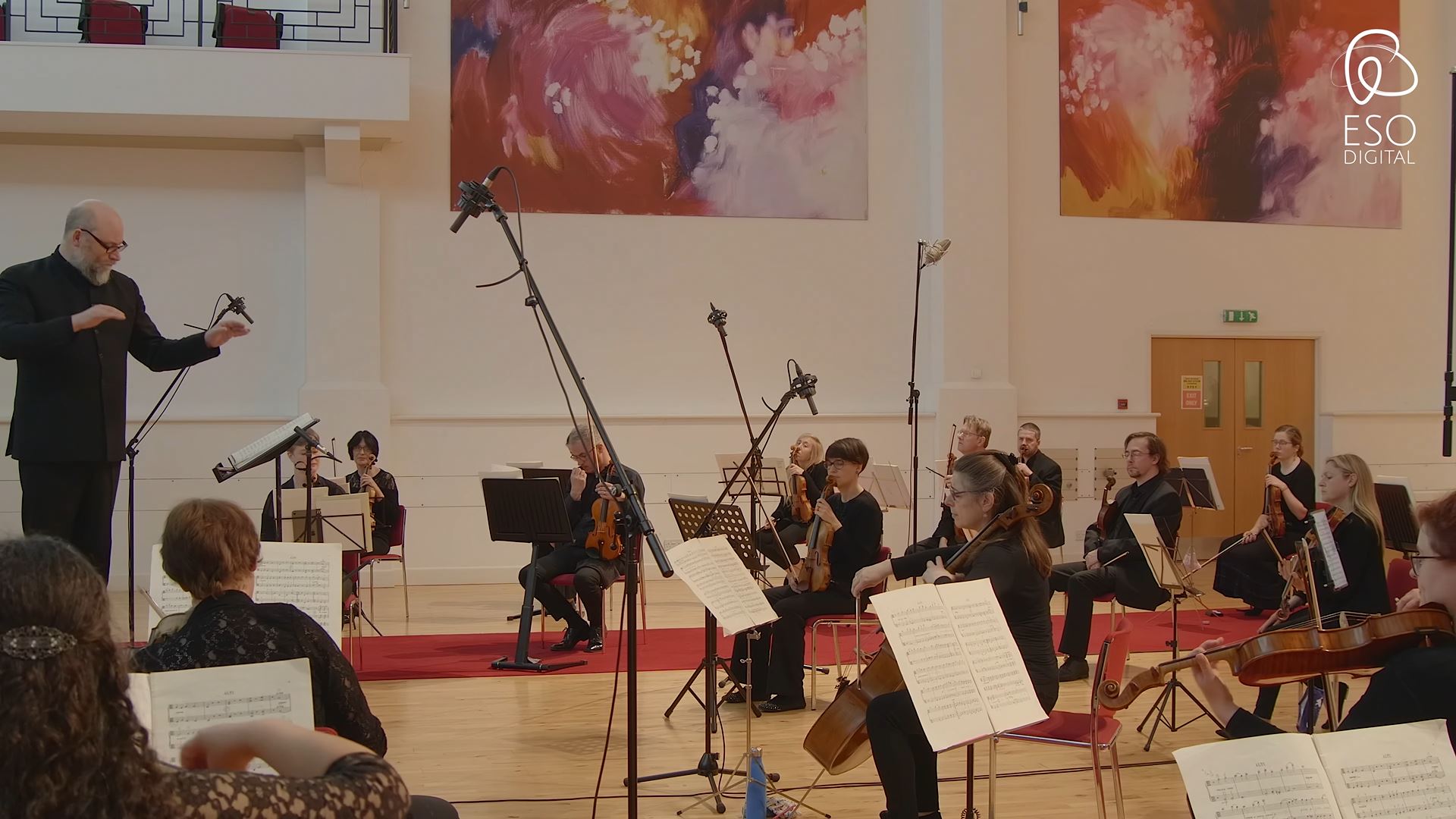
Elgar’s Introduction and Allegro has not unexpectedly been key to the ESO’s repertoire since its founding some 45 years ago, and this performance did not disappoint. Most admirable was the variety and depth of string tone that Woods (a one-time professional cellist) secured from only 19 players, so ensuring a vitality and impact in the more animated sections together with the requisite delicacy in those passages where the composer’s ruminative mood is uppermost. Both aspects were brought into thrilling accord at the close of the powerfully projected coda.
Beforehand, Woods spoke of the changing nature of commissions and the current difficulties in securing the necessary funding. This season has not been easy for the ESO though, on the basis of this programme, these players are commendably taking it all in their collective stride.
Musicians of the English Symphony Orchestra / Kenneth Woods
Doolittle Woodwings (2018, arr. 2021) Gál Divertimento for Wind Octet, Op. 22 (1924) Dvořák Serenade in D minor, B77 (1878)
Henry Sandon Hall @ Royal Porcelain Works, Worcester Saturday 14 October 2023 (4pm)
Reviewed by Richard Whitehouse
Entitled Music for Humans, the coming season from the English Symphony Orchestra promises a wide array of pieces such as focus on what can be achieved through the art of communication and, conversely, what can result when that communication breaks down. This afternoon’s concert enabled the ESO woodwind (along with some of its brass and a couple of its strings) to come into its own with a varied programme as featured music from a regular ESO collaborator, one whom the orchestra has often championed and one who ranks among the greatest of any era.
It may have originated as a wind quintet, but Woodwings by Emily Doolittle (from Halifax, Nova Scotia and now based in Glasgow) proved no less effective when recast for 10-strong wind ensemble (with cello and double-bass) – songs and calls of nine Canadian birds heard over five characterful movements. These range from the playfully assertive Bobolink, via the inwardly plaintive Hermit Thrush and the quizzically engaging Winter Wren, to the cumulatively arresting Snow Goose then a Night Owls finale whose freeform evolution makes for an intriguing and enticing pay-off. First played by the ESO in Kidderminster just over two years ago, it once again provided an appealing concert-opener and certainly bodes well for the 2024-25 season, when Doolittle becomes the ESO’s Composer-in-Association.
The success of his Divertimento was a notable marker for the burgeoning career which Hans Gál enjoyed during the earlier inter-war period, and it remains among the most personable of his chamber works. ‘Intrata’ affords a keen indication of what is to come with its juxtaposing of the martial, hilarious and confiding, proceeded by the capricious exchanges of Pagliazza (inspired by the eponymous tower in Florence?) then the wistful interplay of Cavatina with Gál’s handling of wind sonority at its most beguiling. The mood turns towards the whimsical in the by no means genteel humour of Intermezzo grazioso, before the piece is rounded off with those varied character-portrayals of Pifferari – its title alluding to a group of itinerant musicians playing upon a variety of pipes, and thereby bringing matters to a diverting close.
Although less often performed than its earlier counterpart for strings, Dvořák’s Serenade for Winds (plus cello and double-bass) is arguably more indicative of where his genius lay. The martial theme of its opening Moderato is leavened by a ruminative poise that comes into its own with the minuet-like successor, its felicitous contours duly finding contrast through the animated gaiety of its Presto trio-section. The ensuing Andante is undoubtedly this work’s emotional heart – its eloquence redolent of Mozart in its understatement but also intimation of more ambivalent emotion in the ominous central stage or bittersweet fatalism at its close. From here the final Allegro steers an impulsive but also lilting course through to a climactic restatement of the march theme, then on to a coda that ends the work in exhilarating fashion.
In this judiciously balanced selection, ESO woodwind was heard at its most stylish in music whose appeal belies its technical challenges for individuals and ensemble alike. Next month the orchestra heads to Malvern for an imposing double-bill of Tchaikovsky and Shostakovich.
Just a decade after he became conductor of the English Symphony Orchestra, Kenneth Woods looks back on his varied career in the US and UK, then considers what might be coming next.
interview by Richard Whitehouse
Autumn customarily sees the start of a new concert season for UK orchestras – except when, of course, the requisite financial support is not forthcoming. That could easily have been the case for the English Symphony Orchestra were it not for its ambitious schedule, as detailed in the document Music for Humans, which reflects the convictions and the vision of several persons who work for and as part of this ensemble – notably its chief executive officer Seb Lovell-Huckle and, above all, its principal conductor and artistic director Kenneth Woods.
With his extensive discography and frequent appearances online or on radio, Woods is not exactly a ‘best kept secret’ among British or – given he hails from the USA – British-based musicians, but his contribution to British musical life during the past two decades is a very substantial one and worth reflecting on for any consideration of music-making in the UK during that period. Speaking to him recently in Worcester, where the ESO has its HQ and gives many of its concerts, brought some of these achievements into closer perspective.
A native of Madison (capital of the state of Wisconsin and which, situated adjacent to five lakes with various historic landmarks including several buildings designed by Frank Lloyd Wright, surely ranks among the most visually striking cities of America’s upper mid-west), Woods did his early academic training here and at Indiana University before doctoral studies at the University of Cincinnati. Here he studied conducting at the College-Conservatory of Music and assisted Jesús López Cobos, music director of the Cincinnati Symphony Orchestra.
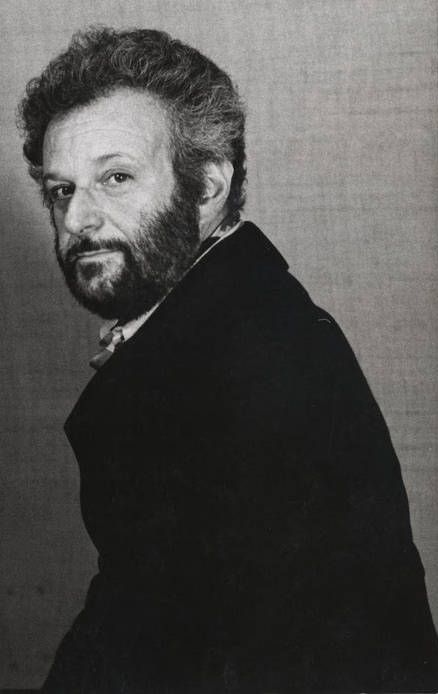
Subsequent mentors included Leonard Slatkin, David Zinman and Jorma Panula, but the most decisive influence was Gerhard Samuel (above) who, in 21 seasons with the Cincinnati Philharmonia, programmed a wide range of unfamiliar and contemporary works. Those who were present are unlikely to forget their London visit in 1989 featuring the UK premiere of the Symphony by Hans Rott, while his later recordings include Larry Austin’s realization of Ives’s Universe Symphony and the entertaining ‘Symphony of 1825’ allegedly by Schubert but now known to be a publisher’s concoction – on both of which, Woods features in the cello section. Also a composer, with a distinctly though never inflexibly contemporary idiom, Samuel remains a totemic musical figure whose undoubted significance Woods continues to acknowledge.
‘‘Working with Gerhard was important not just in terms of honing my conducting technique, but also in helping me to understand that the responsibility of a conductor give audiences a chance to hear works from outside the canon, whether new works or lost works of the past. His long experience of bringing to life pieces such as Hans Rott’s Symphony and Mahler’s orchestration of Beethoven’s Ninth showed me the positive impact a conductor can make simply by giving an unknown work a chance to be heard rather than simply written about.”
The latter was a challenge Woods took on with directorships of the Grande Ronde Symphony and Oregon East Symphony orchestras at the end of the last century then into the new one. During the 2000’s he also maintained an active collaboration as Principal Guest Conductor with the Rose City Chamber Orchestra in Portland. Guest engagements included the BBC National Orchestra of Wales, Northern Sinfonia and the State of Mexico Symphony (a 2004 account of the first movement from Prokofiev’s Fifth Symphony can be heard on YouTube below). He continued (and continues) to appear as a cellist, notably as part of the string trio Ensemble Epomeo with whom he worked widely in the decade from 2008 and made several recordings.
‘‘Playing with Epomeo was a great opportunity to explore a repertoire which is much more extensive than often imagined, and to extend that repertoire through timely revivals and new commissions. It also enabled us to approach the issue of music education a slightly different way, the Auricolae album bringing new music to younger listeners via the retelling of often familiar stories and commissioning composers whose music they’ll more than likely enjoy when they’ve heard it. Any regret at disbanding was tempered by the knowledge of what we achieved over that decade, and what we all learned from that intensity of collaboration with one another. I’d hope we can be proud of what we’ve contributed to the string trio medium’’.
Having relocated to the UK in the mid-2000s and pursued a varied freelance career, Woods’s major break came when he was appointed principal guest conductor of the Orchestra of the Swan in 2009. The following four years brought several notable projects, most significantly a first recorded cycle of the symphonies by Hans Gál. Although he lived out his long life as a respected pedagogue in Edinburgh, Gál never regained the eminence he enjoyed in Germany and Austria prior to the Third Reich. Both as cellist and conductor, Woods has done as much as any musician to bring about fuller reassessment of a composer who not merely continued the Austro-German lineage but took this in often unexpected and intriguing directions. Even the cycle of symphonies had come about through an unlikely succession of circumstances.
‘‘Having conducted the first recordings of Gál’s orchestral music [Violin Concerto, Violin Concertino and Triptych for Orchestra] with the Northern Sinfonia, our producer Simon Fox-Gál [grandson of the composer] and I were excited to do the symphonies together. Thomas Zehetmair and the Northern Sinfonia had already recorded the first two for Avie, so Simon thought it would be diplomatic for me to start with the Third and Fourth to avoid any direct competition. It was my dear friend Melanne Mueller [Managing Director of Avie] and her husband Simon Foster [Avie’s co-founder] who suggested before we’d recorded a note that we announce this project as a complete cycle. It was a big risk as we didn’t have funding in place, but things don’t happen in this business unless you decide to make them happen. I was keen from the start to couple each of these symphonies with one by Schumann, as this gave a relevant context for listeners to approach Gál while allowing me to record interpretations of works that I’d often conducted and about which I felt I had something worthwhile to say’’.
The critical and popular reaction to these releases certainly justified the confidence placed in Woods by label and producer. The resulting cycle, part of the Avie label’s extensive coverage of Gál’s output, was later reissued as a standalone double-set but the originals remain of value for underlining the continuity of thinking across centuries between these composers and their aesthetic connections. Was Woods at all surprised that these recordings failed to translate into public performances of the Gál symphonies, or that other conductors failed to take them up?
‘‘More disappointed than surprised. Much unfamiliar music remains so, not through its lack of appeal for players or listeners but because orchestra managers and promoters simply won’t take any risk – preferring to schedule what they know will attract an audience, without any real thought as to expanding a repertoire that has become more restricted in terms of Baroque or Classical music through notions of authenticity, and in contemporary music because of the failure to commission more substantial pieces as might occupy the second half of a concert’’.
It was just such thinking that Woods was able to put into practice with the English Symphony Orchestra. Founded by William Boughton in 1978 as the English String Orchestra and based in Malvern, it enjoyed a successful spell in the concert hall and recording studio – promoting a wide range of music with an emphasis on British music of the early and mid-20th century. Having stood down in 2006, Boughton was replaced by a sadly ailing Vernon Handley – his death two years later leaving the orchestra in a period of uncertainty until 2013, when Woods became director of its Malvern concert series – becoming principal conductor the following year and its artistic director in 2016. From the outset, he was keen to make commissioning and recording of new pieces central to the ESO’s activities. Its first such undertaking was the 2014 violin concerto Wall of Water by Deborah Pritchard, which also saw the orchestra renew its long-term association with the Nimbus label, but Woods was already thinking in terms of a more ambitious strategy which duly resulted in the ESO’s 21st Century Symphony Project.
‘‘Three events led me to conceive of this project. First, early on in my conducting studies, my experience of learning Brahms’s First Symphony when I found myself imagining the amazing feeling those present at the premiere in 1876 must have had in witnessing a seminal addition to the repertoire. Why shouldn’t it be possible to enjoy a similar experience today? Second, performing Philip Sawyers’s Second Symphony with ’the Swan in 2013 when the musicians, listeners and I all experienced something akin to those at the premiere of the Brahms. Third, having commissioned Philip’s Third Symphony when I joined ESO, I realised that it needn’t be a one-off. My new post with the ESO was the catalyst so here we are over a decade later – the project having come through a pandemic and associated lockdowns, with six symphonies commissioned and premiered, and more to follow as we start on this project’s second phase’’.
Indeed, what started out as the commissioning, performing and recording of nine symphonies in as many years has evolved into a process featuring composers new to and already involved with the project. Following on from Sawyers’s Third, it has seen the premieres and recordings of David Matthews’s Ninth, Matthew Taylor’s Fifth, Steve Elcock’s Eighth, Adrian Williams’s First and Robert Saxton’s Scenes from the Epic of Gilgamesh. Six very different works from six very different composers, all confirming the validity of the symphony in the present day.
Alongside this project, Woods revived the ESO’s Composer-in-Association chair – beginning with John McCabe then, after his untimely death in 2015, the post was re-named in McCabe’s memory and has since been occupied by Philip Sawyers (now Composer Laureate), Adrian Williams, David Matthews and Steve Elcock. Again, the exact nature of this role depends on the incumbent but Woods is keen these composers represent who the ESO is and what it does.
‘‘It’s not just a matter of commissioning then premiering their new works, but of having their active involvement at the time of composition and rehearsal; of reviving some of their earlier pieces, and maybe getting their input as to how we might schedule their music in the context of an overall concert. Hopefully it also gives audiences the chance to become more familiar with the composer as a ‘real person’ instead of merely a name in the programme. I feel sure that the quality of what these composers have been writing for us is its own justification’’.
In addition to overseeing the ESO’s educational and social activities (not least the ESO Youth Academy with its extensive schedule of courses at beginner, intermediate or advanced levels, performances by ESO musicians at residential care-homes and ‘relaxed’ concerts of a more informal nature), Woods has a longstanding blog A View from the Podium that tackles issues pertinent to the music-world from a wholly non-partisan angle; unafraid to stir controversy on topics of wider relevance than is often evident from their coverage in the mainstream media.
Since 2018 Woods has been in charge of the Elgar Festival – a two-day series of concerts and recitals with related events held on the weekend nearest to the composer’s birthday (June 2nd), while making full use of the various places and venues associated with Elgar’s home county.
‘‘Given the region in which most of our concerts take place, it made sense to revive the Elgar Festival and perform his music at venues associated with his life and work in the region. It’s also been a welcome opportunity to include music by recent and contemporary composers who come audibly within the Elgar lineage, and I’m aiming with next year’s festival to try a reordering of the conventional concert programme to feature familiar pieces by Elgar next to others that might spring a few surprises, but which I hope the audience will enjoy hearing’’.
It would be remiss not to mention the Colorado MaherFest which Woods took over from long -serving founder Robert Olson in 2016, and whose remit he has successfully expanded while remaining true to the spirit of an event endorsed by the International Gustav Mahler Society.
‘‘Taking on directorship of MahlerFest after Robert was a daunting prospect given how many years he had been at its helm and the performance tradition he’d established during that time. Of course, I have my own convictions as to Mahler interpretation, and our performances have been able to utilize recent developments in scholarship such as the new critical edition of the First Symphony [published by Breitkopf and Härtel] we gave in 2019. Here again, I was keen to expand the context in which this music was performed – both in terms of medium, Mahler having left little else apart from symphonies or songs, and in other composers heard here. We think of programming in terms of celebrating Mahler’s influences such as Beethoven, Wagner and Schumann. Also we explore his artistic and creative ties to contemporaries in a variety of media – whether artists like Klimt and Roller, writers, philosophers or, of course, composers. We’ve performed contemporaries like Robert Kahn and Zemlinsky, and last year there was Alfredo Casella [the First Cello Sonata], who was an active supporter of Mahler’s music in Italy when it was all but unknown there.”
The festival also aims to look forward. “Finally, we try hard to raise awareness of the music of composers who were influenced by Mahler. This includes modernists such as Schoenberg, Berg and Webern, together with more tonal composers such as Krenek, Schulhoff and Weill. This opens the door to the music of those composers who were either murdered or forced into exile by the Nazis such as Krása, Gál or Ullmann; not to mention such as Korngold, Waxman and Steiner, who founded the art of film scoring as we understand it today. This can only lead to a wider appreciation of Mahler’s legacy and hopefully encourage others to seek out music they would otherwise not have performed or heard, thereby enriching their own experience’’.
A more recent move has been making the final concerts of MahlerFest available on CD or for download, enhancing a discography that makes Woods among the most recorded of present-day conductors. Along with releases for the Avie, Nimbus, Signum, Somm and Toccata labels, plans are well advanced for the ESO’s own label – drawing on a wealth of material recorded at the Wyastone studios in Herefordshire during the pandemic and its aftermath, besides such as the complete symphonies of Sibelius. Nos. 5, 6 and Tapiola are planned as the first release.
There may be lots to be proud of in terms of achievement, but Woods is hardly one to rest on his laurels, not least because the future of those projects here outlined – indeed, even the very future of the ESO is not something that could, or should, be taken for granted. A full schedule of events is now in place until next spring, with much in the pipeline after that as long as the finances are there to make it happen. Given that his negotiating skills are no less adept than his conducting skills, Woods is quietly optimistic that things will come together as intended.
‘‘It’s not always been an easy process in securing funds to make possible what we’ve wanted to commission and perform, but then nobody working in this field in the UK expects to have it easy, so I’m just pleased that we’ve accomplished as much as we have so far. There’s much more that I want to achieve with the ESO, so we’ll have to keep finding ways to make things happen. What I do know is that there are composers who have much to give an audience, and that these listeners are more than willing to give this music a try given the right conditions’’.
Such things are vital, not least at a time when the value of what might reasonably be called the Western Cultural Tradition is being questioned as never before. This being the case, and while accepting that ‘the situation’ is likely to get worse before getting better, can one look forward to a further 10 years of the English Symphony Orchestra with Woods at the helm? ‘‘It might be best to ask me that in 10 years’ time, but I’d hope the answer would be ‘yes’’’.
The latest addition to the English Symphony Orchestra library of online music is the first performance of Philip Sawyers‘ major choral work, Mayflower on the Sea of Time.
With its ‘luminous and ecstatic choruses’ picked out by Richard Whitehouse in his review of the initial concert, this is an affirmative and major piece by one of the finest contemporary English composers.
Soprano April Fredrick and baritone Thomas Humphreys are joined by the ESOChorus and English Symphony Orchestra in the premiere from Worcester Cathedral, given on 17 June this year.
April Fredrick (soprano), Thomas Humphreys (baritone), ESO Chorus, English Symphony Orchestra / Kenneth Woods
Dvořák Symphony no.9 in E minor Op.95 ‘From the New World’ (1893) Sawyers Mayflower on the Sea of Time (2018) [World Premiere]
Worcester Cathedral Saturday 17 June 2023
Reviewed by Richard Whitehouse
This final concert of the season by the English Symphony Orchestra brought us the premiere of a piece delayed from three years ago. Philip Sawyers’ Mayflower on the Sea of Time was to have been launched at the Three Choirs Festival in April 2020, but the pandemic derailed this as so many other events. Happily, the tenacity of conductor Kenneth Woods has paid off such that the composer’s largest work so far was finally heard, and in the venue originally intended, making for a notable addition to the English choral tradition and one wholly on its own terms.
Commissioned to mark the 400th anniversary of the sailing of the Mayflower from Leiden to Plymouth and thereby founding the United Sates of America, this is an oratorio in concept but equally a choral symphony in its overall design and thematic cohesion. Its libretto, mainly by the artist Philip Groom, features set-pieces for various figures from the Old and New Worlds duly taken by soprano and baritone soloists (those for treble being allotted to sopranos in the chorus), but these along with ones for chorus are drawn into an inherently musical evolution.
Formally, there are four continuous parts. Persecution and Journey, a sonata design such as informs the Pilgrims’ flight from religious persecution and their decision to cross the Atlantic; Arrival in the New World, a slow movement charting their embarkation and tentative initial interaction with native peoples; Survival and Making our Community, a scherzo where the Pilgrims’ industriousness and idealism quickly becomes its own justification; and Our New World, a rondo-finale whose looking to the future is framed by choruses of growing fervour.
As befits such a work, the choral writing is both extensive and resourceful – not least when it elides between depicting Pilgrims or Natives, and that of a more abstract commentary. No less assured, the writing for soprano and baritone allows Sawyers’ lyrical impulse free reign – not least in extended sections toward the end of the second and fourth parts; the latter, especially, rendering comparable passages by Delius or Tippett from a perspective wholly of the present. On either side, luminous and ecstatic choruses accentuate an essentially affirmative message.
The contributions of April Fredrick (no stranger to Sawyers via her long association with the ESO) and Thomas Humphreys could hardly be faulted for commitment or insight, while that of the ESO Chorus exuded a power and immediacy amplified by the resonance of Worcester Cathedral’s acoustic as to belie its relatively modest numbers. The ESO gave its collective all throughout, projecting the textural intricacy and emotional heft of music whose longer-term formal integration was securely conveyed through Woods’s precise yet unobtrusive direction.
Before the interval, Woods gave a notable account of Dvořák’s Ninth Symphony. The poised anticipation of its introduction and visceral drama of its coda were highlights of the opening Allegro, proceeded by a Largo of an eloquence epitomized by rapt cor anglais playing from Louise Braithwaite. Contrast between the incisiveness of the Scherzo’s outer sections and the lilting delicacy of its trio was pointedly underlined, then the final Allegro surged onward to a coda paying tribute to 19th-century symphonism while blazing a trail for what was to come.