In concert: Pavel Haas Quartet at Wigmore Hall – Suk, Martinů & Korngold

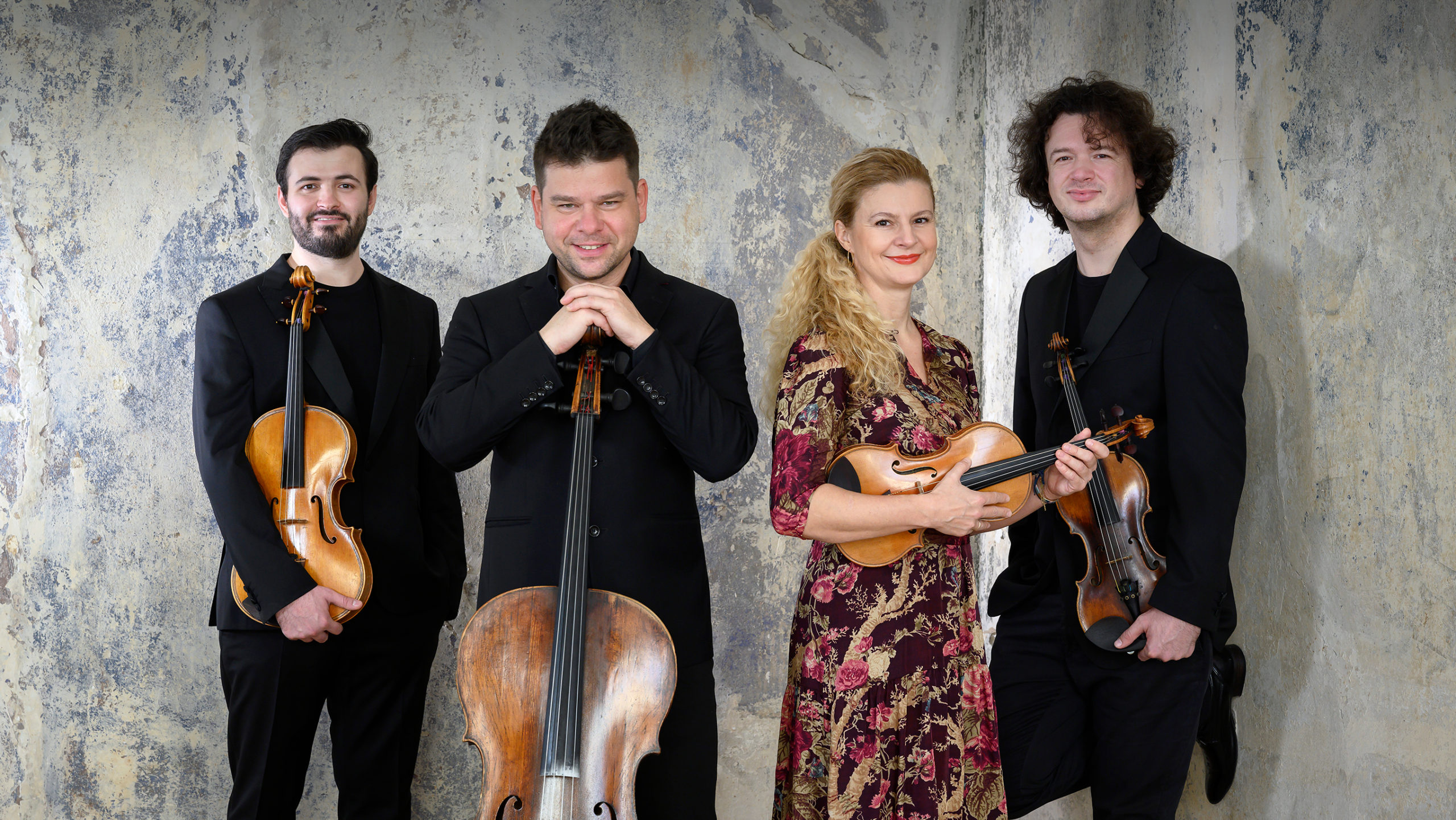
Pavel Haas Quartet [Veronika Jarůšková, Marek Zwiebel (violins), Šimon Truszka (viola), Peter Jarůšek (cello)]

Suk Meditation on an old Bohemian Chorale (St Wenceslas) Op.35a (1914)
Martinů String Quartet no.2 (1925)
Korngold String Quartet no.3 in D major Op.34 (1944-45)

Wigmore Hall
Monday 12 June 2023 1pm

by Ben Hogwood

An unusual and intriguing program from the Pavel Haas Quartet contained music by two fellow Czech composers (Suk and Martinů) and one (Korngold) born in Moravia before moving to America.

The quartet began with a moving piece by Suk, his Meditation on an old Bohemian Chorale (St Wenceslas). This poignant pre-war utterance carried an air of deep profundity right from the first phrase of Simon Truszka’s viola, its elegiac tone enhanced by relative lack of vibrato. The air of solemnity carried throughout, though there was considerable strength in depth as the music grew in stature.

Though a Czech composer, Martinů spent a good deal of time overseas – largely out of necessity. By his early 30s he was in Paris, studying with Roussel, bringing a neoclassical language and tidiness to his music. The String Quartet no.2, though, is a curiously lopsided work, very front heavy with its first movement a combination of substantial slow introduction and quick section. There were close links to the St Wenceslas Chorale here, too, found in the solemn intonations of the Andante. This was the spiritual heart of the piece, dark and uncertain at times and contrasting greatly with the thoughtful but lightly coloured manner in which the quartet began. A resolute first movement found a mood that Martinů reprised in the closing Allegro, a propulsive dance number with a spring in its step. There was an undeniable French flavour to the music here, which the Pavel Haas Quartet brought forward, its elegance at odds on occasion with the rustic dance tunes.

There was tension in the final work, too, though this was undeniably the making of a mature composer. The String Quartet no.3 was Erich Korngold’s last published chamber piece, adjacent in publication to the Violin Concerto, with which it shares the same key of D major. The Pavel Haas Quartet gave a superb account of the piece, exploring its unusual musical language through music that would have presented considerable technical challenges.

The awkward but compelling violin melody in the first movement was brilliantly negotiated by Veronika Jaruskova, who conveyed its uncertainties through sweet tones and phrases. In spite of a convincing and full bodied outburst from all four players, the movement was dominated by this figure, which left a question in the mind. The Scherzo went some way to answering this, a black and white film scene easy to conjure up in the mind as the furtive darting of the main theme ensued. Again this was brilliantly played, as was the heart melting trio, its big tune (from the recently completed score to Between Two Worlds) full of tender longing and given appropriate glissando for expression.

The silvery slow movement flickered in the half light like a candle burning low, but with the flame essentially undimmed. The quartet’s sense of purpose was key here, with burnished lower string tones as viola and cello often combined, a notable cushion on which the searching violin melodies (using material from The Sea Wolf) could rest. Romance was in the air but although some of the music was borne of Hollywood, its intimate confines gave the music a deeply personal air. The atmosphere was heightened as a thundercloud hovered over the Wigmore Hall.

The motorised finale brought conviction and a strong sense of homecoming, not dissimilar to its equivalent movement in the Violin Concerto. Although emphatic in its resolution there were moments where the quartet moved into a different tempo or unexpectedly distant harmonies, Korngold momentarily distracted by edgier thoughts until his focus returned.

The Korngold string quartets have had something of a renaissance of late, with several new recorded versions and a marked increase in performance. On this very cultured evidence it would be no surprise if the Pavel Haas Quartet committed their version to disc soon – but it is to be hoped the other works will join it, for this was a fine concert indeed.

For more livestreamed concerts from the Wigmore Hall, click here

In concert – Nicola Benedetti, BBC Symphony Orchestra / Sakari Oramo: Romantics in Exile – Korngold & Langgaard

BBC SO/Oramo & Benedetti - Romantics in Exile

Korngold Violin Concerto in D major Op.35 (1945)
Langgaard
Symphony no.1 in B minor BVN32, ‘Mountain Pastorals’ (1908-11)

Nicola Benedetti (violin, below), BBC Symphony Orchestra / Sakari Oramo

Barbican Hall, London
Friday 8 April 2022

Written by Richard Whitehouse. Concert photos by James Watkins / BBC

Sakari Oramo has certainly blazed a trail for tackling little-known symphonic works during his tenure at the BBC Symphony Orchestra – witness his recent revival of the Symphony by Dora Pejačević and now that of the First Symphony from Danish anti-hero Rued Langgaard.

One who frequently snatched defeat from the jaws of victory, Langgaard (below) could not have had a better start to his career than its premiere with the Berlin Philharmonic and Max Fiedler on 10th April 1913, just before his 20th birthday. Its enthusiastic reception was never repeated in his remaining four decades, the composer traversing various stylistic phases while fighting a psychological battle with the Danish musical establishment. With its inspiration in Sweden’s Kullaberg peninsula, this work remains testament to the vaunting ambition of his younger self.

Steering a cohesive course across this almost hour-long piece whose sizable forces (not least four Wagner tubas) is no easy task, but Oramo succeeded more convincingly than on any of the three commercial recordings. Not least in a first movement, Surf and Glimpses of Sun, whose elongated sonata design and increasingly histrionic climaxes could so easily veer into overkill, rather than yielding a recklessly if purposefully cumulative momentum. Mountain Flowers is a slow movement of no mean eloquence, not least with Oramo encouraging the strings to relish the limelight over its opening and closing stages then towards its expressive apex. The undoubted highlight is Legend, less an intermezzo than a dark-hued formal crux whose ominous atmosphere looks on toward those anguished confessionals which lay ahead.

More conventional is Mountain Ascent, a lively and often playful scherzo whose impetus finds ready contrast with the wistful trio at its centre. Rendered here with suitable deftness, this made an admirable foil to Courage – an expansive finale not without its longueurs yet whose development affords some strikingly evocative orchestration, then an apotheosis for which Oramo not only prepared judiciously, but that the BBCSO kept within focus even as the addition of off-stage brass threatened to send those closing pages spinning out of orbit.

An experience, then, such as only a live performance can provide, and which demonstrably played to the strengths of this partnership. Might one hope that Oramo and the BBCSO give Langgaard’s Sixth, arguably his symphonic masterpiece, at a Proms concert in due course?

A thought occurred that had the Danish film industry maintained its promise prior to the First World War, Langgaard might have found as productive an outlet for his abilities as Korngold had for his during the golden age of Hollywood. The latter’s Violin Concerto was not always the familiar item it has now become, and Nicola Benedetti’s rendering assuredly conveyed its essence. Pointing up the discreet contrast between the themes of its opening Moderato, with a trenchant account of its cadenza, she gave a finely shaped if overly generalized account of its central Romance, then projected the final Allegro’s incisiveness and high-flown melodrama with relish. Nor did she undersell the suavity of Jacob Gade’s tango Jalousie – a piece which, 97 years on, confirms what is possible if a composer does not entirely eschew popular appeal.

For further information on the BBC Symphony Orchestra’s 2021/22 season, click here For more on Erich Korngold and Rued Langgaard, click on the composer names – and click on the artist names for more information on Nicola Benedetti and Sakari Oramo

In concert – Dr Samantha Ege, CBSO Youth Orchestra / Joshua Weilerstein: Korngold, Tchaikovsky & Price

Samantha-Ege

Korngold Schauspiel-Ouvertüre, Op. 4 (1911)
Price Piano Concerto in D minor (1932-4)
Tchaikovsky Symphony No. 5 in E minor, Op. 64 (1888)

Dr Samantha Ege (piano, above), CBSO Youth Orchestra / Joshua Weilerstein (below)

Symphony Hall, Birmingham
Sunday 27 February 2022

Written by Richard Whitehouse. Picture of Joshua Weilerstein (c) Sim Canetty-Clark

The year’s first concert by the CBSO Youth Orchestra programmed a staple of the symphonic repertoire with two works by composers whose success in their lifetimes subsequently faded almost to oblivion, only to meet with renewed acceptance in a very different cultural climate.

It might have been the first such piece he himself orchestrated, but Overture to a Drama finds the 14-year-old Erich Korngold in command of late-Romantic forces with a tonal opulence to match. Best here are the ominously modal introduction which returns transformed in a defiant peroration, and while the main sonata design rather goes through the motions – not least a ‘by numbers’ development – it engaged due to Joshua Weilerstein’s astute direction, not least his bringing out the wistful charm of its second theme (eloquently played by oboist Elly Barlow).

Florence Price’s Piano Concerto was met with a distinctly equivocal response when given at last year’s Proms, and it made a comparable impression today. The introduction – soloist in ruminative dialogue with trumpet and woodwind – promises much, but the actual Andantino proceeds rather dutifully to a half-hearted climax. This heads into a central Adagio where the piano arabesques elegantly dovetail with instrumental solos (notably cellist Eryna Kisumba) in a manner redolent of Edward MacDowell’s once-ubiquitous D minor Concerto. The final Allegretto unfolds to the rhythm of the Juba (precursor of Ragtime), but the overall effect is tepid compared to its use in Price’s symphonies, even if Samantha Ege (replacing an injured Jeneba Kanneh-Mason) might have made more of its vivacity on the way to a forceful close.

A prominent academic as well as pianist, Dr Ege recently met with considerable acclaim for her album of Price’s piano music Fantasie Nègre (Lorelt), and it would be well worth hearing her in a concerto of greater substance such as those by Adolphus Hailstork or George Walker.

Weilerstein (above) works extensively with youth orchestras, and there was doubting his rapport with these players in Tchaikovsky’s Fifth Symphony. Pensive if never turgid, the first movement’s introduction passed seamlessly into an Allegro whose rhythmic tensility held its expressive fervour in check. The coda’s march-past then found meaningful contrast with the sepulchral start of the Andante, its indelible horn theme (lucidly rendered by Alex Hocknull) part of an inevitable unfolding capped by a stormy return of the ‘fate’ motto and coda of gentle pathos.

Segueing unexpectedly but effectively into the Valse, Weilerstein duly made the most of this music’s elegance and insouciance. Nor did he lose focus in the Finale’s opening restatement of the motto-theme, whose appearance can all too easily pre-empt what follows. There was no lack of impetus as the music built purposefully towards an apotheosis whose affirmation was shorn of bombast, nor any risk of hectoring with the triumphal surge to the close. This is never an easy piece to bring off, and the present performance was rarely less then convincing.

For more information on this concert, click here – and for information on the artists click on the names Samantha Ege and Joshua Weilerstein. Websites dedicated to Korngold and Florence Price can be accessed by clicking on the composer names.

75 years ago today – the first performance of Korngold’s Violin Concerto

Today marks 75 years to the day since the premiere of Korngold’s Violin Concerto. Like much of this composer’s work, the Violin Concerto took a while to gain popularity, but since we have moved into the 21st century it has taken up a much more regular position in the concert hall.

In her excellent biography of the composer, Jessica Duchen tells the story of the concerto, and how it was suggested to Korngold for close on 30 years by his friend Bronislaw Huberman, founder of the Palestine Orchestra (later the Israel Philharmonic). The regular suggestion became something of a running joke until 1945, when Korngold unexpectedly produced a completed score for the concerto. Ultimately the work had its first performance on 15 February 1947, with the incomparable Jascha Heifetz as soloist and the St. Louis Symphony Orchestra conducted by Vladimir Golschmann.

As you will hear from this live performance with violinist Hilary Hahn and the Deutsche Symphonie Orchester under Kent Nagano, the work has an intense, lyrical profile from the start, shot through with the descriptive powers Korngold used to such good effect in his film scores. There is a longing quality to the first movement especially, a nocturnal second and an energetic third which generates impressive momentum to the finish.

Watch and see what you think:

In concert – CBSO Centre Stage: CBSO strings play Kodály & Korngold

CBSO-Strings

Kodály Serenade, Op. 12 (1919-20)
Korngold
String Sextet in D major, Op. 10 (1914-16)

CBSO Strings: Kate Suthers & Charlotte Skinner (violins), Adam Römer & Jessica Tickle (violas), Miguel Fernandes & Helen Edgar (cellos)

CBSO Centre, Birmingham
Thursday 27 January 2022 2pm

Written by Richard Whitehouse

Two unfamiliar while appealing works were featured in this afternoon’s Centre Stage recital given by string players from the City of Birmingham Symphony Orchestra, written during the early stages and in the aftermath of the First World War at a pivotal time in European culture.

The focus on choral and pedagogic music of Kodály’s later years makes his earlier chamber works the more valuable, and while the Serenade for two violins and viola is by no means the most imposing, its deftness and finesse of writing for this unusual line-up cannot be gainsaid. The lively outer movements abound in those allusions to and inflections of folk melodies that Kodály explored extensively in his maturity, with the central Lento touching upon a vein of ‘night music’ less inwardly intense than if equally evocative to that found in the music of his contemporary Bartók. Its relatively extended formal trajectory can make the final Vivo seem unduly prolix, yet in so buoyant and finely integrated a performance, there was no likelihood of this movement forgoing any sense of direction on its way to a decidedly nonchalant close.

Kodály was around 30 when writing this piece, whereas Korngold was barely out of his teens when he finished the Sextet as draws equally on very different (if by no means incompatible) stylistic traits evident in works for this medium by Tchaikovsky and Schoenberg. If the latter composer is to the fore in the lengthy initial Moderato with its intricate thematic interplay and frequent density of texture, the Adagio exudes a melodic eloquence denoting those operas or film-scores to come. The ensuing Intermezzo is arguably the most characteristic movement in its suavity and teasingly coy charm, while the Finale looks back to Brahms and even Dvořák (whose Sextet would be a welcome inclusion in these recitals) for its underlying vitality and easy-going humour as makes the coda’s rush to the finish the more unexpected and engaging.

Such was the impression left by a finely prepared reading by no means lacking in spontaneity or those flights of fancy such as denote the ‘confidence of youth’. Quintets are the order of the day for the next Centre Stage recital, which features contrasting works by Mozart and Brahms.

You can read more about that next Centre Stage recital, and book tickets, on the CBSO website