
Online Concert: Esther Yoo & Jae Hong Park @ Wigmore Hall – Debussy, Grieg, Rachmaninoff & Vieuxtemps

Esther Yoo (violin), Jae Hong Park (piano)

Debussy Violin Sonata in G minor (1916-7)
Grieg Violin Sonata no.3 in C minor Op. 45 (1886-7)
Rachmaninoff Vocalise Op. 34 no. 14 (1915)
Vieuxtemps Souvenir d’Amérique on ‘Yankee Doodle’ Op.17 (pub. c1845)

Wigmore Hall, Monday 6 November 2023 1pm

by Ben Hogwood

This was the first recital given in the UK by the relatively new team of violinist Esther Yoo and pianist Jae Hong Park – but on this evidence, many more will follow. Yoo has been a regular concert giver for ten years now, having joined the BBC Radio 3 New Generation Artist scheme in 2014, so it is easy to forget she is still just 29. Park, meanwhile, took first prize at the Busoni-Mahler Foundation Competition in 2021 and, at the age of 24, looks set for a fine future as soloist and chamber pianist.

The duo began with a fresh take on Debussy’s oft-heard Violin Sonata, his final completed work. The first movement has meaningful if short melodic cells and quickly changing moods, which both performers characterised to great effect, with Yoo’s intonation and phrasing particularly impressive. The second movement was lighter, before the Finale set off at quite a lick, Yoo’s commanding and very impressive virtuosity giving the music a great deal of energy. This was Debussy with a fresh coat of glossy paint, but with a great deal of feeling and understanding too.

Following the Debussy with Grieg’s third essay in the genre was a particularly smart move, as the two composers have closer parallels than one might think. The Violin Sonata no.3 in C minor is a particularly fine work, closely adhering to sonata principles while allowing the performers plenty of room for flights of fancy and characterisation. Both clearly love this work, for the crisp attack of the first movement was immediately gripping, the turbulent passages given the requisite drama. Yoo was fully invested in the fantastical aspects of Grieg’s writing, the violin dreamily floating at some points while swooping with full tone at others. Park ensured the forthright piano writing was delivered at just the right level, too, offering substantial support when needed. The slow movement had an appealing singing style, responding to Grieg’s marking of Allegretto espressivo alla Romanza, while the harmonic twists and turns of the third movement were high on red-blooded drama.

The pair followed with a set of extended encore pieces, beginning with a tasteful account of Rachmaninoff’s versatile Vocalise, which works particularly well in the Michel Press & Josef Gingold arrangement used here. Yoo’s long phrases were nicely floated, but in the following Souvenir d’Amérique on ‘Yankee Doodle’ by Belgian composer Henri Vieuxtemps she took the opportunity to go for broke. This is a great audience piece, with a brilliant send-up of the familiar theme, allowing for portamento, spiky snaps, quickfire left hand pizzicato and much more. In these hands it was a proper showstopper!

Then we heard a Korean folksong, the poignant Milyang Arirang – which, with its pentatonic melody, was not too far removed from the language of the Rachmaninov. A passionate central section and a free, rhapsodic coda were delightful – as was an extra bonus, an affectionate account of Elgar’s Chanson de matin.

For more livestreamed concerts from the Wigmore Hall, click here
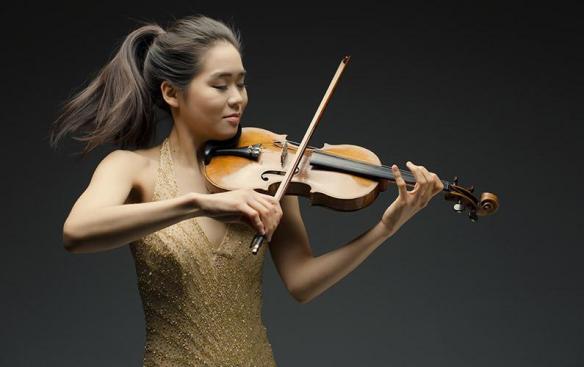
Wigmore Mondays – Esther Yoo & Zhang Zuo play Mendelssohn & Sibelius

esther-yoo

Esther Yoo (violin), Zhang Zuo (piano)

Wigmore Hall, London, 21 March 2016

written by Ben Hogwood

Audio (open in a new window)

http://www.bbc.co.uk/programmes/b07457qx

Available until 20 April

What’s the music?

Bach – Chaconne from the Solo Violin Partita no.2 in D minor, BWV 1004 (c1720) (15 minutes)

Sibelius – Sonatina for violin and piano in E major, Op.80 (1915) (12 minutes)

Glazunov – Grand Adagio from Raymonda (Act 1) (1898) (4 minutes)

Mendelssohn – Violin Sonata in F major (1838) (21 minutes)

Spotify

In case you are not able to hear the radio broadcast, here is a link to a playlist of the music played. Esther Yoo has not recorded any of it in violin and piano form, so substitute versions have been used:

About the music

Sibelius wrote a great deal of music for the violin but other than the famous Violin Concerto, very little of it is heard regularly these days. It is therefore a refreshing change to see the E major Sonatina listed. A relatively short work, it helped Sibelius through a particularly testing time with his finances.

Mendelssohn has a number of parallels with Sibelius where the violin is concerned, writing a famous Violin Concerto that gets played at the expense of pretty much everything else. Once again in this case there are works for violin and piano, and the Violin Sonata chosen for this concert is the most substantial, completed in 1838. For some unexplained reason it was not published in Mendelssohn’s lifetime, and was resurrected by Yehudi Menuhin in the 1950s.

Esther Yoo begins the concert alone, with Bach’s famous Chaconne – taken from his Solo Violin Partita no.2. It is a landmark in solo instrument writing, a tour de force of 64 different versions of the same sequence of chords that Bach develops with ever greater virtuosity.

She complements the Sibelius, meanwhile, with a short piece – an excerpt of a love scene from Glazunov’s ballet Raymonda.

Performance verdict

A refreshing program from Esther Yoo, who has just recorded a very well-received disc of Sibelius and Glazunov with Vladimir Ashkenazy.

It was particularly good to report a rare outing for the Sibelius Sonatina, a piece with energy and fresh invention that definitely sweeps away the cobwebs! Yoo and her musical partner Zhang Zuo (known as ‘Zee-Zee’) gave a performance full of enthusiasm and energy, giving Sibelius’ melodies a real shot in the arm. Prior to this Yoo had greatly impressed with her account of the Bach Chaconne, a deliberately slow and careful start gathering in pace and intensity, taking the fearsome technical challenges in her stride.

Glazunov’s Grand Adagio made a fitting complement to the Sibelius, invested with suitable passion, but the real discovery was the Mendelssohn, a piece of great craftsmanship and, in the slow movement, a depth of feeling unusual even for him. The two performers had great chemistry here and clearly enjoyed their interactions through the faster music, taking time in the slow movement to let the hymn-like passage sing.

An excellent concert concluded with a Korean folksong arranged for violin and piano, played with delicacy and then great gusto!

What should I listen out for?

Bach

1:28 – the violin begins with a grand statement of a chord sequence which it then proceeds to spin out over 64 variations, reaching great intensity in the string crossing around 7:30. The variations are set mostly in the minor key but move to the major at 9:15. Bach gives an enormous variety of colour, speed, attack, repose and musicality, starting relatively slowly but moving to passages of increasing difficulty and intensity, notably the string-crossing passage mentioned above, but this is also one of his most profound pieces of music when interpreted well. The music turns back to the minor key with impressive dramatic effect.

Bach often asks for the violin to employ ‘multiple stopping’; that is, playing more than one note at a time – which means the music can sound as though it is in many parts, despite still being played on the one instrument.

Sibelius

18:49 – a bold start from Sibelius, with the colour from the piano recognisably his. The grand introduction cuts to a quicker theme at 19:30 which suggests the outdoors. The music trips along at quite a pace – as so often Sibelius suggesting quick movement in his music. It also ends with a typical lack of fuss.

22:25 – the thoughtful second movement starts to spread its wings with the emergence of a rather beautiful melody from the violin.

27:03 – a broad melody on the lower register of the violin restores a grand air to the piece, though soon the violin twists upwards. The music gets faster again, returning us to the spirit of the first movement, with energy and grace in equal measure. Up to the end it becomes increasingly breathless, Sibelius throwing in a surprisingly light finish.

Glazunov

31:05 – as you might expect from a declaration of love in a Russian ballet, this is deeply passionate music, with a melody tailor made for the violin. With long phrases and sweeping gestures the music swoons. The violin reaches for the heights around 34:35, before sinking gracefully into a soft coda.

Mendelssohn

36:47 – it is difficult to understand why Mendelssohn did not publish his Violin Sonata when it starts as brightly as it does in this performance. A distinctive theme leads to close interplay between violin and piano. This being Mendelssohn there is a typically busy piano part, but there is a particularly nice, spring-like passage around 40:00 where the music slows and the composer’s lyrical side comes out.

45:38 – the slow movement is an unexpected treat, one of Mendelssohn’s most searching emotionally. It begins with a solemn statement on the piano, joined by the violin in

52:40 – a typically brisk Mendelssohn finale, the violin scampering off with the piano in hot pursuit. Initially there is barely room for breath, right up until a contrasting slower section.

Further listening

Yoo’s new disc would seem the ideal place to go next, containing Glazunov’s Violin Concerto as well as the one by Sibelius. It has been very well received and can be heard here:

Meanwhile you can watch a preview of the disc here: