Wigmore Mondays – Escher Quartet play Schubert’s ‘Death and the Maiden’

escher-quartet

Escher Quartet: Adam Barnett-Hart, Aaron Boyd (violins), Pierre Lapointe (viola), Brook Speltz (cello)

Photo by Sophie Zhai

Wigmore Hall, London

Monday, 8 February 2016

Audio (open in a new window)

http://www.bbc.co.uk/programmes/b06zjbv2

Available until 10 March

What’s the music?

Mendelssohn (1809-1847): Andante and Scherzo for String Quartet, Op.81/1 & 2 (1847) (10 minutes)

Schubert (1797-1827): String Quartet in D minor D810, ‘Death and the Maiden’ (1824) (40 minutes)

Spotify

The Escher Quartet have made recordings of the music of Mendelssohn, but these are not currently available on Spotify. Instead you can hear the music played by the quartet’s unofficial mentors, the Emerson String Quartet, on the playlist below – including the off-broadcast encore of Haydn:

About the music

Schubert’s Death and the Maiden quartet is arguably the most famous in the string quartet repertoire. It is certainly one of the composer’s finest works in the form, and brings with it a steely tone and darkness that had only really been heard before in the works of Beethoven.

The reason for its nickname lies in the second movement, a set of variations on a theme from a song of the same name written by Schubert in 1817. It is the emotional heart of the work, but there is plenty elsewhere that leaves a lasting and deeply felt impression. The way the quartet leaps out of the blocks at the start is striking, as is the quick chase of the last movement.

Schubert wrote the quartet in 1824, after a serious illness – and when he realised, at the age of 27, that he was not going to recover. It carries a lot of resentment and anger, but also a deeper resolve.

Mendelssohn also wrote his Andante and Scherzo in the final year of his life. They were the start of a projected seventh string quartet, but in the event were the only two movements written. Two earlier movements were added to make a set of four that were published as his Op.81, but the four pieces are rarely heard together.

Mendelssohn was suffering at the time of composition from a series of strokes, heavily aggravated by the death of his sister Fanny. He, like Schubert, died at such a young age – 38 – but you would never know from the size and maturity of his compositional output.

Performance verdict

The Escher Quartet gave a superb account of Death and the Maiden, achieving remarkable clarity and unity of ensemble in the striking unison moments, but also reaching great emotional depths in the Theme & Variations second movement. This was the heart of their performance, but technically their fast playing in the third movement Scherzo, with its driving syncopations, and the fourth movement, with its quick fire string writing, were hugely impressive.

Despite the prevailing darkness this was a performance that offered hope in the lighter moments that come along – the sunny disposition of the third movement Trio and the brief major key excursions of the finale being two examples. The end was utterly convincing.

The Mendelssohn made an ideal contrast, the lightness of the Andante enhanced by the velvety tone of Pierre Lapointe’s viola in the first variation on the theme. In the Scherzo the quartet’s unity was again in evidence, but so was the furtive nature of much of Mendelssohn’s arguments, fading to the end with unsettling speed.

As an encore – unfortunately not heard on the radio broadcast – we heard the slow movement from Haydn’s String Quartet in F minor Op.20/5. First violinist Adam Barnett-Hart dedicated this to Haydn himself, ‘the father of the string quartet’ – without whom the form would not even exist! It was an appropriate and affectionate finish to a very fine recital.

What should I listen out for?

Mendelssohn

1:30 – an airy Andante theme, light of touch. The variations on it begin at 2:18 where the viola takes the lead, after which there is a sweet violin solo. Despite the sunny air there is a note of nervousness too, realised at 4:39 when the music switches to the minor key. The theme returns at 6:03 – and all is now well as the music finishes quietly.

7:32 – the Scherzo is also light of touch, though much quicker – and here the nervousness is right to the fore. There are moments of subtle humour, and the music is in the form of a quick dance, but it is a shadowy outline too. There is a hint of a more fluid waltz at 10:55, but the music becomes detached again, petering out at the end.

Schubert

13:39 – the start of this quartet is one of the most instantly recognisable tunes in all string quartet writing, hurled out as a unison by all four instruments. The mood is immediately fraught, and Schubert makes frequent references to two themes – the one punched out at the beginning and a second, quicker one at 14:11. These compete for space throughout the first movement.

At 16:55 the music sweetens for the first time, but by 20:18 the main theme returns. The movement ends in brooding fashion.

25:58 – this is the centrepiece of the quartet, a movement of theme and variations. The theme, a solemn and very sad tune heard from the outset, seems almost inconsolable, but as Schubert begins to work his magic it becomes more flexible in musical content and mood. The violin is sweeter, while from 30:33 the cello takes over expressively. From 32:31 the quartet are united in driving forward. The music spends some time briefly in the sunny major key, but from 36:47 is ploughed back into a mood of sombre uncertainty, and the emotional climax of the movement from 37:30.

The final minutes are plaintive but ultimately positive, falling into silence at 39:44.

40:27 – the third movement is a Scherzo – and finds us resolutely back in the quartet’s ‘home’ key of D minor. The music drives forward with grim determination, but the clouds part at 42:05 for the ‘trio’ section, where the textures are lighter and the tune much sweeter. The respite is all too brief, though, and we head back to the scherzo music at 43:31.

44:35 – the last movement is a quick dash, the four instruments chasing as a pack with a distinctive tune that seems destined never to stop. Because this is a ‘rondo’ it is written in a certain form that means the main tune recurs several times, interspersed by a grand ‘B’ section (46:16) and a ‘C’ (47:02)

Encore (not heard on the broadcast)

The slow movement from Haydn‘s String Quartet in F minor Op.20/5 – one of the composer’s ‘Sun’ quartets.

Further listening

You can watch the Escher Quartet in the slightly earlier Quartet movement (Quartettsatz) by Schubert in the clip below:

There are some very fine late works from Mendelssohn to explore, darker though they have become because of the death of the composer’s sister. The F minor string quartet, published as Op.80, is especially good, as is the late String Quintet no.2 in B flat major, Op.87. Both can be found on the Spotify playlist below:

Under the surface – Mendelssohn Preludes and Fugues played by Howard Shelley (Hyperion)

mendelssohn-shelley

Composer: Felix Mendelssohn (1809-1847)

Nationality: German

What did he write? Schumann regarded Mendelssohn as the ‘Mozart of the nineteenth century’, as he was an uncommonly gifted child prodigy. A pianist as well as a composer, Mendelssohn is nonetheless better known for his orchestral and choral works. His five symphonies are best represented by the Scottish, the Italian and the Reformation (nos.3-5 respectively), while his most famous choral work – and one often performed by amateur choral groups – is the story of the Old Testament prophet Elijah.

The composer’s impressive body of chamber music is now better appreciated, headed by two Piano Trios and six published String Quartets.

What are the works on this new recording? Mendelssohn’s work for solo piano is often regarded as a set of attractive miniatures. This is doubtless due to the popularity of the Lieder ohne Worte (Songs Without Words), published in sets of six throughout the composer’s career. They are around three minutes each in length and carry attractive music and titles such as Venetian Gondola Song. On this recording, part four of a complete series of Mendelssohn piano music, Howard Shelley gives us the fifth book, a complement to the main work itself – the set of six Preludes and Fugues.

Mendelssohn was almost single-handedly responsible for the revival of Bach’s music in the nineteenth century, resurrecting the composer in a performance of the St Matthew Passion in Berlin in 1829, when Mendelssohn was still only 20. In the Preludes and Fugues he was paying a more obvious musical homage, using a form Bach had perfected for the keyboard.

What is the music like? When a composer writes a fugue it can sound as though they are showing off academically rather than communicating emotionally, but Mendelssohn brings to these works a strong sense of purpose and poise. His instinctive writing for the piano means the notes effectively play themselves, but they are not easy to play – which is where Howard Shelley comes in! Under his fingers the fugues really jump off the page when moving at pace, and the preludes each have strong personality.

Complementing them with Book 5 of the more romantic Songs without Words is a good move, and Shelley takes up the role of poet in the fanfare of the third piece or the lyrical Spring Song. Finally he adds the Andante cantabile e Presto agitato, an unpublished work of two halves, the first soft-hearted and the second bright and energetic.

What’s the verdict? This brilliantly played and recorded disc shows just how accomplished Mendelssohn’s writing for piano became, and with Howard Shelley completely mastering the technical demands the listener can appreciate the emotion of the music. The Preludes and Fugues are inspiring for their resilience, the Songs without Words for their poetic charm.

Give this a try if you like… Schubert, Chopin, J.S.Bach.

Listen

You can listen to excerpts from the disc at the Hyperion website

Meanwhile you can hear more of the composer’s Songs without Words on Spotify, in a complete set made by Daniel Barenboim:

Wigmore Mondays – Benjamin Appl & Graham Johnson

benjamin-appl-graham-johnson

Benjamin Appl (baritone) and Graham Johnson (piano) perform settings of the poetry of Joseph von Eichendorff

Wigmore Hall, London

Monday, 4 January 2016

Audio (open in a new window)

http://www.bbc.co.uk/programmes/b06tkp3w

Available until 3 February

What’s the music?

Schumann (1810-1856): Frühlingsfahrt Op.45/2 (1840); Der Einsiedler Op.83/3 (1850; Der frohe Wandersmann Op.77/1 (1840)

Mendelssohn (1809-1847): Pagenlied (1832); Nachtlied Op.71/6 (1847); Wanderlied Op.57/6 (1841)

Brahms (1833-1897): In der Fremde Op.3/5; Mondnacht; Parole Op.7/2; Anklänge Op.7/3 (all 1852-1853)

Pfitzner (1869-1949): In Danzig Op.22/1 (1907); Der Gärtner Op.9/1 (1888-9); Zum Abschied meiner Tochter Op.10/3 (1901)

Wolf (1860-1903): Nachruf (1880); Das Ständchen; Der Musikant; Der Scholar; Der Freund (all 1888)

Spotify

Benjamin Appl has not yet recorded any of this repertoire, but a reproduction of his program using available versions can be accessed below, for listeners who cannot hear the BBC broadcast. Where possible I have used recordings made by Appl’s mentor, Dietrich Fischer-Dieskau:

About the music

Joseph_Eichendorff

Joseph von Eichendorff (picture used courtesy of Wikipedia)

With around 5,000 song settings of Joseph von Eichendorff’s poetry from the 19th century alone – with thanks to BBC Radio 3 announcer Sara Mohr-Pietsch for the info! – Benjamin Appl and Graham Johnson had no trouble making up a concert of 18 ‘lieder’ for the first Wigmore Hall lunchtime concert of the year.

Their choice gives an intriguing insight into different approaches to the poet. Broadly speaking, Schumann ranges from love-laden to thoughtful and a little morose (though his selection comprises three prayers), Mendelssohn is either forthright or reflective in his three songs; the youthful Brahms is surprisingly relaxed, while Pfitzner emerges as an inventive painter. Perhaps the most striking examples here come from Hugo Wolf, who wanted to focus on the ‘comparatively unknown humourously and robustly sensual side’ of von Eichendorff’s poetry.

Performance verdict

A slightly downbeat return for the WIgmore Hall in 2016, but a concert that was beautifully performed. The pairing of an incredibly experienced pair of hands in Graham Johnson and a singer starting out on his artistic voyage in Benjamin Appl was a good match and yielded many rewards.

Several songs left lasting impressions from the program, among them two from Brahms, with Appl’s control throughout Mondnacht and the picture painting from Johnson in Parole especially notable.

It was good to hear some rarely-sung lieder of Hans Pfitzner, whose use of the piano’s lowest end brought a wholly new texture to In Danzig, while the Wolf selection reminded us how original he could be in his song settings, the piano cast in a prominent role of scene setting, one that Johnson relished and used to his great advantage.

What should I listen out for?

Schumann

2:06 – Frühlingsfahrt (A spring journey) – the initial optimism of this march is quite bracing, but it soon subsides as the poet thinks of old age.

5:31 – Der Einsiedler (The hermit) – quite a sad song, solemn and lost in thought. Again old age is a preoccupation, the piano supporting the vocal melody as a walking stick might support the physical frame.

9:02 – Der frohe Wandersmann (The happy wanderer) – a much more positive, open-air march that talks of streams ‘rushing down the mountains’ and larks that ‘soar heavenwards’. More spring than winter!

Mendelssohn

11:03 – Pagenlied (Page’s song) – a tentative detached figure in the piano part adds to the tension of this song, which is relatively subdued and distracted.

13:11 – Nachtlied (Night song) – there is a withdrawn feel to this song also, until the Nightingale is encouraged to sing out at 14:39.

16:12 – Wanderlied (Song of travel) – a typically busy piano part from Mendelssohn gives the impression of rapid movement, the traveller set on his way with the minimum of fuss – and happily so!

Brahms

20:49 – In der Fremde (In a foreign land) – a rather downcast setting in a minor key, the poet in reflective mood. The piano hints at a major key near the end but such thoughts are quickly forgotten.

22:12 – Mondnacht (Moonlight) – dappled piano lines suggest moonlight in the branches, and there is a more romantic mood, with yearning vocal lines.

25:03 – Parole (Password) – again Brahms thinks privately, using vivid picture painting from the piano that depicts the huntsman through distant calls but also the ‘one last shot’ (26:44), where Johnson adds extra emphasis.

28:02 – Anklänge (Echoes) – a short but evocative song of two halves, the first depicting a lonely house in a forest, the second greeting the maiden inside.

Pfitzner

30:07 – In Danzig – the mood changes dramatically in this darkly coloured song exploiting the lower range of both piano and singer. The mysterious and faintly menacing mood is aided by elusive harmonic movements.

34:38 – Der Gärtner (The Gardener)­ – this song is more conventional in its language, looking back to Schumann and Brahms. The mood is positive and quite dreamy, but reaches a very impressive climax at the end with the words ‘Viel schöne, hohe Fraue, Grüss ich dich tausendmal’ (‘I, lovely gracious lady, greet you a thousand times’)

38:08 – Zum Abschied meiner Tochter (Farewell to my daughter) – a positive farewell, and an expansive setting that reaches another impressive climax at 40:07.

Wolf

42:58 – Nachruf (In memoriam) – the piano imitates the lute in this song as Appl sings a gentle lament

47:06 Das Ständchen (The serenade) – a watery piano introduces an adventurous setting that contains the tune of a serenade but some unconventional dissonances between voice and piano. There is a great deal of sadness in this song.

50:27 – Der Musikant (The minstrel) – the choice of music over marriage is made here by the singer! As if to emphasise his decision there is a rather lovely piano introduction that proves to be the bedrock of the song.

52:14 – Der Scholar (The scholar) – there are a number of examples of picture painting in the piano part for this song, depicting the ‘little birds’ and the rain that ‘rattles on the leaves’. Again the singer extols the virtues of making music but occasionally with a few too many wines! (53:40)

54:55 – Der Freund (The friend) – The joy of friendship is celebrated here, though not without travelling through a storm or two (55:30) where the crushing piano and loud voice descend into brief turmoil before emerging triumphant.

Encore (not heard on the broadcast)

Verschwiegene Liebe (Silent Love) The twinkling piano introduction was followed here by a sensitive and grateful rendition from Appl.

Further listening

As a complement to the concert, how about a recital based on poems by Heinrich Heine? Anothre great influence on 19th century vocal music, Heine’s music was set by a number of composers – and here the great tenor Christoph Prégardien and fortepianist Andreas Staier look at songs by Schubert, Schumann and Mendelssohn:

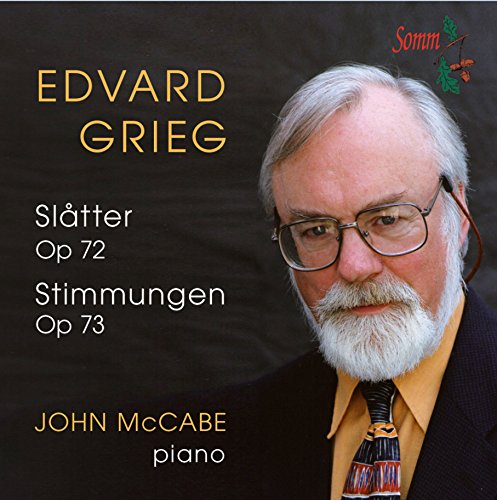
Under the surface – Grieg Piano Music played by John McCabe

grieg

Composer: Edvard Grieg (1843-1907)

Nationality: Norwegian

What did he write? Two of Grieg’s works are among the most popular in classical music. These are the early Piano Concerto and the music for Ibsen’s play Peer Gynt, containing such treasures as Morning and In The Hall of the Mountain King.

What are the works on this new recording? In this new issue of remastered recordings originally made for RCA in 1978, the recently deceased pianist John McCabe plays two late collections of the composer’s music for solo piano – the Slåtter (Norwegian Peasant Dances) and a collection of short pieces published as Stimmungen (Moods) in 1905.

What is the music like? Grieg writes delightfully for the piano, and these pieces show a complete mastery of the three-minute format. In the case of the Slåtter (Norwegian Peasant Dances) he effectively turns transcriber, arranging original folk material for piano but in such a way that it sounds like it was originally written for the instrument.

It is tuneful music, and in both collections the composer’s gift for melodic setting is clear. Often his melodies are played out over drones in the left hand of the piano, giving the music a rustic feel.

McCabe finds the exquisite tension in the first piece, Resignation, while by contrast the second, Scherzo-Impromptu, is an amicable dance, and Tune from the Fairy Hill, the fourth of the Slåtter, is a dance for the outdoors. In the Hommage à Chopin, a technically demanding Studie from the Stimmungen, McCabe is wholly equal to the task.

Grieg’s music may be charming but if often demonstrates a chilling undercurrent, which can clearly be heard in The Mountaineer’s Song and Night Ride from Stimmungen. McCabe communicates this with a real frisson.

What’s the verdict? This music feels intensely personal, and although it is the work of a composer in his sixties there is still a resolutely youthful side to it, and McCabe brings out the balance between the two.

Give this a try if you like… Sibelius piano music, Chopin or Mendelssohn

Spotify Playlist

Firstly you can listen to Resignation, the first piece of the Slåtter, here

A playlist of lesser-known Grieg is available on Spotify below, including the mature Violin Sonata no.3, the two Elegiac Melodies, Bergliot for baritone and orchestra and finally the Lyric Suite, comprising orchestrations of some of his piano pieces. The final March blows away the cobwebs!

Wigmore Mondays – Narek Hakhnazaryan and Pavel Kolesnikov

narek-hakhnazaryan

Narek Hakhnazaryan (cello), Pavel Kolesnikov (piano)Wigmore Hall, London, live on BBC Radio 3, 23 November 2015

Listening link (open in a new window):

http://www.bbc.co.uk/programmes/b06pxdz7

on the iPlayer until 23 December

Spotify

In case you cannot hear the broadcast, here is a Spotify playlist of some the music in this concert. Narek Hakhnazaryan has not yet committed any of these works to disc, though the Khudoyan solo sonata is available to watch on YouTube below:

Alternative versions of the Schumann and Mendelssohn can be heard below:

What’s the music?

Schumann: Five Pieces in folk style, Op.102 (1849) (16 minutes)

Adam Khudoyan: Solo Cello Sonata no.1 (1961) (8 minutes)

Mendelssohn: Cello Sonata No.2 (1843) (27 minutes)

What about the music?

Schumann found in the cello an instrument with which he could express his music naturally, and his music for the instrument ranges from a late Cello Concerto to various ‘fantasy pieces’ for cello and piano. Five of these, the Funf Stücke im Volkston (Five Pieces in Folk Style) are vignettes for the combination where Schumann is clearly enjoying himself, music that ranges from the playful first and fourth pieces to the warm of the lyrical lullaby.

I have to confess this was my first encounter with the music of Adam Khudoyan (1921-2000), though, as the Wigmore Hall booklet writer Brian David discussed, he was one of Armenia’s most highly-regarded twentieth-century composers. He completed his Solo Cello Sonata no.1 in 1961, the first of a number of works for the instrument. It is a relatively short but intense work, David writing that ‘it has at its heart a deep, extended lament that moves between extremes of sorrow and anguish’.

Mendelssohn’s middle period of composition saw him writing with incredible spontaneity, and it is into this part of his career that both his major works for cello fall. Both of his cello sonatas are rich in expressive melodies and positive feeling, and the outpouring of good spirits at the start of the Second is difficult to shake off through the work. It does have a profound side too though, found in the slow movement where Mendelssohn works a prayerful chorale in a manner often interpreted as a contemplation of his dual Jewish/Christian heritage.

Performance verdict

From this evidence the partnership of Armenian cellist Narek Hakhnazaryan and Russian pianist Pavel Kolesnikov is most definitely one to keep an eye on. The duo clearly enjoy the music they make together, and while the perception is that Narek is the one to wear his heart on his sleeve more obviously, Pavel provides some wry humour as a counterpart.

That was most evident in the second movement of the Mendelssohn, where the piano phrases were beautifully shaped and strung out just a bit longer to enhance the witty theme. This performance was excellent, maybe a bit over-wrought in the first and last movements but reaching a degree of stillness in the slow movement that was very moving.

Their Schumann was also very enjoyable, played with a very fresh approach and again with a nice dash of humour. This music is rich in melody and the two clearly enjoyed each new tune and turn of phrase.

It was also very satisfying to hear the Khudoyan sonata for the first time, extending this Armenian’s credentials as an extremely proficient writer for cello. The use of folk melodies gets us close to the heart of Armenia quickly, and it was clear from his expression that Hakhnazaryan felt the same way. A technically superb and emotionally charged performance of music that has real concentrated expression.

What should I listen out for?

Schumann

1:32 – a bright and slightly mischievous first piece, marked ‘Vanitas vanitatum’, where the spiky cello and detached piano embark on a breezy march. The middle section from 2:50 is by contrast heavier and assertive.

4:49 – a rather gorgeous lullaby, led by the cello with dreamy accompaniment from the piano.

8:46 – a graceful dance that is a little within itself, the cello elusive and the piano quiet as though in thought. Perhaps a sign of shadow that suggests this to be a later composition – though the warmer middle passage, where the cello plays chords, is a much more positive complement.

12:49 – the exuberant fourth piece, led by the cello in breezy fashion – with a nice, more lyrical theme to boot from 13:15.

14:47 – the last piece is quite a frenetic affair that sounds almost as though it could have been written by Brahms. Here the cello and piano are in much more obvious dialogue with the syncopated rhythms.

Khudoyan

19:36 – the solo sonata starts with a bold statement, with chords on the cello. The forceful and heady mood. It brings to mind a little the rather bigger sonata by Kodály, especially at 20:45 when a slower tune is heard, one that seems to be inspired by folk music.

There are some quite jarring moments where Khudoyan puts two pitches very close together but overall the sonata is full of powerful and moving melodic lines, the composer using the cello chords as more of a rhythmic prompt.

25:45 – from here the cello has a brief but thoughtful section of ‘pizzicato’ (plucking) before the material from the beginning returns with even greater force. The piece ends with powerful chords.

Mendelssohn

29:33 – right from the beginning it is clear this is going to be a positive piece. Cello and piano open together with a sweeping melody, and the piano part is typically busy for Mendelssohn. The cello retains a song-like delivery to its melodies, and the music continues to surge forward strongly, suggesting the composer’s inspiration was very instinctive at this point in his life. The main theme returns at 34:00.

37:33 – this is a lovely example of Mendelssohn’s lightness of touch, a piece of music that has subtle humour and a memorable tune to go with it. This is introduced by the piano and repeated by the pizzicato (plucked) cello. A contrasting and flowing theme crops up at 39:22, before the main ‘scherzo’ material comes back at 40:49. A strong coda section begins at 41:58, with a more obviously romantic mood in the cello line.

44:04 – the slow movement begins with a set of chords from the piano that sound rather like a hymn (or ‘chorale’). The top note of each of these chords forms the melody which the cello eventually takes up, reaching an impressive intensity at 47:02. Then a meditative passage takes place over a long held note on the cello. The whole movement is almost certainly under the influence of Bach in the stepwise manner in which it moves and is beautifully simple.

49:44 – the finale returns us to the brisk manner of the first movement, cello and piano ducking and diving as they move towards the main theme at 50:09 on the cello. The music proceeds at a bustling pace, often with little opportunity for breath, as though Mendelssohn were writing music as fast as he possibly could!

Encore

57:54 – an encore in the form of an arrangement for piano of Rachmaninov’s Vocalise. A lovely, romantic, slow moving piece of music where time slows down a little – for nearly seven minutes, in this case!

Further listening

If you enjoyed the Mendelssohn and Schumann in this concert then there is more to explore in the cello and piano repertory from both composers. A very attractive account of Mendelssohn’s complete music for the combination can be found here, played by Antonio Meneses and Gérard Wyss:

The same combination released an album of Schubert and Schumann works for cello and piano in 2006, on which the Schumann pieces all make a lasting impression – as does Schubert’s substantial Arpeggione Sonata: