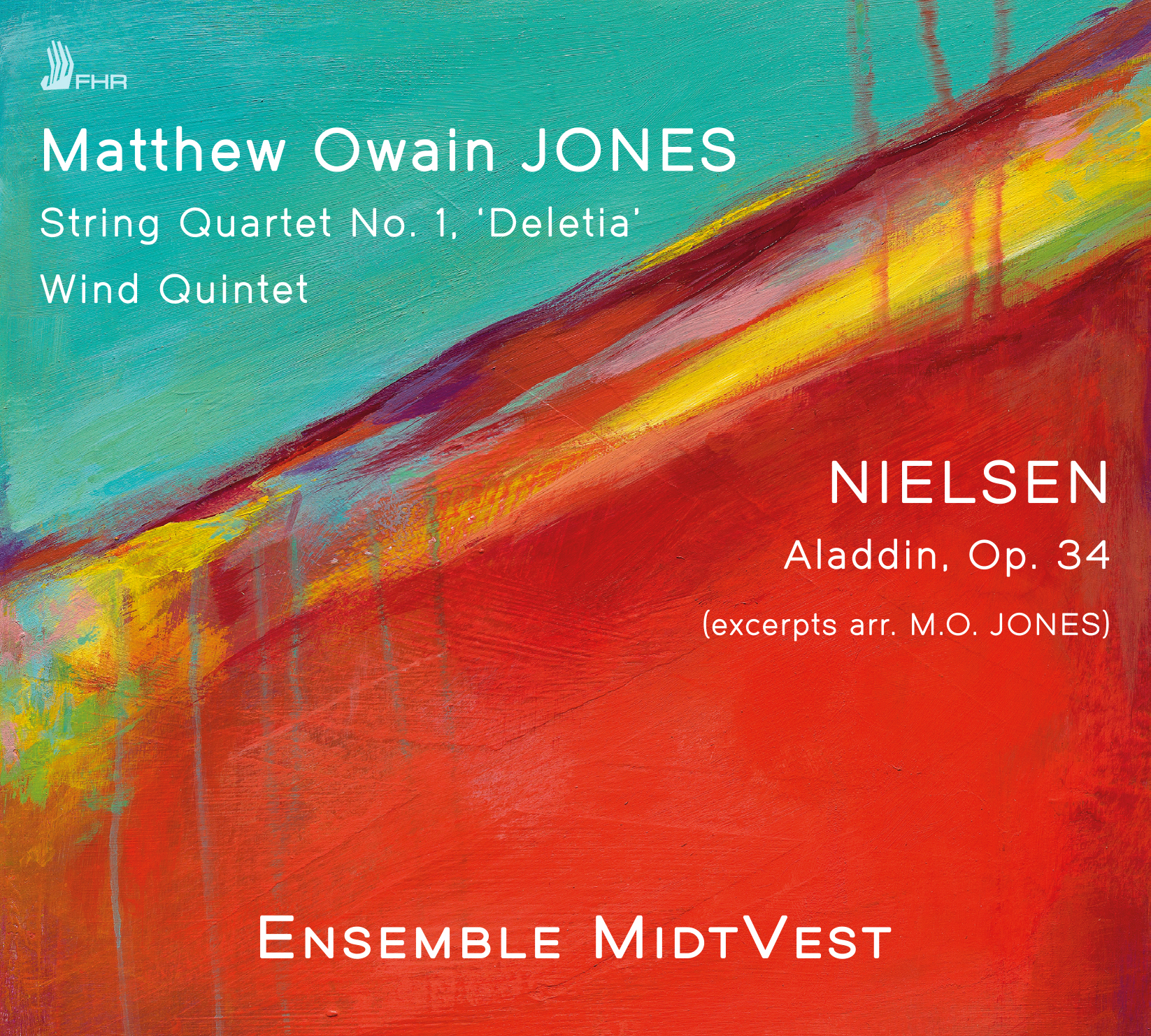
On Record – Ensemble MidtVest – Matthew Owain Jones: String Quartet no.1, Wind Quintet; Nielsen arr. Jones: Aladdin (First Hand Records)

Matthew Owain Jones
String Quartet no.1 ‘Deletia’ (1993, rev. 2012)
Wind Quintet (2016)
Nielsen arr. Jones
Aladdin, FS89: Nine Pieces for wind quintet, string quartet and piano (1917-19, arr. 2018)

Ensemble MidtVest [Charlotte Norholt (flute), Peter Kirstein (oboe), Tommaso Lonquich (clarinet), Yavor Petkov (bassoon), Neil Page (horn); Matthew Owain Jones, Karolina Weltrowska, Ana Feitosa (violins), Sanna Ripatti (viola), Jonathan Slaatto (cello), Martin Qvist Hansen (piano)]

First Hand Records FHR163 [63’53’’] All world premiere recordings
Producers / Engineers Michael Ponder (String Quartet, Wind Quintet), Morten Mogenson (Aladdin)

Recorded 6 December 2017 (String Quartet), 11 January 2018 (Wind Quintet), 29-31 August 2018 (Aladdin) at Den Jyske Sangskole, Herning, Denmark

Reviewed by Richard Whitehouse

What’s the story?

First Hand Records makes a welcome addition to its contemporary catalogue with this release of music or arrangements by Matthew Owain Jones, all performed by the extended outfit that is Ensemble MidtVest and among whose varied personal the composer himself can be found.

What’s the music like?

Fifty last year, Jones has had a diverse career as a musician as is recounted in his personable booklet notes. Composing has often taken a back seat in his activities, the works here written almost a quarter-century apart, yet there can be no doubting the idiomatic nature of his music.

Composed when barely out of his teens, the First String Quartet is evidently the product of a gifted if unfocussed musical talent. Jones admits as much by appending the subtitle ‘Deletia’ to its revision almost two decades on – the original four movements having been reduced to just two, albeit substantial entities. These duly complement each other in almost all respects – the initial Andante exuding a warmth and fervency that is questioned, without being denied outright, by the ensuing Allegro whose ‘minaccioso’ marking underlines its capricious while sometimes ominous nature. The result is uneven yet engaging – making it a pity that, after a musical co-written with his sister, Jones should have left composing somewhat in abeyance.

It was the positive reception accorded that revision of his quartet which encouraged Jones to return to composition in earnest, and among the first fruits of this resumption was his Wind Quintet. Its substantial single movement falls into four continuous sections such as outline a relatively Classical design (albeit with an intermezzo-like section placed second), and Jones cannily exploits those incremental changes in timbre or texture without recourse to extremes of tempo and mood. The outcome is music demonstrably within the lineage of a genre more extensive than often supposed and, though its content breaks little new ground, this is never less than expertly conceived for the medium and affords a pleasurable listen in its own right.

The locus classicus of wind quintets has to be that written just over a century ago by Nielsen, music by which composer ends this collection. Although its suite is periodically revived, the lavish incidental music (not a ballet, as is referenced several times in the notes, though there is a notable element of dance) for Adam Oehlenschlager’s play Aladdin proved too ambitious even at its Copenhagen premiere. Surprising, perhaps, that the nine numbers included here translate so well into the medium of a mixed decet – preserving the distinctive nature of music from Nielsen’s maturity (it comes mid-way between his Fourth and Fifth Symphonies) and thus making it freely available to practitioners for the very different context of the recital room.

Does it all work?

Pretty much. Much of the attraction of this collection lies in the respect which the members of Ensemble MidtVest have for Jones and his music, thereby making for performances that could scarcely be improved upon in terms of technical refinement or interpretative insight.

Is it recommended?

It is, not least as the sound conveys the immediacy but also delicacy of this music with ideal clarity and perspective. Jones must feel vindicated by the enterprise, as indeed he should, and one looks forward to more releases of both his compositions and arrangements in due course.

Listen & Buy

Click on the names to read more about composers Matthew Owain Jones and Carl Nielsen, and the performers Ensemble MidtVest

Published post no.2,515 – Saturday 26 April 2025

On Record – Crispin Lewis & Raymond Lewis: Herbert Murrill: The Rediscovered Songs (First Hand Records)

Herbert Murrill
Four Elizabethan Songs (1927-30)
Three Carols (1929)
Self-Portrait (1929)
Trois Poèmes (1930)
Four Pastorals (1936)
The Months of the Year (c1936)
Two Herrick Songs (1938)
In Youth is Pleasure (1942)
Sonatina for Piano (1952) – Andantino

Crispin Lewis (baritone); Raymond Lewis (piano) with Rachel Broadbent (oboe, carols)

First Hand Records FHR161 [55’48’’] All world premiere recordings
English/French texts and English translations included
Producer Emily Baines Engineer John Croft

Recorded 19 & 20 April 2024 at Rosslyn Hill Chapel, Hampstead, London

Reviewed by Richard Whitehouse

What’s the story?

First Hand Records issues this first release devoted to the songs of Herbert Murrill (1909-52), now a largely forgotten though once influential figure on music circles in London and further afield; his pedagogical and administrative skills held in high esteem by a younger generation.

What’s the music like?

Murrill’s death at only 43 brought to its premature end a career which, in addition to a sizable output, involved working at the BBC – latterly as its Head of Music – and, in the earlier war years, intelligence work at Bletchley Park. An unassuming figure who operated within if at a conscious remove from the music establishment of his day, Murrill was widely respected for his professionalism – as is borne out by his own music with its lightness of touch and its deft handling of traits stemming from Stravinsky, Poulenc and neo-Classicism between the wars.

It made sense to open this recital with My Youth is Pleasure, its airy setting of Robert Wever highlighting that acute yet unforced nostalgia such as pervades so many of these songs. The lengthy The Months of the Year sustains itself ably, then a wittily engaging quartet of songs to Elizabethan texts almost inevitably recalls the influence of Peter Warlock. Four Pastorals find Murrill indulging his more lyrical tendencies to appealing effect, notably in a setting of the anonymous text Phillada Flouts Me that unerringly catches its deadpan anguish. Nor is he unwilling to tackle more contemporary writers, witness his Satie-esque response to verse by Jacques Prévert and Robert Desnos; though whether those changes to the former’s poems were considered improvements or just unintentional anomalies is now impossible to decide.

A trio of carols with oboe accompaniment (including a Medieval Scottish translation of verse by Martin Luther) would be a welcome addition to a medium which features little other than Vaughan Williams’s masterly Blake settings. After which, the wryly elegant Arioso from a Piano Sonatina makes one wish the surrounding movements could have been included (there was certainly room in terms of playing time). The brace of songs to texts by Robert Herrick summons a more sustained and eloquent response, as to suggest that Murrill’s music might have explored deeper emotions had he lived. This anthology concludes with Self-Portrait – four settings of his contemporary Geoffrey Dunn which anticipate Betjeman in their dry wit and self-deprecating humour – a very English take, indeed, on matters of existential import.

Does it all work?

Yes, albeit for the most part within its narrowly while precisely defined limits. As a composer, Murrill was clearly not out to change the world but rather to offer a discreet commentary from the margins, which he does with admirable skill and not a little affectingly. He has a devoted advocate in Crispin Lewis, for whom this project was doubtless a labour of love, and who is sensitively accompanied by Raymond Lewis or, in the Three Carols, Rachel Broadbent. He also contributes informative and well-researched notes about the life of this singular figure.

Is it recommended?

It is, and there is enough of interest musically to make one curious to hear such as Murrill’s jazz-opera Man in Cage, written to a libretto by Dunn and that enjoyed an eight-week run in London in 1930 before vanishing without trace. For now, this collection ably fulfils its remit.

Listen & Buy

Click on the artist names to read more on Crispin Lewis, Richard Lewis and Rachel Broadbent

Published post no.2,509 – Saturday 19 April 2025

On Record – Early Stereo Recordings Vol. 6: Sibelius – Finlandia, Pohjola’s Daughter, String Quartet etc (First Hand Records)

Sibelius
Finlandia Op.26 (1899)(a)
Finlandia – Hymn (1938)(b)
Song of My Heart Op.18/6 (1900)(b)
The Origin of Fire Op.32 (1902, rev, 1910)(c)
Pohjola’s Daughter Op.49 (1906)(d)
Valse triste Op.44/1 (1904)(a)
String Quartet in D minor Op. 56 ‘Voces intimae’(e)
Finlandia Op.26 (1899)(f)

cSulo Saarits (baritone); eQuatuor Pascal [Jacques Dumond, Maurice Crut (violins), Léon Pascal (viola), Robert Salles (cello)]; bcHelsinki University Chorus / Martti Turunen; cdCincinnati Symphony Orchestra / Thor Johnson; aOrchestra del Maggio Musicale Fiorentino / Vittorio Gui; fPhilharmonia Orchestra / George Weldon

First Hand Records FHR85 [82’37”]
Producer and Engineer Raphaël Mouterde

Recorded aOctober 9th and b10th 1953, November bd20th and c21st 1953, fMarch 12th 1956, ebefore July 1957. Transfers and Remastering Paul Baily
Detailed production credits at the First Hand Records website

Reviewed by Richard Whitehouse

What’s the story?

First Hand Records continues its valuable Early Stereo Recordings series with this volume devoted to Sibelius, mostly featuring performances that had little wider availability on their initial release and which have seldom, if at all, been reissued in their original stereo format.

What are the recordings like?

First issued on two Livingston Audiosphere binaural tapes, Vittorio Gui’s Sibelius confirms this conductor’s wide-ranging sympathies as to repertoire. Finlandia is accorded a forthright and impulsive reading which is brooding and even ominous in its earlier stages, then with its hymnic melody elegantly while unaffectedly rendered. Valse triste feels arguably even more persuasive as Gui secures playing of poise and finesse from the strings of Maggio Musicale Fiorentino, building up to a culmination of sustained intensity prior to its elegiac conclusion.

George Weldon’s Finlandia affords instructive comparison. First issued on an EMI Columbia stereosonic tape, it exudes no mean spontaneity and panache with the Philharmonia sounding as idiomatic as on the Sibelius recordings made with Herbert von Karajan during this period.

Most valuable are those remaining items. What was initially issued as an A-V Tape Libraries binaural tape is a fascinating collection, not least for this first studio recording of the cantata The Origin of Fire which is overall the best of Sibelius’s Kalevala-derived choral works, and combatively rendered here by Sulo Saarits with the Helsinki University Chorus – which latter contributes respectively stirring then evocative accounts of the indelible Finlandia Hymn and delectable Song of My Heart under Martti Turunen. The Cincinnati Symphony Orchestra comes into its own with Pohjola’s Daughter, the symphonic fantasia that straddles its composer’s nationalist and more classical phases – duly endowed with often irresistible momentum by Thor Johnson (1913-1975), the American conductor who made numerous important recordings at this time.

Surely the highlight, though, is Quatuor Pascal’s reading of Voces intimae. First issued as a Concert Hall Society stereophonic tape, this was only the work’s fourth recording (after those (two) by the Budapest and Griller quartets) and demonstrates acute appreciation of Sibelius’s idiom as shared by few French musicians at this time. From the powerfully wrought opening Allegro with its pulsing Vivace continuation, via the inwardly eloquent Adagio then trenchant Allegretto, to the impetuous final Allegro – this is an interpretation to rank with the very best.

Does it all work?

Yes it does, remembering these recordings were made in Sibelius’s lifetime (just two months before his death in the case of the String Quartet) and can lay claim to pioneering status. The transfers have been expertly managed, conveying the dynamic range and tonal range of those original masters without unwarranted intervention. Tully Potter pens informative annotations, and Peter Bromley invaluable context, though the timing for Weldon’s Finlandia should read 9’17” rather than 8’31” hence is faster than Gui by mere seconds rather than almost a minute.

Is it recommended?

Indeed it is, and it could well be regarded as the most significant release in this FHR series so far. Coming in the wake of groundbreaking inter-war projects from the Sibelius Society, these issues are a vital chapter in the history of Sibelius recording and an indispensable acquisition.

Listen & Buy

For further information and purchase information visit the First Hand Records website. Additional details on (most of) these recordings can be found on the Discogs website

Published post no.2,381 – Tuesday 3 December 2024

On Record – Hensel: Lieder (First Hand Records)

Fanny Hensel
Wenn ich ihn nur habe. Die Schönheit Nicht, Mädchen, Wohl deinem Liebling (all 1820). Der Abendstern. Die sanften Tage, Der Sänger. An die Entfernte (all 1823). Auf der Wanderung. Abschied. Mond. Sehnsucht, HU190 (all 1824-6). Sehnsucht, HU192. Maigesang. Seufzer. An den Mond. An die Ruhe. Sehnsucht, HU203. Sehnsucht, HU205. Umsonst. Suleika (all 1827). Sehnsucht, HU217. Nacht. In der Ferne (all 1828-33). Über allen Gipfeln ist Ruh’. Ach, die Augen sind es wieder. Das Meer Erglänzte. Ich wandelte unter den Bäumen (all 1835-8). Der Fürst vom Berge. Traurige Wege. Dämmrung senkte sich von oben. Traum. Mutter, o sing mich zur Ruh’ (all 1840-44). Erwache Knab’. Vorwurf (both 1846).

Jennifer Parker, Stephanie Wake-Edwards (mezzo-sopranos), Tim Parker-Langston (tenor), Jâms Coleman, Genevieve Ellis, Ewan Gilford (pianos)

First Hand Records FHR148 [82’25’’]
German texts and English translations included. Producers and Engineers Tim Parker-Langston, David Jones
Recorded 3-8 January 2023 at Mendelssohn-Haus, Leipzig, Germany

Reviewed by Richard Whitehouse

What’s the story?

First Hand Records expands its already enterprising catalogue with this release of Lieder by Fanny Hensel (1805-47) – Felix Mendelssohn’s elder sister – who has recently come into her own not least through her prolific song output, many of which are only now being recorded.

What’s the music like?

Hensel left some 450 individual works, with songs comprising over half this total. A handful of these appeared under her brother’s name, while she had published just three collections of songs and piano pieces at the time of her death: a measure of the extent of her composing is that half of those songs featured here are being recorded for the first time. Covering some 26 years, this selection feels representative of her musical development in terms of its evolving approach to harmony and word-setting, together with the range and type of authors being set.

Although other sequences are perfectly feasible, the decision to proceed chronologically is justified by relative unfamiliarity of Hensel’s songs. Starting with the appealing gaucheness of the Novalis setting If I could only have him, this continues with such relatively ambitious numbers as the Ludwig Uhland ballad The Gentle Days (at almost five minutes the longest item here) or wistful eloquence found in Ludwig Tieck’s Parting. A highlight is her setting   of Ludwig Hölty’s May Song, notably the subtle variations of tone and texture drawn from its 12 verses. The songs from the late 1830s include a striking treatment of Heinrich Heine’s I wondered beneath the trees and those from the early 1840s include the sustained intensity found in Nikolaus Lenau’s Sorrowful Paths, which poet’s Reproach is almost her last song.

A good way into Hensel’s songs is through comparing those five items (from a total of nine) all entitled Sehnsucht (Longing) and written during the mid-to later 1820s. First, a setting of Johann Voss which never ventures far from its subdued opening; next, a setting of Hölty that points up this poem’s conflicting images with real acuity, followed with two briefer settings by these poets (that by Hölty the shortest here at barely 50 seconds) such as amply turn such succinctness to expressive advantage and, finally, a poem by Friedrich Märcker whose overt pantheism inspires a setting of gentle profundity. Here, as in almost all these songs, Hensel never forces the issue with regard to ‘interpreting’ the words at hand – rather, her approach is to tease out its meaning through a dialogue between voice and piano in which inference is all.

Does it all work?

Almost always, not least owing to the advocacy of these artists. The lion’s share is entrusted to Tim Parker-Langston (not unreasonably so given his masterminding of this project), whose mellifluous tenor is eminently suited to Hensel’s music. Of the two mezzos, Stephanie Wake-Edwards’s soulful contralto is duly complemented on three numbers with the lighter tone of Jennifer Parker. The 34 songs are divided almost equally between three pianists who, between them, confirm Hensel wrote as idiomatically as any more illustrious peer for this combination.

Is it recommended?

It is, given this release is a significant contribution to the ongoing dissemination of Hensel’s music. The booklet, too, is admirably produced with its succinct introductory note alongside full texts and translations. Those looking for an overview of these songs need look no further.

Buy

You can explore purchase options on the First Hand Records website Click to read about Hensel Songs Online, and on the artist names to read more on Jennifer Parker, Stephanie Wake-Edwards, Tim Parker-Langston, Jâms Coleman, Genevieve Ellis and Ewan Gilford

Published post no.2,173 – Thursday 9 May 2024

On Record – Serena Wey, Basel Sinfonietta / Mark FitzGerald – Weill: Die sieben Todsünden, Die Dreigroschenoper, Suite panaméenne (First Hand)

Weill
Die sieben Todsünden (1933)
Die Dreigroschenoper – Suite, arr. Schönherr (1928, arr. 1956)
Suite panaméenne (1934)
September Song (1938)
Surabaya-Johnny (1929)

Serena Wey (soprano), Martin Müller, Werner Güra (tenors), Othmar Sturm (baritone), Grzegorz Rózycki (bass), Basel Sinfonietta / Mark Fitz-Gerald

First Hand Records FHR140 [65’48’’]
German texts included. Producer Philipp Steiner Remastering Engineer John Croft
Recorded 3 February 1991 and 5 September 1993 (Suite panaméenne) at Stadtcasino, Basel

Reviewed by Richard Whitehouse

What’s the story?

First Hand Records continues its series of reissues with this appealing collection of music by Kurt Weill, capably performed by the Basel Sinfonietta and judiciously conducted by Mark Fitz-Gerald, who has since become synonymous with recreating Shostakovich’s film scores.

What’s the music like?

The main work is The Seven Deadly Sins, the ‘ballet chanté’ Weill wrote in Paris after having departed Berlin in the wake of Nazi rule and which was his final collaboration with Berthold Brecht. Written as a vehicle for his wife Lotta Lenya this found only limited success, though its conceit of the main role being split between singer and dancer was to prove influential on later generations of dramaturgs. Serena Wey captures the spirit of Anna in her journey from innocence to experience over each of those sins, their respective settings in seven American cities pointing up that critique of Capitalism which Brecht and (still at this time) Weill were intent on making. The four male vocalists ably convey the role of ‘The Family’, somewhere between Greek Chorus and Barbershop Quartet in its pertinent observations and occasional tendency to moralize. Often revived with its main role transposed to the mezzo register, the piece benefits from being heard as it was conceived and, had it been issued at the time, this account would have been early in establishing an authentic ‘tradition’ of Weill performance.

Suites derived from two of Weill’s other stage-works are further enhancements, even if that from The Threepenny Opera is not the one he himself adapted – rather, a truncated selection by Max Schönherr (1903-84), a composer and conductor of light music whose arrangement for full orchestra is expert rather than inspired but features most of the items for which this ‘play with music’ remains famous. More valuable, though, is the Panamanian Suite drawn from incidental music to the play by Jacques Deval that takes in a breezy Introduction and uproarious March of the Panamanian Army alongside the pert fusion of Tango-Habañera and no less catchy Tempo di Foxtrot – this suite echoing the masterly and still underrated Second Symphony from the same time in its deft irony and edgy melodicism. Of those two songs which round off this release, September Song (Knickerbocker Holiday) sounds oddly uninvolving in German, despite Martin Müller’s mellifluous delivery, but Surabaya-Johnny (Happy End) leaves a plangent spell even out of context through Wey’s affecting eloquence.

Does it all work?

Pretty much. As already indicated, the performances are never less than idiomatic thanks to Fitz-Gerald’s evident sympathy with Weill’s subtle changing idiom and committed playing from the Basel musicians. The sound is a little dull and unyielding, though the remastering has clearly done much to improve it, with Rodney Smith’s succinct and informative notes a welcome addition. A pity that only the original German texts have been included here, but English translations can be found online while the presentation cannot otherwise be faulted.

Is it recommended?

Indeed, and as more than merely an archival release. The performance of the main work can hold its own with most of those which choose the original version, and it is to be hoped that more instances of Fitz-Gerald’s Basel collaborations from this period can be made available.

Listen

Buy

You can explore purchase options on the First Hand Records website Click on the artist names to read more on conductor Mark Fitz-Gerald, soprano Serena Wey, tenor Martin Müller and the Basel Sinfonietta

Published post no.2,171 – Tuesday 7 May 2024