On Record – Hensel: Lieder (First Hand Records)

Fanny Hensel
Wenn ich ihn nur habe. Die Schönheit Nicht, Mädchen, Wohl deinem Liebling (all 1820). Der Abendstern. Die sanften Tage, Der Sänger. An die Entfernte (all 1823). Auf der Wanderung. Abschied. Mond. Sehnsucht, HU190 (all 1824-6). Sehnsucht, HU192. Maigesang. Seufzer. An den Mond. An die Ruhe. Sehnsucht, HU203. Sehnsucht, HU205. Umsonst. Suleika (all 1827). Sehnsucht, HU217. Nacht. In der Ferne (all 1828-33). Über allen Gipfeln ist Ruh’. Ach, die Augen sind es wieder. Das Meer Erglänzte. Ich wandelte unter den Bäumen (all 1835-8). Der Fürst vom Berge. Traurige Wege. Dämmrung senkte sich von oben. Traum. Mutter, o sing mich zur Ruh’ (all 1840-44). Erwache Knab’. Vorwurf (both 1846).

Jennifer Parker, Stephanie Wake-Edwards (mezzo-sopranos), Tim Parker-Langston (tenor), Jâms Coleman, Genevieve Ellis, Ewan Gilford (pianos)

First Hand Records FHR148 [82’25’’]
German texts and English translations included. Producers and Engineers Tim Parker-Langston, David Jones
Recorded 3-8 January 2023 at Mendelssohn-Haus, Leipzig, Germany

Reviewed by Richard Whitehouse

What’s the story?

First Hand Records expands its already enterprising catalogue with this release of Lieder by Fanny Hensel (1805-47) – Felix Mendelssohn’s elder sister – who has recently come into her own not least through her prolific song output, many of which are only now being recorded.

What’s the music like?

Hensel left some 450 individual works, with songs comprising over half this total. A handful of these appeared under her brother’s name, while she had published just three collections of songs and piano pieces at the time of her death: a measure of the extent of her composing is that half of those songs featured here are being recorded for the first time. Covering some 26 years, this selection feels representative of her musical development in terms of its evolving approach to harmony and word-setting, together with the range and type of authors being set.

Although other sequences are perfectly feasible, the decision to proceed chronologically is justified by relative unfamiliarity of Hensel’s songs. Starting with the appealing gaucheness of the Novalis setting If I could only have him, this continues with such relatively ambitious numbers as the Ludwig Uhland ballad The Gentle Days (at almost five minutes the longest item here) or wistful eloquence found in Ludwig Tieck’s Parting. A highlight is her setting   of Ludwig Hölty’s May Song, notably the subtle variations of tone and texture drawn from its 12 verses. The songs from the late 1830s include a striking treatment of Heinrich Heine’s I wondered beneath the trees and those from the early 1840s include the sustained intensity found in Nikolaus Lenau’s Sorrowful Paths, which poet’s Reproach is almost her last song.

A good way into Hensel’s songs is through comparing those five items (from a total of nine) all entitled Sehnsucht (Longing) and written during the mid-to later 1820s. First, a setting of Johann Voss which never ventures far from its subdued opening; next, a setting of Hölty that points up this poem’s conflicting images with real acuity, followed with two briefer settings by these poets (that by Hölty the shortest here at barely 50 seconds) such as amply turn such succinctness to expressive advantage and, finally, a poem by Friedrich Märcker whose overt pantheism inspires a setting of gentle profundity. Here, as in almost all these songs, Hensel never forces the issue with regard to ‘interpreting’ the words at hand – rather, her approach is to tease out its meaning through a dialogue between voice and piano in which inference is all.

Does it all work?

Almost always, not least owing to the advocacy of these artists. The lion’s share is entrusted to Tim Parker-Langston (not unreasonably so given his masterminding of this project), whose mellifluous tenor is eminently suited to Hensel’s music. Of the two mezzos, Stephanie Wake-Edwards’s soulful contralto is duly complemented on three numbers with the lighter tone of Jennifer Parker. The 34 songs are divided almost equally between three pianists who, between them, confirm Hensel wrote as idiomatically as any more illustrious peer for this combination.

Is it recommended?

It is, given this release is a significant contribution to the ongoing dissemination of Hensel’s music. The booklet, too, is admirably produced with its succinct introductory note alongside full texts and translations. Those looking for an overview of these songs need look no further.

Buy

You can explore purchase options on the First Hand Records website Click to read about Hensel Songs Online, and on the artist names to read more on Jennifer Parker, Stephanie Wake-Edwards, Tim Parker-Langston, Jâms Coleman, Genevieve Ellis and Ewan Gilford

Published post no.2,173 – Thursday 9 May 2024

On Record – Serena Wey, Basel Sinfonietta / Mark FitzGerald – Weill: Die sieben Todsünden, Die Dreigroschenoper, Suite panaméenne (First Hand)

Weill
Die sieben Todsünden (1933)
Die Dreigroschenoper – Suite, arr. Schönherr (1928, arr. 1956)
Suite panaméenne (1934)
September Song (1938)
Surabaya-Johnny (1929)

Serena Wey (soprano), Martin Müller, Werner Güra (tenors), Othmar Sturm (baritone), Grzegorz Rózycki (bass), Basel Sinfonietta / Mark Fitz-Gerald

First Hand Records FHR140 [65’48’’]
German texts included. Producer Philipp Steiner Remastering Engineer John Croft
Recorded 3 February 1991 and 5 September 1993 (Suite panaméenne) at Stadtcasino, Basel

Reviewed by Richard Whitehouse

What’s the story?

First Hand Records continues its series of reissues with this appealing collection of music by Kurt Weill, capably performed by the Basel Sinfonietta and judiciously conducted by Mark Fitz-Gerald, who has since become synonymous with recreating Shostakovich’s film scores.

What’s the music like?

The main work is The Seven Deadly Sins, the ‘ballet chanté’ Weill wrote in Paris after having departed Berlin in the wake of Nazi rule and which was his final collaboration with Berthold Brecht. Written as a vehicle for his wife Lotta Lenya this found only limited success, though its conceit of the main role being split between singer and dancer was to prove influential on later generations of dramaturgs. Serena Wey captures the spirit of Anna in her journey from innocence to experience over each of those sins, their respective settings in seven American cities pointing up that critique of Capitalism which Brecht and (still at this time) Weill were intent on making. The four male vocalists ably convey the role of ‘The Family’, somewhere between Greek Chorus and Barbershop Quartet in its pertinent observations and occasional tendency to moralize. Often revived with its main role transposed to the mezzo register, the piece benefits from being heard as it was conceived and, had it been issued at the time, this account would have been early in establishing an authentic ‘tradition’ of Weill performance.

Suites derived from two of Weill’s other stage-works are further enhancements, even if that from The Threepenny Opera is not the one he himself adapted – rather, a truncated selection by Max Schönherr (1903-84), a composer and conductor of light music whose arrangement for full orchestra is expert rather than inspired but features most of the items for which this ‘play with music’ remains famous. More valuable, though, is the Panamanian Suite drawn from incidental music to the play by Jacques Deval that takes in a breezy Introduction and uproarious March of the Panamanian Army alongside the pert fusion of Tango-Habañera and no less catchy Tempo di Foxtrot – this suite echoing the masterly and still underrated Second Symphony from the same time in its deft irony and edgy melodicism. Of those two songs which round off this release, September Song (Knickerbocker Holiday) sounds oddly uninvolving in German, despite Martin Müller’s mellifluous delivery, but Surabaya-Johnny (Happy End) leaves a plangent spell even out of context through Wey’s affecting eloquence.

Does it all work?

Pretty much. As already indicated, the performances are never less than idiomatic thanks to Fitz-Gerald’s evident sympathy with Weill’s subtle changing idiom and committed playing from the Basel musicians. The sound is a little dull and unyielding, though the remastering has clearly done much to improve it, with Rodney Smith’s succinct and informative notes a welcome addition. A pity that only the original German texts have been included here, but English translations can be found online while the presentation cannot otherwise be faulted.

Is it recommended?

Indeed, and as more than merely an archival release. The performance of the main work can hold its own with most of those which choose the original version, and it is to be hoped that more instances of Fitz-Gerald’s Basel collaborations from this period can be made available.

Listen

Buy

You can explore purchase options on the First Hand Records website Click on the artist names to read more on conductor Mark Fitz-Gerald, soprano Serena Wey, tenor Martin Müller and the Basel Sinfonietta

Published post no.2,171 – Tuesday 7 May 2024

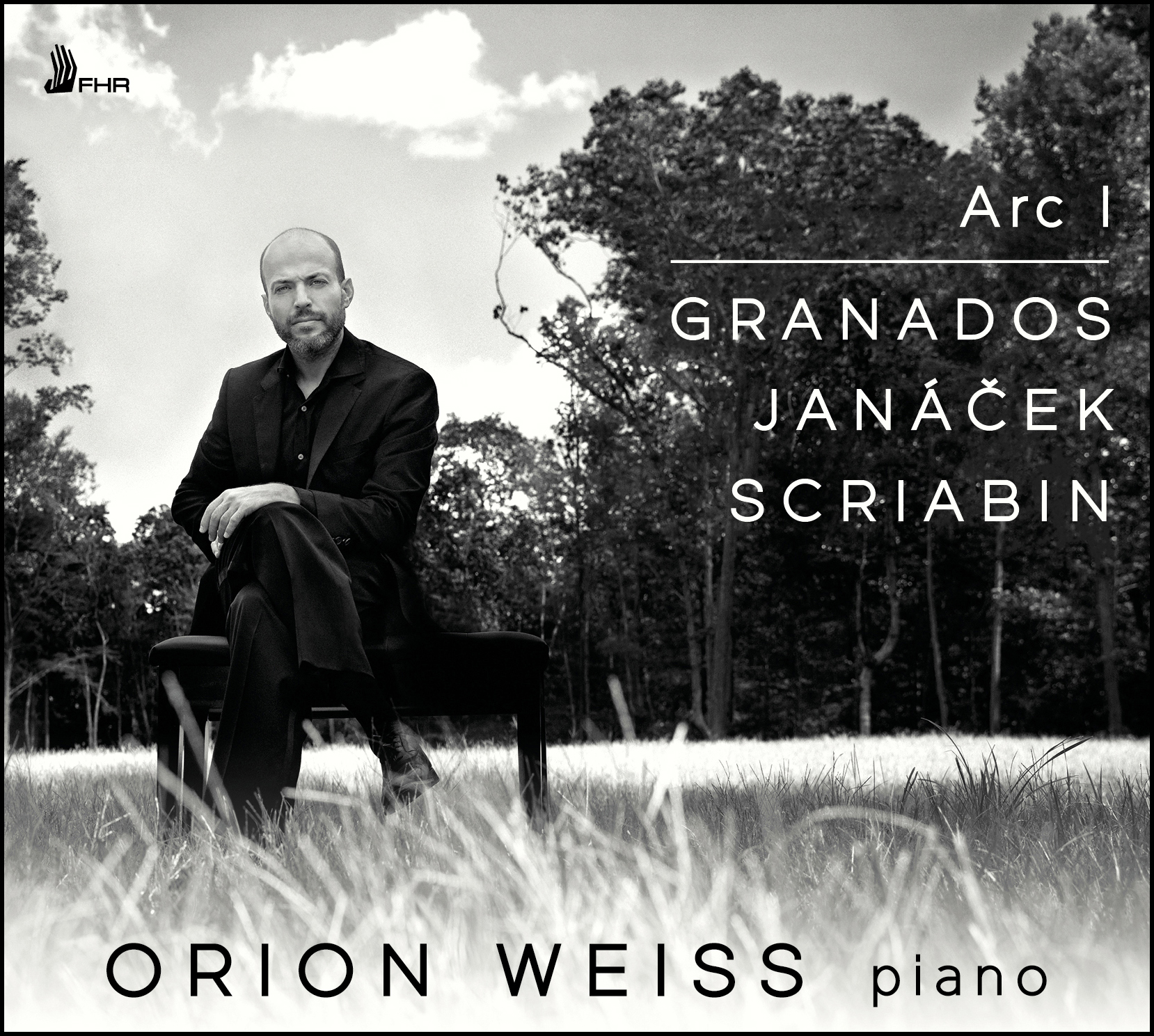
On Record – Orion Weiss: Arc 1: Granados, Janáček & Scriabin (First Hand Records)

Granados Goyescas Op.11 (1911)
Janáček In the Mists (1912)
Scriabin Piano Sonata no.9 in F major Op.68, ‘Black Mass’ (1913)

Orion Weiss (piano)

First Hand Records FHR127 [74’51”]
Producer David Frost; Engineer Silas Brown
Recorded 22-24 May 2014 at SUNY Purchase Performing Arts Center, New York

Reviewed by Richard Whitehouse

What’s the story?

First Hand Records issues the first instalment of another planned trilogy (see also The Future is Female with Sarah Cahill), the Arc series being a traversal by Orion Weiss across a century of piano music with intermittent forays into conceptually related pieces by earlier composers.

What’s the music like?

Focussing on music from before the First World War, this first volume is dominated (at least in terms of length) by Goyescas – the cycle of piano evocations in which Granados both paid homage to the illustrious Spanish artist, while extending the potential for large-scale formal design associated primarily with Liszt. That the composer subsequently transformed this into a one-act opera says much for the original’s motivic interconnections, such as Weiss further emphasizes throughout an interpretation in which characterization and cohesion are as one.

The listener is guided from teasing melodic interplay in Flattery, via the (mostly) confiding intimacy of Conversation at the Window then encroaching fear of separation in Fandango by Candlelight and its pained experiencing in Laments, or The Maiden and the Nightingale. A tragic climax arrives in the ballade Love and Death; after which, Serenade of the Ghost offers an ironic epilogue. Weiss renders this methodical yet visceral sequence with no mean insight, drawing out that pathos seldom far beneath the surface of Granados’s mature music.

If the Spanish composer was realizing his vision despite – or even because of – his success as composer and performer, In the Mists finds Janáček combating those vicissitudes of personal and professional failure. Hence the tonally and expressively oblique nature of its initial three sections, such as Weiss articulates with notable emphasis on their volatile mood-swings and frequent welling-up of emotion. All of this is duly thrown into relief by the final Presto with its gradual yet, as here, inexorable tendency towards ultimate fragmentation and dissolution.

Much has been written over the past century about those occult and even satanic connotations of Scriabin’s Ninth Sonata, whose Black Mass subtitle was only added after the event and at the prompting of another. Once again, it is the harnessing of such fluid and increasingly violent expression to a formal follow-through as precise as it is fastidious which gives this music its uniqueness. Weiss ensures an audibly cumulative build-up that, in the closing stages, achieves a claustrophobic intensity which could be considered liberating or annihilating as one prefers.

Does it all work?

Yes. Although it is not hard to locate alternative recordings for each of these pieces of at least comparable value, their juxtaposition within this context makes for a programme absorbing in its overt contrasts yet satisfying in its overall cohesion. Whether or not Weiss has performed this in recital, the trajectory towards an even greater self-absorption and inward intensity feels as inescapable as the presentiments of world conflict which lie behind much of what is heard here. Future volumes will doubtless offer a changing perspective and maybe a ‘way forward’.

Is it recommended?

It is. The sound has a lucidity and detail ideal for piano music from this period, with Weiss’s annotations succinct but also pertinent to his interpretations. This series is a notable addition to his extensive discography, further information about which can be accessed at his website.

Listen

For further information on this release, head to the First Hand Records website, and for more information on Orion Weiss, head to his website

On Record – Sarah Cahill: The Future is Female, Vol.1: ‘In Nature’

Beglarian Fireside (2001)
Bon Keyboard Sonata in B minor, Op.2/5 (1757)
Carreño Un rêve en mer (1868)
Dillon Birds at Dawn, Op. 20 No. 2 (1917)
Gribbin Unseen (2017)
Jambor Piano Sonata ‘To the Victims of Auschwitz’ (1949)
Kaprálová Dubnová preludia, Op.13/1 & 3 (1937)
Kashperova Au sein de la nature – no.3: Le Murmure des blés (1910)
Mendelssohn-Hensel Lieder Op.8/1 & 3 (1846)
Watkins Summer Days (2020)

Sarah Cahill [piano, voice (‘Fireside’)]

First Hand Records FHR131 [71’32”]
Producer/Engineer Matt Carr
Recorded 15-28 August 2021 at St. Stephen’s Church, Belvedere, California

Reviewed by Richard Whitehouse

What’s the story?

First Hand Records has issued the first instalment in a planned trilogy devoted to piano works by female composers ranging across the past three centuries, played by Sarah Cahill who has made both the reviving and commissioning of this music a mainstay of her performing career.

What’s the music like?

As Cahill relates in an introductory video (below), The Future is Female is a project to record music by women composers from the Baroque era through to the present-day. Loosely based around the theme of nature, this first volume opens with music from the cusp of the Classical era: Anna Bon, Venetian-born and Prussian-educated, whose primary keyboard work is Six Sonatas published as her Op. 2 – the fifth comprising three relatively substantial movements which finds influences from C.P.E. Bach being put to productive use.

The music of Fanny Mendelssohn-Hensel has now started to come into its own, her extensive output for piano well represented by two from a set of Vier Lieder published as her Op. 8 and akin to the Songs without Words of her brother Felix in their respectively limpid and poetic moods. Exerting considerable influence as pianist and administrator, the Caracas-born Teresa Carreño wrote little in later life, making this teenage Étude-méditation the more striking for its suffused intensity. Equally highly regarded as a pianist, Leokadiya Kashperova brings an impressionist deftness to this movement from her piano suite In the Midst of Nature, whereas Fannie Charles Dillon yields an even lighter touch through an extract from Eight Descriptive Pieces with its pioneering though always subtle approach on the notation of various birdsong.

Long remembered through her association with Martinů, the short-lived Vitĕzslava Kaprálová was an able composer whose piano output includes April Preludes – elusive miniatures which pivot around without ever losing a sense of tonality. The sure highlight is the Piano Sonata by Agi Jambour, its recollection of Budapest during the Nazi occupation inspiring a piece whose three movements take in fraught passion, an Epitaph of sombre poise, then a finale of stark resolve. Of the three living composers, Eve Beglarian features the recitation of a poem by the teenage Ruth Crawford-Seeger within the context of an improvisatory piano backdrop. Deidre Gribbin pens a forceful study of London at a time of social and cultural upheaval, then Mary D. Watkins’s capricious evocation of children at play ends the recital on a more hopeful note.

Does it all work?

Yes. Although not all these pieces are of comparable value, the chronological approach such as Cahill favours makes sense in terms of a stylistic evolution in writing for piano; a parallel (rather than alternative) trajectory through 250 years of Western art music. There can be few reservations concerning either the sound, as good as it gets in terms of clarity and perspective, or the pianist’s detailed and informative annotations. At least half of this selection should be featured in the repertoire of pianists, male or female, which says much as to its overall worth.

Is it recommended?

Indeed. The second volume is imminent with the third in preparation, making for a series as inclusive as it is wide-ranging. Cahill has already amassed a significant discography – further information can be found at her website, which also gives details of her forthcoming recitals.

Listen

For further information on this release, head to the First Hand Records website, and for more information on Sarah Cahill, click here. For more information on the composers, click on the names of Leokadiya Kashperova, Vitĕzslava Kaprálová, Agi Jambor, Eve Beglarian, Deidre Gribbin and Mary D. Watkins

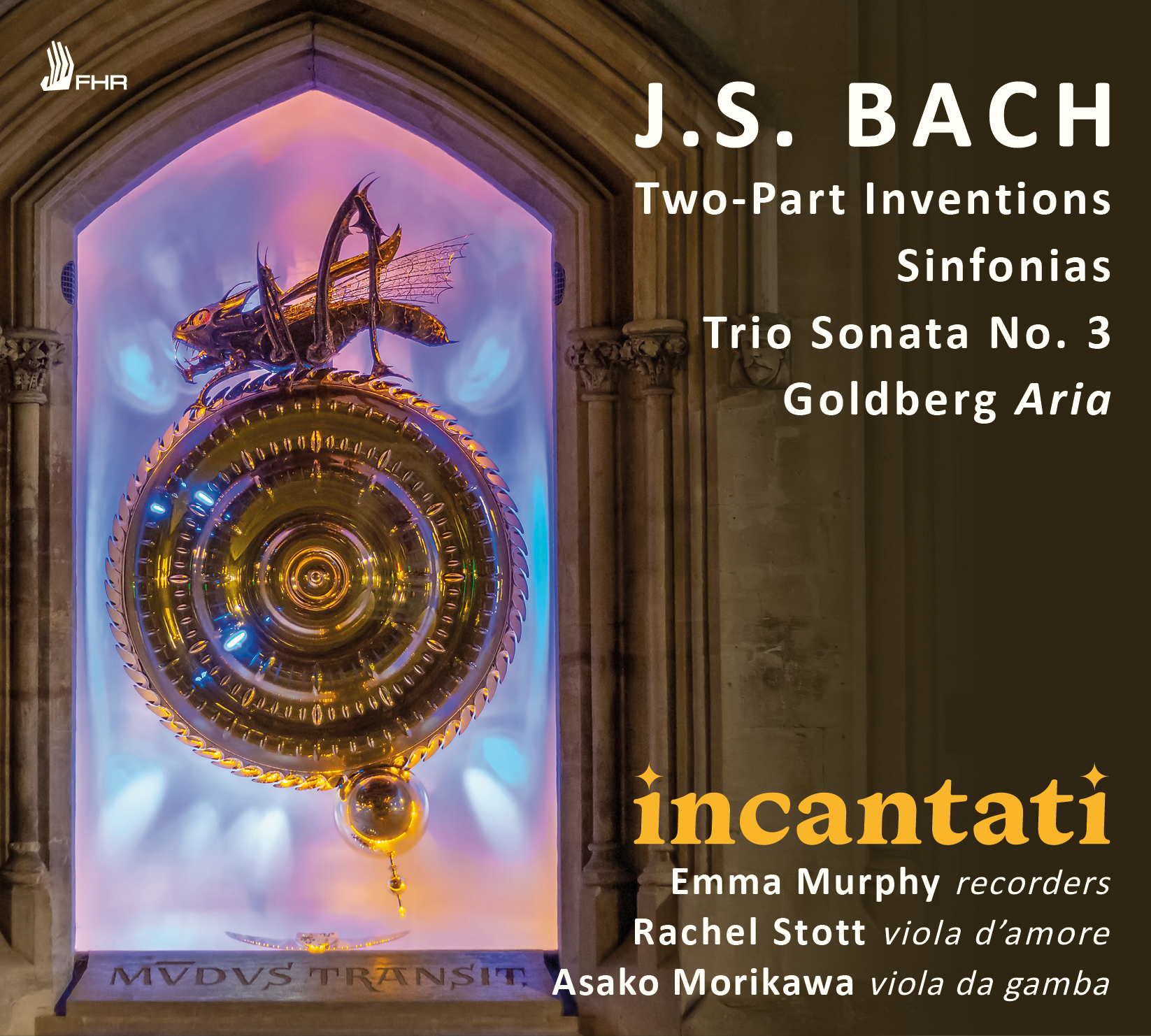
On Record – incantati: J.S. Bach: Two-Part Inventions, Sinfonias, Trio Sonata no.3, Goldberg ‘Aria’ (First Hand Records)

incantati [Emma Murphy (soprano/alto/tenor recorders, voice flute); Rachel Scott (viola d’amore); Asako Morikawa (viola da gamba)]

J. S. Bach
Inventions, BWV772-86 (selection): no.1 in C; no.2 in C minor; No.4 in D minor; No.7 in E minor; no.8 in F; no.10 in G; No.11 in G minor; No.13 in A minor; No.15 in B minor. Sinfonias, BWV787-801 (selection): no.1 in C; no.4 in D minor; no.8 in F; no.9 in F minor; no.11 in G minor; no.13 in A minor
Chorale-Preludes: Herr Jesu Christ, dich zu uns wend BWV655; Wer nur den lieben Gott lässt walten BWV691; Allein Gott in der Höh sei Her BWV716
Trio Sonata no.3 in D minor BWV527
Trio Sonata no.6 in G major BWV530/2
Aria in G major (from Goldberg Variations BWV988)

First Hand Records FHR122 [59’48”]

Producer Tom Hammond
Engineer John Croft

Recorded 19-21 May 2021 at Church of the Ascension, Plumstead, London

Reviewed by Richard Whitehouse

What’s the story?

The trio incantati performs a miscellany of pieces by Bach, including selections from the two-part Inventions and the three-part Sinfonias, excerpts from the trio sonatas and several chorale preludes in what is a diverting hour-long recital by three complementary Baroque instruments.

What’s the music like?

Both the Inventions and Sinfonias stem from Bach’s period in service to Prince Leopold of Anhalt-Cöthen during 1717-23. Both sets comprise 15 pieces that ascend in chromatic order (from C major to B minor) and they explore a range of formal and contrapuntal possibilities. While the Inventions are often canonic and the Sinfonias are mainly fugal, there are various instances where Bach allows his melodic inspiration full rein. Conceived as teaching pieces they may have been – most notably for his eldest son, the talented though quixotic Wilhelm Freidemann – but there is never any feeling that these cannot be appreciated as music for its own sake. Perhaps the ideal way to enjoy them is to play them, but few of those who do will find themselves able to match the discipline and insight conveyed by the present musicians.

Also included here are three chorale-preludes which can be found in either of the Notebooks for Anna Magdalena Bach that the composer assembled from a variety of sources (including music by other composers) while at Cöthen and later at Leipzig. Although these may be less intricately textured than the two- and three-part pieces, their focus on elaborating the melodic line against a spare if pertinent harmonic accompaniment brings its own rewards. Otherwise, the trio sonatas are drawn from the set of six Bach likewise assembled in Leipzig and which also derive from pedagogic material written with Wilhelm Friedmann in mind. The third of these pieces is included here complete – its three movements being ruminative, eloquent and vivacious. The Aria on which Bach based his Goldberg Variations makes for a limpid envoi.

Does it all work?

It does. For all its economy and restraint, this music is never easy to perform and record such that the delicate interplay can be savoured in real-time – but incantati and Chiaro Audio have done just that. It helps when the pieces played have been judiciously chosen to underline the variety that Bach draws from his textures and in relatively diverse contexts. Put another way -none of this music is unfamiliar even to non-specialists, but hearing it played thus ensures it is not predictable. Ivan Moody’s succinctly informative notes are an additional enhancement.

Is it recommended?

Indeed. As recommendable as this release is in musical terms, it also and regrettably serves a commemorative function. Emma Murphy, who died in August from the effects of an auto-immune disorder just before her 50th birthday, was among the leading recorder players of her generation and respected advocate for her instrument whether as performer or teacher. Tom Hammond, who died last December from heart failure at 47, was a musician of many talents – trombonist, conductor (notably those premieres of Matthew Taylor’s Third Symphony and his Flute Concerto) of Sound Collective and Sinfonia Tamesa, teacher (masterclasses on the occupied West Bank in Israel), co-organizer of Hertfordshire Music Festival and producer for Chiaro Audio. This proved to be their final recorded project, and both will be greatly missed.

For further information on this release, and to purchase, visit the First Hand Records website. For more on incantati, click here – and for more information, click on the names of Emma Murphy, Tom Hammond and Chiaro Audio