On record – Frankfurt Radio Symphony Orchestra / Mark Fitz-Gerald – Mortimer Wilson: The Thief of Bagdad (First Hand Records)

wilson-baghdad

Frankfurt Radio Symphony Orchestra / Mark Fitz-Gerald

Wilson The Thief of Bagdad Op.74 (1924)

First Hand Records FHR126 [74’45”]

Producer Philipp Knop Engineer Lisa Harnest

Recorded 11 April 2019 at Sendesaal, Hessicher Rundfunk, Frankfurt

Written by Richard Whitehouse

What’s the story?

First Hand Records comes up with another ‘first’ in this recording of the score for the film The Thief of Bagdad starring Douglas Fairbanks – one that set new standards for the ‘epic’   during the silent era, and which originally featured music to match from Mortimer Wilson.

What’s the music like?

Having starred in several major films (The Mark of Zorro, The Three Musketeers and Robin Hood), Fairbanks Sr determined to take matters to another level with The Thief of Baghdad – not least making its score an integral component. For this he turned to Wilson (1876-1932) – who had studied in Leipzig with Reger and later directed the Atlanta Symphony Orchestra, writing numerous compositions and several pedagogical books – encouraging him to create music whose symphonic aspect and panoramic expression were in themselves innovative.

Not all those involved in the project shared Fairbanks’s enthusiasm – among them impresario Morris Gest, who conspired to replace Wilson’s score with one from a higher-profile figure. James C. Bradford’s hurriedly assembled concoction almost immediately fell by the wayside, allowing the film’s highly successful first run to continue with Wilson’s music firmly in situ. Understandable, perhaps, why it had garnered praise but also attracted reservations given an emotional intensity and technical intricacy in advance of those previously attempted within a cinematic context. That said, Wilson was keen to make realization as practicable as possible – using relatively modest forces to facilitate performances in out-of-town venues, limiting the number of tempo or expression markings and even printing its parts in an easy-to-use format.

Nine decades on, its restoration was inevitably a challenge such as Mark Fitz-Gerald, having done comparable work on Shostakovich’s similarly ground-breaking scores for New Babylon (Naxos 8.572824-25) and Alone (Naxos 8.570316), was well equipped to undertake. How the music was initially reassembled and then adjusted to ensure its absolute synchronization with the film is explained in the accompanying booklet, a process which took several months prior to the first present-day showing at the Pordenone Silent Film Festival in October 2016, with the French premiere at Lyon this March. DVD presentation will hopefully be possible in due course; for now, the opportunity to hear Wilson’s superbly crafted score in so sympathetic a performance can only be welcomed by admirers of silent films and early 20th century music.

Does it all work?

Nearly always. Wilson’s music is firmly within the late-Romantic vein of Glière or Respighi, though a pertinent comparison might be Ernesto Halffter’s score for the silent film Carmen released just two years later and on which Fitz-Gerald undertook a similar act of restoration (Naxos 5.572260). In both cases, the music’s panoramic sweep is reinforced by interplay of themes and motifs which sustains dramatic tension across the whole. Moreover, the exclusion of repeated sections makes for a ‘screen symphony’ which fits comfortably onto a single disc.

Is it recommended?

Indeed. The Frankfurt Radio Symphony Orchestra responds ably to Fitz-Gerald’s astute direction, and the sound has clarity as well as presence. The booklet, featuring extensive commentaries by Fitz-Gerald and Patrick Stanbury, sets the seal on this ambitious and worthwhile enterprise.

Listen and Buy

To listen to excerpts from this disc and view purchase options, visit the First Hand Records website. To read more about Mortimer WIlson, this interesting article from the New York Times gives more information, while for more on Douglas Fairbanks click here To read more about the performers, click on the names of Mark Fitz-Gerald and Frankfurt Radio Symphony Orchestra.

On record – Dmitry Smirnov: Bach, Bartók & Schneeberger – Works for solo violin (First Hand)

dmitry-smirnov

Dmitry Smirnov (violin)

J.S. Bach Partita no.2 in D minor BWV1004 (c1720)

Bartók Sonata, BB124 (1944)
Schneeberger Sonata (1942)
First Hand Records FHR117 [61’45”]

Producer / Engineer Jean-Daniel Noir

Recorded 8-10 February 2021 at ‘Il Poggio’, Montecastelli Pisano, Italy

Written by Richard Whitehouse

What’s the story?

The violinist Dmitri Smirnov makes his debut for First Hand Records with this release of unaccompanied works from Bach and Bartók, together with a first commercial recording    for the wartime sonata by Schneeberger in what proves an astute and instructive coupling.

What’s the music like?

The Solo Violin Sonata by Bartók is the pre-eminent work of its kind in the twentieth century – Smirnov setting out his credentials in a forthright though never over-wrought account of its initial Tempo di ciaccona, followed by a tensile reading of the Fuga which still admits a bracing humour into its methodical construction. The Melodia is the emotional core of this work, and here Smirnov avails himself of a wide variety of timbre in its heartfelt unfolding, then the Presto makes for a coruscating finale that ultimately heads to its decisive ending.

Its famous finale can easily dwarf the initial four movements of Bach’s Second Solo Partita, but Smirnov is mindful to accord due emphasis to this succession of capricious Allemande, trenchant Courante, eloquent Sarabande then cavorting Gigue, whose jazzy syncopation provides a telling foil for what follows. Attacca in this instance – Smirnov heading directly into the Chaconne which here eschews rhetorical grandeur for an impulsive traversal of its motivically close-knit variations, sustained through to an unexpectedly taciturn conclusion.

Interest understandably focusses on a Solo Sonata by Swiss violinist Hansheinz Schneeberger (1926-2019), with whom Smirnov was personally acquainted. The present work is structured in three compact movements: a powerfully sustained Adagio – entitled Introduzione (quasi cadenza) – followed by an alternately humorous and suave Allegro, then a closing Allegro which is barely half the length of its predecessors, while compensating for any formal short-windedness with an unflagging energy which is maintained right through to its final cadence.

Does it all work?

Yes, whether in terms of a collection whose constituents can be enjoyed separately or as a straight-through recital. There are many other recordings of both the Bach and Bartók, but Smirnov brings his own interpretative approach to bear on each work while, at least for the present, has the field to himself in the Schneeberger. The repertoire for solo violin is wider than supposed, and Smirnov will hopefully continue with its exploration – maybe tackling one of those sonatas by Mieczysław Weinberg, Benjamin Frankel, or Bernard van Dieren.

Is it recommended?

Indeed. The focussed while never constricted sound provides an ideal ambience for Smirnov, whose playing is complemented by his informative annotations. Both CD and booklet cover feature one of Scheeberger’s paintings, The Forest, dating from two years before his Sonata.

Listen & Buy


You can get more information on the disc at the First Hand website. 

On record – Early Stereo Recordings Vol.4: Albéniz, Bizet, Kodály & Ravel (First Hand)

early-stereo-recordings-4

Philharmonia Orchestra / Eugene Goossens (a), Guido Cantelli (d); Royal Philharmonic Orchestra / Vittorio Gui (b) Paul Kletzki (c), Eugene Goossens (e)

Albéniz (orch. Arbós) Iberia – excerpts (1905-09, orch. c1928) (a)
Bizet Petite Suite (1871, orch. 1880) (b)
Kodály Dances of Galánta (1933) (c)
Ravel Daphnis et Chloé Suite no.2 (1909-12): Danse générale (d); Boléro (1928) (e)

First Hand Records FHR79 [78’21”]

Producers David Bicknell (a), Lawrance Collingwood (b,d,e), unknown (c)
Engineers Christopher Parker (a-d), Robert Gooch (e)

Recorded 12 July 1955 (b), 18 September 1957 (e) at Abbey Road Studios, London; 15 February (a), 24 March (c) and 28 May 1956 (d) at Kingsway Hall, London

Written by Richard Whitehouse

What’s the story?

First Hand Records continues its exploration of pioneering stereo recordings from the EMI archives with this collection of orchestral works, mainly from the earlier decades of the 20th century, as demonstrates the success of various HMV producers and engineers in harnessing the potential of stereophonic sound to the playing of what, in the 1950s, were the two finest London orchestras – the Philharmonia and Royal Philharmonic, working with conductors in music with which they were not necessarily associated over the greater part of their careers.

What are the performances like?

Starting with an incisive yet expressively deadpan take on Ravel’s Danse générale, all that survives in stereo of Guido Cantelli’s recording of the Second Suite from Daphnis et Chloé, the selection proceeds to excerpts from Albéniz’s piano cycle Iberia, orchestrated by Enrique Arbós. Seldom encountered in concert nowadays, these five pieces (all of the First, plus one each from the Second and Third Books) constitute a worthwhile suite in themselves. Eugene Goossens duly underlines his prowess in earlier 20th-century music with performances that bring out the evocative poise of Evacación, then alternate fervour and piety of El Corpus en Sevilla, before the capricious charm of Triana and capering energy of El Puerto; the cumulative emotional charge of El Albaicin closing this sequence with unfailing panache.

Goossens is hardly less persuasive in Ravel’s Boléro – at this time, not quite the ubiquitous showpiece it became – the inexorably accumulating momentum ideally served by his refusal to rush its devastatingly effective trajectory; the final stage largely taking care of itself when allowed to emerge inevitably. A further worthwhile revival is that of Bizet’s Petite Suite, five miniatures drawn from his earlier cycle for piano duet Jeux d’enfants and given with winning deftness by Vittorio Gui – demonstrably in his element when the sessions for his re-recording of Mozart’s Le nozze di Figaro finished ahead of schedule. Kodály’s Dances of Galánta has itself returned to favour in recent years, but few accounts are ever likely to match that of Paul Kletzki in his steering this ever more animated sequence through to its breathless conclusion.

Do they all work?

Pretty much, allowing for occasional lapses in ensemble that are notably few given the hectic schedule these London orchestras pursued at this time. Remastering has been deftly handled by Ian Jones – Albéniz and Bizet being transferred from HMV Stereosonic tapes, respectively by Giampaolo Zeccara and Ted Kendall (the latter’s 1997 set of Mahler ‘first recordings’ for Conifer is fondly remembered). There are extensive background notes from David Patmore, along with observations by Peter Bromley, whose tenacity has made possible this FHR series.

Are they recommended?

Indeed, not least given the interest of the actual music and the relative unfamiliarity of most of the recordings. The rapid standardization of the listening experience through the medium of streaming has made such releases as this more valuable by (hopefully) making potential listeners aware of just what became possible with the greater recourse to the stereophonic process, as of those numerous triumphs (among not a few failings) which resulted given the right combination of technology and musicality. Further instalments are keenly anticipated.

Listen & Buy


You can get more information on the disc at the First Hand website, where you can also find information on the first, second and third volumes in the series 

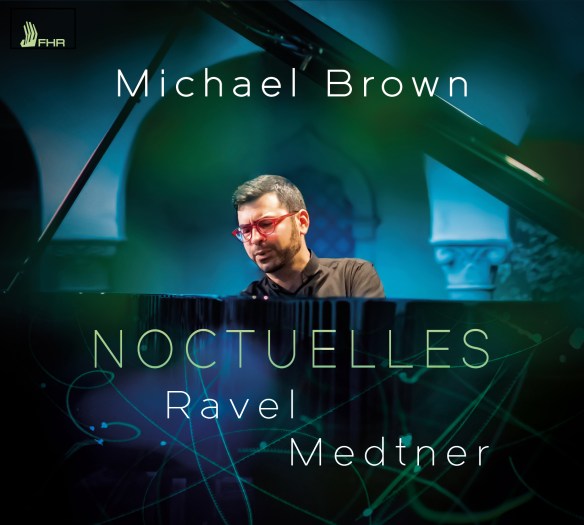
On record: Michael Brown – Noctuelles: Ravel & Medtner (First Hand Records)

Michael Brown (piano)

Ravel  Miroirs (1904-5)
Medtner Second improvisation (in variation form) Op.47 (1925)

First Hand Records FHR78 [61’49”]
Producers Adam Golka, Roman Rabinovich
Engineers Monte Nickles, Jim Ruberto

Recorded 2-10 January 2019 at Olivier Music Barn, Tippet Rise Arts Centre, Fishtail MT

Reviewed by Richard Whitehouse

What’s the story?

Michael Brown follows his earlier disc for First Hand Records (Beethoven and Mendelssohn on FHR67) with this coupling of Ravel’s most extensive solo piano work and Medtner’s most extended such piece outside of his sonatas; here featuring two recently discovered variations.

What’s the music like?

While the term ‘post-impressionism’ had not then been applied in a musical context, Ravel’s Miroirs effectively inaugurates this through five pieces that evoke the essence of the image in question rather than merely attempting its depiction. Other pianists may have rendered these evocations more acutely, but few have approached so highly contrasted a sequence with such evident concern for formal and expressive unity.

Hence the overall seamlessness with which the fugitive activity of Noctuelles is followed by the wistful poise of Oiseaux tristes; itself proceeded by those glistening textures and kaleidoscopic timbral interplay of Une barque sur l’océan, then the stark juxtaposition (vividly delineated here) between high-jinx and eruptive unease of Alborada del gracioso. Nor is La vallée des cloches the slight anti-climax it can often seem, Brown judiciously setting the scene for that stately modal theme as is among the composer’s most potent inspirations. An interpretation leaving one more than usually aware that the audacity of Ravel’s musical thinking is made more so by its pointed understatement.

One cannot imagine that Medtner had much regard for this music – but, fortunately, he almost always proved more flexible in his accommodation with past and present as composer than as writer. Never more so than with his Second Improvisation, written after he had left the Soviet Union for uncertain exile in Paris then London – its subtitle ‘in variation form’ indicating the fusing of precision and fluidity that gives this work its substance and its fascination. Brown’s perceptive reading is made more so by his inclusion of two previously unpublished variations which he tracked down to the National Library of Canada: thus, the elaborate passagework of La Cadenza (placed between variations four and five) and the coursing rhetoric of Pesante (placed between variations 11 and 12) which, between them, open out the emotional scope of what is already a design as unpredictable as it is engrossing. Certainly, the trajectory between the initial Theme and eventual Conclusion exudes a freedom from inhibition that Medtner here achieves almost despite himself and which Brown is demonstrably intent on conveying.

Does it all work?

Yes, given Brown teases out those musical connections between composers whose aesthetic outlook differed greatly (Medtner forthright in condemning most of his contemporaries). The account of Miroirs can certainly hold its own in what is now a crowded field (one featuring such as Beatrice Rana on Warner and Steven Osborne on Hyperion), whereas in the Second Improvisation the main competition comes from Hamish Milne (CRD) and Geoffrey Tozer (Chandos), neither of who include the additional two variations that Brown interpolates here.

Is it recommended?

Indeed. The acoustic of the Olivier Music Barn is ideal for piano music of this intricacy and subtlety, while Brown’s booklet notes are succinctly informative. A welcome release by one of the Tippet Rise triumvirate who have become notable contributors to First Hand Records.

Listen and Buy

For further information on this release, and to purchase, visit the First Hand Records website. Meanwhile you can listen to Noctuelles on Spotify:

On record – Lysander Piano Trio: Mirrors – 21st Century American Piano Trios (First Hand)

Cohen Around the Cauldron (2016)
Moya
Ghostwritten Variations (2015/16)
Higdon
Love Sweet (2013)*
Belimova
Titania and Her Suite (2014)
Cooper
An den Wassern zu Babel (2010)
Ciupinski
The Black Mirror (2013/14)

Lysander Piano Trio (Itamar Zorman (violin), Michael Katz (cello), Liza Stepanova (piano) with *Sarah Shafer (soprano)

First Hand Records FHR111 [71’26”]

Producer & Engineer Ryan Streber, *Paul Griffith

Recorded 2 & 3 January 2018 at Oktaven Audio, Mount Vernon, New York; * 21 February 2018 at Performing Arts Center, Athens, Georgia

Written by Richard Whitehouse

What’s the story?

An enterprising and finely realized collection of recent works for piano trio (all of them first recordings) by the Lysander Piano Trio, an ensemble now well established on the American recital circuit, which here gets to display its versatility and conviction in abundant measure.

What’s the music like?

As varied as the composers featured. Senior among them, Jennifer Higdon (b1962) contributes in Love Sweet a song-cycle very different from the extrovert orchestral works for which she is best known; the unusual yet effective combination of soprano and piano trio affording a deft characterization of these five poems by early twentieth century author Amy Lowell that trace the fateful unfolding of a relationship with ruminative poignancy. Following directly, Titania and Her Suite by Sofia Belimova (b2000) is a disarmingly assured miniature by a composer then in her early teens – its animated and unpredictable take on the figure from Shakespeare’s A Midsummer Night’s Dream having a maturity and assurance as to put into the shade efforts by other more recent prodigies. Where its composer goes from here should prove fascinating.

Either side of these works, Ghostwritten Variations by Reinaldo Moya (b1984) draws on four seminal novels of the post-war era in four variations on a theme whose understated eloquence is ideally suited to the respectively searching, agitated, insouciant and disembodied treatments which follow – so making for an trajectory enhanced by this theme’s audible presence at each stage. As its title suggests, An den Wassern zu Babel by William David Cooper (b1986) draws on Psalm 37 not only as text but also the melody found in a setting contemporaneous with the German translation by Martin Luther; from which emerges a continuous set of six variations whose contrasts are permeated (never slavishly) by the spirit of German expressionism from the early twentieth century, and in what becomes a ‘mirror’ as revealing as it is disconcerting.

With its influences ranging from prog rock to klezmer, Around the Cauldron by Gilad Cohen (b1980) opens the programme with a vividly evocative sequence inspired by the three witches (also known as the weird sisters) from Shakespeare’s Macbeth; these seven tightly contrasted vignettes taking in a Witches Waltz of glinting irony then culminating in Sacrificial which is hardly less chilling than the Third Ear Band’s score for Roman Polanski’s (in)famous film rendering. Concluding this collection, The Black Mirror by Jakub Ciupinski (b1981) takes up procedures associated with Baroque painter Claude Lorrain – the piece slowly emerging from tentative piano phrases and string harmonics to a climax whose etherealized intensity could not be better described than by the composer’s description of ‘‘an explosion in slow motion’’.

Does it all work?

Yes – inasmuch that there are no also-rans among the pieces featured and, even if there were, the unwavering commitment of the musicians would likely be more than compensation; not least Sarah Shafer, whose singing adds much to the affecting aura of the Higdon song-cycle.

Is it recommended?

Indeed. The sound presents an often difficult medium to best advantage, while credit should be given to the booklet which features succinctly insightful notes on each piece along with biographies of each of the composers and artists – not to mention those five Lowell poems.

Listen and Buy

You can discover more about this release at the First Hand Records website, where you can also purchase the recording.