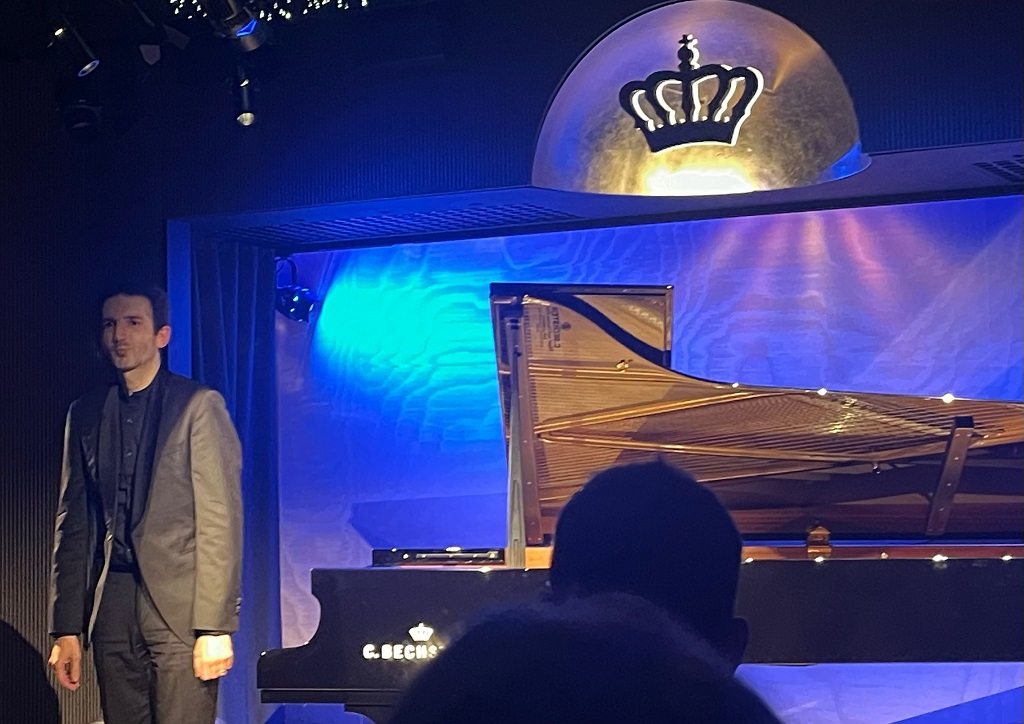
In concert – Emmanuel Despax @ Bechstein Hall, London

Emmanuel Despax (piano)

Ravel Miroirs (1905)
Despax Sounds of Music – Concert Paraphrase on The Sound of Music by Richard Rodgers and Oscar Hammerstein (unknown)
Fauré arr. Despax Après un rêve Op.7/1 (1877)
Debussy Clair de lune (1905)
Ravel Gaspard de la nuit (1908)

Bechstein Hall, London, 7 March 2025

by John Earls. Photo credit (c) John Earls

The most recognised piece of music by French composer Maurice Ravel is his 1928 large orchestral work Boléro, famously used in the film 10 and by Torvill and Dean when ice dancing their way to a 1984 Winter Olympics gold medal.

But there is also a magnificent repertoire of piano music including for solo piano and this provided the main feature of this recital by Emmanuel Despax, marking the 150th anniversary of Ravel’s birth.

The first set opened with Miroirs (Mirrors), a suite of five short movements Ravel dedicated to his fellow members of the French avant-garde artist group Les Apaches.

Noctuelles (Night Moths) had twinkling moments of calm surfacing through its dark undertones, contemplative birdsong is evoked in Oiseaux tristes (Sad Birds), Une barque sur l’océan (A Boat on the Ocean) captured both the flow and ripple of the waves, Alborada del gracioso (The Jester’s Aubade) had a jittery, Spanish aspect, and the bells of La vallée des cloches (The Valley of Bells) are not peals so much as melancholic, dark flashes.

The set ended with Despax’s Sounds of Music, a ‘Concert Paraphrase’ on Rodgers and Hammerstein’s The Sound of Music. I enjoyed its dark humour and nods to other classical piano composers – “If you hear something you recognise it’s not plagiarism, it’s on purpose” Despax forewarned us.

The second set opened with Despax’s arrangement of Faure’s Après un rêve (After a Dream) which was serious and majestic followed by Debussy’s Clair de lune (Moonlight) which whilst thoughtful and considered was also beautifully delicate and expressive.

But the evening was Ravel’s and it concluded with his epic three part masterpiece Gaspard de la nuit (Gaspard of the Night) derived from the prose poems by Aloysius Bertrand. Described by Despax as a “symphonic work for solo piano” it is notoriously difficult to play.

Ondine’s hypnotic trills are shaken by a short powerful blast towards the end and Despax displayed his virtuosity throughout. Le Gibet presents bells of a different kind to those featured in the earlier set, more disturbing and ominous as the repeating tolls maintained throughout evoke the lone hanged man of its inspiration. The way Despax leaned into his keyboard in rapt concentration reminded me of jazz pianist Brad Mehldau at his most intense. The final piece, Scarbo, depicts a mischievous goblin and was spritely before its dramatic long pause towards the end and a forceful energetic finish. It was as captivating to watch as it was to listen to.

What was clear from this performance is the attachment and affinity that Emmanuel Despax has for the music of Maurice Ravel. This was confirmed by an encore of Pavane pour une infante défunte (Pavane for a Dead Princess) which provided a moving and tender conclusion to the evening.

John Earls is Director of Research at Unite the Union. He posts on Bluesky and tweets / updates his ‘X’ content at @john_earls

Published post no.2,468 – Sunday 9 March 2025
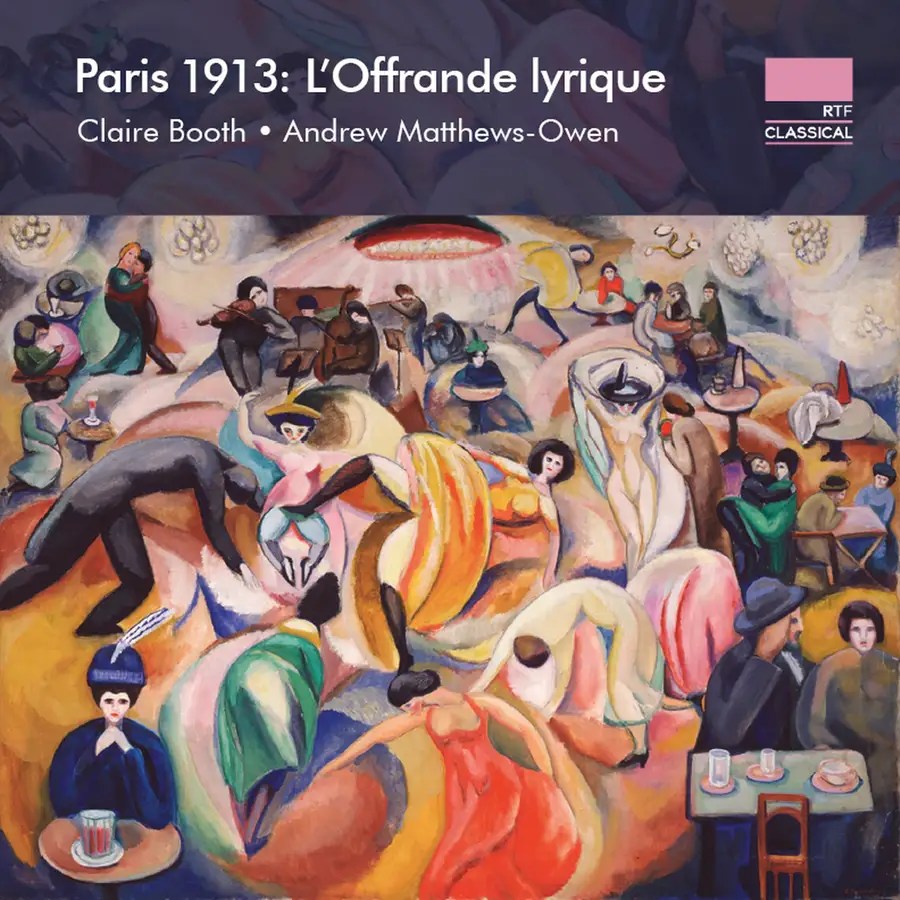
On Record – Claire Booth & Andrew Matthews-Owen: Paris 1913: L’offrande lyrique (Nimbus)

Caplet En regardant ces belles fleurs
Milhaud L’innocence Op. 10/3
Hahn À Chloris
Ravel arr. Stravinsky Trois poèmes de Stéphane Mallarmé M64
Auric Trois Interludes: Le pouf.
Ropartz La Route
Durey L’Offrande lyrique Op. 4
Saint-Saëns Petit main Op.146/9
Fauré Il m’est cher, Amour, le bandeau, Op. 106/7
Chaminade Je voudrais être une fleur
Debussy Trois poèmes de Stéphane Mallarmé L127
Satie ed. Dearden Trois Poèmes d’Amour
Lili Boulanger Clairières dans le Ciel: Vous m’avez regardé avec votre âme
Grovlez Guitares et mandolines

Claire Booth (soprano), Andrew Matthews-Owen (piano)

Nimbus RTF Classical NI6455 [66’23”] French texts included
Producer & Engineer Raphaël Mouterde

Recorded 11/12 March, 4-6 September 2023 at Wyastone Concert Hall, Monmouth

Reviewed by Richard Whitehouse

What’s the story?

Another enterprising song recital from Claire Booth and Andrew Matthews-Owen, this one focussing on songs that were either conceived, composed or premiered in Paris during 1913 and resulting in an absorbing collection best heard as a diverse while unpredictable totality.

What’s the music like?

Interleaving standalone songs and song-cycles, this recital opens with André Caplet’s take on Charles d’Orléans, its limpid modality highly appealing, then continues with an early song by Darius Milhaud as already demonstrates his distinctive and amusing approach to word-setting, while that by Reynaldo Hahn typifies the teasing charm familiar from his vocal music overall. Maurice Ravel’s triptych to texts by Mallarmé is performed in a version by Stravinsky with its accompanying nonet reduced to piano which, in preserving and maybe even accentuating the music’s questing introspection, represents no mean fete of transcription. Still relatively little known, this certainly deserves to be heard as at least an occasional alternative to the original.

Remembered best as a prolific writer of film scores, Georges Auric had shown a precocious talent for song as is evident in his sensuous setting of René Chalupt. A composer who often wrote on a symphonic scale, Guy Ropartz is heard in a setting of his own verse that amounts to a ‘scena’ in its wide expressive ambit. Interest understandably centres on the eponymous cycle by Louis Durey, a member of Les Six whose increasingly far-left conviction tended to marginalize his creativity yet, as these lucid and empathetic settings of Rabindranath Tagore (as translated by André Gide) confirm, had emerged as a protean talent by his mid-twenties. Hopefully these artists will be encouraged to investigate other of his songs from this period. By contrast, a late song by Camille Saint-Saëns exudes a touching poignancy, while that by Gabriel Fauré typifies the elusiveness of those in his last decade. As is evident here, Cécile Chaminade was a songwriter of style and elegance, then the Mallarmé triptych by Debussy (its first two texts identical to those of Ravel) finds this composer probing the inscrutability of these poems while drawing back from any more explicit intervention. The inscrutability conveyed by Erik Satie’s aphoristic settings (edited by Nathan James Dearden) of his own texts is altogether more playful – after which, the recital continues with a pensive offering by Lili Boulanger, with Gabriel Grovlez’s sultrily evocative setting of Saint-Saëns to finish.

Does it all work?

Yes, given the fascination of this collection taken as a whole and, moreover, the quality of these renditions. Booth is not a singer willing to take the easy option in her interpretations, and so it proves here with singing as fastidious as it is refined, while Matthews-Owen duly instils often deceptively spare accompaniments with understated insight. They contribute a succinctly informative note, but the booklet includes only the French texts with the English translations available at https://rtfn.eu/paris1913/: might it have best the other way round?

Is it recommended?

Very much so. There is much to fascinate even those who consider themselves afficionados of the ‘chanson’, and those who are unfamiliar with much of this repertoire could not have a better means of acquainting themselves with certain of its treasures – hidden or otherwise.

Listen & Buy

For purchase options, you can visit the Ulysees Arts website. For information on the performers, click on the names to read more about Claire Booth and Andrew Matthews-Owen

Published post no.2,466 – Friday 7 March 2025

In concert – Steven Isserlis and Friends – Fauré at the Wigmore Hall (5)

Steven Isserlis (cello) – with Joshua Bell, Irène Duval (violins), Blythe Teh Engstroem (viola), Connie Shih, Jeremy Denk (pianos)

Fauré Dolly Suite Op.56 (1894-6)
Enescu Pièce sur le nom de Fauré (1922)
Ravel arr. Garban Berceuse sur le nom de Garbriel Fauré M74 (1922)
Koechlin Hommage à Gabriel Fauré Op.73bis (1922)
Fauré Cello Sonata no.2 in G minor Op.117 (1921)
Fauré String Quartet in E minor Op.121 (1923-4)

Wigmore Hall, London
Tuesday 5 November 2024

Reviewed by Richard Whitehouse Picture (c) Wigmore Hall Trust

So to the final concert of this series, curated by cellist Steven Isserlis and centred on Fauré’s larger chamber works in the centenary of his death. The last of five concerts was rounded out in its coverage by including his most popular work for piano duet, along with miniatures from several pupils of one who was held in equal esteem as a teacher.

It is doubtless as easy to describe the Dolly Suite with patronizing charm as it is to play it so but, with Jeremy Denk and Connie Shih an alert if always sensitive partnership, there was no likelihood of this latter. A limpid take on the evergreen Berceuse was followed by no less a deft rendition of Mi-a-ou; the ineffable charm of Le jardin de Dolly made a telling foil to the skittish evocation (of a dog) that is Kitty-valse, then the searching poise of Tendresse created a delightful contrast with that affectionate send-up of Chabrier in Le pas espagnol.

Quite why the journal Le Revue chose Fauré’s 77th year to publish an edition devoted to his music is unclear, but it did enable seven former students to express their admiration through miniatures that encapsulate his own idiom as surely as theirs. Hence the intricate texture and enfolding harmony of Enescu’s Pièce, the pert elegance of Ravel’s Berceuse arranged (from its violin-and-piano original by Lucien Garbon), then the gently inflected wit of Koechlin’s Hommage to remind one of the latter composer’s service to Fauré as sometime orchestrator.

These three items were engagingly played (and introduced) by Denk, and it seemed a pity the other four (by Aubert, Ladmirault, Roger-Ducasse and Schmitt) could not have been included – perhaps at the start of the second half – given the appositeness of the programme. This first half ended with the Second Cello Sonata which, while it resembles its predecessor in form, is appreciably more forthcoming as to expression. It is evidently a work that Steven Isserlis first played as a teenager, and there could be no mistaking his identity with the close-knit dialogue of its opening Allegro, pathos bordering on the elegiac of its central Andante that started out as music commemorating the centenary of Napoleon’s death, and effervescence of a finale as endows what is otherwise typical late Fauré with a genial humour never less than captivating.

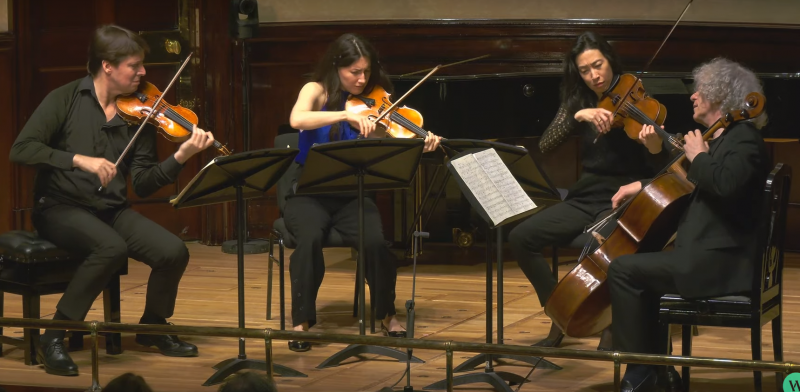
After the interval, this series ended in the only way possible with the String Quartet that was Fauré’s last work. In his initial remarks, Isserlis mentioned how long it had taken for him to ‘get’ this piece and, indeed, its three movements each unfolds in a seamless polyphonic flow which can feel disconcerting even in the context of the composer’s other late chamber works. Whether or not they play it frequently, Joshua Bell, Irène Duval, Blythe Teh Engstroem and Isserlis audibly had its measure – their steady though always flowing tempo for its Allegro moderato ideally complemented by the luminous radiance of its Andante; before its Allegro elides elements of scherzo and finale in music whose dextrous pizzicato writing and gently cumulative intensity conveys an affirmation that speaks of a challenge, and a life, fulfilled.

As a work and as a performance, it set the seal in the only way possible on a series of concerts through which the quality and substance of Fauré’s chamber music could not have been more eloquently confirmed, which is just as should be expected from a retrospective of this nature.

You can watch the concert below, thanks to the Wigmore Hall YouTube channel:

For more information on the Fauré series, visit the Wigmore Hall website – while you can also read Arcana’s interview with Steven Isserlis about the French composer

Published post no.2,355 – Thursday 5 November 2024

In concert – Steven Isserlis and Friends – Fauré at the Wigmore Hall (4)

Steven Isserlis (cello) – with Joshua Bell, Irène Duval (violins), Connie Shih, Jeremy Denk (pianos), Quatuor Agate [Adrien Jurkovic, Thomas Descamps (violins), Raphaël Pagnon (viola), Simon Iachemet (cello)]

Fauré Cello Sonata no.1 in D minor Op.109 (1917)
Enescu Violin Sonata no.2 in F minor Op.6 (1899)
Fauré Piano Trio in D minor Op.120 (1922-3)
Ravel String Quartet in F M35 (1902-03)

Wigmore Hall, London
Monday 4 November 2024

Reviewed by Richard Whitehouse Picture (c) Wigmore Hall Trust

Tonight’s instalment of the Wigmore Hall series focussing on Fauré’s larger chamber works was also the most cohesive in its alternating two of the composer’s late pieces with formative ones by Enescu and Ravel for what was a fascinating programme of echoes and anticipations.

While not necessarily the weakest of those works played in this series, Fauré’s First Cello Sonata is the least remarkable – the melodic content reduced to barest essentials such that its main motifs can verge on the anonymous. That said, its opening Allegro is a model of formal economy and expressive restraint, Steven Isserlis and Connie Shih being no less perceptive in the pensive musing of its central Andante or the urbanity of a final Allegro whose ‘commodo’ aspect was always evident. Less may not always be more, but it is rarely less than appealing.

Less often heard than its successor, Enescu’s Second Violin Sonata is no less significant. Its composer’s first masterpiece, much of the fascination lies in the degree to which its melodic ideas evolve across and between each of the three movements for a potent demonstration of motivic unity. This was something Irène Duval conveyed in ample measure, yet without ever neglecting that reticent or sometimes ominous quality characterizing much of its content – at least until the quixotic finale channels these diverse elements towards a resolution achieved almost despite itself. Throughout, Jeremy Denk’s pianism was a model of lucidity and poise in a performance which went all the way in confirming this work as one of the three greatest masterpieces by a teenager – the other two being written 74 years earlier, then 72 years later. (presumably Mendelssohn’s Octet and a piece to be confirmed! – ed)

Fascinating how much Enescu’s precocity resembles Fauré’s maturity in what was the latter composer’s penultimate work. Compact almost to a fault, the Piano Trio is dominated in all respects by a central Andantino whose melodic eloquence has intensified almost to the point of ecstasy by its close, not least as rendered by Joshua Bell, Isserlis and Denk in what was a near-ideal performance. Succinctness almost gets the better of the outer movements, though it would be churlish not to acknowledge the tensile energy of its opening movement and the exhilaration of a finale whose element of syncopation marks Fauré’s nearest approach to the jazz idiom. Interesting as it is to hear this piece with clarinet as was originally intended, its interplay of violin, cello and piano is no less inevitable than in the parallel work by Brahms.

The well-regarded Quatuor Agate duly took the stage for Ravel’s String Quartet, evidently a work for which Fauré expressed only muted enthusiasm. Superbly played though a little self-regarding interpretively, this account was at its best in its latter stages – the inward rapture of its slow movement in pointed contrast to the volatility and ultimate decisiveness of its finale. The opening movement at times verged on expressive inertia and the scherzo’s deft humour was rather self-conscious, but the overall conviction of this performance still came through. Seemingly the Agate will not be playing Fauré’s String Quartet which forms the culmination of tomorrow’s concert and of this series; one that also includes the Second Cello Sonata and music written in tribute to a composer whose greatness could hardly be doubted now as then.

You can watch the concert below, thanks to the Wigmore Hall YouTube channel:

For more information on the Fauré series, visit the Wigmore Hall website – while you can also read Arcana’s interview with Steven Isserlis about the French composer

Published post no.2,354 – Wednesday 5 November 2024

In concert – Steven Isserlis and Friends – Fauré at the Wigmore Hall (3)

Steven Isserlis (cello) – with Joshua Bell, Irène Duval (violins), Blythe Teh Engstroem (viola), Jeremy Denk, Connie Shih (pianos)

Fauré Violin Sonata no.1 in A major Op.13 (1875-6)
Saint-Saëns Piano Trio no.2 in E minor Op.92 (1892)
Ysaÿe Solo Violin Sonata in D minor Op.27/3 ‘Ballade’ (1923)
Fauré Piano Quintet no.2 in C minor Op.115 (1919-21)

Wigmore Hall, London
Sunday 3 November 2024

Reviewed by Richard Whitehouse Picture (c) Joanna Bergin

This third instalment of the Wigmore Hall’s journey through Fauré’s larger chamber works, as overseen in typically understated fashion by Steven Isserlis, took in works from (almost) either end of this composer’s output alongside pieces by two very different contemporaries.

It was Joshua Bell’s recovering illness that brought a switch in programme such that tonight began with the First Violin Sonata which established Fauré’s reputation and remains among his best-known works (also the only one of these pieces in a major key). The melodic verve of its initial Allegro responded well to Bell’s tonal warmth, despite marginal loss of focus as the development ran its cumulative course, then the Andante lacked little in lyrical intimacy nor the scherzo in nimble dexterity. That the final Allegro felt less than animated (not much evidence of ‘quasi presto’) was understandable in context and, even if it meant rounding off this performance with less than ideal decisiveness, there could be no doubting the sense of epiphany as its main theme returns transformed for an apotheosis of heightened eloquence.

At a time when Fauré was grappling with the implications of what became his Second Piano Quintet, Saint-Saëns was writing his no less substantial Second Piano Trio with relative ease. Its stylistic retrenchment is not hard to discern, witness the opening movement’s prolonged and ultimately doomed struggle to break free of a main theme riven with doubt and anxiety. Tensions relax appreciably in the sequence of middle movements – a lithe and ingratiating Allegretto, an Andante of ‘song without words’ lyricism, then a Grazioso with more than its touch of quixotic humour – during which, interplay between Bell, Isserlis and Jeremy Denk was at its most felicitous. Returning to weightier issues, the finale takes in some intensively contrapuntal passages prior to a conclusion whose headlong impetus came to the fore here.

After the interval came the third of Ysaÿe’s solo sonatas – the Ballade dedicated to Enescu but, as Bell pointed out, premiered by his teacher Josef Gingold who had been the last pupil of its composer; its ‘introduction and allegro’ format incisively delineated on this occasion.

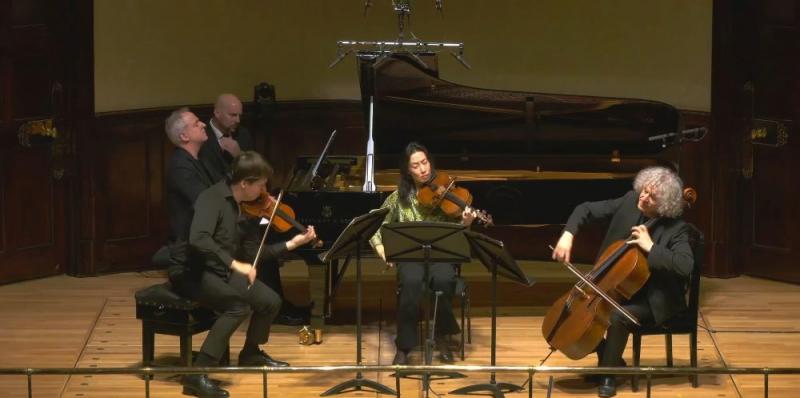
Thence to Fauré for his Second Piano Quintet. Although written relatively quickly compared to its predecessor, it is no less fastidious in content or elusive in character – witness the initial movement whose harmonic subtlety is accentuated by the flexibility of its rhythmic contours, which latter aspect comes to the fore in a scherzo whose angularity betrays more than a touch of malevolence. Is there a more consummate instance of this composer’s art than its Andante? Once characterized as a synthesis between Beethoven and Wagner, it exudes a transcendent calm entirely its own in which the eloquence of Irène Duval and Blythe Teh Engstroem added appreciably to the underlying affect. If the finale is less remarkable, it injects an impetus that propelled the work to a headily affirmative close which was conspicuous by its presence here. An impressive performance of a masterpiece that, while it will never achieve in popularity what it has in respect, could never seem other than communicative when realized with this empathy – something that should be no less evident in the remaining concerts of this series.

You can watch the concert below, thanks to the Wigmore Hall YouTube channel:

For more information on the Fauré series, visit the Wigmore Hall website – while you can also read Arcana’s interview with Steven Isserlis about the French composer

Published post no.2,353 – Tuesday 5 November 2024