
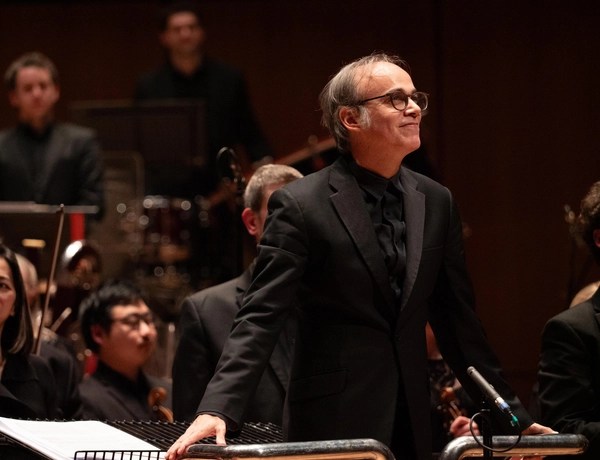
City of Birmingham Symphony Orchestra / Ilan Volkov (above)
Frescobaldi arr Stokowski Gagliarda Seconda (1627/1934)
Purcell arr Stokowski Dido’s Lament (1689/1949)
Debussy arr Stokowski The Sunken Cathedral (1910/1930)
Mussorgsky arr Stokowski Boris Godunov: Coronation Scene (1874/1936)
J.S. Bach arr Stokowski Toccata and Fugue in D minor BWV565 (c1708/1927)
Stravinsky The Rite of Spring (1911-13)
Symphony Hall, Birmingham
Wednesday 3 June 2026
Reviewed by Richard Whitehouse Picture (c) Hannah Blake-Fathers
He might not officially become Principal Guest Conductor of the City of Birmingham Symphony Orchestra until next season, but Ilan Volkov – a valued collaborator over the past two decades – gave notice of his intentions with this enterprising programme of Stokowski and Stravinsky.
Stokowski, that is, in his role as an arranger often interventionist, frequently provocative while always compelling. The first four of these pieces played without break – the hieratic poise of Frescobaldi’s Gagliarda Seconda, with its layering of wind and strings, leading into Purcell’s Dido’s Lament with its soulful interplay of solo and massed strings. This sequence moved up a gear with The Sunken Cathedral, here becoming the most evocative of Debussy’s Préludes as its washes of percussion prepared for an apparition of sonorous splendour before returning to the murky depths. Volkov will hopefully schedule Stokowski’s entire Symphonic Synthesis from Mussorgsky’s Boris Godunov at a future concert though, for now, the Coronation Scene offered a tantalizing taster as its ringing ostinato patterns built toward a cinematic apotheosis.
It made sense to round off this sequence with Toccata and Fugue, most characteristic of the conductor’s numerous Bach reworkings and the most archetypal of all his arrangements. Its sonic opulence is balanced by an analytical acuity with the orchestral sections stratified so to bring out the motivic intricacy of its Toccata as well as the mounting impetus of its Fugue on the way to a glowering peroration. The CBSO gave its collective all in a piece that, whether or not this is actually by Bach, could not be an arrangement by anyone other than Stokowski.
Stokowski directed the American premiere of Stravinsky’s The Rite of Spring in Philadelphia some 104 years ago and the questing zeal heard in his 1930 recording seemed no less evident in Volkov’s performance – assuredly no powerhouse conception and all the more impressive because of it. With bassoonist Nikolaj Henriques given his head in its plangent Introduction, the first part proceeded stealthily and its myriad shades of detail or expressive nuance given focus through the music’s unfolding at a consistent while unbroken pulse. Such as the innate violence in Ritual of Abduction and inexorable Ritual of the Rival Tribes were drawn into an indivisible whole whose accruing tension found release in a seismic Dance of the Earth.
If the second part emerged more episodically, this was owing more to its actual content than to any interpretative failing. Certainly the diaphanous haze of its Introduction segued with due seamlessness into Mystic Circles of the Young Girls of ominous import. Nor was there any wanton pictorialism in Ritual Action of the Ancestors, with the trenchancy at the start of the Sacrificial Dance a telling foil to the unbridled impetus which followed. Others may have drawn a purely visceral frenzy from this music, but relatively few can have channelled such impetus through to so conclusive and (strange as this sounds) satisfying a final gesture.
Impressive music-making, then, that augurs well for Volkov’s three concerts with the CBSO next season. Hopefully there will also be an opportunity for this conductor to expand on his extensive discography, as part of what should prove an arresting and productive relationship.
To read more about the CBSO’s 2025/26 season, visit the CBSO website. Click on the name to read more on conductor Ilan Volkov, while you can watch him in action in a number of videos below:
Ilan Volkov conducts works by Schreker and Strauss – YouTube
Tchaikovsky: Symphony No. 4 in F minor, Op. 36 – Brussels Philharmonic & Ilan Volkov – HD
Published post no.2,908 – Friday 5 June 2026


