
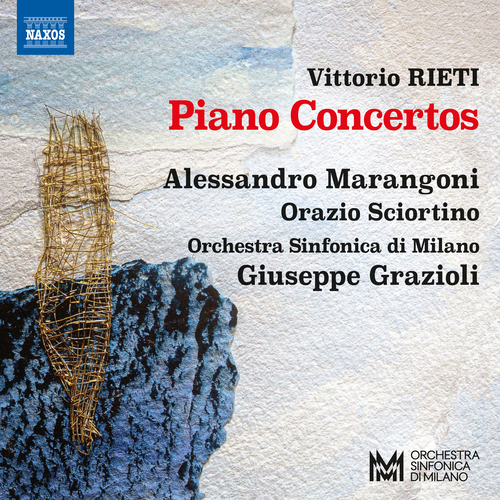
Rieti
Piano Concerto no.1 (1926)
Piano Concerto no.2 (1937)
Piano Concerto no.3 (1955)
Concerto for Two Pianos (1951)
Alessandro Marangoni, Orazio Sciortino (pianos), Orchestra Sinfonica di Milano / Giuseppe Grazioli
Naxos 8.564505 [80’27”]
Producer Stefano Barzan Engineer Cinzia Guareschi
Dates: 21-22 August 2022, 17-20 August 2023 (Piano Concerto no.3, Concerto for Two Pianos) at Auditorium di Milano
Reviewed by Richard Whitehouse
What’s the story?
Naxos continues its enterprising 20th Century Italian Classics with the concertante works for piano by Vittorio Rieti (1898-1994), the Egyptian-born Italian composer whose years in Paris then New York and Chicago afforded contact with a range of illustrious musicians and artists.
What’s the music like?
Dedicated to Poulenc and likely inspired by the success of Prokofiev’s Third Concerto earlier that decade, Rieti’s First Piano Concerto brings a deft touch to its ostensible neo-Classicism – whether in the martially-inflected playfulness of its initial Allegro, laconic but also beguiling ambivalence of its central Andantino, or the theatrical high-jinx of a final Allegro whose nod towards jazz rhythm marks this out as a piece decidedly yet always unaffectedly of its time. Seemingly forgotten following its premiere (by the composer?), its revival is well deserved.
Just over a decade on, the Second Piano Concerto emerged from material originally intended for a harpsichord concerto. On a similar scale to its predecessor, the opening Allegro has an impetus that denotes the uncertainty spreading throughout Europe at this time, and which is intensified by the central Adagio with its plangent discourse between soloist and orchestra; a quality the final Allegro (which follows with barely a pause) does not so much overcome as dismiss through an energetic repartee which brings about the nominally affirmative ending.
By the time of his Third Piano Concerto, Rieti was well established in the United States such that the present work is audibly in the lineage of American works for this medium of the post -war era. Any undue portentousness in the introductory Largo is dismissed with the vivacious Allegro that follows, then the central Andantino confirms that, while Rieti’s idiom might not have altered substantially over his career, it gained in subtlety and depth. Any more ominous expression is avoided in the final Allegro as it wends a capricious course to its decisive close.
Written in the wake of his relocation to the USA, the Two-Piano Concerto helped to establish Rieti’s reputation in a very different cultural climate. There is little moderate about either the tempo or character of the impetuous opening Allegro, then the central Allegretto comprises a set of variations’ which takes its unassuming theme through a diverse range of moods without losing focus on route to the pensive close. The final Allegro turns away from any encroaching inwardness with its energetic fugal interplay such as makes for an ending of pointed defiance.
Does it all work?
It does, provided one accepts Rieti as a product of his age rather than trailblazer or innovator. Stravinsky, Prokofiev and even Jean Françaix are prominent in the stylistic mix, with a more tensile aspect derived from Copland in the works of his American years. Not that this should offset enjoyment of music that feels never less than communicative and often engagingly so, particularly as regards the latter two pieces. Both of these were recorded way back in the LP era, but to have all four works rendered in such sympathetic readings is hardly to be gainsaid.
Is it recommended?
It is, not least when Alessandro Marangoni (alongside Orazio Sciortino) is so attuned to this music, while Giuseppe Grazioli obtains a committed response from the Milan orchestra. The succinct booklet notes are highly informative and further enhance the appeal of this release.
Listen & Buy
For purchase options, you can visit the Naxos website. For information on the performers, click on the names to read more about Alessandro Marangoni, Orazio Sciortino, Giuseppe Grazioli and the Orchestra Sinfonica Milano. An interview between Vittorio Rieti and Bruce Duffie can be read here
Published post no.2,492 – Wednesday 2 April 2025
 Arcana.fm