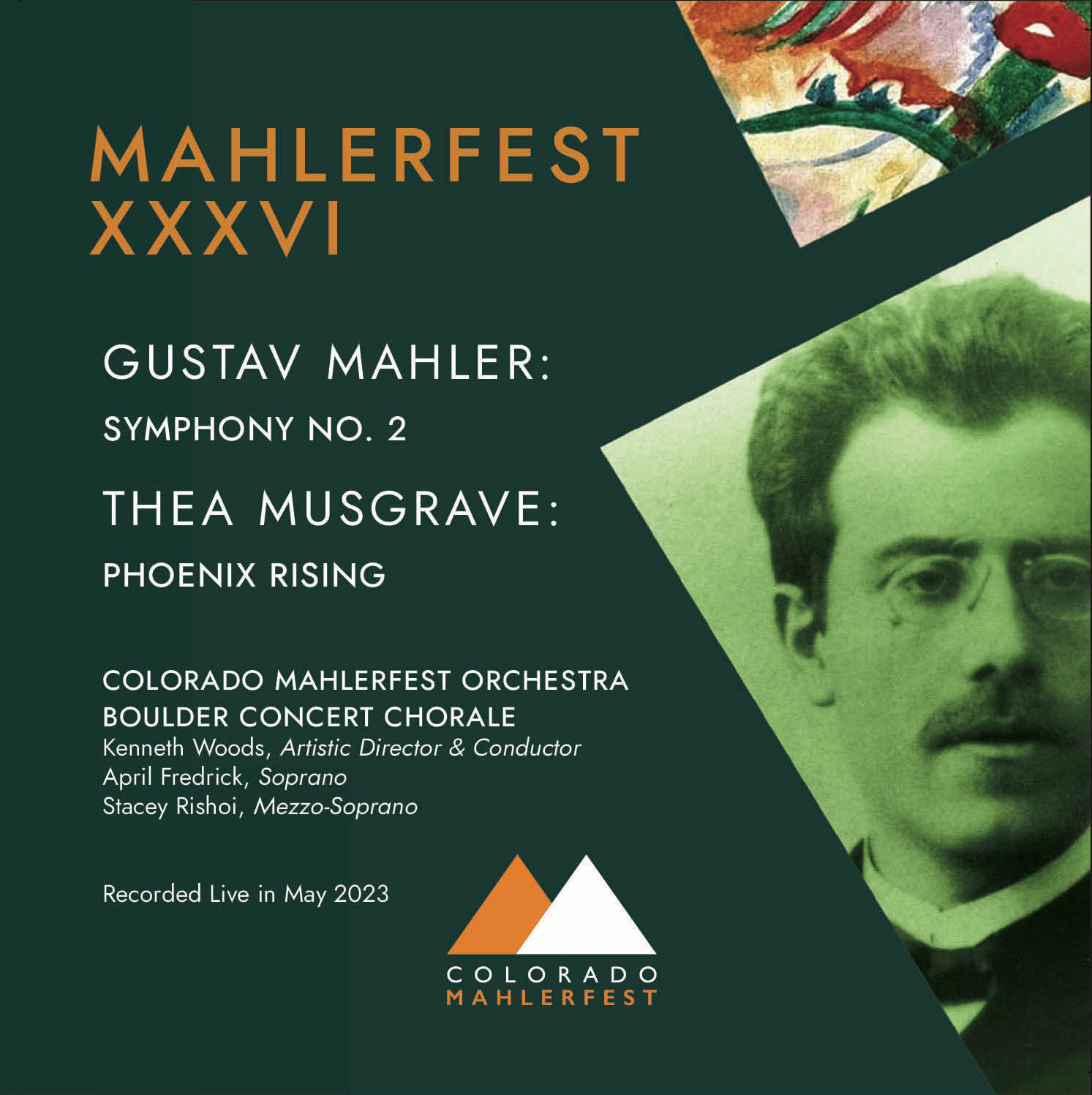
On Record – MahlerFest XXXVI: Kenneth Woods conducts ‘Resurrection’ Symphony & Musgrave’s Phoenix Rising

April Fredrick (soprano), Stacey Rishoi (mezzo-soprano), Boulder Concert Chorale, Colorado MahlerFest Orchestra / Kenneth Woods

Musgrave Phoenix Rising (1997)
Mahler Symphony no.2 in C minor ‘Resurrection’ (1888-94)

Colorado MahlerFest 195269301194 [two discs, 104’02”]
Live performances on 21 May 2023, Macky Auditorium, Boulder, Colorado

Reviewed by Richard Whitehouse

What’s the story?

Last year’s edition of MahlerFest continued its latest, not-quite-chronological traversal of the symphonies with the Second – appropriately coupled on this release (as in the concert) with a work such as considers ‘resurrection’ from a very different while no less relevant perspective.

What’s the music like?

Six years in the writing, Mahler’s Second Symphony fairly laid the basis for his reputation as a composer at its Berlin premiere in 1895. It is a measure of this performance that it captures something of the shock or excitement no doubt in evidence back then, not least in an opening movement with Kenneth Woods notably more interventionist tempo-wise as compared to that of the Third Symphony a year before. What emerges is imposing but never diffuse, at its most gripping in that baleful lead-in to a development whose terseness duly accentuates its impact, with the pathos of the second subject on its reprise making the coda’s sardonic recessional the more acute. After which, the second movement feels the more enticing through its alternation of warm sentiment with capering animation while heading to a conclusion of beatific repose.

There is no lack of incident in a scherzo whose glancing irony is leavened yet not lessened by its trios, the first as soulful with its lilting trumpets as the second is ominous in its import; but not before Stacey Rishoi has characterized the Urlicht setting with rapt inwardness. What to say about the finale other than, while this may not be the most overwhelming take on its vast fresco, it is matched by relatively few as regards an organic unfolding that sees the movement whole. Its contrasting elements here fuse with unforced cohesion to a fervent rendering of the chorale episode then on to a surging Toten-marsch – the kinetic momentum carried through to a methodical reprise of earlier ideas, then a rendering of Klopstock’s text (much altered by the composer) as only grows in intensity before the majestic affirmation of its closing pages.

As the ‘first half’, Thea Musgrave’s Phoenix Rising provides an ideal complement. The much esteemed (latterly more in the US than the UK) nonagenarian has written often for orchestra, but seldom with such immediacy than in a piece whose formal and expressive trajectory feels nothing if not symphonic in its progress. Comparison with the 2016 studio recording by BBC National Orchestra of Wales and William Boughton (Lyrita SRCD372) confirms that, passing tentativeness in ensemble excepted, Woods’s reading demonstrably makes more of this aspect.

Does it all work?

Yes, pretty much always. As on previous releases in this ongoing Mahler cycle, the Colorado MahlerFest Orchestra punches appreciably above its weight in music which should never fall prey to wanton virtuosity. The unyielding acoustic of Macky Auditorium is less an issue than before, with the finale’s offstage brass adeptly managed. April Fredrick brings her customary eloquence to bear on this movement, and the Boulder Concert Chorale – as prepared by Vicki Burrichter – rises to the occasion with notable fervency as this work reaches an ecstatic close.

Is it recommended?

It is. There have been too many superfluous Mahler cycles, but this traversal is shaping up as one of the most worthwhile and more than the memento of a memorable occasion. Hopefully such standards will be maintained by the Sixth Symphony as part of next year’s 37th edition.

Buy

For further purchase options, visit the MahlerFest website – and for more information on the festival itself, click here. Click on the names for further information on conductor Kenneth Woods, soloists April Fredrick, Stacey Rishoi and composer Thea Musgrave

Published post no.2,244 – Friday 19 July 2024

Online Concert – April Fredrick, Stacey Rishoi, Brennen Guillory, Gustav Andreasson, Colorado MahlerFest Orchestra / Kenneth Woods: Mahler’s Liederabend

Mahler’s Liederabend: A Recreation of Mahler’s Concert in Vienna on 29th January 1905

Mahler
Des Knaben Wunderhorn – selection (1892-1901)
Kindertotenlieder (1901-4)
Vier Rückert-Lieder (1901)

April Fredrick (soprano), Stacey Rishoi (mezzo-soprano), Brennen Guillory (tenor), Gustav Andreasson (bass), Colorado MahlerFest Orchestra / Kenneth Woods

Macky Auditorium, 1595 Pleasant Street, Boulder CO (Links to concert sections embedded below)
Saturday 20th May 2023

by Richard Whitehouse

In an event as inclusive as Colorado’s MahlerFest, it was happily inevitable the Liederaband Mahler gave in Vienna on 29th January 1905 be recreated and, while the decision to distribute these songs between four singers was not strictly ‘authentic’, it yet emphasized their variety of thought and expression more readily than had one vocalist been present throughout. What remained consistent was the creative zeal of Mahler at a crucial juncture in his composing, as he left behind the fantastic realm of his earlier music for greater realism and even abstraction.

The first half was of seven songs from Des Knaben Wunderhorn, which collection dominated Mahler’s thinking the previous quarter-century. Two of them are ostensibly dialogues, but the absence of a second singer mattered little when April Fredrick rendered that interaction of the yearning woman with her condemned lover in Lied des Verfolgten im Turm so graphically; as too the more wistful imaginings of separated lovers in Der Schildwache Nachtlied. She also underlined the glancing irony of Des Antonius von Padua Fischpredigt and the playful whimsy of Rheinlegendchen with understated assurance. Brennen Guillory pointed up the deadpan humour of Trost im Unglück and if Der Tamboursg’sell felt a little too earnest, the stridency that increasingly borders on aggression of Revelge was bracingly delivered.

Here, as elsewhere, adherence to Mahler’s scoring, with its emphasis on woodwind and brass, brought out its evocative quality which outweighed any passing thinness of tone in the strings. This was even less of an issue during the sparser textures of Kindertotenlieder, whose songs find universal truths in Friedrich Rückert’s intimate ruminations. Gustav Andreasson seemed a little raw of timbre in Nun will die Sonn’ so hell aufgeh’n, though the yearning fatalism of Nun seh’ ich wohl, warun so dunkel Flammen was tangibly conveyed, as too was the aching poignancy of Wenn dein Mütterlein. The bittersweet elegance of Oft denk’ ich, sie sind nur ausgegangen felt slightly undersold, but not those contrasts of In diesem Wetter as this final heads from fraught anguish toward a repose from which all dread has been wholly eradicated.

Kenneth Woods directed the Colorado MahlerFest Orchestra with that unforced rightness evident from his earlier Mahler performances. Never more so than the four Rückert-Lieder which ended this programme – albeit in a discreet but effective reordering from that of 118 years before. Thus, the capricious whimsy of Blicke mir nicht in die Lieder! preceded the deft enchantment of Ich atmet einen Linden duft; Stacey Rishoi proving as responsive to these as to Um Mitternacht, with its crepuscular winds and majestic climax with swirling arpeggios on harp and piano. Fittingly, the sequence closed with Ich bin der Welt abhanden gekommen – the finest of Mahler’s orchestral songs in its rapt serenity, Rishoi’s conveying of Rückert’s otherworldly sentiments more than abetted by Lisa Read’s eloquent cor anglais. If recreating the Liederabend meant no place for Liebst du um Schönheit (now available in a far more idiomatic orchestration by David Matthews), which might have made a pertinent encore), its absence did not lessen the attractions of this enterprising and successful concert.

Click on the name for more information on Colorado MahlerFest 2024, and on the artist names for more on Kenneth Woods, April Fredrick, Stacey Rishoi, Brennen Guillory and Gustav Andreasson

On Record – MahlerFest XXXV: Kenneth Woods conducts Symphony no.3 & Gunning Symphony no.10

Stacey Rishoi (mezzo-soprano), Boulder Children’s Chorale, Women of Boulder Concert Chorale, Colorado MahlerFest Orchestra / Kenneth Woods

Gunning Symphony no.10 (2016-17) [First public performance]
Mahler Symphony no.3 in D minor (1893-6)

Colorado MahlerFest 195269164287 [two discs, 114’21”]
Live performances on 22 May 2022, Macky Auditorium, Boulder, Colorado

Reviewed by Richard Whitehouse

What’s the story?

The 35th Colorado MahlerFest, the eighth under the direction of Kenneth Woods, reached its culmination with the performance of Mahler’s Third Symphony and preceded in this concert with a first public hearing for the 10th Symphony by the late-lamented Christopher Gunning.

What’s the music like?

In its setting out the creation of the world, from an inanimate state to the dawn of humanity, Mahler’s Third Symphony is his most ambitious conceptually and certainly his lengthiest. It is to Woods’s credit that, though his account at 92 minutes is among the swiftest, there is no sense of haste – not least his handling of the first movement’s vastly extended sonata design, which amply conveys the burgeoning of natural forces with unbridled impetus but equally a fantasy or even playfulness manifest through the irresistible abandon of those closing pages.

Those having watched the online broadcast will recall Woods observing the customary break before the remaining five movements which constitute the second part. Here, though, there is barely a pause going into the second movement, its minuet-like lilt and evocation of all things vernal rarely having sounded so delicate or ingratiating. The ensuing scherzo is almost as fine, the often boisterous irony of its outer sections finding contrast in trios whose post-horn solos are ethereally rendered by Richard Adams, with a frisson of danger emerging in the final bars.

Nor is Stacey Rishoi found wanting in a Nietzsche setting that alternates earnest speculation with heartfelt yearning. She is no less inside its successor’s setting of a Knaben Wunderhorn text, its ambivalence offset by a whimsical response from the women’s and children’s choirs. Others may have found even more profundity from the finale, but Woods ensures it emerges as a seamless totality – the anguish at its centre drawn into a rapt eloquence which is carried through to a coda bringing this disciplined and persuasive performance to its ecstatic close.

Unlike other of his peers, their concert output little more than a rehash of their work for film and television, Christopher Gunning’s symphonies and concertos seem abstract music with a vengeance. The single-movement 10th Symphony is both cohesive in its structure and methodical in its evolution. Woods has recorded it with BBC National Orchestral of Wales (Signum Classics), and while that studio recording has greater formal focus, the Colorado musicians unfold this quixotic score to its serene ending with demonstrably greater spontaneity and impulsiveness.

Does it all work?

Almost always. Those who prefer a more expansive or interventionist approach in the Mahler may be disappointed, but the no-nonsense nature of Woods’s traversal conveys any amount of insight or expressive nuance. Presentation is equally straightforward, but Mahler’s expression markings for each movement should have been included alongside those descriptive headings he later deleted, while the Gunning might have been best placed at the start (as in the concert) with the first part of the Mahler – allowing its second part to unfold as an unbroken continuity.

Is it recommended?

Very much. Boulder’s Macky Auditorium might not have the most spacious perspective, but its clarity and definition audibly benefit a performance that is much more than the memento of an occasion. Indeed, this MahlerFest series is shaping up to be a memorable Mahler cycle.

Buy

For further purchase options, visit the MahlerFest website – and for more information on the festival itself, click here. Click on the names for further information on conductor Kenneth Woods and composer Christopher Gunning

BBC Proms 2023 – Leila Josefowicz, BBC Symphony Orchestra / Sakari Oramo – Berg & Mahler

Prom 35 – Leila Josefowicz (violin), BBC Symphony Orchestra / Sakari Oramo

Berg Violin Concerto (1935)
Mahler Symphony no.7 (1904-5)

Royal Albert Hall, London
Thursday 10 August 2023

by Richard Whitehouse photos by Chris Christodoulou / BBC

The late indisposition of Sir Andrew Davis saw Sakari Oramo at the helm for this programme of Berg and Mahler, an effective coupling even allowing for the replacement of the latter’s Tenth Symphony with his Seventh. Hopefully it will be ‘third time lucky’ for Davis and Mahler 10.

It might have received almost 20 hearings at these concerts, but Berg’s Violin Concerto is not easy to bring off in so resonant an acoustic as the Albert Hall’s. As elegantly as she delineated the initial Andante’s arch-like trajectory, Leila Josefowicz did struggle to make herself heard against a restrained though dense orchestral backdrop. Balance righted itself with the ensuing Allegretto – the soloist’s ingratiating response ideal for its alluring, even coy expression with a bittersweet folksong inflections then its ominous foreshadowing of the work’s second part.

It was in that latter half’s Allegro the performance really took flight, Josefowicz as attuned to its fractious opening pages as to the plangent searching of its cadenza-like central span. Both the seismic start of the movement’s culmination and its convulsive wind-down were assuredly handled – the emergence of Bach’s Es ist genug chorale setting the course for a final Adagio where pensive inwardness and heartfelt supplication were palpably conveyed through to the fervent climax, then a close bringing matters full circle with its mood of beatific resignation.

Unheard at the Proms until 1969, Mahler’s Seventh was also the last of his symphonies to win wider acceptance and is still a tough challenge to make cohere. Oramo (above) had its measure though not consistently in an opening movement, the effortfulness of whose introduction pervades its main Allegro yet without impeding its onward and increasingly cumulative course. For all the wonderment of its central interlude then emotional heft of the lead-in to the reprise, there was yet a sense of this music being coerced into shape rather than unfolding with due inevitability. Not so the ‘First Night Music’, its intertwining of the speculative and crepuscular rendered to bewitching effect – Oramo balancing those intricate yet translucent textures with a sure sense of where this movement was headed, namely a resolution not so much tentative as intangible.

Equally elusive, the central Scherzo can seem an exercise in flitting gestures as fail to add up to anything more substantial but here exuded darkly ironic humour as it wended its unsettling way. The ‘shadowy’ duly found its ideal complement in the ‘amorous’ manner of the ‘Second Night Music’ – its underlying affability all too easy to make bland or faceless, yet which here unfolded with a precise feel for its function within Mahler’s teasingly oblique formal scheme. As was almost equally true of the Rondo-Finale – its ordinario marking easy to misinterpret, but in which Oramo’s sure and steadfast if never turgid course made the most of its engaging progress. Hardly alone in not quite making the reappearance of first-movement material feel other than contrived, he nevertheless headed through those final pages with irresistible verve.

This performance would not have been as successful overall without its sterling contribution by the BBC Symphony Orchestra, both in soloistic passages or those tuttis as give the outer movements their impact. Ten years on, the rapport between orchestra and conductor remains undimmed.

For more on the 2023 BBC Proms, visit the festival’s website at the BBC. Meanwhile click on the names for more information on artists Leila Josefowicz, the BBC Symphony Orchestra and their chief conductor Sakari Oramo

In concert – CBSO / Robert Treviño – Mahler’s 10th symphony

City of Birmingham Symphony Orchestra / Robert Treviño

Mahler, ed. Cooke Symphony no.10 in F sharp major (1910)

Symphony Hall, Birmingham
Thursday 18 May 2023

Reviewed by Richard Whitehouse

The City of Birmingham Symphony Orchestra has a notable association with Mahler’s Tenth Symphony – realized by Deryck Cooke – having given memorable performances with Simon Rattle and more recently with Sakari Oramo. This evening’s account was to have been taken by Mirga Gražinytė-Tyla, but her indisposition brought American conductor Robert Treviño to the helm for what was a memorable performance that vindicated (if such were needed) this ‘performing edition’ and hinted at what might develop into a notable partnership in the future.

The quality of string playing these days means the initial viola melody no longer poses quite the risks it once did. Treviño went on to shape this opening Adagio with a sure sense of how its contrasting themes are drawn into an evolution whose unpredictability is informed by an emotional candour, heard at its most explicit in the climactic dissonance (evidently added at a late stage) such as makes the beatific coda the more affecting. Nor did he fail to tease out the underlying continuity of music shot through with the knowledge of its own dissolution.

Such an issue is more graphically present in the first Scherzo, its contrapuntal texture fitfully realized in the score but here achieved with a deftness making the trade-off between its polka- and ländler-like ideas the more potent. Not least during the later stages of a movement where these themes alternate with ever increasing frequency, as if in a stretto of activity, on the way to the most decisive and even affirmative conclusion found in Mahler’s late music. Treviño’s opting not to tone down those more unlikely percussive touches proved its own justification.

Almost Mahler’s shortest symphonic movement, the Purgatorio is yet crucial to the overall design – the ‘treadmill’ motion of its outer sections exuding acute irony, with the histrionics at its centre firmly held in check so their implications were made more than usually evident.

Performances of this work most often founder in the second Scherzo, but not here – Treviño launching it with anguished intent, while maintaining a persuasive balance between this and the more consoling element which informs its progress. The brief central interlude conveyed exquisite pathos, tension barely receding as the expression gradually and inevitably subsides into crepuscular activity with its fleeting intimations of what went before and what is still to come. Just one bass-drum stroke, surely, is needed to separate this movement from the finale.

That said, the unfolding of this latter left nothing to chance – whether in the sepulchral gloom of its initial bars, the poise of its indelible melody for flute, or a central phase of activity that here emerged as the natural consequence of what went before. Treviño (rightly) retained the additional percussion necessary to make the return of the first movement’s climax the more shattering – the sheer eloquence of what followed building to a rapturous culmination which, as with the closing emotional wrench, drew an unfaltering response from the CBSO strings.

A memorable performance, and one that met with an enthusiastic response. Treviño brought the soloists and sections to their feet, but might have started with trumpeter Jason Lewis and flautist Marie-Christine Zupancic – their contributions typifying the excellence of the whole.

You can read all about the 2022/23 season and book tickets at the CBSO website. For more on Robert Trevino, visit his website