
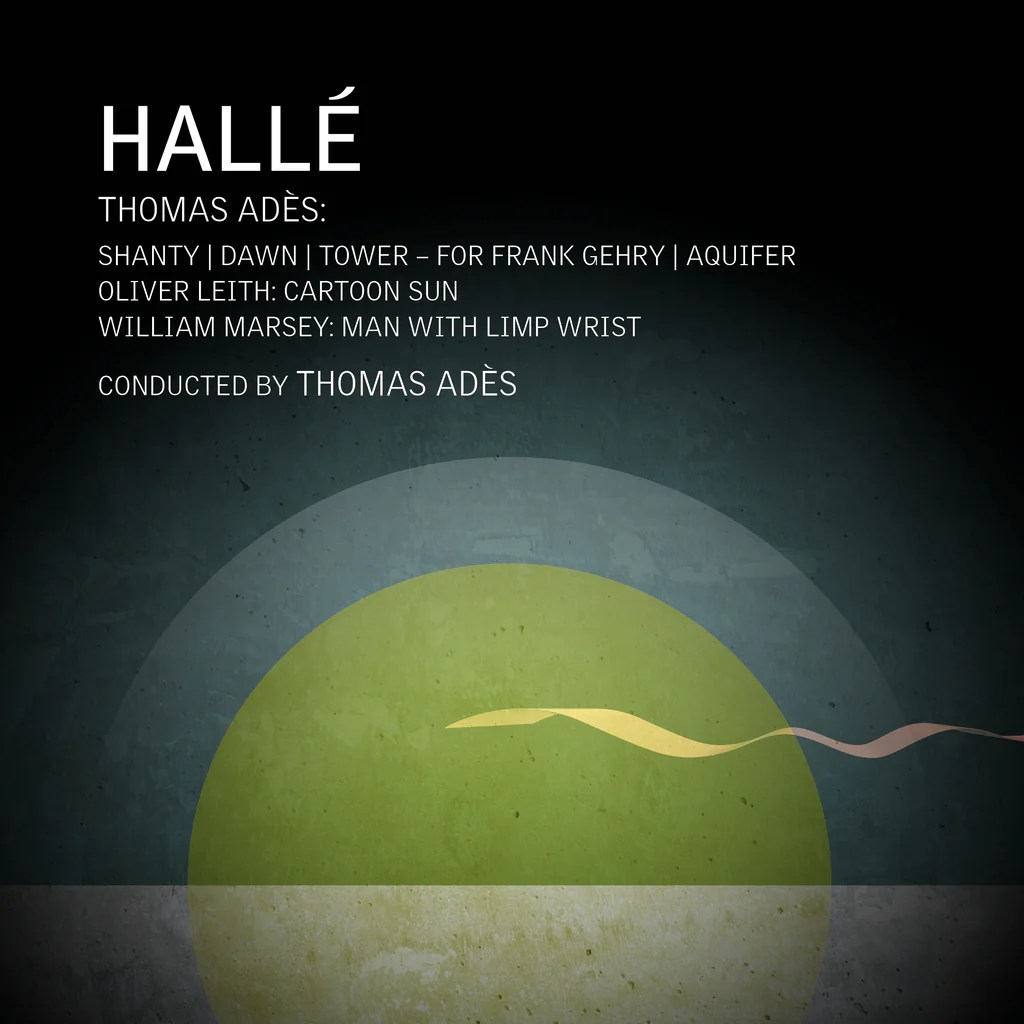
Thomas Adès Shanty (2020); Dawn (2020); Tower (2021); Aquifer (2024)
Oliver Leith Cartoon Sun (2024)
William Marsey Man with Limp Wrist (2023)
Hallé / Thomas Adès
Hallé CDHLL7567 68’20”
Producer Jeremy Hayes Engineers Steve Portnoi, Niall Gault, Edward Cittanova
Live performances at Bridgewater Hall, Manchester, 21-24 November 2024
Reviewed by Richard Whitehouse
What’s the story?
This latest release on the Hallé’s label focusses on music by or conducted by Thomas Adès during his 2023-25 residency with this orchestra, with works by two younger composers he has championed heard alongside several of his own pieces – including a major UK premiere.
What’s the music like?
Of the three shorter pieces by Adès, Shanty – Over the Sea unfolds as cumulative variants on an archetypal-sounding sea-shanty, with all this may imply in terms of transcending captivity and longing for freedom. Subtitled ‘Chacony for Orchestra at Any Distance’, Dawn conveys in spatial terms a concentric evolution toward a likely epiphany that yet remains out of reach. By contrast, Tower – For Frank Geary envisages a building near Arles by the Canadian-born American architect in terms of a bracing and increasingly effervescent fanfare for 14 trumpets.
Of those works by younger composers, Man with Limp Wrist finds William Marsey drawing on paintings by Salman Toor for a sequence of eight ‘scenes’; the first seven of which are as succinctly descriptive as the titles that inspired them. The eighth piece, which takes its name from the titular canvas, brings culmination of sorts through its collision of old tunes (mainly hymns) in music as feels arresting if curiously uninvolving. Much the same could be said of Cartoon Sun by Oliver Leith, a detailed evocation of which is provided by the composer and whose premise that ‘‘Everything looks different under the sun’’ is related over three sections – the first two relatively brief and primarily gestural, the lengthier third building cumulative intensity which dissipates towards the end as if to confirm that nothing is ever what it seems.
Premiered in Munich by the Bavarian Radio Symphony Orchestra, Aquifer is Simon Rattle’s third major commission from Adès (after Asyla for the City of Birmingham Symphony then Tevot for the Berlin Philharmonic). Its title referring to ‘‘a geological structure which can transmit water’’, the piece unfolds across seven continuous sections, though the outline of a sonata design can be sensed not as the dynamic means of change but rather (and more appropriately) as a fluid construct from which ideas emerge and mutate – as might water as it passes between different vessels. In terms of content, it ranges widely over styles and allusions before culminating in a vivid while hardly epiphanic coda, yet its overall cohesion along with its assured handling of sizable orchestral forces ensures an impact which audibly commended it to all those present.
Does it all work?
Whether or not it does so is much of the fascination. The works by Marsey and Leith offer no mean indication in terms of where these composers (in their mid-30s) are headed, while those by Adès afford intrigues aplenty. Neither is there any doubt as to the commitment of the Hallé in presenting these pieces to best advantage, nor of Adès’s ability to get the most out of these players. If a sense persists of his music having an essence that beguiles more than it conceals in intrinsic substance, no living composer has reinvented the wheel quite so skilfully as Adès.
Is it recommended?
Yes, not least as the programme makes for a cohesive and engaging listen throughout. Sound makes the most of Bridgewater Hall’s evident clarity and spaciousness, with annotations as informative as usual from this source. Adès is undeniably a defining presence in new music.
Listen / Buy
You can explore purchase options at the Hallé online shop
For more on the artists featured, click on the names to read more about The Hallé and album conductor Thomas Adès – and click on the names for Thomas Adès as a composer, Oliver Leith and William Marsey
Published post no.2,629 – Sunday 17 August 2025

 This was followed by an extremely tasteful reading of Mozart’s Symphony no.34. This is a work that doesn’t get to poke its head above the parapet as much as its neighbouring ‘named’ symphonies in the composer’s output such as the Haffner and Linz. Wigglesworth chose his speeds well, so that the lovely Viennese textures were just the right density for Mozart’s lighter (but not lightweight) melodies. The energetic Hallé strings went well with the more graceful woodwind, particularly in the joyful finale, while the serene slow movement was also a highlight.
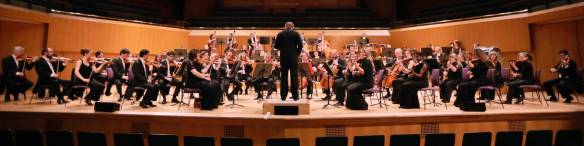 Mahler’s Symphony no.4 is, on face value, his most ‘classical’, following traditions established by Schubert and the like, innovatively adding a soprano for the final movement, a child’s vision of heaven. Wigglesworth’s interpretation was carefully thought out and extremely well played, the woodwind of the Hallé rising to the considerable challenges posed by this deceptively difficult symphony.
 Arcana.fm