
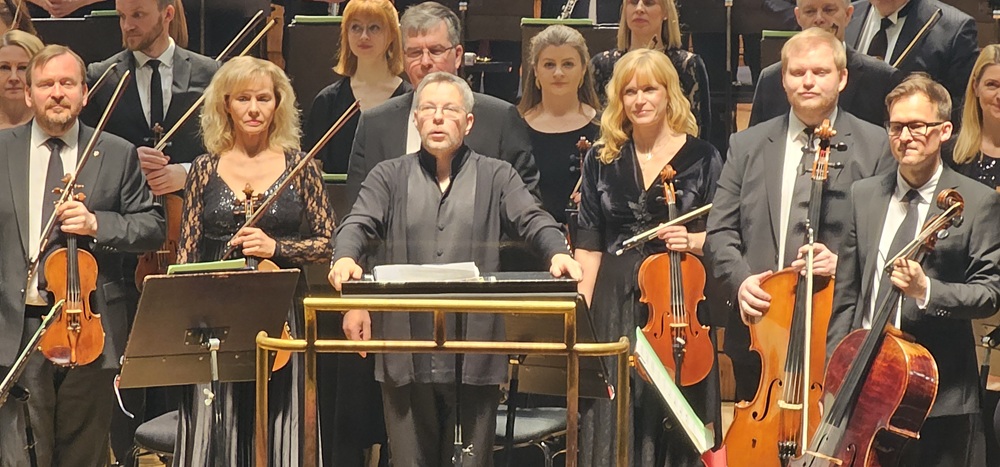
In Concert – Hans Christian Aavik, Estonian National Symphony Orchestra / Neeme Järvi & Olari Elts @ Estonia Concert Hall, Tallinn

Hans Christian Aavik (violin), Estonian National Symphony Orchestra / Neeme Järvi, Olari Elts

Verbytsky / Chubynsky National Anthem of Ukraine
Eller Homeland Tune (1918/1953)
Sibelius Andante festivo (1922/1938)
Tüür Violin Concerto no.2 ‘Angel’s Share’ (2018)
Sumera Symphony no.2 (1984)

Estonia Concert Hall, Tallinn
Wednesday 15 April 2026

Reviewed by Ben Hogwood Pictures (c) Ben Hogwood

There was a celebratory air to this concert in the Estonian National Symphony Orchestra’s Violin Concerto series, which began with powerful solidarity as the orchestra played the Ukrainian National Anthem to a standing audience.

They were conducted by the return of the much-loved Neeme Järvi, soon to be 89 – the unofficial godfather of an Estonian conducting dynasty now spreading well beyond his own sons Paavo and Kristjan. Järvi also conducted Homeland Tune by the pioneering Estonian composer Heino Eller, whose stints at Tartu and Tallinn musical establishments found him teaching the likes of Arvo Pärt and Tubin. The burnished string tone of the Estonian NSO strings was to be savoured in this affectionate rendering, as it was in a warm account of Andante Festivo, the popular Sibelius encore.
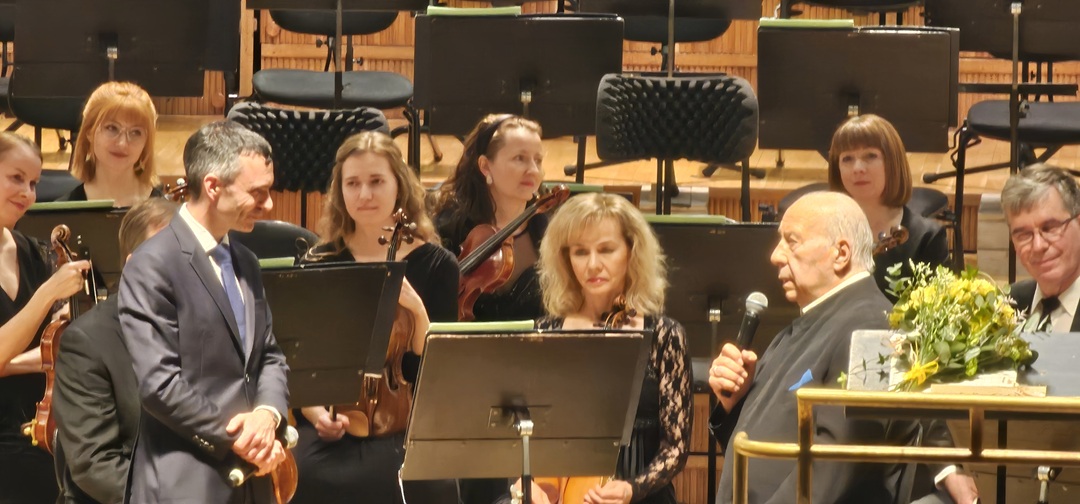
The impish Järvi, playing to the gallery, was then joined on stage by Martin Cullingford (above) editor of Gramophone magazine. While there were mischievous asides from the conductor there were serious points too – the merits of composer Joachim Raff, the latest in a long list of countless musical discoveries, and the concluding exhortation that without music, life is nothing. It was difficult to disagree, Järvi showing just why he is held in such great esteem.

So, too, is composer Erkki-Sven Tüür, in his fifties but with a thirty-year career in which he has established himself on the world stage as a composer whose evolution is compelling to witness. Tüür writes with great fluency in established classical forms, and his Violin Concerto no.2 shows his ability to apply an emotive program to those structures. ‘Angel’s Share’ refers to the pocket of air appearing in a barrel of whisky during the ageing process, a phenomenon applied to the maturing of an adult.

The silvery edge to the tone of violinist Hans Christian Aavik was the ideal spur for music that engaged in luminous dialogue, while laced with folksy references. The frequency spectrum of this piece is wide, from the metallic percussion of the first gesture to the important part played by the double basses, providing notable depth, their counter melodies central as the concerto pushed forward. Aavik’s virtuosity was key, convincingly delivering with spacious phrasing. This concerto needs repeated listening but is on its way to becoming a repertoire regular.

The same fate should befall the Second Symphony of Lepo Sumera, a 20-minute single movement span that proved something of a revelation. Sumera is not often heard beyond his own country, but this work completely validated his compositional approach, blending an American-style minimalism – admired by John Adams, no less – with fresh melodies and open textures that could only be Baltic in origin.

The work began with the two harps (Sara Siria D’Amico and Saale Kivimaker) who played exquisitely, their distinctive motifs the seeds from which the music grew, forming like a sped-up motion picture of the growth of a tree, its branches extending outwards and upwards in twisting figures, germinating new ideas at every turn while all the while building a majestic canopy.

Olari Elts oversaw this process with admirable surety, aided by unexpected interventions from the trombones, and double basses, with wild whoops and guttural phrases introducing a more primal edge. The climactic section confirmed Sumera’s continental approach, for the tree could now be in the American plains given the wide-open textures around, and also his tight grasp of structure, with barely a note out of place. Gradually the music returned to earth, and to the harps of the beginning, its story told in a singularly powerful voice.

Sumera’s output numbers seven symphonies, each earmarked for release in recordings by this conductor and orchestra on the Finnish label Ondine. Judging by this rediscovered masterpiece, we are in for a treat – and for Sumera, whose life was cut tragically short at the age of 50, recognition of his talents looks set to go well beyond this appreciative Tallinn concert hall.

Published post no.2,862 – Sunday 19 April 2026

In concert – Sol Gabetta, NHK Symphony Orchestra Tokyo / Paavo Järvi: Takemitsu, Schumann & Rachmaninov

Sol Gabetta (cello), NHK Symphony Orchestra Tokyo / Paavo Järvi (above)

Royal Festival Hall, Southbank Centre, London
Monday 24 February 2020

Takemitsu How slow the wind (1991)
Schumann Cello Concerto in A minor Op.129 (1850)
Rachmaninov Symphony no.2 in E minor Op.27 (1906-07)

Reviewed by Ben Hogwood

This Royal Festival Hall concert offered the relatively rare chance to catch the NHK Symphony Orchestra, on a mini-tour from Tokyo in the company of their chief conductor, Paavo Järvi.

As he told Arcana in an interview the previous week, Järvi has been acquainting himself with the music of Toru Takemitsu in recent years, culminating in a recording of his orchestral works with the NHK. One of them, How slow the wind, was a descriptive and colourful way in which to open the concert, presenting a picture of relative calm.

One of Takemitsu’s best qualities is the descriptive power of his music, which is able to capture the elements in a subtle but meaningful way. Rain, earth and air are three you can expect to encounter with particularly vivid results, and the latter was to the fore in this intriguing symphonic poem. As the title suggests, it really was the slowed down movement of air, and was played with attention to detail and affection, painting a picture far away from the Southbank. The influence of Debussy, as outlined by Järvi, was clear, but so too were elements of Ravel and Messiaen, though the percussive colours in which Takemitsu dressed the piece were wholly his own.

Sol Gabetta then took charge of the Schumann Cello Concerto. Clearly this is a piece she loves, and it is gratifying in recent years to see the concerto come into the centre of the instrument’s repertoire. The first movement, dominated by a nagging theme that stays in your head for long after, was a dramatic affair, the cellist seizing the initiative but ensuring Järvi and the relatively small orchestral forces were with her every step of the way. Gabetta’s high register tone was probing, with unerring accuracy in her tuning.

When Schumann moves seamlessly into the slow movement it is like walking into a different, calmer room of the same house, but Gabetta ensured the links throughout were clearly signposted, and her duet with leader of the NHK cellos Ryoichi Fujimori was both sensitive and ideally balanced.

The finale found a bold approach from Gabetta capitalizing on Schumann’s innovative writing, with the written-out cadenza particularly strongly executed before a thoroughly affirmative end. Gabetta capped this with the inclusion of the first movement of VasksGramata cellam as an encore. Gabetta gave this at the first night of the BBC Proms in 2016 and it is no less startling heard once again with its vocalisation.

For the second half it was slow burning Rachmaninov, the NHK smoothly into their stride for the first movement of the Symphony no.2 in E minor. If the moody bass strings at the opening were slightly withdrawn, that gave Järvi plenty to work with as the music unfolded. With the faster tempo came an airy texture as though the sun was shining through outdoors. Once we had glimpsed the brightness it was hard not to let go of it, and the Scherzo, taken at a fastish tempo, glinted at the edges.

Järvi judged the famous Andante just right, indulging in the gorgeous textures but never overdoing it, so that Kei Ito’s clarinet was given the best possible platform to deliver a heartstopping solo. Yet it was in the excited whoops of the finale where this interpretation really delivered, the orchestra stepping up another gear as the music excitedly passed between the instrument groups, percussion adding a sheen to the wonderful wall of sound.

It being Estonian Independence Day, Järvi – while noting the amusement of celebrating the day in London with a Japanese orchestra – gave us a glimpse of summer through Heino Eller’s sunkissed Homeland Tune, from the 5 Pieces for Strings. It was a fitting end to a concert that helpfully reminded us of the approach of spring – and in the process told of classical music’s potential reach. A Japanese orchestra conducted by an Estonian with an Argentinian cellist. What’s not to like about that?!

Further listening

You can listen to a playlist of the programme performed by the NHK Symphony Orchestra and Paavo Järvi. It includes Gabetta’s recording of the Schumann, and leading recordings of the other repertoire (including encores):

For a very fine disc of Heino Eller’s music for string orchestra, this collection from the Tallinn Chamber Orchestra and Tonu Kaljuste on ECM is just the ticket: