
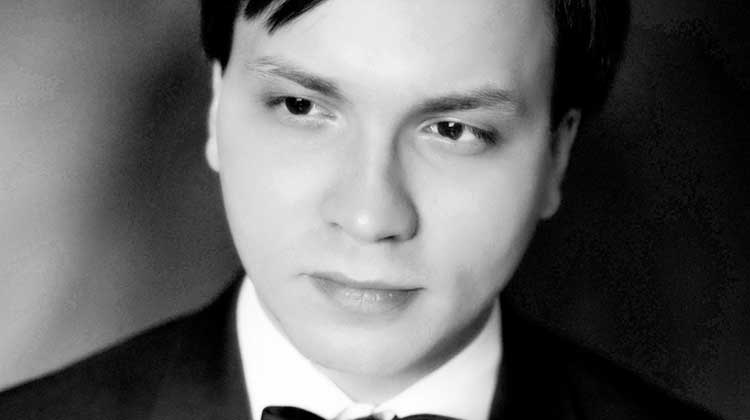
Alexei Grynyuk at the Wigmore Hall – Schubert’s last breath

alexei-grynyuk

Alexei Grynyuk, Wigmore Hall, 16 April 2015.

The last of Schubert’s 21 published piano sonatas is a remarkable piece of music, as in it we encounter one of those truly rare instances where time really does seem to stand still.
Alexei Grynyuk, completing a fine season of lunchtime recitals at the Wigmore Hall under the sponsorship of Lisa Peacock, gave the piece an eloquent and moving account, maintaining remarkable feats of concentration over the near-50 minutes in which Schubert’s last inspiration unfurled.

The opening movement seemed to go on for ever – but not in a bad way! From the off it was clear Grynyuk was going to let this music breathe, refusing to hurry in much the same way the great Sviatoslav Richter used to work with the sonata. Because of that the first movement alone clocked in at 28 minutes, but the disquiet it brought whenever the left hand was rumbling low in the piano register was palpable.

Eventually there was a form of resolution, but the questioning nature of the music returned in the slow movement and its less than comfortable modulations. As the sonata progressed so did Schubert’s willingness to cast his demons aside, and because of this Grynyuk ensured the third movement scherzo became ever sunnier as it progressed. Meanwhile the finale, despite some strife in its minor key exertions, ultimately strove for positivity.

This was a magnificent and clearly thought through performance, one where Alexei Grynyuk was ready to stand back, remove any showiness from his interpretation, and let Schubert’s music do the talking. Similar praise could be levelled at his performance of the Three Movements from Petrushka, arranged by Stravinsky from the ballet. A lot of pianists show off here but Grynyuk was careful to characterise, to bring forward the abundant selection of tunes and – crucially – not to play too loudly. His approach worked wonderfully well.

A Spotify playlist containing the works in concert can be accessed below. As Alexei Grynyuk has not yet recorded these works – though I understand this performance of the Schubert was recorded for future release – I have chosen versions by Maurizio Pollini:

Stravinsky – Works for piano and orchestra

Featured recording: Stravinsky – Works for piano and orchestra (Chandos)
stravinsky-bavouzet

Jean-Efflam Bavouzet, a specialist in 20th century piano music, teams up with conductor Yan Pascal Tortelier and the Sao Paulo Symphony Orchestra to present Stravinsky’s complete music for piano and orchestra. Happily this includes the wonderful Petrouchka!

What’s the music like?

Stravinsky was not a piano virtuoso in the way fellow Russians Rachmaninov and Prokofiev were, but he developed his own distinctive style of writing for the instrument.

This new collection from Chandos brings together some of the grittier works for the combination with functional titles – Movements, Capriccio, Concerto for piano and wind) with the dazzling colours of his second ballet Petrouchka. For this Bavouzet had to adapt his own routine as a soloist to go and sit in the orchestra.

Stravinsky writes with little sentiment when using the piano, and Movements, the Capriccio and the Concerto all tend to explore the instrument as a form of percussion rather than outright lyrical content. So we get punchy syncopations, spicy chords and incisive rhythms, as a matter of course – but in some of the slower moments of the Concerto there is an unexpected depth of feeling when the piano is pitted with slow brass. The Capriccio, too, can sparkle in places, with some florid writing for the right hand that seems to derive from the Baroque period.

Petrouchka, on the other hand, is a riot of melody, a circus full of orchestral tricks, with brilliant, showy figures and thrilling mixes of colour.

Does it all work?

Absolutely. The ballet receives an ideal performance in vivid sound, its orchestral inventions caught by Tortelier with crisp ensemble, sudden moments of fragility and out-and-out duels between the instruments. This bright, invigorating music is ideally contrasted by the gritty Movements, with its terse musical language.

The performances of the Capriccio and Concerto are terrific, the former with some wonderfully exuberant outbursts and the former taking time for contemplation in its slow movement. That said, the moment when then piano barges into the conversation of the winds (1’33” into the disc) is the dramatic equal of anything in the ballet.

Is it recommended?

Yes. Stravinsky may be a grumpy old so and so at times in his music, but some of his finest invention is here!

Listen on Spotify

Bavouzet’s recordings are not on the streaming service yet, but samples from each track can be heard here