Arcana at the Proms – Prom 35: BBC Scottish Symphony Orchestra / Ilan Volkov – Ellington, Braxton and Mary Lou Williams

Ellington orch. Gould Solitude (1934), Mood Indigo (1930), Sophisticated Lady (1932), Caravan (1936)
Mary Lou Williams Zodiac Suite (1944-6) [UK premiere]
Braxton Composition no.27 (+ nos. 46, 59, 63, 146, 147, 151 & Language Music) (1972-91) [Proms premiere]

Mikaela Bennett (soprano), Aaron Diehl (piano), James Fei (saxophone/conductor), Gregory Hutchinson (drum kit), Ingrid Laubrock (saxophones), Brandon Lee (trumpet), Chris Lewis (clarinet/saxophone), David Wong (double bass), Katherine Young (bassoon/conductor), BBC Scottish Symphony Orchestra / Ilan Volkov

Royal Albert Hall, London
Thursday 15 August 2024

reviewed by Richard Whitehouse Photos (c) Sisi Burn

Never a conductor to take the path of least resistance, Ilan Volkov centred his latest Prom with the BBC Scottish Symphony Orchestra (whose Creative Partner he remains) around jazz – not that there was anything orthodox about the repertoire or the follow-through in what was heard.

The four Duke Ellington numbers heard tonight became standards in the Depression era, their pioneering spirit stylishly offset in orchestrations by Morton Gould (the first three on 1957’s Blues in the Night and the fourth on 1956’s Jungle Drums). Solitude ranks among Ellington’s most affecting tunes, while his sultry Mood Indigo proved an inspired co-write with Barney Bigard. The present arrangement fully enhanced the teasing elegance of Sophisticated Lady, before the expressive impetus of the Juan Tizol co-write Caravan left its evocative imprint.
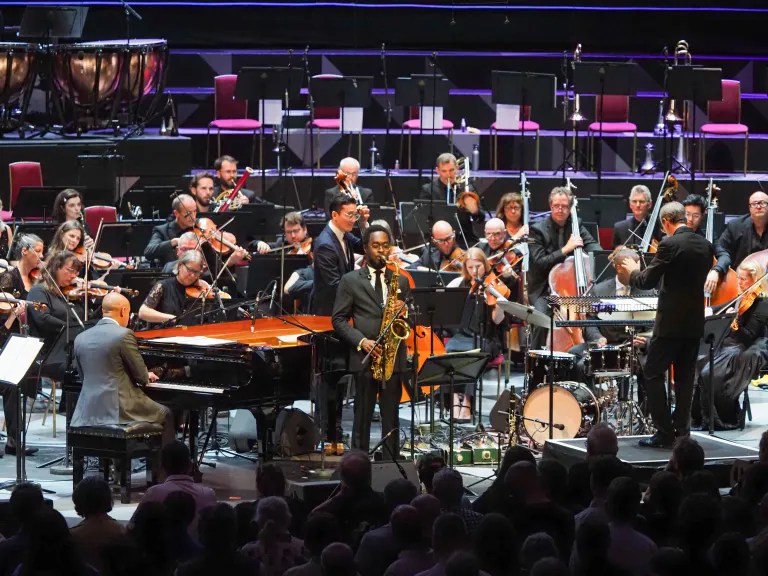
Pianist and arranger for artists from Ellington to Cecil Taylor, Mary Lou Williams’ music only posthumously came to the fore. She wrote nothing more ambitious than Zodiac Suite – a series of 12 tributes to musicians born under various star signs, as went through several incarnations at the end of the Second World War and remains a trailblazer for symphonic jazz. As realized here, each item left room for contributions by the assembled jazz or orchestral musicians: thus the incisiveness of Brandon Lee’s trumpet or mellifluousness of Chris Lewis’ clarinet and alto sax, besides stealthy interplay by the Aaron Diehn Trio (above) or a soulful violin solo by guest-leader Kate Suthers. The sequence concluded with Pisces and an agile vocal (lyrics not printed) by Mikaela Bennett – its manner (surprisingly?) redolent of mid-20th century American art-song.

From here to Anthony Braxton proved a fair conceptual leap, but a meaningful one within this context. One, moreover, for which Volkov has prepared painstakingly across almost a decade – working with several of Braxton’s longer-term collaborators (notably George Lewis), while performing several Braxton compositions duly rendered as the superimposed totality he openly encourages. What resulted was Composition No. 27 as a framework for this performance, into which elements from six later ‘Compositions’ were integrated – this whole entity underpinned by recourse to Language Music, collating 12 musical parameters in what is the codification of Braxton’s practice over six decades. The creative aspect arises at a point when the fullest extent of compositional systematization links with the furthest extent of improvisational spontaneity.
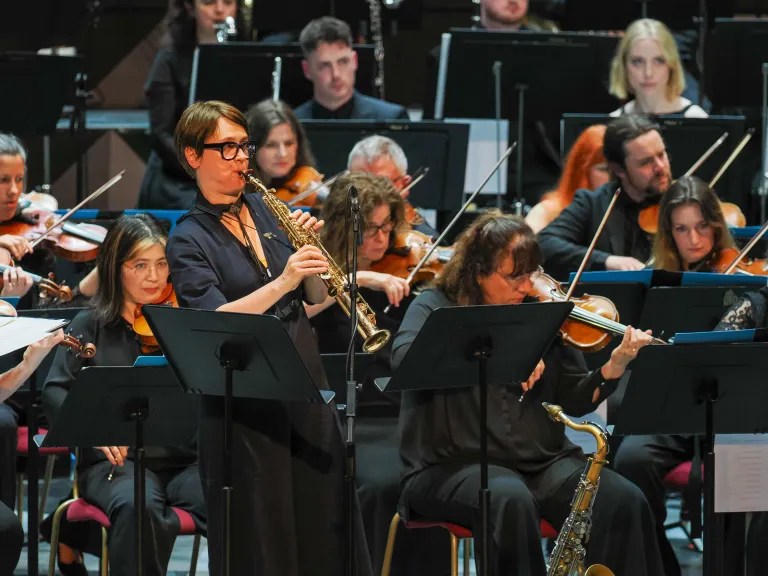
The interaction between jazz and orchestral musicians was intricate and unpredictable, so that saxophonist James Fel and bassoonist Katherine Young – but not the always inventive Ingrid Laubrock (above) – were often conductors next to Volkov in determining the overall trajectory. There were occasions when continuity felt tentative or uncertain, yet these were outweighed by the translucent allure in much of the ensemble playing as well as the resolve with which all those participating headed toward a culmination the more definite for its seeming inconclusiveness. Not that this performance commended itself to all those present, with several dozen exiting the auditorium as though insects under siege. Those who stayed were rewarded with music-making such as encouraged an active participation all too rare in present-day concertgoing.

For more on this year’s festival, visit the BBC Proms website. For further information, click on the artist names for more on Ilan Volkov and the BBC Scottish Symphony Orchestra, and on the composer names for information on Duke Ellington, Mary Lou Williams and Anthony Braxton.

Published post no.2,275 – Monday 16 August 2024

In concert – Stewart Goodyear, CBSO / Ilan Volkov: Ives, Zappa, Lewis & Gershwin

Stewart Goodyear (piano), City of Birmingham Symphony Orchestra / Ilan Volkov (above)

Ives Three Places in New England (1911-14, rev. 1929)
Zappa Bob in Dacron and Sad Jane (1982-3)
Lewis Memex (2014)
Gershwin orch. Grofé Rhapsody in Blue (1924, rev. 1942)

Symphony Hall, Birmingham
Wednesday 27 March 2024

Reviewed by Richard Whitehouse

Ilan Volkov is always a welcome presence on the Symphony Hall podium, and this evening he conducted the City of Birmingham Symphony Orchestra in a fascinating programme of works by American composers – three of them established in music notably removed from classical.

The concert was framed by what have now become repertoire pieces, but Ives’s Three Places in New England had to wait over half a century to be accorded this status. Using what sounded to be the most recent edition, Volkov stressed its late-Romantic impulsiveness and rhetorical eloquence, though some over-emphatic pauses or phrasing slightly undersold the cumulative majesty of The Saint Gaudens and coursing energy of Putnam’s Camp – which latter still teetered (rightly) on chaos at its close. If the build-up in The Housatonic at Stockbridge felt unduly precipitate, Rachel Pankhurst’s rendering of its cor anglais melody had ideal pathos.

The three decades since Frank Zappa’s untimely death have brought into focus his sheer range of musical preoccupations, though his pair of early 1980s albums with the London Symphony Orchestra made plain that being one of rock music’s finest guitarists and leading provocateurs was never enough. Despite their linkage via a ballet with its somewhat dubious scenario, Bob in Dacron and Sad Jane are individual entities and their respective two movements underline Zappa’s concern for musical and expressive diversity – whether in the reckless overkill of the male protagonist or halting fatalism of the female. Volkov secured dedicated playing from the CBSO as brought out Zappa’s debt to ‘third stream’ jazz as much as his modernist forebears.

George Lewis is another figure whose creativity ranges over multiple media – not least that of the orchestra which, thanks not least to Volkov’s advocacy, has gained some familiarity in the UK. Its title referring to a theoretical device for establishing connections across an otherwise unregulated body of information, Memex is typical of the composer through its complexity of textures which affords a heady virtuosity but also a measure of subtlety and inwardness, not least in those final stages when the earlier volatility gradually coalesces into something akin to resolution; as if all that information was, if not dispersed, at least finding discipline. Such, at least, was the impression left by this committed reading of a striking and absorbing piece.

It might have been a conceptual leap too far from here to Gershwin’s galvanizing of the ‘jazz age’ aesthetic almost a century earlier, though Rhapsody in Blue has lost relatively little of its edge during the interim – especially when Stewart Goodyear projected the steely spontaneity of its solo part with such gusto. Admittedly the large orchestral forces (a feature of each work heard tonight) lacked a degree of co-ordination in tutti sections, but Volkov was at one with his pianist in conveying the breezy and often brittle excitement of music which sounded as   if evolving in real-time – not least the final stages that emerged as a high-octane apotheosis.

No little excitement, then, was generated over the course of this performance as of this concert overall: just the sort of event the CBSO should be putting on each season, which latter would certainly be the poorer were artists such as Volkov not encouraged to follow their convictions.

Click on the link to read more on the current CBSO concert season, and on the names for more on pianist Stewart Goodyear, conductor Ilan Volkov and composers Frank Zappa and George Lewis.

Published post no.2,133 – Saturday 30 March 2024

In concert – Isata Kanneh-Mason, CBSO / Ilan Volkov: Sibelius, Prokofiev & Freya Waley-Cohen

Isata Kanneh-Mason (piano), City of Birmingham Symphony Orchestra / Ilan Volkov

Sibelius The Oceanides, Op. 73 (1914)
Prokofiev Piano Concerto No. 3 in C, Op. 26 (1921)
Waley-Cohen Demon (2022) [CBSO Centenary Commission: World Premiere]
Sibelius Symphony No. 5 in E flat, Op. 82 (1915-19)

Symphony Hall, Birmingham
Wednesday 22 February 2023

Reviewed by Richard Whitehouse

A frequent visitor during the past quarter-century, Ilan Volkov’s concerts with the City of Birmingham Symphony Orchestra are always to be anticipated, and so it proved with this evening’s programme which brought together the familiar and the new to engaging effect.

Sibelius provided a potent framework, The Oceanides (of which the CBSO made a fine recording with Simon Rattle now almost four decades ago) heard in a reading of unusual breadth and deliberation. Not that this ever impeded the progress of music whose almost impressionistic eddying goes hand in hand with inexorability of motion; the outcome a double climax whose spiralling intensity – visceral even in the context of Sibelius’s later music – makes way for a coda whose understated fatalism was affectingly conveyed here.

Along with her brother Sheku, Isata Kanneh-Mason has had a major impact on the UK music scene – her skill and insight evident throughout this performance of Prokofiev’s Third Piano Concerto. There was no lack of élan in passagework where the composer sought to confirm his own pianistic credentials as he built a career in the West, but also a tendency to brittleness as arguably sold the music short. It was in more reflective sections that Kanneh-Mason came fully into her own – the limpid musing on its main theme at the centre of the first movement, the spectral half-lights of its successor’s third variation, or the warmly expressive melody at the heart of the finale in which her rapport with Volkov was tangible. If the electrifying close brought less than the ultimate frisson, it still set the seal on a reading of impressive potential.

After the interval, another in the CBSO’s Centenary Commissions – the well-regarded Freya Waley-Cohen (above) duly responding with Demon. Its scenario evoking the more ominous of folk stories, this piece packed a considerable amount of incident into its 11 minutes – a Ligetian playfulness offsetting its frequently intricate polyphony to diverting and, throughout the final stages, impulsive effect. Drawing an incisive and precise response, Volkov seemed intent on presenting this colourful curtain-raiser as well worthy of further and repeated performance.

Volkov’s accounts of Sibelius’s Third and Fourth Symphonies were highlights of a complete cycle at the 2015 Proms, and this account of the Fifth found his advocacy undimmed. Others have found greater atmosphere in the first movement’s earlier stages, but the purposefulness with which he built to its defining climax was undoubted; as too a corresponding build-up of momentum in its ‘scherzo’ – Matthew Hardy’s volleys of timpani spearheading the propulsive coda. More intermezzo than slow movement, the Andante had an appealingly winsome aura for all its darker undertones (with some delectable woodwind playing), while the finale made the most of its contrasts in motion – the ‘swan melody’ eloquently rendered – on the way to an apotheosis whose surging affirmation was driven home by those indelible closing chords.

An impressive performance, then, such as brought this concert to a suitably inspiring close. Volkov is on the podium again this Sunday – directing the CBSO Youth Orchestra in a new piece by Bergrun Snaebjörnsdottir, heard alongside music by Grażyna Bacewicz and Berlioz.

You can read all about the 2022/23 season and book tickets at the CBSO website. Click on the artist and composer names for more on Ilan Volkov, Isata Kanneh-Mason and Freya Waley-Cohen

BBC Proms – Patricia Kopatchinskaja, Folktone, BBC SSO / Ilan Volkov: Bartók Roots

Patkop Konzerthaus artist in Residence serie

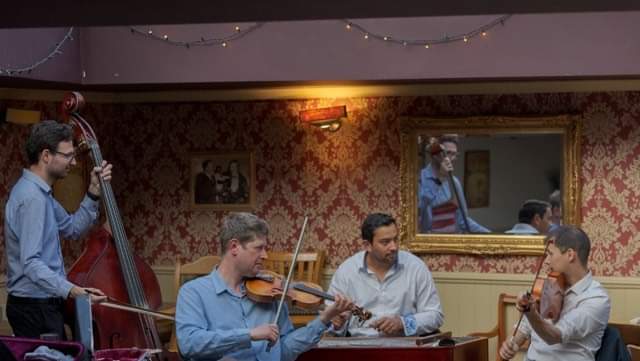
Folktone [below – Adam Römer (violin), Tamás Ferencz (violas, percussion, dance), János Kállai (dulcimer), András Lovászi (double bass)]
Patricia Kopatchinskaja (violin), BBC Scottish Symphony Orchestra / Ilan Volkov

Traditional Hungarian folk music
Bartók
Violin Concerto no.2 BB117 (1937-8)
Traditional
 Hungarian folk music
Bartók
Suite no.2 BB40 (1905-7, rev. 1920 & ’43)

Royal Albert Hall, London
Saturday 28 August 2021

Written by Richard Whitehouse; picture of Ilan Volkov by Astrid Ackermann

This evening’s Prom may have seen the BBC Scottish Symphony Orchestra’s chief conductor Thomas Dausgaard replaced by its principal guest Ilan Volkov, but the ‘Bartók Roots’ concept remained unchanged so as to provide a fascinating and instructive overview of the interface between folk and art music.

Each Bartók piece was preceded by a selection of (mainly) dances courtesy of the band Folktone (led by Adam Römer, familiar as section-leader violist with the City of Birmingham Symphony Orchestra). It was hardly a surprise that Patricia Kopatchinskaja, making her belated Proms debut, should have joined this enterprising quartet to make even more explicit the process whereby Bartók translated those folk melodies directly into the thematic content of his mature compositions – the seamless transition of one to the other doubtless giving Proms listeners pause for thought.

No performance by Kopatchinskaja could be described as routine, as it proved with Bartók’s Second Violin Concerto – less an interpretation than recreation of this greatest from a ‘golden age’ of such works, not least for the way it integrates formal rigour with that spontaneity of emotion emblematic of its composer. While there was no mistaking the all-round correlation between the outer Allegros, the means by which Kopatchinskaja emphasized this without loss of subtlety or expressive nuance underlined just how each of these movements reflects then transforms the other. Volkov secured playing of due sensitivity and poise from the BBCSSO – here and in an Andante whose variations on one of Bartók’s most disarming melodies was never more affecting than when this returns, only to evanesce into silence towards its close.

Kopatchinskaja herself returned for an apposite encore of Ligeti’s early Ballad and Dance in partnership with orchestra-leader Laura Samuel, the BBCSSO then joining-in with a repeat of the second piece. A further selection of folk pieces followed the interval, and prior to the performance of the Second Suite – among several early orchestral works by Bartók that are seldom revived but which throw a fascinating light on his evolution. If less amenable to the pointing up of its derivations from folk sources, the putative connections are no less evident.

At just over 30 minutes and scored for relatively reduced forces, this piece catches Bartók on either side of his initiation into collecting then absorbing of folk material. Such glimpses that emerge during the first three movements tend to be brushed aside by recurrences of that late-Romantic ethos stretching back via Strauss and Wagner to Liszt – hence the genial urbanity of the initial Serenata, rhythmic energy of the ensuing Allegro diabolico with its intensive fugal workout (this movement being the only piece its composer ever conducted in public), rhapsodic progress of the Scena della Puszta with its ruminative preamble for bass clarinet or new expressive vistas of the Per finire as it elides between folk melodies and voluptuous harmonies through to a close the more provisional for its having set out on a new beginning.

The BBCSSO recently recorded this work with Dausgaard (Onyx), but the present rendition with Volkov was no less idiomatic and maybe even more responsive to the chameleon-like aspect of its stylistic remit. It certainly ended this Prom in appealingly understated fashion.

You can find more information on the BBC Proms at the festival’s homepage. Click on the performers’ names for more information on Folktone and Patricia Kopatchinskaja, while for more information on the BBC Scottish Symphony Orchestra’s most recent Bartók release on Onyx Classics click here

Live review – CBSO & Ilan Volkov: Mahler Symphony no.9, Krása & Klein

City of Birmingham Symphony Orchestra / Ilan Volkov (above)

Symphony Hall, Birmingham
Thursday 25 April 2019

Krása Overture for small orchestra (1944)
Klein arr. Saudek Partita for strings (1944)
Mahler Symphony no.9 (1909)

Written by Richard Whitehouse

Photo of Ilan Volkov (c) Astrid Ackermann

Pursuing one of the more eventful conducting careers of his generation, Ilan Volkov returned to Birmingham for this pertinent juxtaposition of music by composers who numbered among countless Nazi atrocities next to what is arguably Mahler’s greatest symphonic achievement.

Mahler has long been central Volkov’s programming (performances of the Sixth and Seventh Symphonies when principal conductor of the BBC Scottish Symphony Orchestra resonate in the memory), and this evening’s account of the Symphony no.9 exuded conviction borne of long familiarity.

Even now, it is uncommon to hear a reading of the expansive first movement which unfolded with such unforced inevitability; those extremes of anguish and introspection finding seamless accord within the composer’s most elaborate formal design. Nor was there any lack of contrast with what follows – the ‘fantasia’ on ländler rhythms whose symmetrical elegance is constantly undercut by that glancing irony at its most acute during the final pages, when the texture appears to disintegrate out of weariness then from any more rational intent.

Excellent as was the City of Birmingham Symphony’s playing thus far, it raised its game for the third movement – the Rondo-Burleske whose contrapuntal intricacy can become turgid at too stolid a tempo and lose definition at too rapid a pace. Not that this fazed Volkov, who duly steered a secure course across what is tonally and emotionally Mahler’s most fractious statement – the soulful strains of its trio section allowing for precious little repose before the initial music returns in an explosive denouement. After this, the closing Adagio emerged as long-breathed yet never flaccid as it accumulated gravitas through to a fervent climax, then subsided into a coda shorn of false emoting or affectation – the CBSO strings all the while maintaining focus as Mahler’s silence-riven gestures seemingly attained the desired closure.

The brief though worthwhile first half had featured a brace of works by Czech composer who both flourished in the Nazi transit camp at Terezin before being murdered at Auschwitz. Not that there is any sense of encroaching dread in the Overture by Hans Krása – its purposeful elision of traits drawn from Stravinsky and Hindemith abetted by scoring as economical as it is characterful. Volkov secured an incisive rendering, only easing up for the final bars whose sense of suddenly opening-out onto new and unforeseen vistas was palpably conveyed here.

Even more engaging was the Partita by Gideon Klein. An arrangement – by Vojtěch Saudek (1951-2003) – of the String Trio that proved to be Klein’s last completed work, it features at its centre a sequence of variations on a Moravian folksong in which elements derived from Janáček take on a distinctive and undeniably personal guise at the hands of one who would have surely found a defining role in post-war Czech music. If the vigorous outer movements seem less individual, they are none the less effective within the context of this piece overall.

In both these works, Volkov secured a spirited response from the CBSO strings (perhaps a little too dogged in the Klein). Hopefully he will return to this orchestra during the 2019/20 season, and hopefully include further pieces by the ‘Terezin generation’ in his programmes.

For further information on the City of Birmingham Symphony Orchestra’s 2018-19 season click here

Further listening

This concert will be broadcast as part of ‘Radio 3 in Concert’ on Friday 3rd May. To access that concert click on this link

Ilan Volkov is yet to record a Mahler symphony, but for a leading version of the Symphony no.9 from the Berliner Philharmoniker and Herbert von Karajan you can listen on Spotify below: