In concert – Martin Fröst, Janine Jansen, LSO / Gianandrea Noseda: Lost and Found @ Barbican Hall

Martin Fröst (clarinet), Janine Jansen (violin), London Symphony Orchestra / Gianandrea Noseda

Beethoven Leonore Overture no.3 Op.72b (1806)
Beamish Distans: Concerto for violin and clarinet (UK premiere) (2023)
Prokofiev Symphony no.7 in C# minor Op.131 (1952)

Barbican Hall, London
Thursday 20 June 2024

Reviewed by Ben Hogwood Pictures (c) Mark Allan

The London Symphony Orchestra and their principal guest conductor Gianandrea Noseda continued their Prokofiev symphony cycle with the elusive Seventh, prefaced by one of Beethoven’s four operatic overtures and a finally realised UK premiere.

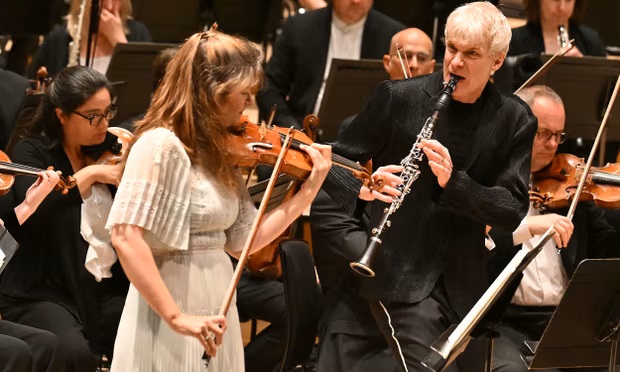
This was Distans, a co-commission between four orchestras for Sally Beamish to write a concerto for the unusual combination of clarinet and violin. Its first performance was delayed due to the pandemic, which became the inspiration for the content of the work. Themes of separation run through the three movements, drawing on the composer’s Swedish and Scottish connections. Separated from her children during lockdown, Beamish also used the forceful musical personalities of soloists Martin Fröst and Janine Jansen (both above) for inspiration.

The two began offstage, however, beckoning to each other across the Barbican Hall as Calling, the first movement, took shape. This was named in the concert notes as ‘kulning’, “the high-pitched singing of women calling the calls on remote pastures”. Beamish’s wide-angle musical lens produced an effective and touching first paragraph, the soloists eventually united on stage in music of the dance, evoking a Swedish fiddle with the full weight and energy of the orchestra in support.

Echoing, the slow second movement, explored more intense feelings of isolation through beautiful scoring, earthy cellos and metallic percussion casting a rarefied light suggesting a Swedish winter. The third movement, Journeying, was powered by an ancient march, the soloists together in spirit and melody, out in the elements with the orchestra. Although the music of beckoning reappeared, the mood was one of reunification, the soloists now at peace and content to remain on stage.

Distans made a strong impact in the hall, and Beamish’s writing for clarinet in her first major piece for the instrument made the most of Martin Fröst’s extraordinary breath control and agility. Jansen also fully inhabited the spirit of the piece, though her part often felt within that of the clarinet, and rarely used the high register. This was definitely a work to hear again, for Beamish’s sound world is a very attractive one in concert.
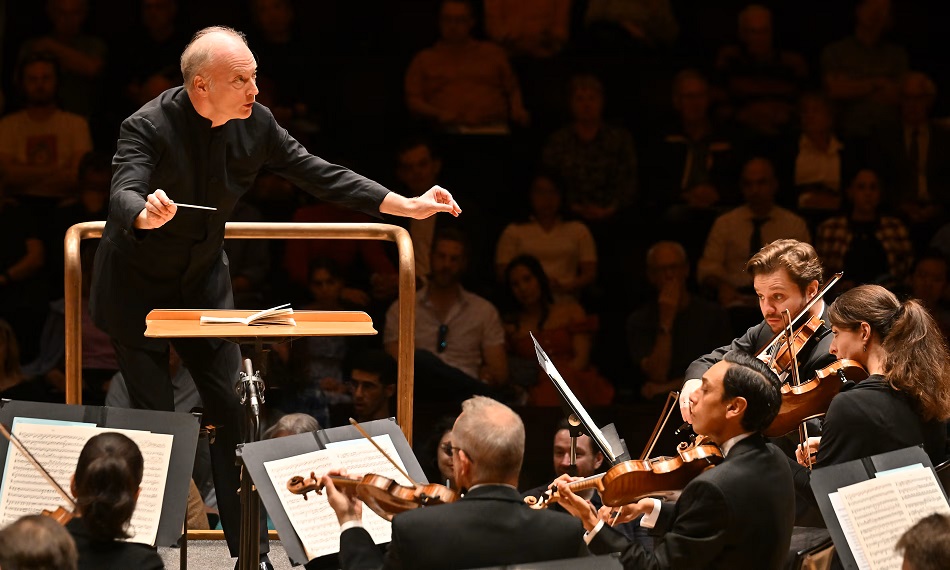
After the interval, Prokofiev’s Seventh Symphony was given an affectionate performance, yet one that also found the darkness lurking within. One of Prokofiev’s final works, the Seventh was written for the Soviet Children’s Radio Division, and as a result adopts a youthful stance, with commendably little room for nostalgia. Instead the composer gets up to his characteristically witty tricks, with inventive scoring enjoyed by the orchestra as woodwind doubled in octaves, and the piano and harp supplemented lower strings.

The music danced, a reminder of Prokofiev’s balletic qualities. The second movement Allegretto had poise in its first tune but a heavier swagger in the second, suggesting the unpredictable movements of older age – though an impressively powerful and assured close was reached. The following Andante enjoyed rich string colours, together with brilliant individual characterisations from oboe (Juliana Koch) and cor anglais (Clément Noël).

Yet the abiding memories came from two themes used in the outer movements. The first, a sweeping unison for orchestra, lovingly recreates the key and spirit of the composer’s first piano concerto, one of his greatest early successes – and was delivered with great charm here. The second, a cautionary motif from flute and glockenspiel resembling a ticking clock, returned like a regretful memory at the end – reminding this listener of an equivalent moment in Shostakovich’s last symphony, completed nearly 20 years later. It ended this performance on a thoughtful note, in spite of the exuberance that had gone before. The LSO were excellent throughout, presenting a convincing case for the Seventh as a bittersweet triumph, and reminding us in the process of Prokofiev’s abundance as a melodic composer.

Meanwhile Beethoven’s Leonore Overture no.3 began in a more desperate mood of resignation, the opera’s main character Florestan losing all hope in prison. Noseda – fresh from recording a symphony cycle with the National Symphony Orchestra in Washington – has very strong Beethovenian instincts, and paced this just right, with an appropriate hush falling over the hall. As the drama heightened, and an evocative offstage trumpet beckoned, the release from prison led to an outpouring of joy, sweeping us up in its forward momentum. The players were off the leash, enjoying every second.

You can find more information on further 2023/24 concerts at the London Symphony Orchestra website

Published post no.2,216 – Friday 21 June 2024
In concert – Janine Jansen and friends play Brahms @ Wigmore Hall

Janine Jansen (violin), Timothy Ridout (viola), Daniel Blendulf (cello), Denis Kozhukhin (piano)

Brahms
Violin Sonata no.2 in A major Op.100 (1886)
Viola Sonata no.2 in E flat major Op.120/2 (1894)
Piano Quartet no.3 in C minor Op.60 (1855-75)

Wigmore Hall, London
Thursday 21 December 2023

Reviewed by Ben Hogwood. Photos of Janine Jansen & Timothy Ridout (c) Marco Borggreve

After the unfortunate cancellation of a concert in her series the previous week, violinist Janine Jansen and friends returned to health and to a Christmassy Wigmore Hall for another all-Brahms programme.

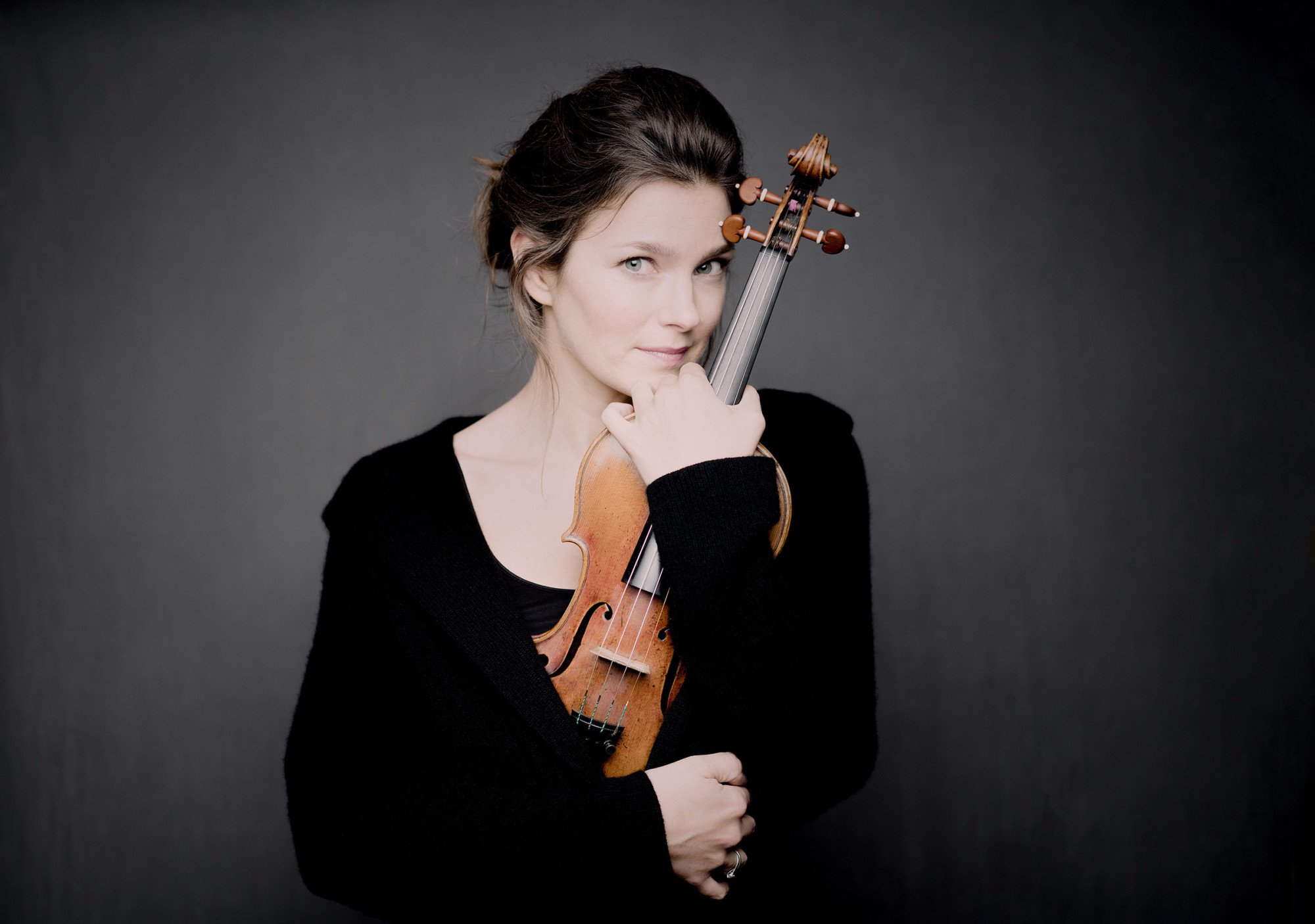
Jansen (above) and pianist Denis Kozhukhin (below) began with the Violin Sonata no.2, a late substitution for the first sonata but a breath of fresh air on a winter evening. One of Brahms’s best-loved chamber piece, its charming first theme has enough to weaken the hardest heart. So it was here, with Jansen’s affectionate playing. Her creamy tone was complemented by the incisive piano playing of Kozhukhin, who was deceptively relaxed in his body language but very much in tune with Brahms’s intricate rhythms and phrasing. The two excelled in the central section of the second movement, which tripped along with admirable definition of those rhythms, and in the finale, where the two enjoyed a more assertive musical dialogue.

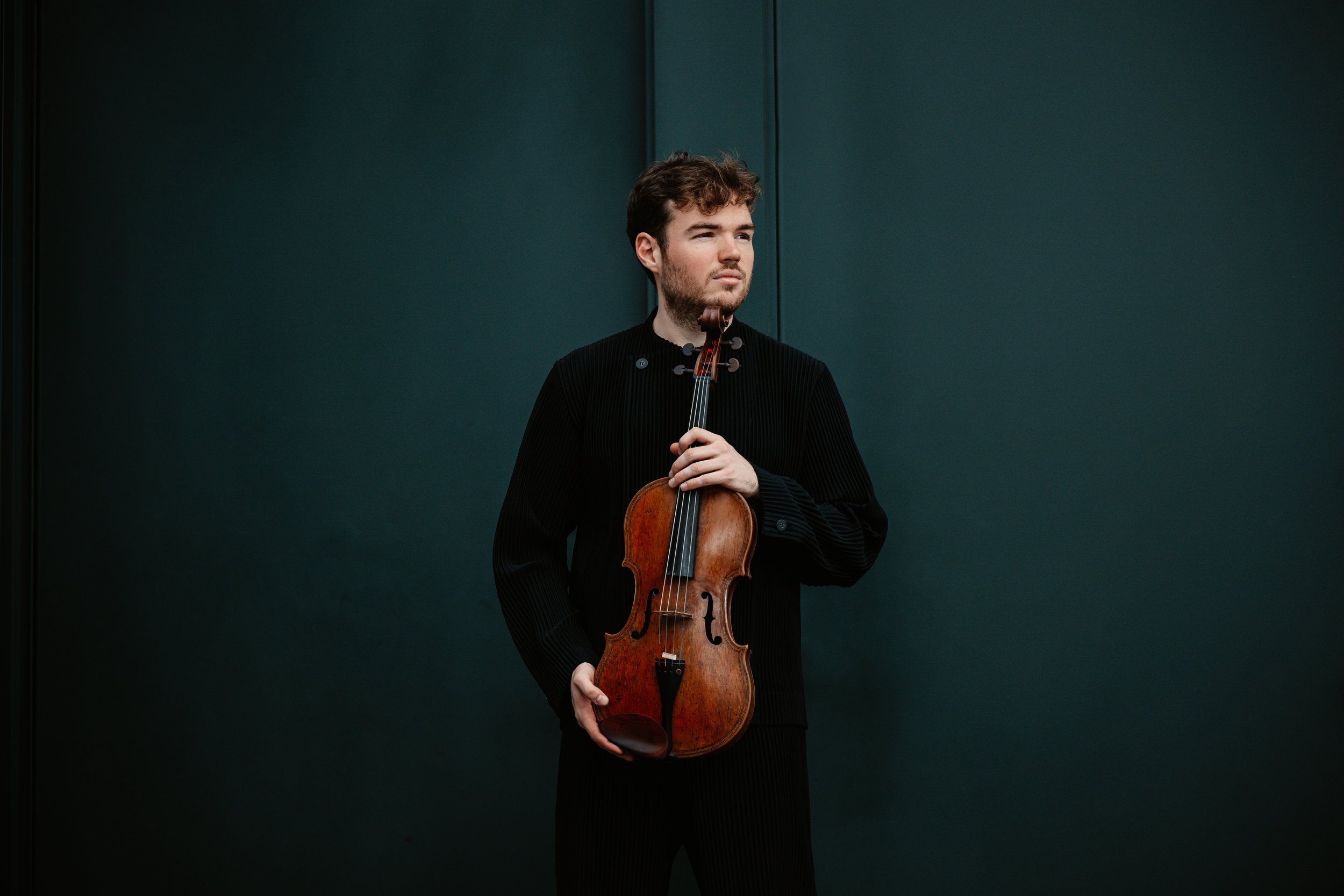
Brahms’s last completed chamber work followed, Kozhukhin joined by violist Timothy Ridout (below) for a performance of the Viola Sonata no.2, arranged by Brahms from the clarinet original. This account exhibited elegance, poise and no little power. Ridout’s burnished tone was ideal for the music, capturing the shadowy outlines of music from a composer in his twilight years, but putting down suitably firm markers in the second movement. Ridout’s high register playing was a treat throughout, his tuning exemplary, and as the two players navigated the theme and five variations of the finale there was an ideal give and take between the part-writing. Particularly memorable was the plaintive stillness of the fourth variation, its mystery dispelled by the affirmative ending.

After the interval we heard the Piano Quartet no.3, competed in 1875 when Brahms was working on the completion of his first symphony. The two works have a good deal in common, beyond sharing the same tonality, for Brahms brings an orchestral dimension to his writing for the four instruments. This grouping needed no invitation to take up the mantle, powering through the first movement with relish, their dramatic account notable for strength of tone and unity of ensemble playing. Jansen and Ridout in particular stood out, their unisons absolutely as one, yet the real hero of the performance was Kozhukhin, elevating the heroic elements of a score closely associated with Goethe’s Werther while keeping the nervousness emanating from Brahms’s syncopated rhythms.

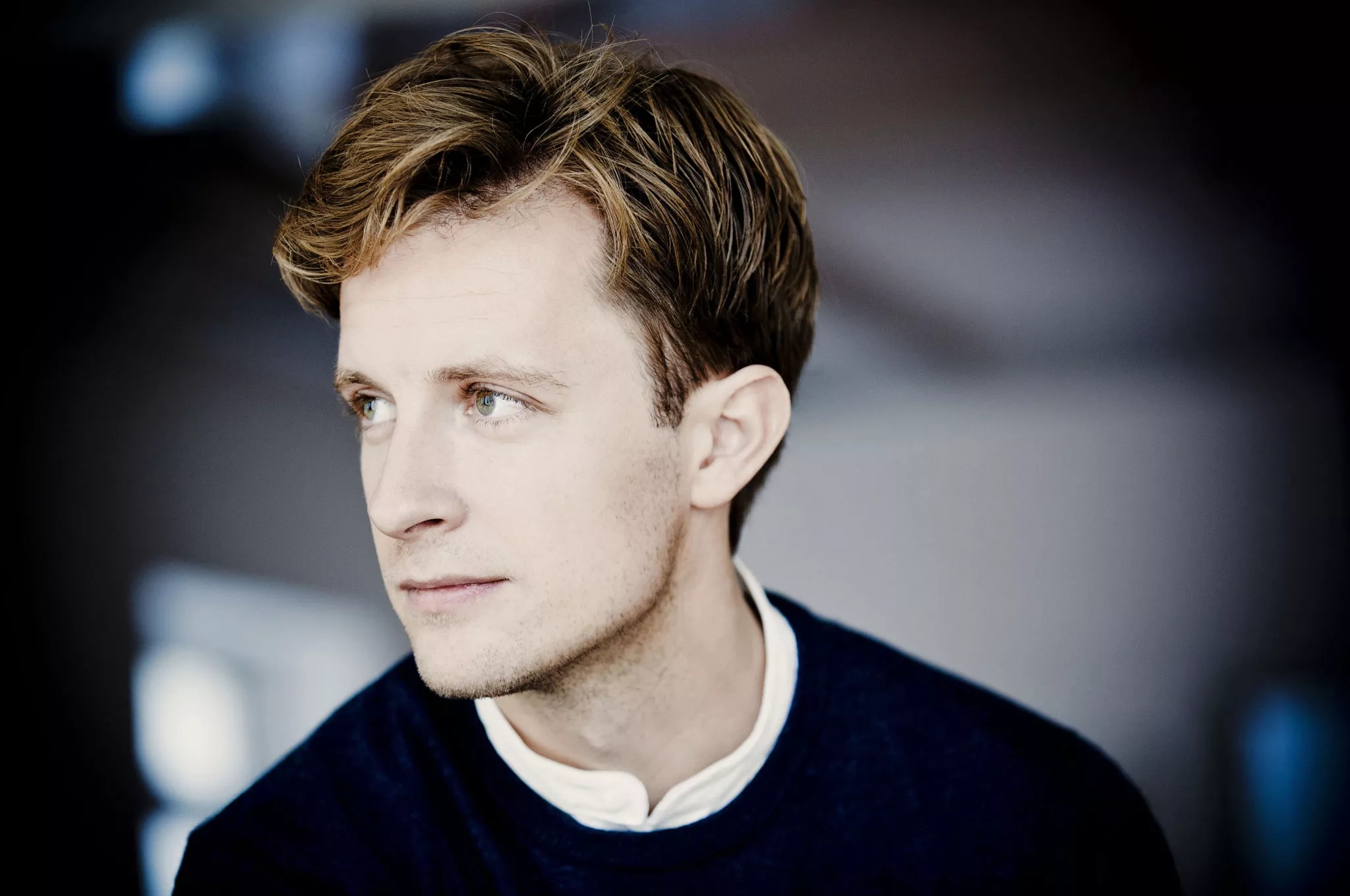
Lest he be forgotten, cellist Daniel Blendulf (above) delivered an understated solo of considerable beauty to begin the Andante, providing respite from the high voltage drama elsewhere but getting to the heart of Brahms’s soulful writing for the instrument. The quartet regrouped for the finale, another show of breathtaking power but with room for reverence in the chorale themes and their development. For all the bravura the air of uneasiness remained as an undercurrent, Brahms never quite at rest even when the quartet reached its emphatic conclusion. This was a truly memorable performance, capping an outstanding evening of music making for which all involved should be immensely proud.

Published post no.2,047 – Friday 22 December 2023

On record: Janine Jansen plays Brahms and Bartók Violin Concertos

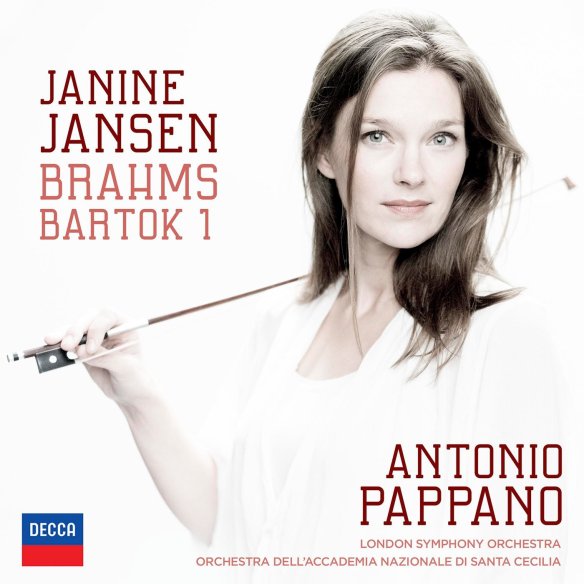
Featured recording: Janine Jansen pairs the Brahms Violin Concerto with Bartók’s First
brahms-bartok-jansen

Leading violinist Janine Jansen explores violin concertos by Brahms and Bartók, bringing out the Hungarian connections between them. The accompaniment is from Antonio Pappano and orchestras from the Santa Cecilia Academy and London.

What’s the music like?

This is an unusual pairing that has not been tried on disc before, but it makes perfect sense. Brahms’ Violin Concerto has a finale that makes much of Hungarian gypsy music, so the leap from that to the thoughts of the young Bartók is not as big as you might think.

The Brahms is a big piece, heavily weighted towards its first movement, which at 21 minutes is more than half the length of the work. In this recording Janine Jansen uses cadenzas (the display parts for violin alone) written by Joseph Joachim, Brahms’s friend and the dedicatee of the concerto. Joachim was a long-fingered virtuoso, and because of that the violin part is technically very demanding.

Bartók’s Violin Concerto no.1 is the first of two such published works, and was completed when the composer was in his mid-20s. It also includes traditional Hungarian music but now the language is noticeably more modern, with crunchy harmonies, swaggering cross rhythms and a solo part that sounds more like a duel with the orchestra. In the Brahms the two forces are very much ‘on side’.

Does it all work?

This is an inspired pairing. Jansen plays with a beautiful tone in the Brahms but just as much credit should be levelled at conductor Antonio Pappano and the Santa Cecilia orchestra, for their singing accompaniment that makes the listener want to hum along with the tunes. The Brahms has been recorded a lot of late but in this recording there is a fresh approach, as though the melodies have just been written. The oboe solo in the slow movement is gorgeously played, while the rustic finale is joyous and uninhibited.

The Bartók is similarly fresh, and again the orchestra – this time the London Symphony – cut through all the different textures and crossrhythms to make sense of this occasionally complex music. The rhythmic profile is strong once again, while technically Jansen is right at the top of her game, graceful in the first movement and gritty in the second but without losing any poise.

Is it recommended?

Yes. The two works complement each other in a highly original and brilliantly played pairing.

Listen on Spotify

You can judge for yourself by hearing the album on Spotify here: