
Connecting Bach with Mozart – Giuliano Carmignola and Kristian Bezuidenhout link J.S. Bach with Mozart by way of three violin sonatas
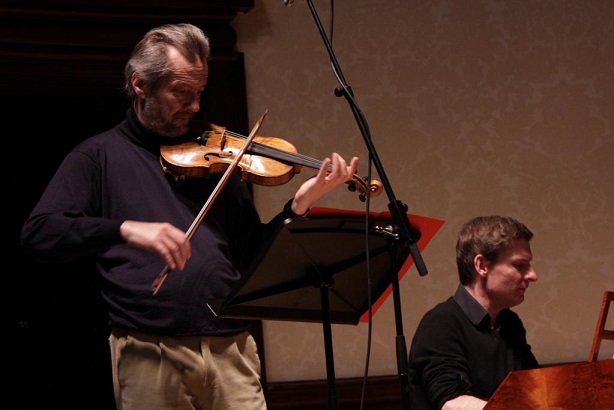 Giuliano Carmignola and Kristian Bezuidenhout – Wigmore Hall, live on BBC Radio 3, 16 February 2015. Photo © Ben Collingwood
Listening link (opens in a new window):
http://www.bbc.co.uk/programmes/b051chkl
on the iPlayer until 17 March
For non-UK listeners, this Spotify playlist is available:
For those unable to hear the broadcast I have put together a Spotify playlist, including Giuliano’s recordings of the Bach with harpsichordist Andrea Marcon, and the Mozart – which he has not yet recorded – with Mark Steinberg and pianist Mitsuko Uchida on Decca:
What’s the music?
J.S. Bach – Sonata no.2 in A major for violin and keyboard BWV1015 (thought to be between 1717-1723) (13 minutes) (the ‘BWV’ number gives an indication of the work’s position in the Bach-Werke-Verzeichnis (Bach Works Catalogue)
J.S. Bach – Sonata no.3 in E major for violin and keyboard BWV1016 (thought to be between 1717-1723) (15 minutes)
Mozart – Violin Sonata in A major K526 (1787) (21 minutes) (the ‘K’ number gives an indication of the work’s position in Mozart’s catalogue. This is no.526 of a total of 626 numbered published works)
What about the music?
This is a ‘period instrument performance’ – that is, played on instruments from or designed to sound like those in Bach and Mozart’s time. The BBC Radio 3 announcer Sara Mohr-Pietsch confirmed Carmignola’s violin is an Italian model dating from 1739, while Bezuidenhout used an early piano developed from an original of 1805.
Mozart wrote dozens of sonatas for violin and keyboard, but the later ones are generally regarded as his finest. This particular example was written around the same time as the opera Don Giovanni, and is dedicated to the memory of Mozart’s friend and fellow-composer Carl Friedrich Abel.
The two Bach works are not as often performed as his works for solo violin, but demonstrate his ease and flair with writing for the instrument. Violin and piano are very closely linked in this music.
The Bach connection comes through the friendship between Bach’s son Johann Christian – whose music is still frequently performed to this day – and Carl Abel. Both met the eight-year old Mozart and stayed in touch with him.
Performance verdict
Carmignola’s bright tone is ideal for the Bach, which could be dry in lesser hands. Here he brings out all the vocal elements in the writing, and is helped by strong support by Bezuidenhout, whose springy rhythms and nicely shaped phrases are a constant pleasure.
The Mozart is an exceptional performance, bringing deep emotion and uncertainty to the slow movement in particular. The grace with which both performers play is unusual in period-instrument playing, and the softness of tone from the fortepiano is beautiful.
The Bach works are a little less obviously expressive, but are extremely well played. What was abundantly clear – an often underestimated point – is just how much the players were listening to each other during performance, not to mention a clear enjoyment of the music!
What should I listen out for?
Bach Sonata no.2
4:49 – at first I actually wondered if the two instruments were tuning up, as they were playing a unison ‘A’! However it turned out to be the easy going start of a graceful slow movement, the first of four.
7:49 – quite a punchy beginning to the first fast music of the sonata, the instruments dovetailing their melodic lines and with several cleverly worked sequences. The music ends quite suddenly.
10:54 – marked ‘Andante’ (at a walking pace), this has purposeful movement despite the slower tempo, and a slightly sorrowful air. Carmignola gives some tasteful ornamentation to the melody.
13:49 – an energetic fourth and final movement. The movement between the violin and piano parts (‘counterpoint’) drives the music forwards.
Bach Sonata no.3
18:47 – a spacious but very expressive slow movement, marked ‘Adagio’. The profile of the violin melody is as if written for a singer, with a common five-note accompaniment for the fortepiano.
22:29 – a lively second movement, with a constant stream of dialogue (‘counterpoint’) between the two instruments, beautifully dovetailed in this performance.
25:29 – this may be a slow movement but there is a soft dance element. Eventually it peters away into almost nothing.
29:44 – a vigorous fourth movement, simply marked Allegro, where both violin and fortepiano work hard together and apart.
Mozart
35:43 – a colourful fast movement to begin with, with both instruments equally involved in the dialogue and sharing the themes. The piano has some particularly tricky runs in the right hand which Bezuidenhout appears to manage easily.
42:19 – a deeply profound piece of contemplation, where Mozart appears to be remembering his friend in music that alternates between hope and deep thought. The passages of ‘hope’) (from the start, for example) tend to be in the ‘major’ key, while the passages of darker introspection (45:28 for example) are rooted in the minor.
49:15 – to start with the violin and piano seem out of sync, with some elaborate rhythms from Mozart. The piano in particular is incredibly busy, with the left hand shadowing the right in melodic profile. The violin becomes more showy in the central section.
Encore
57:49 – A short and nippy encore, the last movement of J.S. Bach‘s Violin Sonata in B minor, BWV1014. This work was published as the first of a group of six – the works above being the second and third in the group.
Want to hear more?
As the link between this music is Johann Christian Bach, here is a link to a disc of ‘Six Favourite Overtures’, played by the Academy of Ancient Music under Christopher Hogwood:
For more concerts click here

 Arcana.fm