Wigmore Mondays – Brentano String Quartet play Haydn and Britten

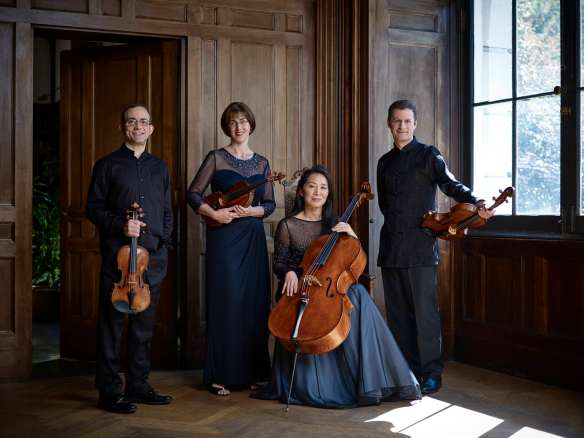
BRENTANO QUARTET - Misha Amory/ viola, Serena Canin/violin (glasses), Nina Lee/cello, Mark Steinberg/violin (glasses) www.http://brentanoquartet.com/

BRENTANO QUARTET – Misha Amory/ viola, Serena Canin/violin (glasses), Nina Lee/cello, Mark Steinberg/violin (glasses) www.http://brentanoquartet.com/

Wigmore Hall, London, 7 March 2016

written by Ben Hogwood

Audio (open in a new window)

http://www.bbc.co.uk/programmes/b072hw4q

Available until 6 April

What’s the music?

Haydn – String Quartet in F sharp minor, Op.50/4 (1787) (20 minutes)

Britten – String Quartet no.3, Op.94 (1975) (27 minutes)

Spotify

The Brentano String Quartet have not yet recorded this music, but other versions can be accessed via the playlist below, in case you can’t get to the broadcast:

About the music

Haydn wrote nearly 70 string quartets, but he was one of those composers incapable of writing the same thing twice. He also had a bit of a penchant for exploring relatively rare keys, and so this quartet, the only one he wrote in F sharp minor, occupies a special place.

It was part of a present for King Frederick William II of Prussia, to whom he had already sent his ‘Paris’ symphonies (nos.82-87) – receiving a ring in return. Haydn decided to send six string quartets, known as the ‘Prussian’ quartets – which continue to show his development as a composer in this relatively new form. The F sharp minor example is not as dark as some of the works in this key, though it does have some idiosyncratic moments described below.

Britten’s third numbered string quartet – his fifth and last to be published in the medium – is a direct product of the composer’s ailing health in 1975. With his capacity for work dwindling but not unbowed, it was suggested to him – in all seriousness by his friend Hans Keller – that if he wrote for less staves on the manuscript score he would be able to write more music.

He therefore completed a dedication for his friend, but as Keller recounts in his recent book, Britten: Essays, Letters and Opera Guides, the thought had been in his mind for some while. After a protracted discussion on form and sonata structure, Britten said to his friend, ‘One day, I’ll write a string quartet for you’. What he completed is something of a Divertimento – a wide ranging term that can apply from a short multi-movement piece to something as substantial as Mozart’s Divertimento for string trio, K563. The implication is that Britten wanted the freedom the form gave him.

With the Amadeus Quartet already enthusiastic exponents of his work, Britten took up the challenge with the help of the group and his assistant, composer Colin Matthews, who helped write much of the music from the piano. Although the Amadeus and Britten ran through the piece in private, he did not live to hear the public’s thoughts on the piece, for the premiere took place just over two weeks after his death.

The last movement of the quartet was written in its entirety in Venice, where Britten was still well enough to go on holiday, and perhaps inevitably it takes its lead from Death in Venice for its musical material. These are thought to be a present in musical form for Peter Pears. The final chord was a matter of some conjecture, and Britten changed it – for in the words of Colin Matthews, he wanted the work to ‘end on a question’.

For more thoughts on Britten’s last full work, visit the Good Morning Britten blog entry

Performance verdict

The Brentano Quartet were notable for their accuracy of tuning and ensemble in this concert but at times some of the raw emotional elements of the music were not necessarily close at hand.

The Haydn was extremely well played but did not have a freshness or spontaneity of the best Haydn performances. It was however impressive for the way they found the inherent darkness in the music, especially the finale, which had a grim determination. The slow theme and variations that make up the second movement could perhaps have enjoyed more variety between each one.

The Britten reached further emotionally, and the beautifully played last movement was a fitting finale. The Brentano were also very effective in the two faster movements, finding the right level of aggression. The rippling textures of the outer movements were beautiful too, recognising the very unusual colours Britten achieves in this music. Britten’s quartets travel internationally now – they were very much confined to this country for a while – and it is intriguing to hear them played from afar. This performance did the Third Quartet justice.

What should I listen out for?

Haydn

1:21 – the first four notes are key in the first movement of this quartet, for they form the basis of everything that follows – a bit like the repeated note motif in Beethoven’s Symphony no.5 but in a very different mood. Here the outlook is quite sombre, though the violin is positive. The first section is repeated (2:55), then at 4:25 the four note theme moves into development mode, before Haydn brings it back in original form at 5:37. Then he shifts the key to F sharp major at 6:22, and there is a notable upturn in mood.

7:31 – after the relative strife of the first movement the second begins in a pure and rather lovely form. A simple theme is presented before Haydn subjects it to several variations, but the peace doesn’t last and things take a darker turn at 9:30, the cello moving into its lowest register. At 10:55 the sunshine returns but is still affected by the music prior to it, and sure enough the minor key returns (12:34) – before Haydn moves once again to the major key for the next variation (13:16). The movement ends in a sudden full stop.

15:14 – the third movement, as is tradition, is a Minuet­ – but this one is a bit different as Haydn sets it in F sharp major, the most difficult of all keys for string players. It has a strange air about it, and some sudden loud bits do not help the mood of anxiety. At 16:45 a trio section starts, slipping into the minor key and feeling more vulnerable as a result. The Minuet music returns at 18:06, but doesn’t fully ease the tension.

19:10 – the mood of the quartet gets even darker for its finale, an austere fugue – which is where each part comes in at regular intervals playing slightly altered versions of the same tune. It makes a busy sounding texture, which Haydn works ingeniously until a sudden end, the finale only two minutes long.

Britten

23:54 – immediately in this work there is a sense of otherworldly mystery. In the third quartet Britten picks up where Death in Venice left off, the first violin using the same conversational style that Britten assigned to Aschenbach,(e.g. 25:14) the other instruments painting pictures of the undulating waters of the city’s canals. There is an intense period of contemplation that runs through this movement, subtitled Duets – because Britten tends to divide the quartet equally as the music unfolds

30:34 – the second movement (Ostinato) arrives with a jolt, and though its statements often end on a chord built on C – one of Britten’s favourite tonalities – it often sounds dissonant and unfeeling. There is a central section where brief respite is found, but it does not last long.

33:56 – when the violin takes the lead in this movement, marked Solo, it does so as a leader in prayer and meditation, and the other three instruments stand considerately in the sidelines. As the movement closes Britten reaches a radiant calm.

38:40 – either side of this moving section are two gruff, defiant scherzos, Britten writing closer to the style of Shostakovich but seeming also to shake his fist at the approach of Death. This second scherzo emphatically bursts the bubble created by the violin in the middle movement.

41:09 – the final movement – subtitled Recitative and Passacaglia – has perhaps the strongest sense of inevitability in late Britten. It begins with thoughts from the solo instruments, using the conversational style of the first movement. Then the Passacaglia takes hold (44:05). It is both sure footed and sublime, every repetition of the gently rising phrase feeling like a slow but sure step towards another world. That it ends on a question is something of a masterstroke, for after the serenity of the E major chord is realised in harmonics (50:33), Britten still has questions in his life and beliefs that remain unanswered. Ending on the ambiguous chord speaks volumes.

Encore

53:03 – a difficult call to make, doing an encore – but the Brentano chose nicely, opting for the first fugue from J.S.Bach’s The Art of Fugue (3 minutes). This is also reproduced on the Spotify playlist.

Further listening

Where to go after Britten’s final thoughts? It’s a very tricky question to answer, so how about some late or final thoughts from other composers? Included at the bottom of the playlist are Beethoven’s Piano Sonata no.32, Schubert’s last String Quartet and the Adagio from Mahler’s Symphony no.10:


Britten Sinfonia At Lunch Two: Anna Clyne’s This Lunar Beauty

britten-sinfonia

Julia Doyle (soprano), Marios Argiros (oboe), Maggie Cole (harpsichord), Jacqueline Shave, Miranda Dale (violins), Clare Finnimore (cello), Caroline Dearnley (cello)

Wigmore Hall, 20 January 2016

Written by Ben Hogwood

If you live in London or the South East of England, and fancy a bit of musical exploration, then the Britten Sinfonia’s At Lunch series comes highly recommended.

Celebrating its tenth anniversary, the enterprise promises a brand new work in every concert – and proceeds to build the whole hour of music around it, often with the shared theme of a particular instrumental or vocal combination. With programme notes for adults or schoolchildren, it is one of the most accessible lunchtime concerts you could wish to enjoy – and as well as having the obvious bonus of professional quality performances, it is completely judgement-free!

This particular concert illustrated just why the formula works so well. Taking as its theme the combination of voice, oboe and strings, the Britten Sinfonia built an intricately weaved concert taking in arias from Bach and Scarlatti cantatas as well as two very different approaches to minimalism from Arvo Pärt and Ligeti. It was fitting, then, that the final piece – the new commission from Anna Clyne, This Lunar Beauty, should bring all these strands together.

anna-clyne

Anna Clyne photo by Javier Oddo

Setting the W.H. Auden poem of the same name, Clyne has written a piece of outstanding beauty. Its calling card is a distinctive melody that seems to be sourced from medieval England, but works it in a way of which the late 1960s British folk pioneers such as Fairport Convention, Steeleye Span or Pentangle would be entirely proud.

The repetitions of the tune, given in soprano Julia Doyle’s clear tones, were subtly varied by additions and subtractions to the instrumental texture, filling up with strings or paring back so the glitter of the harpsichord could be sensed on top. This Lunar Beauty left a strong emotional impression, using its forces sensitively in new music of rare quality and depth.

Before this, Doyle leant her clear tones to three varied arias from Bach Cantatas, with oboist Marios Argiros excelling in the obbligato to the aria Tief gebückt und voller Reue. We also heard Salvatore Sciarrino’s arrangement of two arias by Alessandro Scarlatti, the first of which had a striking accompaniment of muted strings without vibrato.

The two very different approaches to minimalism were fascinating. In Arvo Pärt’s Fratres time stood suspended as the string quartet’s theme, first heard in ghostly harmonics, gradually found body and soul before ebbing away into the distance. Ligeti’s Continuum froze time in a wholly different way, the solo harpsichord – brilliantly played by Maggie Cole – seemingly trapped in rapidly flashing strobes. Somehow, despite the hyperactive energy, this too found its own stillness.

A very fine concert, hopefully to be broadcast on the BBC in the future. In the meantime, have a listen to the audio below – and get yourselves over to listen to vocal works on Anna Clyne’s website, because this is a composer we want to hear a lot more of!

You can also hear her new Violin Concerto The Seamstress on the BBC iPlayer, performed by Jennifer Koh and the BBC Symphony Orchestra conducted by Sakari Oramo. The concert is available until 14 February 2016

Under the surface – Mendelssohn Preludes and Fugues played by Howard Shelley (Hyperion)

mendelssohn-shelley

Composer: Felix Mendelssohn (1809-1847)

Nationality: German

What did he write? Schumann regarded Mendelssohn as the ‘Mozart of the nineteenth century’, as he was an uncommonly gifted child prodigy. A pianist as well as a composer, Mendelssohn is nonetheless better known for his orchestral and choral works. His five symphonies are best represented by the Scottish, the Italian and the Reformation (nos.3-5 respectively), while his most famous choral work – and one often performed by amateur choral groups – is the story of the Old Testament prophet Elijah.

The composer’s impressive body of chamber music is now better appreciated, headed by two Piano Trios and six published String Quartets.

What are the works on this new recording? Mendelssohn’s work for solo piano is often regarded as a set of attractive miniatures. This is doubtless due to the popularity of the Lieder ohne Worte (Songs Without Words), published in sets of six throughout the composer’s career. They are around three minutes each in length and carry attractive music and titles such as Venetian Gondola Song. On this recording, part four of a complete series of Mendelssohn piano music, Howard Shelley gives us the fifth book, a complement to the main work itself – the set of six Preludes and Fugues.

Mendelssohn was almost single-handedly responsible for the revival of Bach’s music in the nineteenth century, resurrecting the composer in a performance of the St Matthew Passion in Berlin in 1829, when Mendelssohn was still only 20. In the Preludes and Fugues he was paying a more obvious musical homage, using a form Bach had perfected for the keyboard.

What is the music like? When a composer writes a fugue it can sound as though they are showing off academically rather than communicating emotionally, but Mendelssohn brings to these works a strong sense of purpose and poise. His instinctive writing for the piano means the notes effectively play themselves, but they are not easy to play – which is where Howard Shelley comes in! Under his fingers the fugues really jump off the page when moving at pace, and the preludes each have strong personality.

Complementing them with Book 5 of the more romantic Songs without Words is a good move, and Shelley takes up the role of poet in the fanfare of the third piece or the lyrical Spring Song. Finally he adds the Andante cantabile e Presto agitato, an unpublished work of two halves, the first soft-hearted and the second bright and energetic.

What’s the verdict? This brilliantly played and recorded disc shows just how accomplished Mendelssohn’s writing for piano became, and with Howard Shelley completely mastering the technical demands the listener can appreciate the emotion of the music. The Preludes and Fugues are inspiring for their resilience, the Songs without Words for their poetic charm.

Give this a try if you like… Schubert, Chopin, J.S.Bach.

Listen

You can listen to excerpts from the disc at the Hyperion website

Meanwhile you can hear more of the composer’s Songs without Words on Spotify, in a complete set made by Daniel Barenboim:

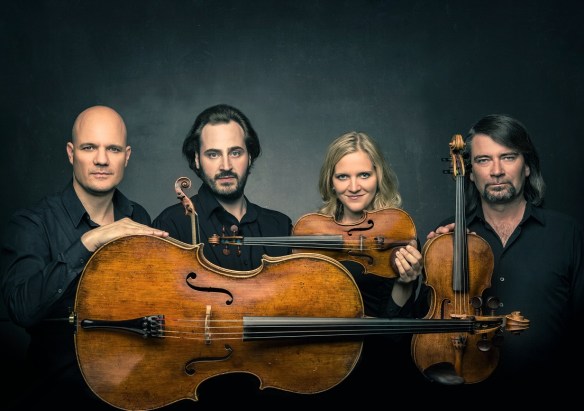
Wigmore Mondays – Artemis Quartet and Markus Groh: In Memoriam Friedemann Weigle

artemis-quartet

Artemis Quartet – with Friedemann Weigle (viola) on the far right.

Markus Groh (piano), Members of the Artemis Quartet – Vineta Sareika (violin), Gregor Sigl (viola), Eckart Runge (cello) – Wigmore Hall, London, live on BBC Radio 3, 30 November 2015

Listening link (open in a new window):

http://www.bbc.co.uk/programmes/b06qjz7t

on the iPlayer until 30 December

Spotify

In case you cannot hear the broadcast, here is a Spotify playlist of the Brahms played in this concert, from available versions on Spotify:

What’s the music?

Bach/Piazzolla, arr. Eckart Runge: Partita for StringTrioIn Memoriam Friedemann Weigle (18 minutes)

Brahms: Piano Quartet No. 3 in C minor, Op. 60 (1875) (35 minutes)

What about the music?

This concert was a tribute to the violist Friedemann Weigle, a member of the Artemis Quartet who sadly died at the age of 53 earlier this year. The quartet write this about the Bach / Piazzolla suite with which they begin, arranged by their cellist Eckart Runge:

“Featuring excerpts from Bach‘s Goldberg Variations, the English Suite BWV808 and the Sinfonia BWV795, as well as two fragments from Piazzolla‘s Oblivion and Fuga 9, the Partita for Trio spans the lifetime of Friedemann, from his beginnings as a church musician’s son to his time as a member of the Artemis Quartett. In 2012, when we were conceptualising our Bach-Piazzolla suite, Friedemann was devoted to arranging the works of Johann Sebastian Bach. He had a special affinity for the music of Bach, music that had accompanied him since his childhood. At the same time, he had been fascinated by pop music – from rock to jazz – since his youth. Indeed, he often proudly said that his first public musical performance was as a drummer in a rock band. Friedemann’s curiosity for new musical forms once again became apparent when he learned – and learned to love – Piazzolla’s Tango Nuevo through the Artemis Quartett.

We performed the Aria from the Goldberg Variations at Friedemann’s funeral. The idea then came about for us to honour Friedemann through the arrangement of a Partita, which would bring together these two aspects of his musical interests and, as a trio, to show the absence of a beloved friend.”

Performance verdict

Sometimes in a concert it almost does not matter what the standard of performing is like, and this was one such occasion. Unfortunately Arcana was unable to attend but I am sure you will be able to gauge the depth of feeling immediately from the sensitive Bach arrangements, which are arranged into a very effective suite.

The BBC Radio 3 announcer Sara Mohr-Pietsch tells us that the last recording at which Friedemann was present was of Brahms String Quartets – and so the group have been performing Brahms with guest pianists on their tour. There is an extra poignancy and potency to their performance of the C minor Piano Quartet No.3, with a depth of feeling that even over the radio is very intense. The resilience and power of the outer movements is most impressive, the rhythms are sharply defined and the slow movement is the soft, beautifully played centre of the performance.

What should I listen out for?

Bach / Piazzolla

1:40 – a solemn opening passage of music, where the held notes on the string trio could be mistaken for the sonorities of the bandoneon – an instrument Piazzolla often used.

5:54 – a fugue – presumably from Bach’s English Suite BWV808 – begins, the players using next to no vibrato and keeping their bows near the bridge of their instruments by the sound of things, to secure quite a coarse sound – but then there is much more of Piazzolla appearing as the music moves into a characterful dance at 7:30. Then at 8:06 the mood changes abruptly again, returning to sorrowful memories.

17:18 – the Aria from the Goldberg Variations signals a switch from the sorrowful minor key to a much more optimistic major. With it the instruments bring more vibrato. The versatility of Bach’s music is very clear in this arrangement, the parts beautifully even in their distribution.

Brahms

markus-groh

Markus Groh (piano)

23:23 – the piece begins with a slow introduction, where a single unison from the piano brings in the strings with their theme. This call and response is repeated. At 24:22 the first movement proper begins, and is notable for its full texture and big musical statement. The music then subsides a little to softer, undulating thoughts and a second theme at 25:30 from the piano. Brahms continues with some powerful statements from both forces. At 31:42 the music is more graceful, led by the piano, but soon the fraught atmosphere returns, and at 32:57 the mood of the slow introduction returns, and the first movement finishes.

33:52 – the Scherzo, which as so often with Brahms features nervy crossrhythms and the feeling of piano versus strings. At 35:12 there is a flowing passage but still the nervousness is present – and at 36:34 the main theme returns, with razor sharp accuracy from the players, before an emphatic finish moves the music from C minor to C major.

38:21 – the slow movement begins with the cello softly playing, an elegiac line that is beautifully rendered here by Eckart Runge over a quiet piano accompaniment. Soon he is joined by the violin and the pattern for this deeply felt piece of music is set, the instruments sticking closely together but playing music of great tenderness and feeling. The movement ends quietly and thoughtfully at 47:45.

47:58 – the finale begins with a sense of nervousness again, the piano figuration dancing around the violin theme, before the music really cuts loose with all four instruments, Brahms unleashing the power at his disposal. In this performance the group take the repeat at 50:00. Then the music moves farther afield, in terms of its distance from the harmonies Brahms uses for the main key – before returning around the 53:35 mark – where we hear another account of the main melody on a lower part of the violin. The work as a whole leaves a strong impression, with a thoroughly convincing finish.

Further listening

Brahms enjoyed writing for the piano with stringed instruments, and his other two Piano Quartets are massive works but ones that repay repeated listening. The more popular of the two is the Piano Quartet No.1 in G minor, a really impressive structure that is one of the composer’s earliest large scale chamber works. The Piano Quartet No.2 in A major followed soon after…and both are given excellent performances on this album from pianist Nicholas Angelich, string playing brothers Renaud and Gautier Capuçon (violin and cello respectively) and Gérald Caussé (viola):

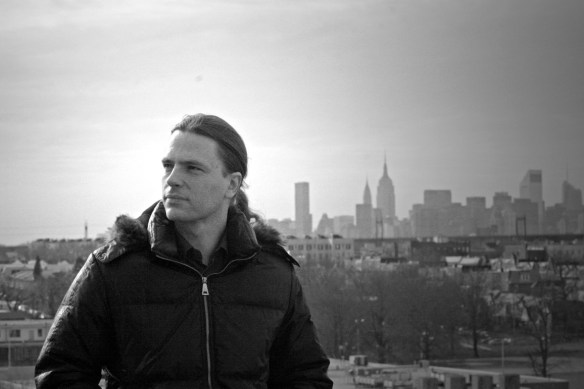
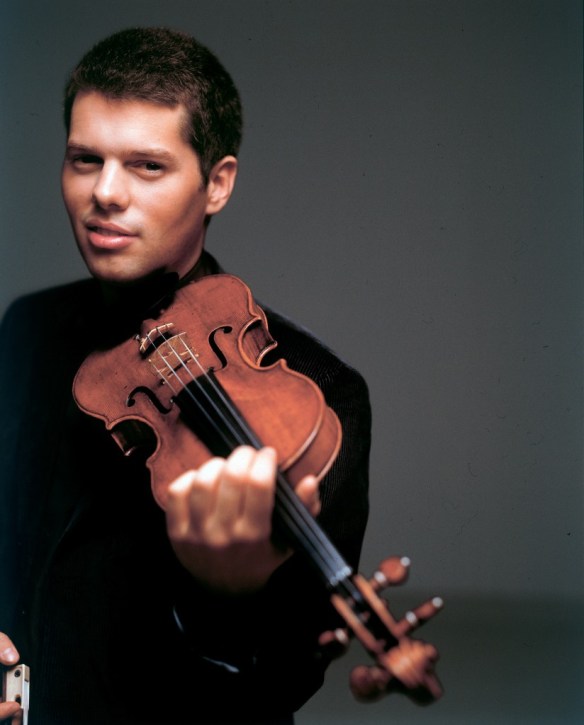
Wigmore Mondays – Barnabás Kelemen

barnabas-kelemen
Photo (c) Laszlo Emmer

Barnabás Kelemen (violin) – Wigmore Hall, London, live on BBC Radio 3, 9 November 2015

Listening link (open in a new window):

http://www.bbc.co.uk/programmes/b06nrj16

on the iPlayer until 9 December

Spotify

In case you cannot hear the broadcast, here is a Spotify playlist of the music in this concert, from available versions on Spotify:

https://open.spotify.com/user/arcana.fm/playlist/7hpQWH2e75lnrwx3ibS4LU

What’s the music?

J.S. Bach: Partita No. 2 in D minor (1720) (30 minutes)

Ysaÿe: Violin Sonata No.3, ‘Ballade’ (1923) (6 minutes)

Paganini: 4 Caprices (from the 24 Caprices Op.1) (1802-17) (12 minutes)

Piazzolla: Tango Étude no.1 (1987) (3 minutes)

What about the music?

It’s quite possible to think of the violin as an ancestor of the guitar when you listen to this music. Some of it appears to be purely for show-off, especially when you get to the incredibly testing works by Ysaÿe, Paganini and Piazzolla, but when you look closer they are actually found to be musically proficient as well as technically demanding.

If Paganini was alive today I would imagine him behaving a bit like the guitarist Steve Vai, performing superhuman feats on his instrument but making sure at all times that not a note was wasted. That much is true in each of the famous Caprices, written for solo violin in a way that taxes all kinds of techniques with the performance of the instrument. The four here test the violinist’s ability with rapid string crossing, with playing three or four notes at the same time, and with rapid fingerwork.

Ysaÿe was also a virtuoso violinist, one who enjoyed dedications from Franck (his Violin Sonata) and Debussy (the String Quartet). Not much of his music is heard today, and when it is the Solo Violin Sonatas such as the one in this recital tend to be picked. Ysaÿe also taxes the violin but again ensures it is not just for display purposes. Piazzolla, meanwhile, was not known primarily as a violin composer, and his Tango Studies were originally written for the flute, but they transcribe naturally for the instrument, which can supply the rhythmic ‘snap’, as well as the other nuances that make the tango such an intense method of musical expression.

J.S. Bach’s Partitas for the solo violin come from a very different viewpoint. As in much solo Bach there are moments in these pieces where the listener feels as though they have entered a different time dimension, Bach’s treatment of his musical material so inevitable and so effortlessly calculated that it feels like the passing of time. The Solo Violin Partita no.2 is one of his most famous examples for a solo instrument, partly for the massive Chaconne with which it ends – a series of 64 variations on a small but ever-present loop.

Performance verdict

I wonder how many notes Barnábas Kelemen played in the course of this hour of music? Certainly Paganini ensured there were as many as possible in the selection of Caprices that he played, while Ysaÿe too packed a load into his brief but strikingly intense Solo Sonata.

Brilliantly played though this recital was, it could have done with a little more light and shade in the programming. The shade was to be found in the Bach, which was a really convincing account and was clearly a work close to Kelemen’s heart. He was relatively slow in the Allemande dance, which was an effective tactic as it meant the Gigue carried greater impact – though of course everyone was really waiting to see what he did with the Chaconne. Here Kelemen demonstrated a very firm grasp of the form, making a natural build through the 64 different variations, Bach’s vision growing in power and impact until it carried all before it.

Staying in the same key for the Ysaÿe was a brave but effective move, and this brief piece carried a Romantic intensity. It was good to be reminded of the Belgian composer’s genius, for his is not a voice often heard. Following this with Paganini was perhaps a step too far, like a mixed grill with no vegetables if you’ll pardon the parallel! That said, the Devil’s Laughter was brilliantly evoked in the last of the four caprices. Finally the Piazzolla, while harnessing the rhythms of the tango, was a bit too short to fully appreciate.

Kelemen is clearly a player of great ability – and although this recital might be better experienced in two takes, it demonstrates his technical prowess and keen musicality.

What should I listen out for?

J.S. Bach

1:42 – the Partita begins with a relatively slow dance, the Allemande. Kelemen does not use much vibrato to begin with, and his violin has a penetrating tone. As with much of the best Bach the music appears to unfold in a single, natural phrase.

7:08 – the Courante is much more purposeful, the notes quicker and the tone fuller. Bach drives the music on with a persuasive triple-time rhythm that Kelemen takes quickly. The tone of the instrument is also a bit brighter, the notes in a slightly higher register.

9:49 – the slow dance, the Sarabande­ – where the minor key really comes into its own. Here the violin is asked to do a lot of ‘multiple stopping’, which is playing more than one note at once, effectively making its own chords.

12:28 – the Gigue, another triple time dance that Kelemen takes at quite a lick, but which still has plenty of contrast with the repeats being used in each of the two sections. Bach gathers a lot of energy here, and as often uses the Gigue as the last dance form in his suites, but there is no feeling of finality here because we still have one movement to go…

17:47 – and that final movement is a massive one, the Chaconne, famously performed separately or reinterpreted for other instruments. The violin begins with a grand statement of a chord sequence which it then proceeds to spin out over 64 variations, mostly in the minor key but moving to the major at 24:44. Bach gives an enormous variety of colour, speed, attack, repose and musicality, starting relatively slowly but moving to passages of increasing difficulty and intensity, notably the string-crossing passage from 22:45, but this is also one of his most profound pieces of music when interpreted well. The music turns back to the minor key with impressive dramatic effect at 28:14.

Ysaÿe

33:08 – a slow beginning, acting as an introduction, before the sonata itself begins at 33:27 with a theme that sounds quite oriental. Although set in D minor the music rotates around that centre at quite a distance, and there is a lot of multiple stopping here. Despite the considerable virtuosity required there is a powerful musicality at the heart of this piece, which never uses display for the sake of it.

Paganini

40:37 – the Caprice no.1, almost laughably, is marked Andante (at a walking pace!) It certainly doesn’t begin that way, with a fiendish set of arpeggios facing the violinist. As the bow bounces across the string it is clear however that each of these notes is important, despite the obvious display tactics!

42:07 – the Caprice no.7 is much slower, and presents its theme in octaves – which any string player will know is an invitation for cramp! There is an eerie feel to the presentation of the notes, though soon Paganini can’t resist taking off at a great speed again. At 44:58 the music really goes out the blocks!

45:44 – the Devil’s Laughter of the Caprice no.13 is surely one of the most descriptive things Paganini wrote for the violin, and it crops up at disarming intervals in this piece, in and around the fiendish technical demands of the central section, set in a tempestuous minor key.

48:07 – the famous Caprice no. 24 was the basis of variations written by Rachmaninov and Lutoslawski (not to mention the South Bank Show theme!) but here it is in its original form, for solo violin. This Caprice is in itself a set of variations, and has a wonderful effect of tumbling pizzicato (plucking) at 50:34.

Piazzolla

53:31 – immediately the snappy tango rhythms are evident in the first tango etude, which sounds as though it was written for violin all along. The technical demands are not as extreme as some of the other music on the program, with a grasp of the tango rhythm the most essential part of the performance.

Further listening

https://open.spotify.com/user/arcana.fm/playlist/7hpQWH2e75lnrwx3ibS4LU

Taking Paganini’s Caprice no.24 as a starting point, the Spotify playlist above includes Rachmaninov’s famous Variations on a theme of Paganini for piano and orchestra, as well as Lutoslawski’s Variaions on the same theme for two pianos. Finally, it is a good chance to air one of six substantial concertos that Paganini wrote for violin and orchestra, works that are hardly ever heard in the concert hall these days. The second is one of the best, known as La Campanella because of the tune used in the last movement.