In concert – Roberts Balanas, Ealing Symphony Orchestra / John Gibbons: Electrifying Ealing – Bernstein, Ángela Luq, Coleridge-Taylor & Bliss

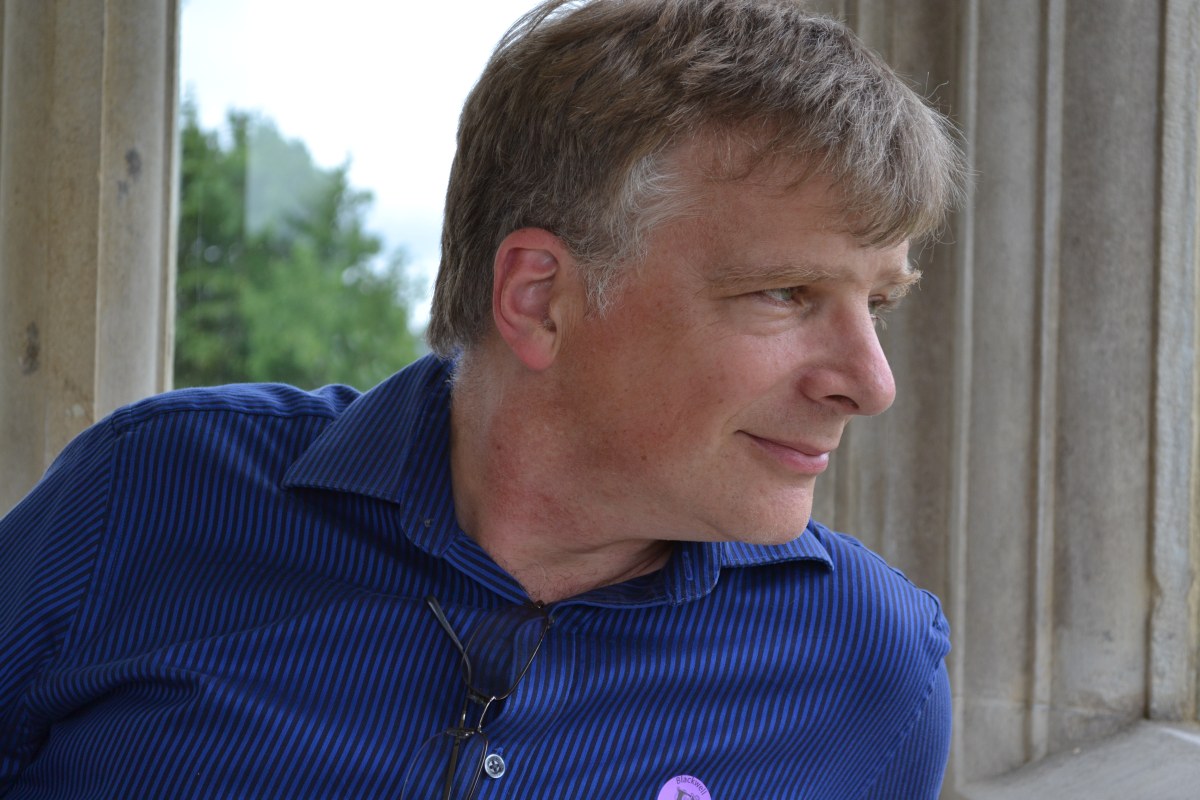
Roberts Balanas (electric violin, below), Ealing Symphony Orchestra / John Gibbons (above)

Bernstein orch. Kostall & Ramin Symphonic Dances from West Side Story (1957 arr. 1961)
Luq Electric Violin Concerto ‘Machina Humana’ (2023-24) [World Premiere]
Coleridge-Taylor Valse de la reine Op.22/3 (1899)
Bliss A Colour Symphony Op.24 (1921-22, rev, 1930)

St Barnabas Church, Ealing, London
Saturday 10 May 2025

Reviewed by Richard Whitehouse Picture of Roberts Balanas (c) Kiril Kozlov

Another typically enterprising concert by the Ealing Symphony Orchestra and its longstanding music director John Gibbons, featuring the first performance (albeit not designated such) of a major work for electric violin and pieces from a diverse trio of British or American composers.

It might have been orchestrated by regular collaborators Irwin Kostall and Sid Ramin, but the Symphonic Dances from Leonard Bernstein’s West Side Story is as characteristic of the latter’s idiom as it is representative of his most successful musical. Rhythmically a little straightlaced in the Prologue, the performance audibly hit its stride with a Somewhere of melting pathos then a vivacious Scherzo leading to an impulsive Mambo, before the insouciant Cha Cha and ominous fugal Cool presaged a visceral Rumble then a Finale of heartfelt eloquence.

Lauded for her work with electronics, Spanish composer Ángela Luq evidently had no qualms when tackling a full-scale concerto for electric violin. Comprising four contrasted movements, Machina humana duly exploits those timbral and expressive possibilities of its solo instrument – whether in the intricate rhythmic dialogues of its opening Machina, the lucid textures and sensuous harmonies of Sueño (Dream), the impulsive conflict between soloist and orchestra of Animal, then the surging emotions of the final Amar (Love). Musical content may have lacked memorability, with the work rather falling short of its ambition (at least as expressed in the composer’s programme note), but the virtuosity or finesse of Roberts Balanas in realizing this innovative project was unarguable, with the Ealing SO audibly relishing its involvement.

No doubt this piece will secure even greater attention when soloist, orchestra and conductor tour it to Latvia in due course. Maybe on that occasion Gibbons will take the opportunity to give what would likely a first hearing there of Valse de la reine by Samuel Coleridge-Taylor. Third in a sequence of Four Characteristic Waltzes, this is a reminder that its composer was highly adept at ‘light’ music; its halting gait and its affecting lyricism to the fore in what was a welcome revival and a pertinent reminder of his legacy at the time of his premature death.

It also made a telling entrée into A Colour Symphony by Arthur Bliss. This 50th anniversary-year of his passing has led to a notable upsurge in performance and not least of what remains his best-known orchestral work. Whether or not Gibbons has previously conducted it, he had the measure of this piece. Purple made for a thoughtful yet never turgid prelude; one whose stately processional found immediate contrast in the alternate impetus and effulgence of the scherzo that is Red. Nor was there any underplaying of that ambivalent and even ominous element which underpins the outwardly placed unfolding of Blue, a slow movement which leads effortlessly into the finale that is Green with its intricately arrayed double-fugue that builds to a peroration whose outcome is a true declaration of intent thrillingly conveyed here.

An impressive performance, then, which once again confirmed Gibbons’s prowess across the broad spectrum of British orchestral music. Hopefully the Ealing SO will be able to include more Bliss in future programmes, this being music it had clearly taken to its collective heart.

Published post no.2,541 – Thursday 22 May 2025

On record – William Wordsworth: Orchestral Music Vol.4 (Toccata Classics)

wordsworth-4

Liepāja Symphony Orchestra / John Gibbons

William Wordsworth
Jubilation Op.78 (1965)
A Spring Festival Overture Op.90 (1970)
Confluence Op.100 (1976)
Symphony No. 7, Op. 107, ‘Cosmos’ (1980)

Toccata Classics TOCC0618 [59’21”]

Producer Normands Slāva
Engineer Jānis Straume

Recorded 4-5 February and 16-18 June 2021, Amber Concert Hall, Liepāja, Latvia

Written by Richard Whitehouse

What’s the story?

Toccata Classics continues its survey of William Wordsworth’s orchestral music with a fourth volume featuring the composer’s Seventh Symphony, alongside three other pieces that reflect his increasing concentration and refinement of thought during those latter decades of his life.

What’s the music like?

If the Fifth Symphony and Cello Concerto (recorded on TOCC0600) represent a highpoint of Wordsworth’s orchestral output, the works that follow are only relatively less ambitious and equally personal. The four heard here appeared at five-year intervals. Subtitled ‘A Festivity for Orchestra’, Jubilation is akin to a ‘concerto for orchestra’ in its intensive while unshowy pursual of those possibilities inherent in its opening fanfare-like idea; one which returns near the close of this engaging piece to provide a rounding-off of good-humoured decisiveness.

A Spring Festival Overture is even more self-contained in its demeanour, though the gradual emergence of activity out of the sombre introduction is a telling metaphor for the coming of this season and the musical discourse attracts attention purely through its dexterity of thought.

Had Confluence been Wordsworth’s ‘sixth symphony’, no-one could surely have doubted its rightness given this music’s motivic density and textural subtlety. As it is, these ‘Symphonic Variations’ are a notable staging-post in the composer’s odyssey towards ever more distilled expression – the variations proceeding as distinct yet interrelated episodes where most of the instruments have a soloistic spot. The penultimate section, with its allusion to Elgar’s Violin Concerto, finds Words worth at his most felicitous and the final build-up at his most visceral.

Scored for comparably sizable forces, the Seventh Symphony continues a process of formal elaboration across a single, unbroken span – its seven sections less a series of variations as a succession of paraphrases on ideas which are nothing if not rarefied. Appropriate, then, that its ‘Cosmos’ subtitle should embody a lifelong fascination with the universe – whether in its astronomical or spiritual dimensions. Inclusion of a prepared tape suggests something more radical than is the case – pre-recorded material limited to two slowly repeating string chords that recur at crucial formal and expressive junctures to channel underlying momentum over   a course inevitable as to its ultimate destination. Paul Conway’s booklet note implies this as being Wordsworth’s most original orchestral work and the present writer would not disagree.

Does it all work?

Yes, though this is not the place to start for anyone new to Wordsworth’s music (the previous instalment with the Fifth Symphony makes for an ideal point of entry). Playing the works in chronological order (rather than Opp. 90, 107, 78 and 100 as on this disc) reveals ever greater focus on motivic essentials allied to an understated while often questing harmonic sense that may have reflected their composer’s immersion in the Scottish East Highlands or the wisdom accrued with age, yet the experience feels never less than absorbing and sometimes profound.

Is it recommended?

Indeed. The playing of the Liepāja Symphony Orchestra is comparable to that on earlier volumes, while John Gibbons directs with his customary ear for detail and care for balance. Hopefully a fifth volume, perhaps including the hitherto unheard Sixth Symphony, will not be long in coming.

Read, listen and Buy

You can read Richard’s review of the first three volumes in the Wordsworth series on Arcana, clicking here for the first volume, here for the second and here for the third

You can listen to clips and purchase this disc from the Toccata Classics website. For more information on WIlliam Wordsworth, click here. For more on the performers on this recordings, click on the names for websites devoted to John Gibbons and the Liepāja Symphony Orchestra respectively.

On record – William Wordsworth: Orchestral Music Vol.3 (Toccata Classics)

wordsworth-3

Florian Arnicans (cello), Liepāja Symphony Orchestra / John Gibbons

William Wordsworth
Symphony no.5 in A minor Op.68 (1957-60)
Cello Concerto Op.73 (1963)

Toccata Classics TOCC0600 [65’55”]

Producer Normands Slāva
Engineer Jānis Straume

Recorded 1-5 February 2021, Amber Concert Hall, Liepāja, Latvia

Written by Richard Whitehouse

What’s the story?

Toccata Classics continues its series devoted to the orchestral works of William Wordsworth (1908-88) in a coupling of two pieces from around the turn of the 1960s, when the changing priorities of the British musical establishment meant such music was increasingly overlooked.

What’s the music like?

Although it had to wait over a decade before its first performance in January 1975 (perhaps as it was written with no specific soloist in mind), the Cello Concerto is unerringly conceived for this instrument – not least the substantial opening Allegretto whose brusque initial orchestral tutti hardly prepares one for the wide-ranging if never discursive dialogue that follows. There is a lengthy and developmental cadenza before a reprise which continues the evolution of its pithy ideas prior to the ruminative close. Designated Nocturne, the ensuing Lento is among Wordsworth’s most atmospheric slow movements; the cello’s eloquent main theme provides a focal point thrown into relief by woodwind via a series of haunting asides, without seriously undermining the repose made tangible in the evocative closing bars. The final Allegro vivace is centred on a lively, even nonchalant refrain whose trenchant rhythmic profile comes to the fore in a fugal section whose accrued energy subsides into a musing solo passage – from out of which the earlier repartee continues through to a decisive while not a little sardonic coda.

Although premiered in 1962 and broadcast thereafter, the Fifth Symphony only now receives its first commercial recording – a pity, given this is arguably Wordsworth’s most emotionally involving such piece. A calmly undulating ‘motto’ at the outset is heard in three guises over each of three movements. Thematic in the initial Andante maestoso, its supplicatory writing for strings complemented with plangent woodwind in a discourse where the slowly emergent ‘landscape’ may well be that of the mind – not least its quietly ecstatic writing for solo violin toward the close. Rhythmic in the central Allegro, a scherzo whose spectral writing for tuned percussion and upper woodwind has more than a little malevolence – even with a whimsical trio to provide contrast. Its recalcitrant ebbing away makes the finale’s slow introduction the more striking, strings building to an expressive apex from where the Allegro begins. Here the harmonic aspect of the ‘motto’ is dominant, episodes of tensile fugato alternating with gentler asides on the way to an apotheosis whose affirmation is necessarily tempered by experience.

Does it all work?

Yes, in that both pieces find Wordsworth’s often elusive tonal language at its most searching. Florian Arnicans cannot have known the Cello Concerto before these sessions, but he captures its brooding understatement with undoubted assurance and thereby reinforces its claim to be the deepest and most substantial of this composer’s concertante works. The Fifth Symphony can be heard in a 1979 studio reading by Stewart Robson with the BBC Scottish Symphony (Lyrita), but Gibbons reveals more fully why it is likely the highlight of Wordsworth’s cycle.

Is it recommended?

Indeed. The playing of the Liepāja Symphony Orchestra is on a par with that of the previous two instalments in this series, and Paul Conway contributes his usual thorough booklet notes. Good to hear the fourth volume in this series, featuring the Seventh Symphony, is imminent.

Read, listen and Buy

You can read Richard’s review of the first two volumes in the Wordsworth series on Arcana, clicking here for the first volume and here for the second

You can listen to clips and purchase this disc from the Toccata Classics website. For more information on WIlliam Wordsworth, click here. For more on the performers on this recordings, click on the names for websites devoted to Florian Arnicans, John Gibbons and the Liepāja Symphony Orchestra respectively.

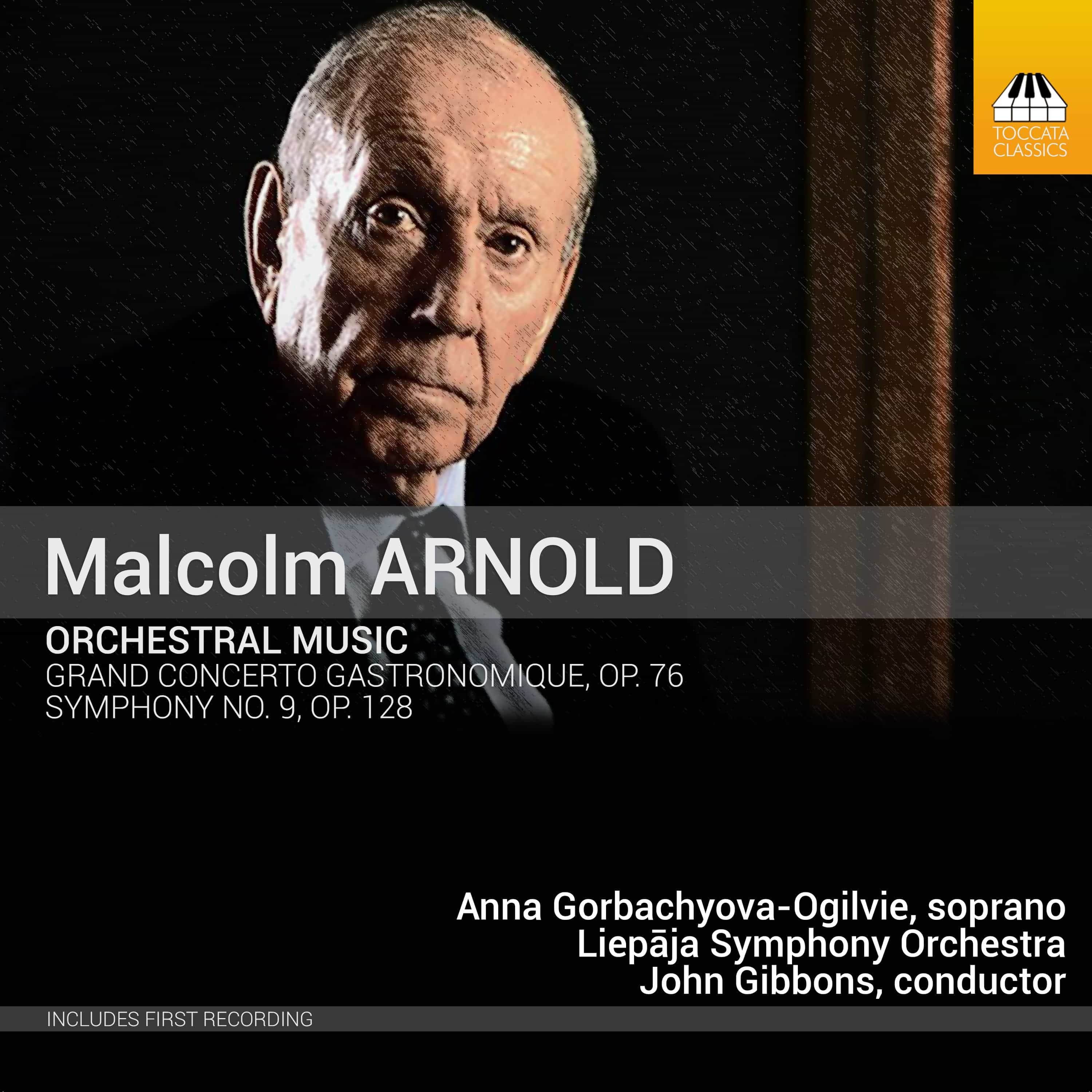
On record – Arnold: Symphony no.9 & Grand Concerto Gastronomique (Liepāja Symphony Orchestra / John Gibbons) (Toccata Classics)

toccata-arnold

Malcolm Arnold
Grand Concerto Gastronomique Op.76 (1961)
Symphony no.9 in D Op.128 (1986)

Anna Gorbachyova-Ogilvie (soprano, Concerto), Liepāja Symphony Orchestra / John Gibbons

Toccata Classics TOCC0613 [57’30”]

Producer Normands Slāva
Engineer Jānis Straume

Recorded 14-16 June 2021 at Great Concert Hall, Liepāja

Written by Richard Whitehouse

What’s the story?

Toccata Classics marks the centenary of Malcolm Arnold’s birth (falling on October 21st) in a pertinent coupling of his final symphonic statement with music finding this composer at his most irreverent and, by so doing, juxtaposes the two sides of his creativity to startling effect.

What’s the music like?

It was the compositional hiatus resulting from emotional breakdown then tortuous recovery as provided the catalyst for the Ninth Symphony, whose superficial simplicity belies the anguish beneath its surface. John Gibbons (who had earlier conducted this work in London, as part of a nine-year Arnold cycle, and Northampton) brings tangible expectancy to the opening Vivace, its arresting initial gestures soon revealing that textural starkness which goes on to define the whole work, with a circuitous evolution even more marked in the Allegretto – an intermezzo whose wistful theme effects less a series of variations than poignant searching for formal and expressive closure. The ensuing Giubiloso is more overtly a scherzo with its headlong motion or trenchant exchanges between wind and strings, yet even here a curious detachment prevails.

Arnold’s eight previous symphonies each concluded in a relatively short and decisive finale, but the Ninth’s final Lento proves anything but – its sustained slowness abetted by restrained dynamics and a sparseness of detail which could have made for unrelieved gloom were it not for those myriad ‘shades of grey’ the composer draws from his reduced palette. An additional factor is Gibbons’s pulse for this movement as a tactus (one-second) rather than crotchet beat, leading to a traversal several minutes less than earlier recordings by Andrew Penny (Naxos), Vernon Handley (BMG) or Rumon Gamba (Chandos) and, as a result, making the cadential chord one of benediction than resignation. Whether or not this approach convinces depends on how one views the symphony overall, but there can be no doubting its sincerity of intent.

Composed for the Astronautical Music Festival – the last of several events inspired by Gerard HoffnungGrand Concerto Gastronomique is Arnold at his most uproarious. Its designation ‘for Eater, Waiter Food and Large Orchestra’ betrays a visual aspect not essential for enjoying this 15-minute consumption of Brown Windsor soup, roast beef, cheese, Peach Melba – with a sensuous cameo by soprano Anna Gorbachyova-Ogilvie – then coffee with brandy; framed by a Prologue and Epilogue of due portentousness, but thankfully no ‘Mr Creosote’ in evidence.

Does it all work?

As a coupling, yes. As to content, the Ninth Symphony will likely always divide opinion as to whether it is what Arnold intended or merely the best that he was able to achieve after the traumas of the preceding decade, but no-one could accuse Gibbons of realizing it as other than a cohesive entity whose formal proportions are as precisely judged as its expressive trajectory is purposefully conveyed. Listeners not convinced by those earlier recordings should certainly hear this new account, lucidly and persuasively rendered by the Liepāja Symphony Orchestra.

Is it recommended?

Yes, enhanced by thought-provoking booklet notes from Timothy Bowers along with realistic sound. Should still-missing orchestral pieces by Arnold (notably the Op. 1 First Divertimento or the Op. 12 Symphonic Suite) come to light, Gibbons will hopefully be asked to record them.

Listen

Buy

You can discover more about this release at the Toccata Classics website, where you can also purchase the recording. You can read more about the Malcolm Arnold society at their website, while for more on each of the performers, click on the names Anna Gorbachyova-Ogilvie, Liepāja Symphony Orchestra and John Gibbons

Live review – Ealing Symphony Orchestra / John Gibbons: Stanford: Symphony no.6

ealing-symphony-orchestra

Ealing Symphony Orchestra / John Gibbons

St Barnabas Church, Pitshanger Lane, London

Broadcast Thursday 10 June 2021, available online

Stanford Symphony no.6 in E flat major Op.94 ‘In honour of the life-work of a great artist: George Frederick Watts (1905)

Written by Ben Hogwood

Next year will be the centenary of the independent Ealing Symphony Orchestra, one of the leading voluntary ensembles in London. In more recent years the group have built a reputation for deviating from ‘normal’ repertoire, and their return from a tortuous year-and-a-half of lockdown saw an immediate return to that approach.

It came in the form of a welcome reappraisal of the Sixth symphony of Charles Villiers Stanford. Stanford occupies a godfather-like position in British music, credited with the instruction of many leading composers (Vaughan Williams, Holst, Coleridge Taylor and Ireland to name but a few), but his music tends to be admired rather than deeply loved. Stanford acknowledges the influence of continental Romantic composers in his music, with hints of Mendelssohn, Brahms and Wagner to be found, but in the course of this symphony closer parallels emerge to the music of Elgar, whose own first symphony was still three years away.

Conductor John Gibbons gave a heartfelt introduction from the podium at St Barnabas Church, where the orchestra are based, and the online pictures illustrated a wide spacing between the instruments, with many players wearing masks. Through necessity the strings were further apart, the cellos particularly far back, with the brass on the conductor’s far left. None of these unconventional placings harmed the performance, however, and there was a very strong sense of joyful homecoming, the opening of a new chapter.

physical energy

A good deal of this was due to Stanford’s music. The sixth symphony celebrates sculptor and artist George Frederic Watts, and in the first movement takes inspiration by Watts’ Physical Energy sculpture, now in Hyde Park (above, picture by David Hawgood). Stanford begins with the most positive and exultant music, played with appropriate gusto here. There were occasional lapses in the strings’ turning early on, but it bears remembering that amateur players in particular have been devoid of ensemble practice for so long, and such moments are inevitable as part of the ‘reawakening’ process. In any case the music powered forward with increasing conviction, its prevailing mood of strength and resolve in keeping with the players’ emergence from lockdown. A particularly fulsome solo from the orchestra’s leader (uncredited) was in keeping with the sunny disposition all around.

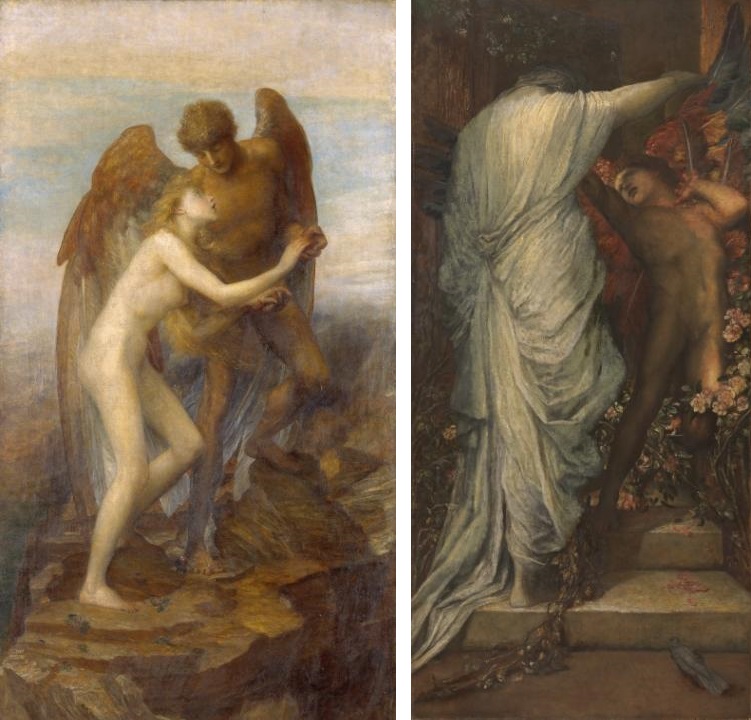
Love and Life c.1884-5 by George Frederic Watts 1817-1904

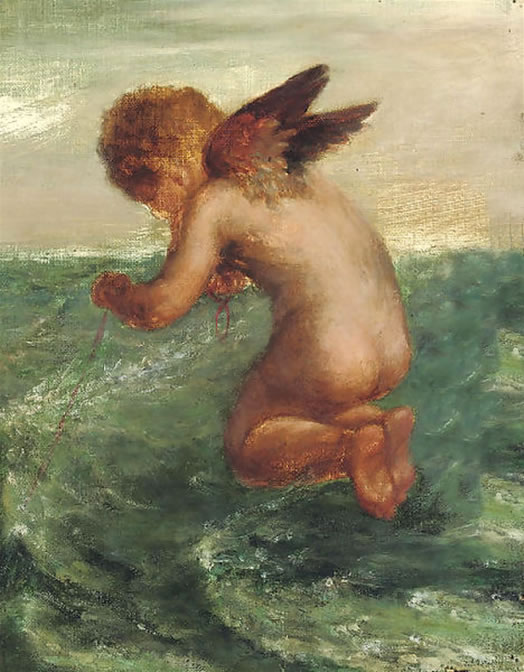
The heart of Stanford’s Sixth lies in the slow movement, where a soulful cor anglais solo sets the tone but long phrases were expertly paced towards the big climax. Based on Watts’ paintings Love and Life and Love and Death (both above), there was an appropriate romanticism near the surface throughout. The scherzo of light and shade was elusive, portraying the movement of water as depicted by Watts in Good Luck to your Fishing (below).

Good_Luck_to_your_Fishing_by_George_Frederick_Watts
This third movement would have benefited from a bit more rhythmic definition, but was still a n engaging account, especially as Gibbons plotted a smooth transition to the finale, where the drama heightened further. The venue proved its worth here, with just the right amount of reverb – and as all passion was spent towards the end the music slowed slightly, giving plenty of room for some excellent woodwind playing.

This was a fine and extremely enjoyable performance, passionate and concentrated – a persuasive advocate for Stanford’s music. His voice is all too seldom heard in this country, but performances like this ought to ensure greater coverage. It was the ideal choice for the Ealing Symphony Orchestra to reassert their identity after lockdown, and the enthusiasm and optimism throughout were uplifting. Watch it if you can.

For more information on the Ealing Symphony Orchestra’s return from lockdown on Saturday 10 July, and further events, visit the orchestra website