

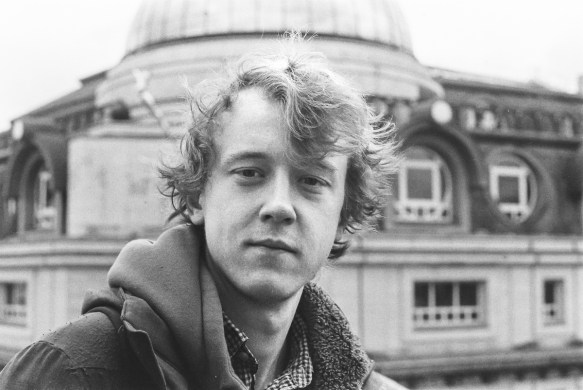
Charlotte Saluste-Bridoux (violin, above) and Joseph Havlat (piano, below)
Szymanowski 3 Myths Op.30 (1915)
Poulenc Violin Sonata (1943)
Szymanowski arr. Havlat 3 Kurpian Songs (from Op.58) (1930-32)
Schubert Rondo Brillant in B minor D895 (1826)
Wigmore Hall, London
Tuesday 10 April 2024 (1pm)
by Ben Hogwood
This recital was given under the umbrella of YCAT (Young Classical Artists Trust), the organisation supporting promising classical talent celebrating their 40th anniversary this year. Violinist Charlotte Saluste-Bridoux is one of the current roster, and with pianist Joseph Havlat she gave a captivating recital.
The two began with the highly perfumed 3 Myths of Karol Szymanowski, ideal concert material that can show off a performer’s virtuosity but also their descriptive potential and range of tonal colour. These pieces, written as part of a highly productive partnership Szymanowski enjoyed with violinist Pawel Kochanski, were declared by the composer to have created ‘a new…mode of expression for the violin’.
There was a sense of the new in this performance, notable for its wide range of instrumental colour. The first ‘myth’, La fontaine d’Aréthuse, was strongly characterised, the fountain vividly evoked by Havlat’s opening phrases before Saluste-Bridoux took control with fearless virtuosity. Both musicians were notable for their convincing melodic phrasing, the violin sound strikingly beautiful both with and without the mute. The musical links back to Wagner and Franck were clear, most notably in Narcisse, where the performers brought clarity to the dense counterpoint. This was descriptive music indeed, and Szymanowski’s sound world – unusually advanced for 1915 – took the audience far from the hall. The hollow piano towards the end of Dryades et Pan was notable, Havlat responding to the ghostly harmonics from the violin.
The excesses of Szymanowski were countered by one of Poulenc’s most substantial chamber works. The Violin Sonata has a very different profile to its more famous counterparts for wind instruments, being a troubled work bearing the imprint of the Second World War and personal bereavement. Completed in 1943, it is a work riddled with dark anxiety, though this performance brought out the bittersweet lyricism of the first movement. The nocturnal Intermezzo evoked the guitar, suggesting the influence of Debussy but soon holding the audience in suspense before the finale took off at quite a pace, as though looking to evade capture. Once again this was a performance of high technical standard, one that got beneath the surface to reveal the loss at the heart of Poulenc’s writing – the composer lamenting the Spanish poet Federico Garcia Lorca, who died in the Spanish Civil War.
We then heard three highly effective arrangements from Joseph Havlat of Szymanowski’s Kurpian Songs, selected from the twelve Polish folk texts set by the composer for singer and piano in 1932. As Prokofiev showed with his arrangements of 5 Poems of Anna Akhmatova for violin and piano, such a transcription can be extremely effective – and Havlat’s arrangements were just that, ideally balanced and equally spread between violin and piano. Saluste-Bridoux played with notable dexterity, the two performers enjoying the rustic Bzicem kunia and the sharp outbursts, tinged with regret, of A pod borem siwe kunie.
The musical outlook changed notably for Schubert’s Rondo brilliant, which was effectively an extended encore. The violin was arguably too full bodied to start with, the piano back in the mix, but as the Rondo progressed the balance was restored and we were able to enjoy Schubert’s humour, expressed through an oft-repeating, stop-start theme. This was successfully lodged in our heads by the end, capping an extremely fine recital. These are two artists to watch out for – especially with the Schubert recorded for Delphian Records.
Published post no.2,144 – Wednesday 10 April 2024

 Arcana.fm