On 16 January 2026, Johnston will give the world premiere of Joseph Phibbs’ Cello Concerto at the Barbican with the BBC Symphony Orchestra conducted by Clemens Schuldt. In 2021,Johnston previously premiered Joseph Phibbs’ Cello Sonata, partly based on an Elizabethan pavane found in the archive of Hatfield House.
Phibbs (below) says about the work:
“This concerto is in five movements, the first and last scored for cello and strings only. The work opens softly with a short Invocation – a type of prayer – which leads without a break to an ebullient and at times abrasive Aubade, the cello moving from its lowest to highest range. The subdued central Elegy hones in on the celebrated lyrical qualities of the cello, before an agitated Notturno presents an unsettled, ever-shifting dialogue between the cello and orchestra, with a virtuoso cadenza featuring towards its close. A short Vocalise, adapted from a sonata Guy commissioned several years ago, ends the work on a note of resolution.
As one of the very finest cellists of his generation, I wanted to bring out Guy’s extraordinary expressive qualities as well as his dazzling technical prowess. The result was music which is often lyrical and emotionally direct sitting alongside that which is harder-edged, and at times frenetically virtuosic.”
This concerto appearance is part of a wider cello odyssey to record the major British cello repertoire. Following the digital release of the Bliss Cello Concerto with the RLPO on Onyx Classics in July 2025, Guy recorded Tavener’s The Protecting Veil with Britten Sinfonia in St Sophia’s Greek Orthodox Cathedral in October 2025 to be released on Signum in 2026. Early 2027 will see a physical release of the Britten Cello Symphony coupled with the earlier recording of the Bliss Cello Concerto with the RLPO on Onyx Classics. Also to be released in 2027 are recordings of Walton’s Cello Concerto and Barber’s Cello Concerto with the Bournemouth Symphony Orchestra.
The 2025-2026 season coincides with Johnston’s returns to the Royal Academy of Music as a Professor of Cello. This role will see him offer bespoke tuition to cello students throughout the year. Johnston started out as a professor at the Academy in 2011, later becoming visiting professor. The appointment follows Johnston’s recent relocation back to the UK following his tenure at the Eastman School of Music in Rochester, NY, from 2018 to 2024.
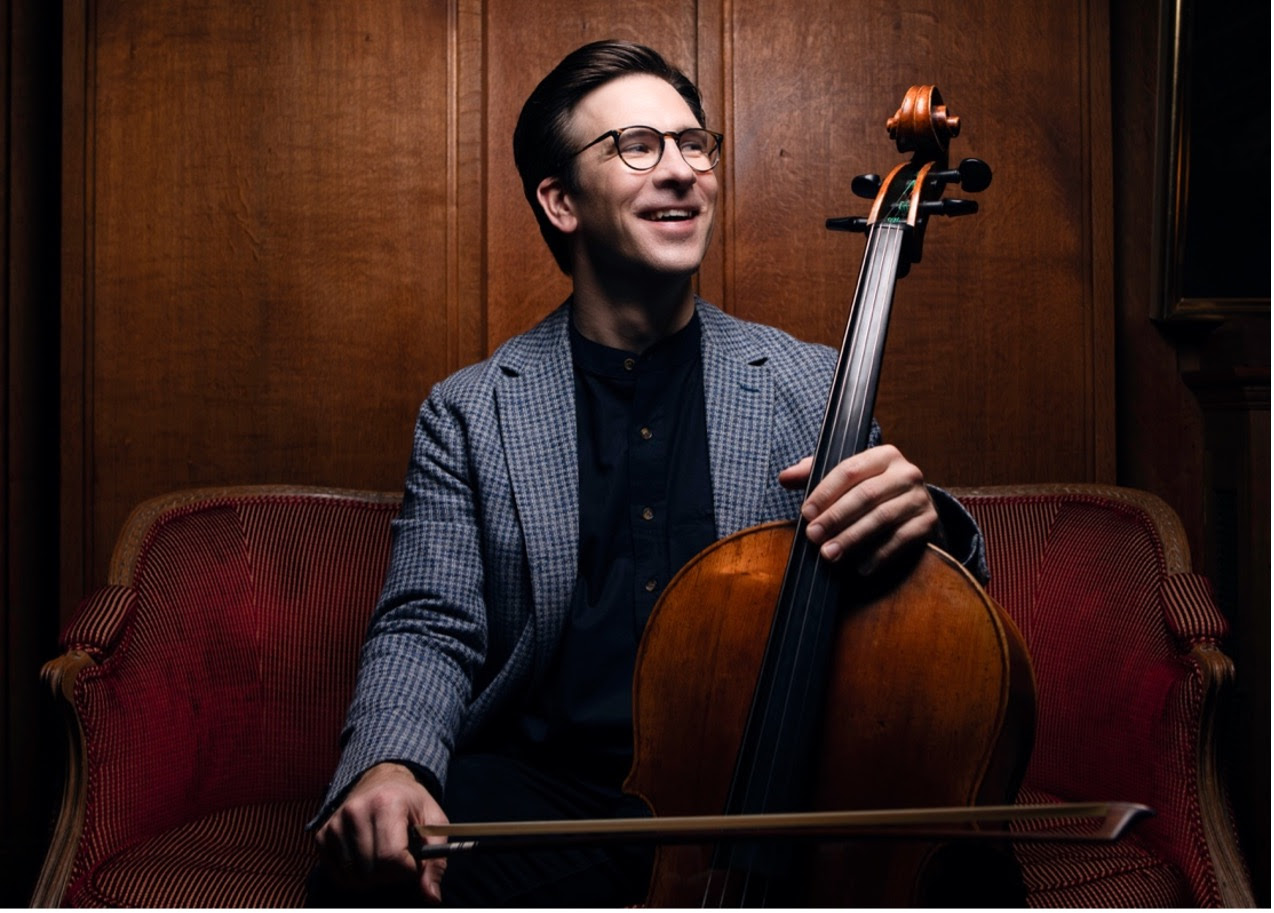
With his 1692 ‘Segelman, ex hart’ Stradivarius Cello, loaned to him from a private sponsor through the Beare’s International Violin Society, Guy Johnston embarks on a British cello odyssey, including the world premiere of a new cello concerto by Joseph Phibbs in January 2026.
To mark Bliss’ 50th anniversary, Johnston’s recording of Arthur Bliss’ Cello Concerto with the Royal Liverpool Philharmonic Orchestra conducted by Andrew Manze is released digitally on 25 July, 2025 on Onyx Classics. It will form a later album release with the Britten Cello Symphony.
Following a performance at the 2025 Hatfield Music Festival on 12 October 2025, Johnston will record The Protecting Veil with the Britten Sinfonia directed and led by Thomas Gould in live concerts on 28 and 29 October, 2025 at St. Sophia’s Greek Orthodox Church in London. The album will be released on Signum in the summer of 2026.
Completed in 1988, Tavener’s The Protecting Veil was begun in response to a request from cellist Steven Isserlis for a short piece. It developed into a more substantial work, and was subsequently commissioned by the BBC for the 1989 Proms season. Like many of Tavener’s compositions, this work reflects the composer’s Orthodox religious faith. The inspiration for the piece comes from the Orthodox feast of the Protecting Veil of the Mother of God, which commemorates the apparition of Mary the Theotokos in the early 10th century at the Blachernae Palace church in Constantinople in grave danger from a Saracen invasion.
As Tavener explained, “the cello representers the Mother of God and never stops singing throughout. One can think of the stings as a gigantic extension of her unending song…the first and last sections relate to her cosmic beauty and power over a shattered world.”
Johnston met Tavener on a number of occasions and was touched to be asked by Britten Sinfonia to perform The Protecting Veil last year on the occasion of what would have been the composer’s 80th anniversary. Johnston was keen to record The Protecting Veil at St Sophia’s, where Tavener used to attend mass.
On 16 January 2026, Johnston will give the world premiere of Joseph Phibbs’ Cello Concerto at the Barbican with the BBC Symphony Orchestra conducted by Clemens Schuldt. In 2021, Johnston previously premiered Joseph Phibbs’ Cello Sonata, partly based on an Elizabethan pavane found in the archive of Hatfield House.
Phibbs, who is a huge admirer of Britten, commented,
“The main focus of this concerto is on melody, and how this might be explored in various ways over the uniquely wide range of the cello. The work is symphonic in structure, adopting a multi-movement form as opposed to the traditional three, and ends with a short ‘Vocalise’ (song) for cello and strings which soars to the very top of the cello’s high register. Elsewhere, a dramatic opposition between soloist and orchestra is emphasized. At the forefront of my mind while composing this work has been the wonderfully varied facets of Guy’s playing, which I have admired for many years. It’s been a huge privilege and excitement to write for such a special performer”
In September 2026, Johnston will record Britten’s Cello Symphony with the RLPO conducted by Andrew Manze for Onyx Classics to coincide with the composer’s 50th anniversary (Britten d. on 4 December 1976). The album will include the Bliss Cello Concerto (previously released digitally).
The 2025-2026 season coincides with Johnston’s returns to the Royal Academy of Music as a Professor of Cello. This role will see him offer bespoke tuition to cello students throughout the year. Johnston started out as a professor at the Academy in 2011, later becoming visiting professor. The appointment follows Johnston’s recent relocation back to the UK following his tenure at the Eastman School of Music in Rochester, NY, from 2018 to 2024.
Johnston commented,
“I’m thrilled to have returned last year to the UK with my family for this exciting series of recordings, commissions and performances.”
Piatti Quartet [Michael Trainor and Emily Holland (violins), Miguel Sobrinha (viola), Jessie Ann Richardson (cello)]
RTF Classical / Nimbus Alliance NI 6452 [55’57”] Producer and Engineer Raphaël Mouterde
Recorded 14 December 2023 at All Saints’, East Finchley, London (String Quartet no.2), 25 April 2024 (String Quartet no.3), 20 June 2024 (String Quartet no.4), St Silas, Kentish Town, London
Reviewed by Richard Whitehouse
What’s the story?
Joseph Phibbs builds upon a growing discography with this release of his latter three string quartets, played by the Piatti Quartet that has already recorded his First Quartet, in what is a notable addition to the RTF Classical label administered by the Richard Thomas Foundation.
What’s the music like?
Having reached his half-century earlier this year, Phibbs can look back on a substantial output such as covers all the major genres. Two shorter works – Agea (2007) and Quartettino (2012) – precede his designated First Quartet (2014), a varied and assured five-movement sequence that was written for and premiered then recorded by the Piatti Quartet as part of its collection Albion Refracted (Champs Hill Records CHRCD145). The ensemble’s collaboration with this composer here continues with a volume that further consolidates his standing in the medium.
Written for and dedicated to the Navarra Quartet, the Second Quartet opens with what Phibbs designates a nocturne – albeit a Presto and with scurrying figuration that persists through to a brief passage of repose. It is countered with a scherzo both edgy and volatile, followed by an Interlude whose Chitarra designation indicates the pizzicato strumming that brings a climax of some velocity. Its subsiding into relative stasis presages a final Lento whose lyrical violin theme evolves toward a culmination which is the more conclusive through its sheer fervency.
Written for the Belcea Quartet and dedicated to the memory of composer Steven Stucky, the Third Quartet starts with a sizable movement whose inward introduction and coda frame an Allegro varied and unpredictable in its content but given focus by an eloquent theme prior to its eventual climax. Next is a fugal Presto – a coursing scherzo to complement the capricious intermezzo of a Corrente and, in between, a freely evolving Notturno whose pensiveness manner finds resolution through a finale of an introspection dispelled by its animated coda. Written for the Piatti Quartet and dedicated to the philanthropist Richard Thomas, the Fourth Quartet is again cast in five movements. Here, however, the trajectory seems overtly fluid as this heads from the impetuous Film Sequence, via an atmospheric Notturno then a gently elegiac Cantilena and an incisive Burlesque, to the final Passacaglia. Much the longest movement, this is centred on an extended soliloquy for cello which does not so much refer to earlier ideas as draw the ensemble into a cohesive texture sustained through to the rapt close.
Does it all work?
Pretty much always. Phibbs is a resourceful while often imaginative writer for string quartet, his music demonstrably in the lineage of 20th-century totems such as Bartók or Shostakovich (with a nod toward Britten), without being beholden to these or any other precedents. It helps when the Piatti Quartet, whose own discography features notable releases of Mark-Anthony Turnage (Delphian DCD34254) and Ina Boyle (Rubicon RCD1098), sounds so well attuned to his idiom and has evidently prepared each one of these works with unfailing commitment.
Is it recommended?
Very much so. Sound has the requisite clarity and definition if a little lacking in warmth, and Phibbs contributes informative notes. Readers should investigate further releases on the RTF Classical imprint, which is building into a valuable anthology of contemporary British music.
words from the press release, adapted for publication by Ben Hogwood
The Piatti Quartet releases a new album of Quartets Nos. 2-4 by British composer Joseph Phibbs, “one of the most successful composers of his generation” (BBC Music Magazine).
The Quartet and Phibbs have maintained a close relationship that stretches back several years. Since its joint second prize and Sydney Griller Award at the 2015 Wigmore Hall International String Quartet Competition, the Piatti Quartet has established a high reputation, particularly in the contemporary repertoire. They have recorded and performed Phibbs’ String Quartet no.1 almost 50 times.
Joseph (above) says:
“Having studied the cello as a child, I have always felt a special affinity with string music. My introduction at the age of 14 to the music of Britten was through his first string quartet, the opening of which still fills me with awe, and his works – especially those for strings – have remained a lifelong inspiration. After the first commission, the Piatti’s enthusiasm encouraged me to continue exploring the genre, and – a decade later – it has been both a privilege and a huge pleasure to have another opportunity to write for them (String Quartet No.4). Much of my music is inspired by light and landscapes (as well as cityscapes). When considering which images would best sum up the overall feel of the album, light – both natural and artificial – as seen within a landscape, seemed the most fitting choice.”
As a composer, Phibbs’ main influences are Lutoslawski, Britten and his former teacher Steven Stucky. Over recent years, he has been primarily exploring melody, forging his way using modal, diatonic and triadic harmonies.
Phibbs’s opera Juliana premiered in 2018 showed “a strong sense of continuity with the past – not least in the markedly post-Britten soundworld” (BBC Music Magazine). The Guardian added, “Juliana is that rare thing nowadays, a genuinely well-made, effective new opera that achieves exactly what it sets out to do.”
You can listen to excerpts from this album at the Presto website
Thomas Gould (violin/director), Miranda Dale (violin), Caroline Dearnley (cello), Britten Sinfonia / Agata Zając (Maconchy)
Corelli Concerto Grosso in F major Op.6/2 (publ. 1714) Tippett Fantasia Concertante on a theme of Corelli (1953) Maconchy Symphony for Double String Orchestra (1953) Phibbs Flame and Shadow (2023) Walton Finale from Variations on an Elizabethan Theme (1953)
Milton Court, London Wednesday 24 May 2023
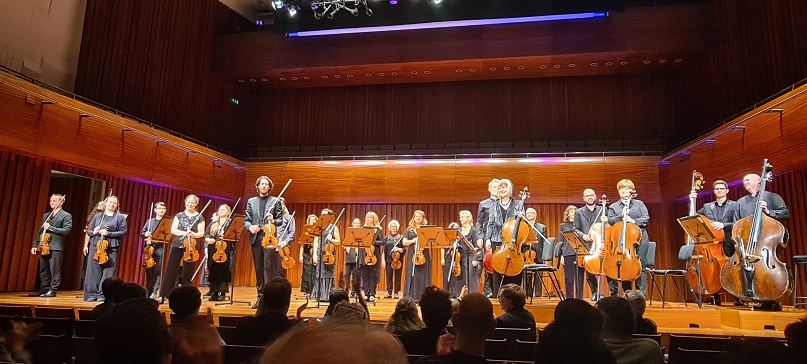
Reviewed by Ben Hogwood Pictures (c) Ben Hogwood
This typically imaginative concert devised by the Britten Sinfonia took as its starting point the events of 1953, where the United Kingdom shifted on its axis. It was of course the year in which Britain witnessed a Coronation, and in which Everest was scaled, but other than Walton’s jubilant finale to the collaborative composer project Variations on an Elizabethan Theme, no explicit musical links were made.
Instead, the Britten Sinfonia concentrated on two major works written for string orchestra in that year – one now well-known and one barely performed. The underdog, Elizabeth Maconchy’s Symphony for Double String Orchestra, made a very strong impression in this performance, brilliantly played by string players using a handwritten manuscript from 1953. The difficulty of this task necessitated a conductor, with Agata Zając joining at short notice. Hers was a dynamic presence, helping emphasise the rhythmic flair and dramatic impetus of the piece.
Maconchy’s music has often been critically coveted but is rarely heard in the concert hall – sadly an all-too familiar plight for a female composer innovating in the 20th century. Where many British composers wrote to include the countryside around them she wrote in a continental style, her music powered by fertile melodic imagination and rhythmic vitality. At times there are elements of Stravinsky and Bartók in her music but the closest parallel is Frank Bridge, with whom she shared an ability to explore the outer reaches of tonality without selling listeners short on melody.
The first movement of the Symphony grips the listener immediately, its powerful forward momentum complemented by soaring violin solos, which Thomas Gould played to perfection here. The febrile main motif bore close resemblance to Stravinsky’s Symphony in Three Movements, and Maconchy’s treatment of it was economical and engaging. Emotionally, however, the heart of the piece lay in the second movement Lento, where an eerie figure crept slowly upwards from cellos and basses, refusing to give way to the sweeter intimate melodies above. A rustic Scherzo, laden with syncopation, was followed by an equally captivating finale, initially pensive but with gathering intensity and drive. Just before the end the music broke out into a joyous country dance before returning to its more angular outlines.
The Britten Sinfonia were at the top of their game, subtly and superbly drilled by leader Gould. Each player was fully engaged, with smiles and nods of encouragement frequently passing between the team. When these qualities are natural, as they were here, a performance is elevated for the audience – and that was certainly the case for Corelli’s Concerto Grosso in F major, second in his set of twelve published as Op.6 in 1714. This opened the concert, dovetailing neatly into the work of Sir Michael Tippett, which it inspired.
Elegance and style were to the fore in the Corelli, with clean melodic lines given just a hint of vibrato for expression, and the interplay and balance between the three soloists and orchestra ideally judged. The work’s sunny countenance spilled over into the Tippett, though here the sun’s rays took on a more ecstatic quality.
The Fantasia Concertante on a theme of Corelli, also dating from 1953, is a compelling study in time travel. Tippett presents the original 18th century material unadorned, but adds his own unique musical language incrementally, so the piece becomes awash with bright colour and reaches a feverish intensity. Gould led a performance to savour, with fulsome support from fellow soloists Miranda Dale (violin) and Caroline Dearnley (cello). Together with the enhanced Sinfonia they rendered the golden textures beautifully, enhancing the elegance of the original material.
With the Tippett and Maconchy works a formidable pair either side of the interval, it says much for the London premiere of Joseph Phibbs’ new work that it was not in any way overshadowed. Though Flame and Shadow looked beyond events of 1953 for its stimulus it nonetheless bore a resemblance to the new coronation, its fresh take on music for strings revealing a busy contemporary approach.
Phibbs has an original and imaginative way with writing for strings, using audience-friendly melodic figurations but allowing them to roam harmonically, changing their perspective. The punchy rhythms of the Dance section here were a thrill, as were the combination of rapid fire and sustained open string pizzicato heard throughout the Interlude. Flame and Shadow, taking its title from a collection of verse by Sara Teasdale, was an edge of the seat piece, even to its closing Vocalise section, where a melody closely related to that found at the opening of Sibelius Symphony no.4 had a sobering effect. The contrasts of darkness and light were vivid and left a lasting impression – as indeed did the whole concert.
In twenty years of covering Britten Sinfonia concerts, and marvelling at their programming and technical prowess, this Milton Court evening confirmed their musical health to be stronger than ever. If only the same could be said for their long-term financial prospects, thrown into doubt by the withdrawal of funding in the latest Arts Council England cuts. Without the immediate publicity of similar actions levelled at English National Opera and the BBC Singers, the Britten Sinfonia have just launched their Play On fundraising campaign. The initial response has been encouraging, but it needs to raise more to secure the organisation’s future. Please do consider giving – I certainly will. This is the only way their imaginative concerts and a wealth of community-based outreach across East Anglia – where they are the only full time orchestra – can continue.



 Arcana.fm