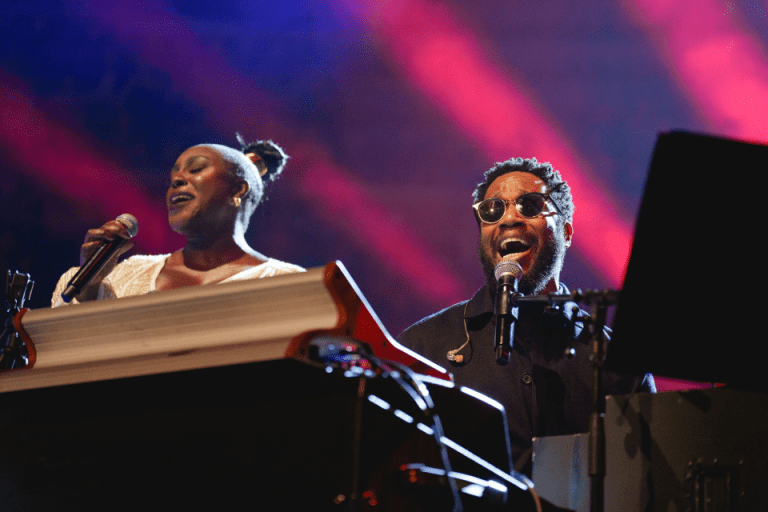
Arcana at the Proms – Prom 8: Nick Drake – An Orchestral Celebration

Olivia Chaney, Marika Hackman, BC Camplight, Scott Matthews, The Unthanks, BBC Symphony Orchestra / Jules Buckley

Royal Albert Hall, London
Wednesday 24 July 2024

reviewed by John Earls Pictures below (c) John Earls and (bottom) Chris Christodoulou

This November sees the 50th anniversary of the tragic death of the English singer-songwriter Nick Drake at the age of 26, having released just three albums of beautiful, bittersweet songs. Little known at the time, his reputation and influence has grown significantly.

This 2024 BBC Prom – an ‘orchestral celebration’ of his music – was destined to be something quite special and credit should go to British journalist and broadcaster John Wilson for proposing it.

Jules Buckley, here conducting the BBC Symphony Orchestra, has been involved in a number of BBC Proms over the years giving orchestral twists to contemporary music. Many of Drake’s songs were released at the time with string arrangements by Robert Kirby (it was good to hear Buckley pay tribute to Kirby who he referred to as “Nick Drake’s foil”) and these were developed, as well as some new ones added, by a number of other arrangers for this concert.

Following a gripping opening of the instrumental Introduction from Drake’s Bryter Layter album, BC Camplight gave excellent performances of Fly and Pink Moon which was deftly accompanied by strings and horns. Alas, his closing of the concert with Drake’s classic Saturday Sun didn’t quite cut it, being a bit too schmaltzy for this reviewer. However, the final all orchestral piece, an arrangement by Sam Gale of Horn, a sparse solo guitar piece from Pink Moon, was luminous and intense, culminating in a poignant solo trumpet.

Marika Hackman gave enchanting versions of Fruit Tree and River Man and her take on Time Has Told Me was a wonderfully smoky blues accompanied by drums, organ and guitar (Neill MacColl did some sterling work throughout the evening).

Scott Matthews opened his account with a wonderful Way to Blue with dramatic strings and timpani which, from where I was sitting, at times slightly overpowered his delicate voice, something rectified in the second half for his lovely performances of Northern Sky and From the Morning.
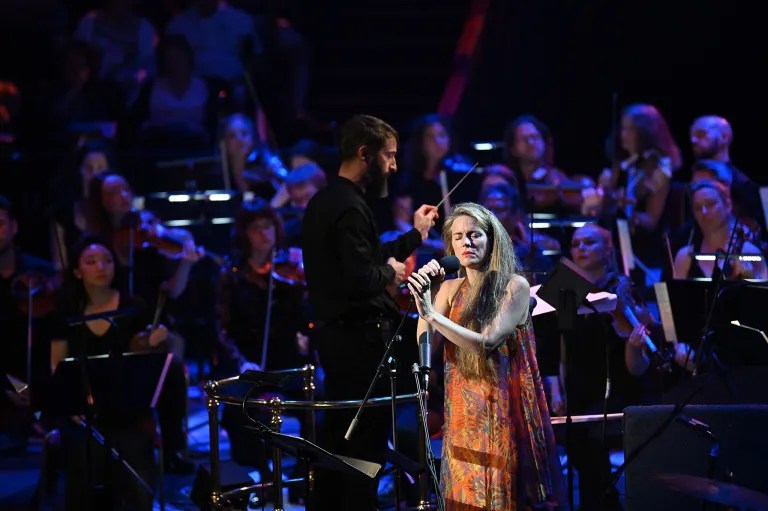
Olivia Chaney (above) gave a strong vocal performance of Hazey Jane I and a terrific version of At the Chime of a City Clock where the strings and horns were again particularly effective. Her solo piano rendition of Time of No Reply was outstanding.

Two of the most moving moments did not feature Nick Drake songs at all but those of his mother Molly. The Unthanks performed touching versions of What Can a Song Do to You? and Set Me Free and were joined by Drake’s sister Gabrielle reciting some of Molly’s poems in both cases. It was extremely affecting.

One can only imagine what Gabrielle Drake must have thought hearing the songs of her brother (and mother) performed in this way after so many years to a packed Royal Albert Hall that listened respectfully and lovingly. It was fitting testimony to the enduring quality of the music of an extraordinary songwriter.

This concert (including interval discussion with John Wilson, Radio 3 presenter Elizabeth Alker and Gabrielle Drake) is available on BBC Sounds until early October. For more on the 2024 BBC Proms, visit the festival’s website at the BBC, and click on the link to read John Earls’ review of Richard Morton Jack’s biography on Nick Drake: The Life. 

John Earls is Director of Research at Unite the Union and tweets / updates his ‘X’ account at @john_earls

Published post no.2,250 – Thursday 25 July 2024
Switched On: Boozoo Bajou – Finistère (Pilotton)

by Ben Hogwood

What’s the story?

This is the first long playing release from Boozoo Bajou for nearly ten years. The Nürnberg duo of Florian Seyberth and Peter Heider are up to their fifth album, and in that time they have seen little reason to change a musical philosophy that has seen them produce some high quality down tempo music over the last 20 years.

Finistère sees them migrate to a new label, their own Pilotton imprint, presumably giving them more autonomy over musical decisions. These include vocalists JULES and Steve Spacek, who contribute guest slots along with co-producers Fürsattl and MODALiST.

The vinyl edition contains exclusive album versions.

What’s the music like?

Boozoo Bajou have the knack of making their music sound completely effortless from the first note., and so it is with this album. “You don’t have to say anything, you don’t have to do anything”, says the voice on Pen Ar Bed – and so it proves. This is music borne of the outdoors, with slow, dusty beats that creep across the sonic perspective, with easy guitar-based material close up and various atmospherics far off.

The beats are typically slow and dub-infused, with heat-soaked panoramas opening up on tracks like Tough Times. This is one of two excellent vocals from JULES, who adds more of a vocalise to Tiefer, later on in the album. She is complemented by Steve Spacek, whose contribution to Sparks features a beautifully measured vocal that takes the groove unexpectedly near to Sade territory.

Of the instrumental tracks, the tick-tock of Orfeu marks the easy passing of time, Calcutta Glow ambles easily down the street and Viajantes, an exotic-sounding number, comes to the listener through a thick heat haze of atmospherics. All these and No Catch, a sultry number, could easily last for twice as long and not outstay their welcome.

Höhensonne is rather lovely in its extended mix, the glare of the sun beating down on the listener, the musical equivalent of the middle of a hot day.

Does it all work?

It does. Boozoo Bajou play to their strengths throughout, the collaborators are very well chosen and the music finds just the right balance between laziness and emotional involvement.

Is it recommended?

It is, without reservation – an album that proves every bit as good as the last four Boozoo Bajou albums. These guys know the meaning of the word ‘consistency’!

Listen

This album is due for release on Friday 3 November, when a Spotify link will appear here.

Buy

You can explore purchase options for Finistère from the Boozoo Bajou website

Published post no.1,994 – Monday 30 October 2023

BBC Proms 2023 – Jon Hopkins with the BBC Symphony Orchestra and Jules Buckley

Prom 58

Hopkins
ATHOS (arr. Jules Buckley) (BBC Commission, world premiere)
Feel First Life (arr. Peter Riley & Leo Abrahams)
The Wider Sun (arr. Sam Gale)
Singularity (arr. Simon Dobson)
Music for Psychedelic Therapy – excerpt (arr. Peter Riley)
Form by Firelight (arr. Peter Riley)
Luna Moth (arr. Sam Gale)
Collider (arr. Simon Dobson)
Abandon Window (arr. Tom Trapp)
Recovery

Jon Hopkins (piano, programming), Leo Abrahams (guitar), BBC Singers, BBC Symphony Chorus (chorus master David Young), BBC Symphony Orchestra / Jules Buckley

Royal Albert Hall, London
Tuesday 29 August 2023

by Ben Hogwood photos by Mark Allan / BBC

Electronic and orchestral music are more closely related than you might think, with Jon Hopkins a classic case in point. For 15 years, the pianist and producer has been carefully sculpting his music either as a contributor for other artists (King Creosote, Coldplay and Brian Eno to name just three) or making his own, weather-beaten albums. Starting with Opalescent and Insides, these have developed into immersive meditations (Singularity and the most recent long player Music for Psychedelic Therapy) by way of more full-bodied rave music (2013’s Immunity). How, then, does this music hold up in a packed and expectant Royal Albert Hall?

Extremely well as it turns out. In order to achieve what he described beforehand as ‘a meditation for 5,000 people’, Hopkins has to temporarily turn his back on beat-driven, post-rave landmarks such as Collider or Form By Firelight. When such material appears, its percussive impact is modified so that the main job is done by the timeless, meditative chorale echoing around the hall.

Hopkins’ music is repetitive, but as with the best exponents of minimalism – Steve Reich, Philip Glass and John Adams, for instance – the material under repetition rewards the investment made. The mind is eased, enjoying the upfront melodies but also taking up the option of picking out new threads beneath the surface, like examining a tartan pattern under a magnifying glass.

The tartan analogy is purposeful, for Hopkins’ earlier music has a distinctive Celtic edge furthered by his work with King Creosote. The Wider Sun, from 2009 album Insides, has an authentic left of centre tuning, is slow but packs emotional heft, beautifully arranged by Sam Gale and masterfully weighted by Jules Buckley and the BBC Symphony Orchestra strings.

Before that we hear a new piece, the 25-minute ATHOS demonstrating Hopkins’ control of larger structures. This is a natural direction for his music to be taking after Music for Psychedelic Therapy, for it is effectively an album ‘A’ side of several interwoven tracks. The profile and material of ATHOS sits closely to composers such as Arvo Pärt, and in particular his Credo, but Hopkins has up his sleeve a number of heart-shifting modulations. Accentuated by the Royal Albert Hall organ, these are once heard, never forgotten moments.

So, too, are the choral passages, thanks to pinpoint interpretations from the BBC Singers and BBC Symphony Chorus, whose lines float effortlessly above the orchestral forces. Their vocal control is masterful and effortless, ensuring the sustained notes keep their emotional impact without wavering. Lesser singers would have tailed off long before these ones even think of blinking!

The sequence of music, running for approximately 75 minutes, is well chosen. Only on occasion does the source material become oversimplified, and as it turns out these moments serve as natural pauses for breath in the musical tapestry.

Guitarist Leo Abrahams, appearing for the last two numbers, makes a critical contribution (above). A good friend and established collaborator with Hopkins and Eno, he brings a sharper timbre to the shredded distortion of Recovery, which is – as throughout – complemented by imaginative and sympathetic lighting.

This was a multisensory Prom, containing a different sort of symphony to which the Royal Albert Hall is normally accustomed. Hopkins has proved his credentials in mastering larger structures, and his development in this field will be worth watching for sure. For now, the afterglow remains.

For more on the 2023 BBC Proms, visit the festival’s website at the BBC. For more on the artists, click here to read about Jon Hopkins, Leo Abrahams, Jules Buckley and the BBC Symphony Orchestra

BBC Proms 2023 – Stevie Wonder’s ‘Innervisions’ with Jules Buckley and guests

Prom 48 – Stevie Wonder‘s Innervisions (1973)

Too High (arr. Rob Taggart)
Visions (arr. Callum Au)
Living for the City (arr. Jochen Neuffer)
Golden Lady (arr. Neuffer )
All in Love is Fair (arr. Tommy Laurence)
Superwoman (Where Were You When I Needed You) (Music of my Mind, arr. Neuffer)
They Won’t Go When I Go (arr. Tim Davies)a
Jesus Children of America (arr. Davies)
He’s Misstra Know-It-Allb
Creepin’ (Fulfillingness’ First Finale, arr. Taggart)c
Something Out of Blue (Where I’m Coming From, arr. Davies)c
Higher Ground (arr. Neuffer)
Never Dreamed You’d Leave in Summer (Where I’m Coming From, arr. Davies)d
Don’t You Worry ’bout a Thing (arr. Tom Richards)d
Superstition (Talking Book)
If It’s Magic (Songs in the Key of Life)

Cory Henry (vocals / keyboards), aLaura Mvula, bLianne Le Havas, cVula Malinga, dSheléa (vocals), Vula’s Chorale, Jules Buckley Orchestra / Jules Buckley

Royal Albert Hall, London
Monday 21 August 2023

by Richard Whitehouse photos by Andy Paradise / BBC

From Nina Simone then Aretha Franklin to Stevie Wonder – these ‘tributes’ masterminded by Jules Buckley have become as much a Proms staple as were John Wilson’s stage-and-screen projects, with the 50th anniversary of Innervisions too notable an occasion to be passed over.

Now routinely hailed as one of the greatest albums, Innervisions was not always held in such esteem – being considered strong in atmosphere if short on hooks, which is rather to miss the point of its nine numbers merging into a seamless continuity broken only with the side-break of the LP. It duly elides between songs of love, self-awareness and social commentary with a mastery abetted by Wonder’s ingenuity as a musician and his skill as a producer; indeed, few albums, from what was to be the heyday for production, can rival its tangible space or depth.

Wonder’s distinctive if by no means inimitable voice makes his songs ideal for covering and, in Cory Henry, have a consummate keyboardist and eloquent singer able to encompass their conceptual and emotional range. Hence the dextrous organ intro’ then big-band stylings that underpinned the breezy ambivalence of Too High, or soulful communing of Visions with its textural enhancements from flute and electric guitar. It may have lacked the original’s urban ambience, but Living for the City emerged as an anthemic parable of racial injustice; then the amorous overtones of Golden Lady were enhanced by its shimmering slow shuffle.

An edgy vocal complemented the insistent groove of Higher Ground with its electronic and synthesized sounds which are no less intriguing today, while the Christian confessional that is Jesus Christ of America exuded piety but no undue emoting. The moodily reflective aura of All in Love is Fair benefitted from that deft backdrop of strings, as did the Latino-inflected jive of Don’t You Worry ’bout a Thing as here made for an irresistibly upbeat ending to the album itself. Typical of Wonder, though, that he should have concluded the original’s playing order with the snide political diatribe of He’s Misstra Know-It-All and which can still punch like a velveted fist when rendered, as here, with the allure of guest vocalist Lianne La Havas.

This begs the question as to whether such a classic album is best heard as an integral unity or interspersed, as was its second side, with other items – which latter course enabled a capacity house to sample each of those albums from Wonder’s ‘golden age’. Thus, the composite that is Superwoman (Where Were You When I Needed You), its interplay of easy grooves with fatalistic thoughts ably rendered by Henry, but the pensively resigned They Won’t Go When I Go felt coarsened and sentimentalized by histrionics from guest vocalist Laura Mvula. Not so the darkly insinuating Creepin’ with superb lead from backing vocalist Vula Malinga, who duetted with Henry on the burnished Something out of the Blue. A star of last year’s Aretha tribute, Sheléa handled the soaring pathos of Never Dreamed You’d Leave in Summer with aplomb, then all reassembled for a rousing send-off in the inevitable guise of Superstition.

It could have ended there, but Henry returned for a rendition of If It’s Magic in its original (and superior) version – confirmation that Stevie’s output will long remain a thing of Wonder.

For more on the 2023 BBC Proms, visit the festival’s website at the BBC. Click on the names for more information on Cory Henry, Laura Mvula, Lianne La Havas, Vula Malinga, Sheléa, Vula’s Chorale, Jules Buckley and Stevie Wonder himself

New music – Public Service Broadcasting

Here is a bookmark for your diary – the next release from celebrated ‘archive band’ Public Service Broadcasting will be an official vehicle for their centenary tribute to the BBC, first heard at the 2022 BBC Proms.

This New Noise will be released on 8 September, a celebration of the power of radio led by the band but with a key role for the corporation’s flagship ensemble, the BBC Symphony Orchestra. They appear under the guise of arranger and conductor Jules Buckley, their Creative Artist in Association. He has an impeccable record for bringing orchestras into contact with other genres in a totally natural way, as seen in the Pete Tong Ibiza Proms and a number of excellent soul collaborations.

Here is a taster for the release, the elegant and rather moving Broadcasting House: