On Record – April Fredrick, Thomas Humphreys, ESO Chorus, English Symphony Orchestra / Kenneth Woods: Sawyers – Mayflower on the Sea of Time (Nimbus)

April Fredrick (soprano), Thomas Humphreys (baritone), ESO Chorus, English Symphony Orchestra / Kenneth Woods

Sawyers Mayflower on the Sea of Time (2018)

Nimbus NI6439 [58’57’’]
Producer and Engineer Tim Burton Engineer Matthew Swan
Live recording, 17 June 2023 at Worcester Cathedral

Reviewed by Richard Whitehouse

What’s the story?

Philip SawyersMayflower on the Sea of Time was to have been launched with performances in Worcester Cathedral four years ago, but the pandemic inevitably derailed this. Happily, the composer’s largest work so far was finally heard last June in the venue as originally intended.

What’s the music like?

Commissioned to mark the 400th anniversary of the sailing of the Mayflower from Leiden to Plymouth, this is an oratorio in concept but equally a choral symphony in design. Its libretto, mainly by the artist Philip Groom, features set-pieces for various Old and New World figures largely for soprano and baritone alongside summative passages for chorus. Self-deprecating about his literary abilities, Groom yet achieves a viable balance between the characterization of individuals as part of a continuous and cumulative trajectory relating that of ‘the journey’.

There are four continuous parts: Persecution and Journey, a sonata design which informs the Pilgrims’ flight from religious persecution and their decision to cross the Atlantic; Arrival in the New World, a slow movement charting their arrival then tentative initial interaction with native cultures; Survival and Making our Community, a brief scherzo in which the Pilgrims’ industriousness and idealism all too soon becomes its own justification; and Our New World, a sizable rondo-finale whose looking to the future is framed by choruses of growing fervour.

Sawyers’ writing for the chorus is expert and resourceful, not least when this elides between a depiction of Pilgrims or Natives with that of a more abstract commentary, while solo sections allow his lyrical impulse free reign – not least towards the end of the second and fourth parts, closing with luminously ecstatic choruses that accentuate an essentially affirmative message. Worth noting is the poignant incorporation of a motet by Thomas Tomkins into its fourth part, which also sets lines by Walt Whitman with a tangible understanding of its expressive syntax.

Does it all work?

Almost always, and not least owing to the persuasiveness of this performance. April Frederick and Thomas Humphreys (the latter after a slightly strained start) can hardly be faulted in their commitment or insight, while the new-founded ESO Chorus evinces a power and immediacy abetted by Worcester Cathedral’s spacious acoustic to belie its modest forces. The ESO gives its collective all throughout, conveying the textural intricacy and the emotional heft of music whose overall formal integration is fully conveyed through Kenneth Woods’ astute direction.

The initial performances might have fallen through, but the associated educational project did go ahead and enabled several hundred youngsters to experience the piece at first hand. This is worth remembering given Mayflower should have a ready appeal for those who know little of the historical background or, indeed, contemporary music. That it can be rendered by around two-dozen singers ought to commend it to enterprising choral societies able to muster the 45 musicians, especially when Sawyers’ writing for both is often exacting but always practicable.

Is it recommended?

Very much so. The sound captures the resonance of its acoustic with no loss of definition, and there are detailed notes by composer, author and conductor. A pity the actual text could not be included, but that this can be scanned via a QR code is another incentive for younger listeners.

Listen & Buy

You can listen to sample tracks and purchase on the Wyastone website. For further information on the artists, click on the names for more on April Fredrick, Thomas Humphreys, the English Symphony Orchestra and their conductor Kenneth Woods. Click on the name for more on composer Philip Sawyers

Published post no.2,157 – Tuesday 23 April 2024

Elgar Festival Fundraiser – ‘Keep the Music Playing’

The Elgar Festival (27 May – 2 June) is working with a 40% funding cut
from Arts Council England

In this short film, Festival Patron Julian Lloyd Webber introduces the Fundraising Campaign
:

The Festival is raising money to help deliver its 2024 iteration, due to a 40% funding cut from Arts Council England

Donations are valuable in helping to continue the legacy of one of England’s most revered composers. As the festival’s organisers say, “We believe Elgar is for everyone and our developing range of events are for people of all ages, interests, and lifestyles.”

For full information, visit The Elgar Festival website

Published post no.2,151 – Wednesday 17 April 2024

In concert – Simon Desbruslais, English Symphony Orchestra / Kenneth Woods: Sibelius, Sawyers, Dvořák, Fribbins & Elgar

Simon Desbruslais (trumpet), English Symphony Orchestra / Kenneth Woods

Sibelius Rakastava Op.14 (1893, arr. 1912)
Sawyers Concerto for Trumpet, Strings and Timpani (2015)
Dvořák Notturno in B major Op.40 (1870, arr. 1883)
Fribbins Soliloquies (2012, arr. 2017)
Elgar Introduction and Allegro for strings Op.47 (1905)

Hall One, Kings Place, London
Sunday 15 April 2024

Reviewed by Richard Whitehouse

Concerts by the English Symphony Orchestra in the London Chamber Music Society’s season are always a worthwhile fixture and this early-evening event, in its mixing established classics with contemporary pieces, demonstrated the stylistic range and sympathies of this ensemble.

A pity that Sibelius’s Rakastava has never been taken up by many British conductors – John Barbirolli and Sir Colin Davis excepted – as this extensive reworking for strings and timpani of an early choral work should be a staple of its repertoire. Kenneth Woods duly brought out the wistful poise of The Lover, and if the stealthiness which underpins The Way of the Lover seemed just a little tentative, the bittersweet pathos that permeates Good evening, Farewell then came through unabated in what is as moving a leave-taking as its composer ever penned.

The music of Philip Sawyers has been a constant feature of the ESO’s programming this past decade, and his Trumpet Concerto more than deserved revival. The outward Classicism of its formal trajectory should not belie the deftness by which Sawyers modifies the sonata design of its opening Allegro, the impetus and reflectiveness of its main themes finding accord prior to a trenchant cadenza with timpani at the fore, or a central Andante that exuded an emotional breadth and fervour in advance of the excellent recording by these artists. Among the leading trumpeters of his generation, Simon Desbruslais – placed high to the rear of the auditorium, to potent effect – was wholly unfazed by its demands; nor those of a final Allegro in which more reflective elements leaven the initial energy, only to be outdone in the virtuosic closing bars.

Next, a welcome hearing for the Notturno that Dvořák salvaged from an early (and reckless) quartet. Its relative swiftness here recalled its intermediate reworking as an intermezzo in the second of his string quintets, so emphasizing its appealing lilt over any more ethereal quality.

Desbrulais (above) returned after a brief hiatus for Soliloquies by Peter Fribbins. A composer as adept on a symphonic as on a miniature scale, these brief if affecting pieces draw on three earlier songs – the recasting of whose vocal line encourages the soloist to an eloquence that, after the relative restraint of the initial Adagio and central Tranquillo, comes to the fore in a final Adagio where evocation takes on an almost cinematic aura. With impressive concertos for piano and violin to his credit, Fribbins ought to consider a full-length work for trumpet.

Elgar’s Introduction and Allegro has not unexpectedly been key to the ESO’s repertoire since its founding some 45 years ago, and this performance did not disappoint. Most admirable was the variety and depth of string tone that Woods (a one-time professional cellist) secured from only 19 players, so ensuring a vitality and impact in the more animated sections together with the requisite delicacy in those passages where the composer’s ruminative mood is uppermost. Both aspects were brought into thrilling accord at the close of the powerfully projected coda.

Beforehand, Woods spoke of the changing nature of commissions and the current difficulties in securing the necessary funding. This season has not been easy for the ESO though, on the basis of this programme, these players are commendably taking it all in their collective stride.

Click on the link to read more on English Symphony Orchestra, and on the names for more on their conductor Kenneth Woods, and trumpeter Simon Desbruslais. Click on the names for more on the new composers featured, Philip Sawyers and Peter Fribbins

Published post no.2,150 – Tuesday 16 April 2024

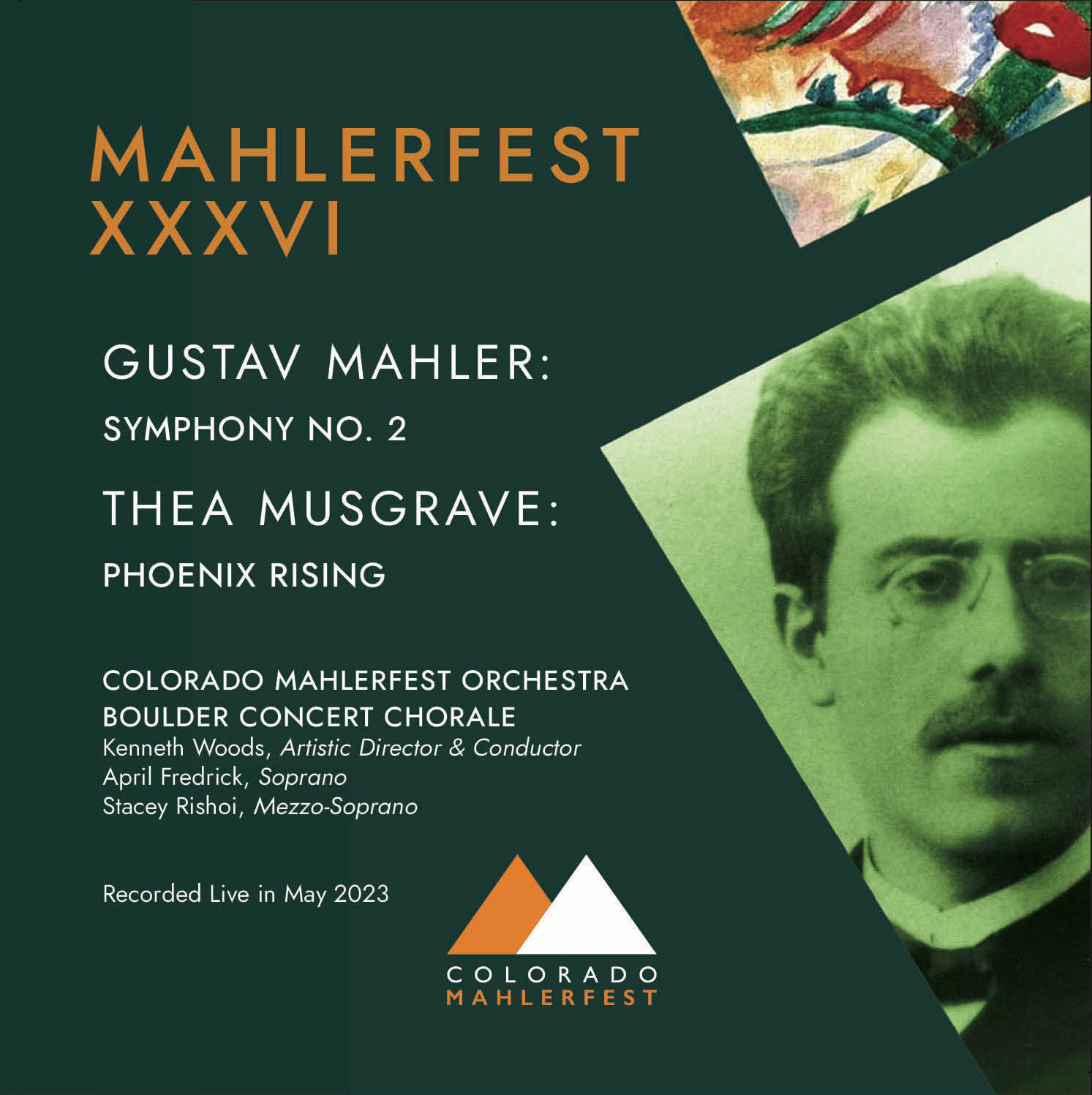
Online Concert – April Fredrick, Stacey Rishoi, Brennen Guillory, Gustav Andreasson, Colorado MahlerFest Orchestra / Kenneth Woods: Mahler’s Liederabend

Mahler’s Liederabend: A Recreation of Mahler’s Concert in Vienna on 29th January 1905

Mahler
Des Knaben Wunderhorn – selection (1892-1901)
Kindertotenlieder (1901-4)
Vier Rückert-Lieder (1901)

April Fredrick (soprano), Stacey Rishoi (mezzo-soprano), Brennen Guillory (tenor), Gustav Andreasson (bass), Colorado MahlerFest Orchestra / Kenneth Woods

Macky Auditorium, 1595 Pleasant Street, Boulder CO (Links to concert sections embedded below)
Saturday 20th May 2023

by Richard Whitehouse

In an event as inclusive as Colorado’s MahlerFest, it was happily inevitable the Liederaband Mahler gave in Vienna on 29th January 1905 be recreated and, while the decision to distribute these songs between four singers was not strictly ‘authentic’, it yet emphasized their variety of thought and expression more readily than had one vocalist been present throughout. What remained consistent was the creative zeal of Mahler at a crucial juncture in his composing, as he left behind the fantastic realm of his earlier music for greater realism and even abstraction.

The first half was of seven songs from Des Knaben Wunderhorn, which collection dominated Mahler’s thinking the previous quarter-century. Two of them are ostensibly dialogues, but the absence of a second singer mattered little when April Fredrick rendered that interaction of the yearning woman with her condemned lover in Lied des Verfolgten im Turm so graphically; as too the more wistful imaginings of separated lovers in Der Schildwache Nachtlied. She also underlined the glancing irony of Des Antonius von Padua Fischpredigt and the playful whimsy of Rheinlegendchen with understated assurance. Brennen Guillory pointed up the deadpan humour of Trost im Unglück and if Der Tamboursg’sell felt a little too earnest, the stridency that increasingly borders on aggression of Revelge was bracingly delivered.

Here, as elsewhere, adherence to Mahler’s scoring, with its emphasis on woodwind and brass, brought out its evocative quality which outweighed any passing thinness of tone in the strings. This was even less of an issue during the sparser textures of Kindertotenlieder, whose songs find universal truths in Friedrich Rückert’s intimate ruminations. Gustav Andreasson seemed a little raw of timbre in Nun will die Sonn’ so hell aufgeh’n, though the yearning fatalism of Nun seh’ ich wohl, warun so dunkel Flammen was tangibly conveyed, as too was the aching poignancy of Wenn dein Mütterlein. The bittersweet elegance of Oft denk’ ich, sie sind nur ausgegangen felt slightly undersold, but not those contrasts of In diesem Wetter as this final heads from fraught anguish toward a repose from which all dread has been wholly eradicated.

Kenneth Woods directed the Colorado MahlerFest Orchestra with that unforced rightness evident from his earlier Mahler performances. Never more so than the four Rückert-Lieder which ended this programme – albeit in a discreet but effective reordering from that of 118 years before. Thus, the capricious whimsy of Blicke mir nicht in die Lieder! preceded the deft enchantment of Ich atmet einen Linden duft; Stacey Rishoi proving as responsive to these as to Um Mitternacht, with its crepuscular winds and majestic climax with swirling arpeggios on harp and piano. Fittingly, the sequence closed with Ich bin der Welt abhanden gekommen – the finest of Mahler’s orchestral songs in its rapt serenity, Rishoi’s conveying of Rückert’s otherworldly sentiments more than abetted by Lisa Read’s eloquent cor anglais. If recreating the Liederabend meant no place for Liebst du um Schönheit (now available in a far more idiomatic orchestration by David Matthews), which might have made a pertinent encore), its absence did not lessen the attractions of this enterprising and successful concert.

Click on the name for more information on Colorado MahlerFest 2024, and on the artist names for more on Kenneth Woods, April Fredrick, Stacey Rishoi, Brennen Guillory and Gustav Andreasson

In concert – Musicians of the English Symphony Orchestra / Kenneth Woods: Blown Away – Doolittle, Gál & Dvořák

Musicians of the English Symphony Orchestra / Kenneth Woods

Doolittle Woodwings (2018, arr. 2021)
Gál Divertimento for Wind Octet, Op. 22 (1924)
Dvořák Serenade in D minor, B77 (1878)

Henry Sandon Hall @ Royal Porcelain Works, Worcester
Saturday 14 October 2023 (4pm)

Reviewed by Richard Whitehouse

Entitled Music for Humans, the coming season from the English Symphony Orchestra promises a wide array of pieces such as focus on what can be achieved through the art of communication and, conversely, what can result when that communication breaks down. This afternoon’s concert enabled the ESO woodwind (along with some of its brass and a couple of its strings) to come into its own with a varied programme as featured music from a regular ESO collaborator, one whom the orchestra has often championed and one who ranks among the greatest of any era.

It may have originated as a wind quintet, but Woodwings by Emily Doolittle (from Halifax, Nova Scotia and now based in Glasgow) proved no less effective when recast for 10-strong wind ensemble (with cello and double-bass) – songs and calls of nine Canadian birds heard over five characterful movements. These range from the playfully assertive Bobolink, via the inwardly plaintive Hermit Thrush and the quizzically engaging Winter Wren, to the cumulatively arresting Snow Goose then a Night Owls finale whose freeform evolution makes for an intriguing and enticing pay-off. First played by the ESO in Kidderminster just over two years ago, it once again provided an appealing concert-opener and certainly bodes well for the 2024-25 season, when Doolittle becomes the ESO’s Composer-in-Association.

The success of his Divertimento was a notable marker for the burgeoning career which Hans Gál enjoyed during the earlier inter-war period, and it remains among the most personable of his chamber works. ‘Intrata’ affords a keen indication of what is to come with its juxtaposing of the martial, hilarious and confiding, proceeded by the capricious exchanges of Pagliazza (inspired by the eponymous tower in Florence?) then the wistful interplay of Cavatina with Gál’s handling of wind sonority at its most beguiling. The mood turns towards the whimsical in the by no means genteel humour of Intermezzo grazioso, before the piece is rounded off with those varied character-portrayals of Pifferari – its title alluding to a group of itinerant musicians playing upon a variety of pipes, and thereby bringing matters to a diverting close.

Although less often performed than its earlier counterpart for strings, Dvořák’s Serenade for Winds (plus cello and double-bass) is arguably more indicative of where his genius lay. The martial theme of its opening Moderato is leavened by a ruminative poise that comes into its own with the minuet-like successor, its felicitous contours duly finding contrast through the animated gaiety of its Presto trio-section. The ensuing Andante is undoubtedly this work’s emotional heart – its eloquence redolent of Mozart in its understatement but also intimation of more ambivalent emotion in the ominous central stage or bittersweet fatalism at its close. From here the final Allegro steers an impulsive but also lilting course through to a climactic restatement of the march theme, then on to a coda that ends the work in exhilarating fashion.

In this judiciously balanced selection, ESO woodwind was heard at its most stylish in music whose appeal belies its technical challenges for individuals and ensemble alike. Next month the orchestra heads to Malvern for an imposing double-bill of Tchaikovsky and Shostakovich.

To discover more of the English Symphony Orchestra’s 2023/24 season, head to the English Symphony Orchestra website. Meanwhile click on the names for more on conductor Kenneth Woods, composers Emily Doolittle and Hans Gál, and the Royal Porcelain Works venue

Published post no.1,980 – Monday 16 October 2023