Online concert – English String Orchestra / Kenneth Woods: Elgar Festival 2022 – In The South

Elgar In The South (Alassio) Op.50 (1903-4)

English Symphony Orchestra / Kenneth Woods

Filmed at Worcester Cathedral, Saturday 4 June 2022

by Richard Whitehouse

The English Symphony Orchestra’s concerts at last year’s Royal Jubilee Elgar Festival have already yielded several online performances of note, with In the South perhaps the finest yet in terms of vindicating a work that can all too easily fall victim to its seeming ‘indulgencies’.

The main issue is in setting a tempo flexible enough to accommodate this concert overture’s extended sonata design without it becoming episodic. At around 24 minutes, this unhurried take was mindful of Worcester Cathedral’s expansive acoustic and utilized it to the music’s advantage. The surging initial theme, its speculative transition and suave second theme duly emerged with a formal continuity – the underlying tension carried through to a development whose impulsiveness was maintained despite (even because of?) the intervening first episode.

Evoking the grandeur of ‘empires past’, this episode necessitates astute handling so that its implacability avoids bathos. Kenneth Woods judged it accordingly, and if his tempo for the second ‘canto populare’ episode felt just a little reticent, its expressive raptness (along with Carl Hill’s playing of its indelible viola melody) more than compensated. Nor was there any loss of continuity across the reprise of the opening themes, with Woods’ gradual building of momentum at the start of the coda ensuring an irresistible but never overbearing apotheosis.

Certainly, the response suggested anyone who may previously have harboured doubts about this piece was won over on this occasion. Further evidence of this orchestra and conductor’s empathy with this music as augers well for the First Symphony at this year’s Elgar Festival.

This concert could be accessed free until 4 April 2023 at the English Symphony Orchestra website, but remains available through ESO Digital by way of a subscription. Meanwhile click on the names for more on the English Symphony Orchestra and Kenneth Woods

In concert – Esther Abrami, English Symphony Orchestra / Kenneth Woods – Robert Saxton, Bruch & Mendelssohn

Avie, London 15 Feb 2011

Esther Abrami (violin), English String Orchestra / Kenneth Woods

Saxton Scenes from the Epic of Gilgamesh (2022-3) [World Premiere]
Bruch Scottish Fantasy in E flat (1880)
Mendelssohn Symphony no.3 in A minor Op.56 ‘Scottish’ (1841-2)

Sheldonian Theatre, Oxford
Friday 10 March 2022

Reviewed by Richard Whitehouse

There cannot be any more historic or atmospheric performance venues than the Sheldonian Theatre in Oxford, which is still going strong after over 350 years and the setting for this latest contribution to the English Symphony Orchestra’s ‘21st-Century Symphony Project’.

Speaking only recently, Robert Saxton stated a reluctance to call his Scenes from the Epic of Gilgamesh a symphony and yet the piece, a result of many years’ thinking about the musical treatment right for one of the oldest written texts, has a formal cohesion and expressive unity comparable to previous instalments in the ESO’s project. Scored for late Classical forces of pairs of woodwind, horns and trumpets with timpani and strings, its textural clarity serves to imbue any illustrative aspect with an abstract focus duly sustained across the five movements.

Charting a deft course over its narrative, the work heads from the fluid motion of a Prologue to The Journey to the Forest of Cedar, whose passacaglia-like evolution finds this composer at its most harmonically alluring, then to From dawn to dusk and a scherzo as tensile as it is evocative. Lament distils a tangible emotional force into its gradual yet inexorable build-up, moving straight into an Apotheosis which opens out the melodic content of earlier ideas and so brings a powerful culmination as the hero is forced to seek his immortality by other means.

More overtly tonal it may have become, Saxton’s music still presents considerable challenges technical and interpretive. Suffice to add these were met with finesse and no little conviction by Kenneth Woods (above) and the ESO who, having previously recorded this work for future release, were fully conversant with its elusive while always approachable idiom. Almost four decades on from the flamboyant pieces which helped establish his name, Saxton revealed an orchestral mastery that will hopefully find an outlet in further such pieces – whether or not ‘symphonic’.

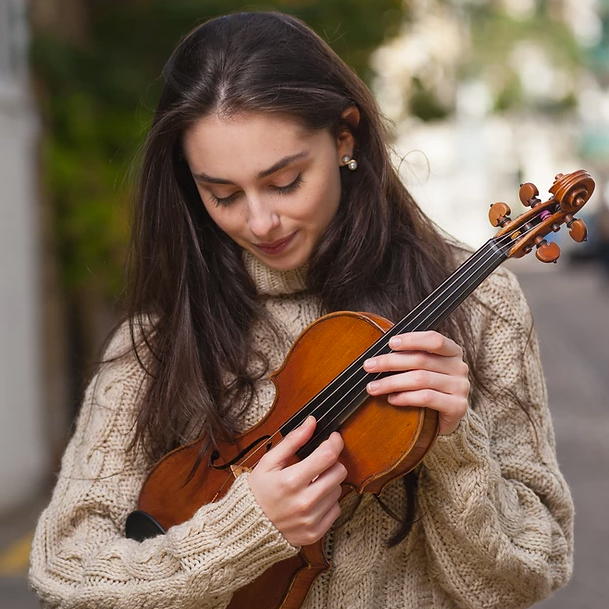
Tonight’s concert was also notable for featuring the ESO’s new Creative Partner and Artist in Residence – violinist Esther Abrami (above), her presence on social media enhanced by the release of her eponymous debut album for Sony. Stylishly attired (with an image that, for older readers, might recall Audrey Hepburn), she gave an account of Bruch’s Scottish Fantasy at its best in the transition from sombreness to eloquence of its Introduction and high-flown sentiments of an Andante in which the composer’s recourse to folk melodies is at its most felicitous. Before it, the Scherzo ideally needed more incisiveness for its engaging humour fully to register, with the final Allegro (given in abbreviated form) rather less than ‘warlike’ – though its mellifluous second theme enabled Abrami to conjure a tonal warmth which was never less than appealing.

After the interval, the ESO came fully into its own with an impressive take on Mendelssohn’s ‘Scottish’ Symphony. Whatever its genesis in his tour of that country when just 20, the work is demonstrably that of a composer who, having reached a creative mid-point, surveys his many successes but also failings. Hence the fatalistic aura such as informs the opening movement’s introduction or the tense agitation of its main Allegro – both of which were palpably brought out by Woods, who then gave the brief if scintillating scherzo its head. The highlight was an Adagio whose constant pivoting between pathos and anguish was graphically stated – aided by an orchestral discipline no less evident in the final Allegro, its martial overtones carrying through to a pause in which the decision to opt for tragedy or triumph is held in the balance.

That the work closes in triumph has often been felt its downfall but, as conveyed by Woods at a swift if not inflexible tempo, such an apotheosis is one of determination or even defiance in the face of whatever is to come. It certainly brought this concert to a memorable conclusion.

For more information on the artists in this concert, click on the links to read about Esther Abrami, Kenneth Woods and the English Symphony Orchestra. Click on the name to read more about composer Robert Saxton – who also has a page from his publisher here

Online concert – Daniel Rowland, Maja Bogdanović, English Symphony Orchestra / Kenneth Woods: Sawyers: Concerti

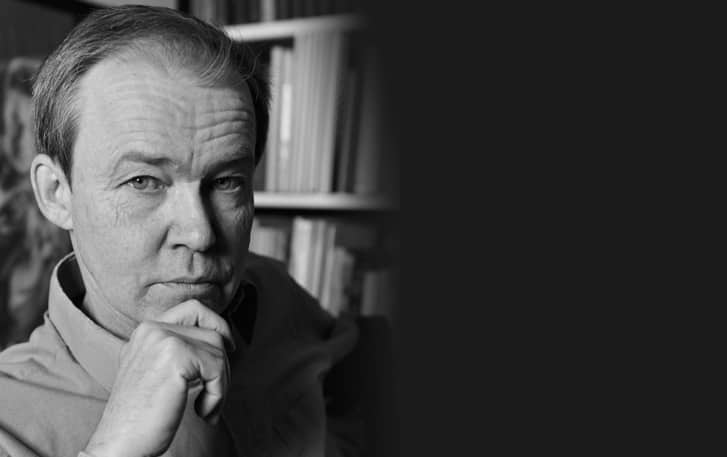
Philip Sawyers (above)
Double Concerto for Violin and Cello (2020)
Viola Concerto (2020)

Daniel Rowland (violin, viola), Maja Bogdanović (cello), English Symphony Orchestra / Kenneth Woods

Filmed at the Wyastone Concert Hall, Monmouth, Thursday 3 March 2022. Producer Phil Rowlands / Videographer Tim Burton

by Richard Whitehouse. Photo of Daniel Rowland and Maja Bogdanović (c) Stefan Bremer

Since returning to composition with a vengeance almost two decades ago, Philip Sawyers has created a varied output dominated by six symphonies along with five concertos that between them confirm the professionalism of his writing and a sensitivity to the instrument(s) at hand. Two of them were written, one after the other, in 2020 and received their public premieres at Hereford and Great Malvern in March last year.

Daniel Rowland (violin), Maja Bogdanović (cello)

Before that, they were recorded at one of the English Symphony Orchestra’s Wyastone sessions and it is these accounts which feature here. The live performances were covered when part of their respective concerts (see the reviews of the Double Concerto and Viola Concerto respectively), hence it only needs to be added that the studio recordings more than compensate for any lack of spontaneity with what they gain in subtlety of characterization.

The conviction of these readings should only be abetted when they are commercially issued on 6th March, as part of the ESO’s latest Sawyers release which also features his Octet for ensemble and Remembrance for strings (its public premiere to be given by the Leamington Chamber Orchestra at Holy Trinity Church, Leamington Spa on Sunday March 26th). Good news, moreover, that his oratorio Mayflower on the Sea of Time, whose premiere at the 2020 Three Choirs Festival fell victim to the pandemic, is to receive its first hearing later this year.

This concert can be accessed free until 28 February 2023 at the English Symphony Orchestra website, but remains available through ESO Digital by way of a subscription. Meanwhile click on the names for more on the English Symphony Orchestra and Kenneth Woods, or on composer Philip Sawyers. Meanwhile the new recording release mentioned above can be viewed and purchased in advance here

In concert – English Symphony Orchestra / Kenneth Woods – American & Canadian Sounds 2

Roman Kosyakov (piano), Rebecca Wood (cor anglais), Stuart Essenhigh (trumpet), English String Orchestra / Kenneth Woods

Barber Adagio for strings Op.11a (1936)
Still (arr. Zur) Dismal Swamp (1935)
Gershwin (arr. Farrington) Rhapsody in Blue (1924)
Copland Quiet City (1941); Appalachian Spring (1945)

Kings Place, London
Sunday 19 February 2022

Reviewed by Richard Whitehouse

London appearances by the English Symphony Orchestra being so infrequent, it was good to see an (understandably) scaled-down orchestra returning to Kings Place for the series American & Canadian Sounds that is taking place under the auspices of London Chamber Music Society.

The ubiquitous Adagio that Samuel Barber arranged from his only string quartet almost had to feature here, but that was no hardship given the excellence of the ESO’s playing – the silence after its climax rightly made the focal-point around which this whole performance revolved.

Although his music never entirely went away, the extent of William Grant Still’s output has barely been explored so all credit to Kenneth Woods for championing Dismal Swamp (heard here in an effective reduction by Noam Zur). Taking its cue from a short yet intense poem by playwright Verna Arvey (Still’s second wife), this 15-minute tone poem evokes the no-man’s land between Virginia and North Carolina across which escaped slaves once fled to freedom. Its concertante role for piano subtly embedded into the orchestral texture, the music charts a progression from sombre desperation to outward elation through a subtly extended tonality (Still having studied with composers as distinct as Chadwick and Varèse) whose apotheosis elides resolve and equivocation with a fervency which was tangibly in evidence.

Roman Kosyakov was the admirable pianist here as in George Gershwin’s Rhapsody in Blue. This also was heard in reduction, Iain Farrington’s arrangement combining the immediacy of Ferde Grofé’s original scoring with the Europeanized grandeur of his later orchestration. Placing the piano rear-centre of the platform likely accounted for any occasional failings of coordination, but Kosyakov’s characterful playing – not least in the lengthy developmental cadenza and ensuing ‘big tune’ – held one’s attention through to the indelible closing bars.

The play by Irwin Shaw for which he wrote incidental music might have passed into history, but Quiet City is among Aaron Copland’s most effective shorter pieces – its halting dialogue between cor anglais (Rebecca Wood) and trumpet (Stuart Essenhigh) given context by the modal plangency of its string writing.

The programme ended with Copland’s Appalachian Spring – heard here in the familiar suite but in the original orchestration with its prominent part for piano, along with solo woodwind contributions that stand out more clearly against the string nonet. Familiar as this music may be, its understated harmonic shadings and keen rhythmic ingenuity are never easily realized in performance, and it was testament to the ESO’s playing that the piece emerged as vividly and as cohesively as it did. In particular, the penultimate sequence of variations on ‘Simple Gifts’ had an unforced eloquence (the last statement of the Shaker hymn eschewing any hint of bathos) which carried through into the coda – its evocation of community no less affecting for being so idealized, and in music such as more than warrants that misused term ‘iconic’.

A rewarding programme and a welcome London appearance by the ESO, which will be back in action next month with (inter alia) a concert at Oxford’s Sheldonian Theatre that features a major new work by Robert Saxton as part of the orchestra’s ‘21st Century Symphony Project’

For more information on the artists in this concert, click on the links to read about Roman Kosyakov, Kenneth Woods and the English Symphony Orchestra. For more on the London Chamber Music Society, click here – and for more on composer William Grant Still, click here

Online concert – Zoë Beyers, English Symphony Orchestra / Kenneth Woods: Elcock: Violin Concerto

Elcock Violin Concerto Op.13 (1996-2006)

Zoë Beyers (violin), English Symphony Orchestra / Kenneth Woods

Filmed at the Wyastone Concert Hall, Monmouth, Thursday 26 May 2022. Producer Phil Rowlands / Videographer Tim Burton

by Richard Whitehouse

The English Symphony Orchestra’s online schedule got off to a fine start for this year with a studio account of the Violin Concerto by composer-in-association Steve Elcock. It may have taken shape across nearly a decade, but the work is no less impressive for that. It also marks something of a transition from less ambitious pieces, often conceived with local musicians in mind, to the symphonic works as have recently been performed and recorded to great acclaim – whose formal as well as expressive concerns it anticipates and shares in various instances.

The concerto opens with an Allegro vivo whose rhythmic energy is maintained throughout, yet with sufficient contrast for its second theme to assume greater emotional emphasis in the reprise, prior to a forceful conclusion. The undoubted highlight is a Molto tranquillo whose haunting main theme, first unfolded by the soloist over undulating upper strings in a texture evidently inspired by change-ringing techniques, is a memorable inspiration. A pavane-like idea latterly comes into focus and the closing stage, which opens onto an eloquent plateau before evanescing almost regretfully into silence, lingers long in the memory. The finale is a relatively taut passacaglia whose theme accelerates through five variations from Andante to Presto, culminating in a combative ‘cadenza’ for violin and timpani then a decisive pay-off.

A tough challenge, indeed, for any soloist and one such as Zoë Beyers and the ESO, under Kenneth Woods, met with assurance over its 33 minutes. Aside from its sheer velocity, the first movement is notable for a close-knit interplay between soloist and orchestra here brought off with admirable precision, while the modal subtleties of the slow movement were deftly rendered as enhancements to its overall tonal trajectory. If its sequence of accelerating variations seemed to be over rather too soon, the finale was nevertheless a cohesive entity that saw this piece to a defiant conclusion.

Good to hear that this performance will be released commercially in due course, as a coupling for the Eighth Symphony which the ESO premiered in 2021 and the tone poem Wreck it gave last year – hence making for a persuasive overview of this increasingly significant composer.

This concert can be accessed free until 7 February 2023 at the English Symphony Orchestra website, but remains available through ESO Digital by way of a subscription. Meanwhile click on the names for more on the English Symphony Orchestra and Kenneth Woods, or on composer Steve Elcock