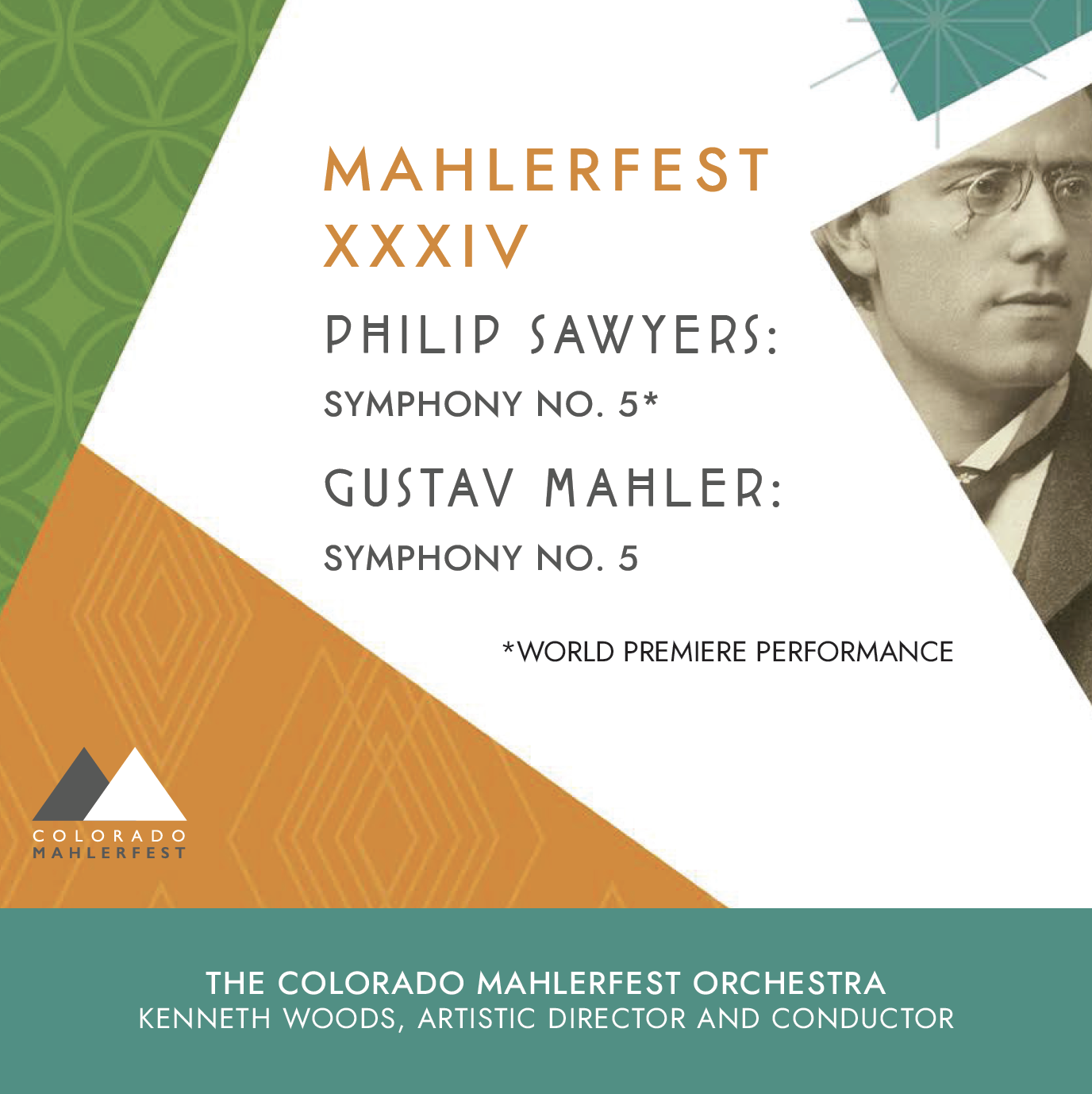
On Record: Colorado MahlerFest Orchestra / Kenneth Woods – MahlerFest XXXIV: Sawyers & Mahler: Fifth Symphonies (Colorado MahlerFest)

Sawyers Symphony no.5 (2021) [World premiere]
Mahler Symphony no.5 in C# minor (1901-02)

Colorado MahlerFest Orchestra / Kenneth Woods

Colorado MahlerFest 195269164287 [two discs, 111’45”]

Recorded Live performances at Macky Auditorium, Boulder, Colorado, 28 August 2021

reviewed by Richard Whitehouse

What’s the story?

Two five-movement Fifths brought the 34th Colorado MahlerFest to an impressive ending. Mahler’s cycle is often seen as ‘end of the line’ for the symphony, yet its further evolution is not hard to discern, and Kenneth Woods is rightly making this a crucial aspect of his tenure.

What’s the music like?

Philip SawyersFifth Symphony pursues a stylistic path comparable to those two before it. Its predecessor ended with an expansive Adagio, and this work continues from such inward seriousness in a Moderato that overrides clear-cut sonata procedures for a gradual unfolding whose thoughtful initial theme takes on greater emotional intensity as it builds to an ominous climax, before closing in a mood of no mean ambivalence. The writing, for an orchestra with fifth horn and harp though no percussion other than timpani, is never less than resourceful.

From here an Allegro increases the tempo to capering and, in its middle stages, wistful effect. The central Lento pursues a sustained course over cumulative paragraphs, the latter climaxing with the work’s most anguished music, before an affecting coda. The ensuing Presto affords greater expressive contrast between impulsive outer sections and a chorale-like trio of musing poise. The final Allegro is the most orthodox movement in its energetic and reflective themes, taking in an intensive development and subtly modified reprise prior to a decisive apotheosis.

Pacing is crucial in Mahler’s symphonies, his Fifth being no exception. The opening Funeral March is ideally judged – its development not too histrionic, then a coda whose eruptive force subsides into numbed uncertainty. Proceeding without pause, its successor steers securely to a climactic yet ill-fated chorale, and if the final return of its initial music lacks vehemence, the pulsating expectancy of the closing bars is tangibly rendered. Woods’ handling of the central Scherzo contrasts a rustically evocative trio with the ländler-infused coyness and contrapuntal contrivance either side, the coda wrapping up this overlong movement with real decisiveness.

The remaining two movements are finely realized, the Adagietto taken at a flowing if flexible pace that enables its inherent rapture to emerge without any risk of indulgence. The deftest of transitions duly prepares for a finale whose elaborate interplay of rondo and sonata elements is replete with a cumulative impetus here carried through to a fervent peroration, the chorale blazing forth during a close in which affirmation and nonchalance are irresistibly combined.

Does it all work?

Almost always. Sawyers’ Fifth symphony is a cohesive and absorbing piece – less arresting in overall content than either of its predecessors, though with an unfailing formal logic and expressive eloquence that are not to be gainsaid. Interesting, moreover, that this Fifth marks something of a rapprochement with ‘classical’ tonality, whereas Mahler’s Fifth sets in motion a fractious discourse which informs almost all this composer’s subsequent symphonic works.

Is it recommended?

Certainly. The playing of the Colorado MahlerFest Orchestra is of a high standard, testifying to the excellence of these musicians in their collective responsiveness to Woods’ technical acumen and interpretive insight. To hear this work so authoritatively realized and within the context of a major new symphonic statement says much for the significance of MahlerFest.

Listen & Buy

Online concert – English String Orchestra / Kenneth Woods: Elgar Festival 2022

Elgar arr. Fraser Nursery Suite (1931 arr. 2022) World premiere of this arrangement
David Matthews Shiva Dances Op.161 (2021) World premiere

English String Orchestra (soloists Zoë Beyers, Suzanne Casey (violins), Carl Hill (viola) and Joely Koos (cello) / Kenneth Woods

Filmed at the Guildhall, Worcester, Friday 3 June 2022

by Richard Whitehouse

Welcome listening for the new year provided by the English String Orchestra, as taken from a programme at this year’s Elgar Festival and which featured the premiere of that composer’s last notable work in what is an idiomatic and often perceptive arrangement by Donald Fraser.

His previous Elgar arrangements ranging from miniatures to the Piano Quintet, Fraser duly captured the wistful charm of the initial Aubade then discreet pathos of The Serious Doll. The ESO steered a secure course through the headlong intricacy of Busy-ness, with the deft profundity of The Sad Doll afforded full rein. Solo strings against an implacable rhythmic ostinato offset any lack of visceral impact in The Waggon (sic) Passes, then the high spirits of The Merry Doll were jauntily in evidence. The extended finale, Dreaming is a threnody of tangible emotional import and a resume of earlier themes on its way to a forthright if not a little regretful coda. Kenneth Woods ensured this had gravitas without losing focus, while a bravura showing from Zoë Beyers was but the last in a sequence of solos all admirably taken.

Solos are by no means absent from Shiva Dances by David Matthews. The combination of string quartet and string orchestra has potent Elgarian connotations, of which the composer avails himself in this continuous sequence inspired as much by Aldous Huxley’s description of the Hindu god Shiva as by Indian classical music. Moving from a slow introduction given piquancy by its modal intonations, the work comprises four dances that between them outline the four elements: an impetuous workout representing ‘earth’, a quixotic interplay for soloists and ensemble that of ‘water’, the scherzo-like agility of ‘air’, and an animated waltz for ‘fire’. This latter builds to a forceful restatement of the opening theme, before a coda intensifies the overall expression such that what came before is rendered from a more ethereal perspective.

It says much for the prowess of the ESO that this first hearing betrayed few signs of caution or uncertainty, Woods directing a confident account with which Matthews must have been well pleased. Those listening to this online programme can also hear an encore in the guise of Nimrod from Elgar’s Enigma Variations, taken from a performance during last year’s Elgar Festival and which exudes a searching eloquence as seems to look beyond forthcoming celebrations to that overtly commemorative atmosphere from only a matter of weeks later.

This concert could be accessed free until 1 January 2023 at the English Symphony Orchestra website, but remains available through ESO Digital by way of a subscription. Meanwhile click on the names for more on the English Symphony Orchestra and Kenneth Woods, or on composer David Matthews

In concert – Zoë Beyers, English String Orchestra / Kenneth Woods – Journeys of Creation and Renewal: Vaughan Williams, Pritchard, David Matthews and Elgar

Vaughan Williams Fantasia on a Theme of Thomas Tallis (1910)
Pritchard Violin Concerto ‘Wall of Water’ (2014)
David Matthews Shiva Dances Op.160 (2021)
Elgar Introduction and Allegro Op.47 (1905)

Zoë Beyers (violin), English String Orchestra / Kenneth Woods

Holy Trinity Church, Hereford
Thursday 24 November 2022

Reviewed by Richard Whitehouse

Just a day after The Journey Home, the ESO reverted to its ‘String’ guise for this judiciously sequenced programme with two contrasted commissions framed by classics of the repertoire for string orchestra – these latter written not so far away from where this concert took place.

Acclaimed at its premiere in Gloucester Cathedral some 112 years ago, Vaughan Williams’s Fantasia on a Theme of Thomas Tallis has never been so popular as it has become this past decade. This performance did it justice – the placing of the ‘echo’ orchestra, behind the altar-screen in the imposing Victorian confines of Holy Trinity Church, abetting those antiphonal exchanges in the central section. Solo string quartet building steadily toward an impassioned culmination, from where Tallis’s theme is movingly recalled prior to the final evanescence.

Next came the welcome revival of an earlier ESO commission by Deborah Pritchard. Inspired by an eponymous series of paintings by Maggi Hambling, Wall of Water is a violin concerto which makes tangible reference to these 13 canvases as it unfolds. Their projection to the rear of the orchestra underlying a visceral as well as imagistic allure, even though the work itself is fully intelligible on its own terms – not least with a three-movement trajectory coalescing out of continuous 13 sections. Elements of Penderecki and Lutosławski can be discerned over its course, but a distinct and engaging personality is also in evidence along with a technical finesse with regard both to the solo writing and that for the strings. Zoë Beyers gave a superb account of a piece which seems sure to enter the repertoire of 21st-century violin concertos.

As too does Shiva Dances by David Matthews. The combination of string quartet and string orchestra is a potent one (see below), of which the composer has availed himself fully in this continuous sequence likely inspired as much in a description of Hindu god Shiva by Aldous Huxley as by Indian classical music. Proceeding from a slow introduction given piquancy by its modal intonations, the work comprises four dances which between them outline the four elements: an impetuous workout that represents ‘earth’, a quixotic interplay for soloists and ensemble that of ‘water’, the scherzo-like agility of ‘air’, then a lively waltz for ‘fire’ – this latter building to a forceful restatement of the opening theme, before the coda opens-out the overall expression such that what went before is rendered from a more ethereal perspective.

Kenneth Woods secured an engaging account of this appealing work, as he did of Elgar’s Introduction and Allegro that concluded the evening. As he pointed out, its main melody is a rare instance of this composer using an actual folksong, yet that never entails a lessening of formal intricacy in what becomes a latter-day recasting of the concerto grosso – reaching its emotional apex in a developmental fugue that bristles with technical challenges. A tough test for the London Symphony Orchestra, with whom Elgar enjoyed a productive association.

Suffice to add the ESO was equal to this task as in the sustained fervency of the final pages. It rounded off another worthwhile evening from this always enterprising ensemble. December brings the seasonal performance of Handel’s Messiah, with further concerts in the new year.

For more information on the artists in this concert, click on the links to read about Zoë Beyers, Kenneth Woods and the English Symphony Orchestra. For more on the composers, click on the names Deborah Pritchard and David Matthews

In concert – April Fredrick, English Symphony Orchestra / Kenneth Woods – The Journey Home: Haydn, David Matthews, Barber & Mozart

Haydn Symphony No. 45 in F sharp minor, Hob.I:45 ‘Farewell’ (1772)
David Matthews Le Lac Op.146 (2018)
Barber Knoxville: Summer of 1915 Op.24 (1947)
Mozart Symphony no.36 in C major K425 ‘Linz’

April Fredrick (soprano), English Symphony Orchestra / Kenneth Woods

Great Malvern Priory, Malvern
Wednesday 23 November 2022

Reviewed by Richard Whitehouse

The English Symphony Orchestra’s season really hit its stride this evening with a programme featuring two major vocal works of the 20th and 21st centuries, heard alongside two notable while very different symphonies from near the start and towards the end of the Classical era.

As Kenneth Woods indicated, Haydn’s ‘Farewell’ Symphony would have been determinedly avant-garde to early listeners, and much of that innovative quality came over here. Not least in the initial Allegro, its jagged course and disjunctive tonal shifts only nominally countered by the Adagio’s increasingly fraught introspection. With its stark alternations in motion and phrasing, the Menuetto proved a telling foil to a finale where a turbulent Presto precedes an Adagio whose eloquence was sustained as the music subsides and musicians vacate the stage.

Whether or not this symphony would have been better placed at the end of this concert, it set up productive contrast with David Matthews’s Le Lac. Remembered more as statesman than poet, Alphonse de Lamartine was a crucial figure in French literature of the early Romantic period – his lengthy 1820 poem a remembrance of lost love comparable to verse by Shelley and Heine, and one whose slowly intensifying rapture is to the fore in this evocative scena. Two orchestral interludes aside, its formal and emotional progress is essentially determined by the vocal line; with which April Fredrick was at one in conveying the wistfulness but also anguish inherent of this music. The fastidious textures were no less finely delineated by the ESO, Woods sustaining a cohesive overall trajectory from earlier promise to ultimate loss.

Evidently it was Fredrick who had suggested juxtaposing this piece with Barber’s Knoxville: Summer of 1915, which pairing succeeded admirably in terms of underlining conceptual and expressive links between them. Its sense of loss may be psychological rather than personal, but an emotional force comes over tangibly for all this music’s overt restraint: James Agee’s poetic reportage summoning a response the more affecting for its restraint and in whose vocal part Fredrick was never less than attuned. Woods brought no mean sensitivity or character to orchestral writing such as eschews the rhetoric found in many of Barber’s earlier scores and so foreshadows the subtlety of those two decades hence. This is a work with few significant precursors or successors, and the present reading made the most of its singular atmosphere.

The evening concluded with the relative extroversion of Mozart’s ‘Linz’ Symphony – a piece whose having been written in four days doubtless occasioned its technical brilliance, yet also a formulaic quality to its actual substance. Not, however, in an Andante whose gentle pathos was to the fore, or a Menuetto whose brevity belies its resourceful use of woodwind. Woods found a winning effervescence in the initial Allegro, and if the second-half repeat in the final Presto may be one such too far, this music’s Haydnesque wit was never less than appealing.

It set the seal on a well-conceived and finely executed concert that, in pivoting between the established and unfamiliar (not only between but also within works) typifies thr resourceful approach to programming with which Woods and the ESO have now become synonymous.

For more information on the artists in this concert, click on the links to read about April Fredrick, Kenneth Woods and the English Symphony Orchestra. For more on composer David Matthews, click here

In concert – Kathryn Rudge, English Symphony Orchestra / Kenneth Woods – Across The Sea: Mendelssohn, Elcock, Britten & Elgar

Mendelssohn Calm Sea and Prosperous Voyage Op.27 (1828)
Elcock Wreck Op.10 (1998) [World Premiere]
Britten Four Sea Interludes from Peter Grimes Op.33a (1945)
Elgar Sea Pictures Op.37 (1899)

Kathryn Rudge (mezzo-soprano), English Symphony Orchestra / Kenneth Woods

Malvern Theatres, Great Malvern
Saturday 15 October 2022

Reviewed by Richard Whitehouse

This first full-length concert in the English Symphony Orchestra’s new season focussed on the sea in all its varied qualities, taking in four works whose encompassing a span of almost two centuries also identified crucial aesthetic differences as to what music itself can express.

Not least as it comes between masterpieces of the early Romantic era (A Midsummer Night’s Dream and The Hebrides), Mendelssohn’s Calm Sea and Prosperous Voyage has often been overlooked on its own merits. Yet this concert overture, as inspired by two of Goethe’s best- known poems, is a fine example of the still-teenage composer’s prowess – Kenneth Woods securing a rapt intensity in its introductory phase, then steering its characterful continuation through to a grand while not unduly bathetic peroration with the sea accorded the final word.

From here to Steve Elcock’s Wreck is to encounter more elemental, even existential forces – what the composer refers to as a ‘‘symphonic allegory’’ portraying a ship’s struggle against intemperate weather at sea. This unfolds as a constantly evolving design, juxtaposing music of unchecked aggression with that of fraught serenity, while highlighting Elcock’s mastery of large-scale formal and expressive contrasts, toward a seismic culmination whose gradual subsidence makes possible the sustained closing section. Here, off-stage mezzo sings in an invented (hence unknown) language what he describes as ‘‘a message of salvation beyond despair, of consolation beyond grief’’ but even this is tempered by encroaching doubt. The ESO gave its all in a piece as demonstrably commended itself to the appreciative audience.

Marine vignettes rather than epics came after the interval. Woods had an audible grasp of the diverse moods in the Four Sea Interludes that Britten drew from his opera Peter Grimes, but more notable was his successful segueing between them – the keening plangency of Dawn leading into the equivocal assurance of Sunday Morning, emergent tonal and emotional blur of Moonlight, then the visceral conflict of Storm with its yearning oasis of calm and brutal closing onslaught. A few failings of ensemble hardly offset the intent continuity of the whole.

The ESO previously recorded Elgar’s Sea Pictures in an arrangement with chorus by Donald Fraser, but it was good to hear this song-cycle as Elgar realized it for mezzo – not least when Kathryn Rudge (taking her customary place at front of stage) proved so eloquent an exponent. The troubled pathos drawn from Roden Nole’s Sea-Slumber-Song was duly complemented by the whimsical charm of Alice Elgar’s In Haven (Capri) – tension rising accordingly for Elizabeth Barrett Browning’s Sabbath Morning at Sea, its larger emotional contrasts well defined. Expressive nuances in Richard Garnett’s Where Corals Lie might have been more subtly pointed, but there was no doubt as to Rudge’s identification here or in Adam Lindsay Gordon’s The Swimmer with its anxious though determined progress to certain affirmation.

It set the seal on a rewarding programme and fine start to what will hopefully be an eventful season for the ESO. More concerts will be announced soon, but for now the recent release of Adrian Williams’s First Symphony (Nimbus NI6432) confirms this as an orchestra on a roll.

For more information on the artists in this concert, click on the links to read about Kathryn Rudge, Kenneth Woods and the English Symphony Orchestra. For more on composer Steve Elcock, click here