In concert – English Symphony Orchestra / Kenneth Woods @ Kings Place: Elgar, Truscott, Fribbins, Weinberg & Shostakovich

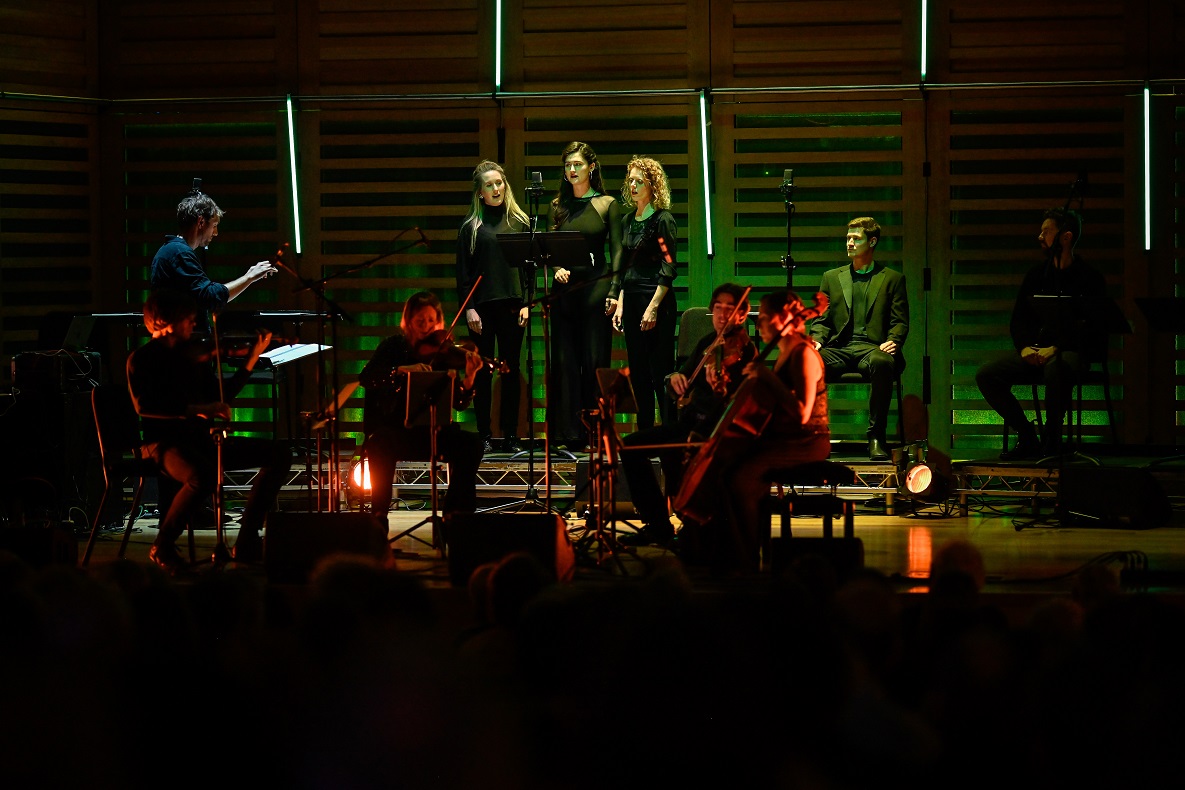
Laura Jellicoe (flute), Rosemary Cow (bassoon), Rosalind Ventris (viola), English Symphony Orchestra / Kenneth Woods

Elgar Romance in D minor Op.62 (1910)
Truscott Elegy in E flat major (1944) [London premiere]
Fribbins Folk Songs (2022) [London premiere]
Weinberg Flute Concerto no.1 in D minor Op.75 (1961)
Shostakovich arr. Barshai Chamber Symphony in A flat major Op.118a (1964, arr. 1971)

Kings Place, London
Sunday 23 March 2025

Reviewed by Richard Whitehouse

What has become the English Symphony Orchestra’s annual appearance in London Chamber Music Society’s season saw an appealing programme of (relatively) familiar and (relatively) unfamiliar British and Soviet-era music as wide ranging as it had been carefully assembled.

It cannot often have begun a concert, but the Romance that Elgar wrote for bassoonist Edwin James made an attractive entrée – its pathos and eloquence fully conveyed by ESO principal Rosamary Cow, always heard to advantage against the strings’ warmly ruminative backdrop.

Harold Truscott finished only three works for orchestra, his Elegy for strings the undoubted masterpiece – eliding intuitively between the already burgeoning British lineage with that of Central Europe (Dvořák’s crepuscular Nocturne, heard at last year’s ESO concert, affords an interesting precedent). Despite its major-key grounding, this is music of intense while often anguished emotion – Truscott bearing his soul to a degree he was rarely, if ever, to do again. As in Worcester four seasons ago, Kenneth Woods searched out its every expressive nuance.

Concertante pieces have featured prominently in Peter Fribbins’s output, with Folk Songs the most recent example. Those traditional tunes range widely geographically and expressively – the Prelude drawing on Welsh melody Bugail Yr Hafod (When I was a Shepherd) in soulful restraint, the Fugue on Serbian tune Ajde Jano (C’mon Jana) in animated dexterity, then the Fantasia on Hungarian song Azt gondoltam eső esik (I thought it rains) in elegant profundity. Superbly played by Rosalind Ventris, it makes a welcome addition to a still-limited repertoire.

Hardly less valuable in its own context is the First Flute Concerto by Mieczysław Weinberg. Written for Alexander Korneyev, its modest proportions fairly belie its substance – whether the energetic interplay of its opening Allegro, the deftly understated threnody of its Adagio, or the whimsical humour of an Allegro anticipating numerous Weinberg finales. It was also the ideal showcase for ESO principal Laura Jellicoe to demonstrate her solo prowess, with ESO strings responding ably to what must be among its composer’s most performed pieces.

Dedicated to Weinberg and written over just 11 days, Shostakovich’s Tenth String Quartet is something of a standalone in the composer’s cycle – coming between four innately personal quartets and four dedicated to each member of the Beethoven Quartet. Yet it is music no less focussed in intent and Rudolf Barshai’s arrangement for string orchestra defines its character more markedly – not least the winsome ambivalence of its initial Andante or visceral force of its ‘furioso’ scherzo, the ESO players tackling those fearsome rhythmic unisons head on. The cellos came into their own with the emotionally restrained variations of the Adagio before, its link seamlessly effected, the final Allegretto built methodically if inexorably to a heightened restatement of the passacaglia’s theme before tentatively retracing its steps to a wistful close.

An impressive demonstration overall of the ESO’s prowess and, moreover, the ideal way to close 17 seasons of LCMS recitals at Kings Place. September finds this series relocating to the newly refurbished St John’s Church at Waterloo, ready for a new chapter in its existence.

Visit the English Symphony Orchestra website to read more about the orchestra, and click on the artist names to read more about flautist Laura Jellicoe, bassoonist Rosemary Cow, viola player Rosalind Ventris and conductor Kenneth Woods. Click also to read more on composers Peter Fribbins and Harold Truscott

Published post no.2,483 – Monday 24 March 2025

In concert – Sacconi Quartet & Festival Voices: Earth Unwrapped – Terry Riley’s Sun Rings

Sacconi Quartet [Ben Hancox, Hannah Dawson (violins), Robin Ashwell (viola), Cara Berridge (cello]; Festival Voices [Lucy Cronin, Ana Beard Fernández, Lucy Goddard, Sam Jenkins, Michael Craddock, Oskar McCarthy] / Greg Batsleer; Brett Cox (electronics)

Riley Sun Rings (2002)

Hall One, Kings Place, London
Thursday 16 January 2025

by Ben Hogwood Pictures courtesy of Monika S Jakubowska / Kings Place

A sobering thought: in the course of this concert, the NASA spacecraft Voyager 1 travelled another 60,000 miles away from the Solar System.

Quite how far it will travel in the course of the Kings Place festival Earth Unwrapped remains to be seen, but by that time audiences will have enjoyed a wide array of musical and visual treats, all designed to heighten awareness of the plight in which we find ourselves here on planet Earth.

Such thoughts were close to the surface throughout Sun Rings, an ambitious start to the festival. The substantial work was completed by Terry Riley in 2002, the result of an approach made by NASA to the Kronos Quartet. They wanted to create a work based on recordings of ‘space sounds’ (plasma waves) from Voyager 1 made by Professor Donald Gurnett. Riley had these transferred to audible audio frequencies in order to mark 25 years since the spacecraft was launched, at the same time contemplating the place of humanity in the universe. Since Sun Rings was completed, Voyager I has passed from the Solar System to interstellar space.

The Kronos Quartet released their recording of Sun Rings in 2019 (reviewed by Arcana here), and until now were the only ensemble to have played the piece in public. This UK premiere from the Sacconi Quartet and Festival Voices changed that, an illustration of the ever-growing reach of ‘minimalist’ music. The twelve assembled on stage performed heroically, the unbroken span of ten movements lasting 90 minutes yet delivered with flair, poise and no little emotion.

The music was prefaced by words from Riley himself, a stamp of authenticity and gratitude from the 90-year-old composer. It was the first of many audio clips carefully managed by Brett Cox, whose contributions were crucial to the success of the performance. Chief among these were the audio translations of the Voyager craft itself, converted by Riley from spectrographs. They provided an industrial edge to the sound – reminiscent of Voyager contemporaries Cabaret Voltaire – and were alternately eerie and consoling in their different sound worlds. As the audience sat in the dark the notion of being on our own journey was inescapable, a reminder that our own planet moves even quicker than Voyager 1 itself.

The quartet made a strong start, bolstered by colourful percussion. The Overture, Hero Danger and Beebopterismo sections had rhythmic vitality, complemented by the electronics and samples. Towards the halfway mark however the momentum and intensity flagged, the notion of deep space now all around us but feeling more oppressive. Time stood relatively still in the eerie Earth / Jupiter Kiss section, though Riley’s musical intensity flagged before being re-energised by the Festival Voices. The excellent singers brought expression and impetus to Earth Whistlers and Prayer Central, but on occasion it was difficult to hear some of the words, the singers’ pitch aligned with the frequency of the audio recordings.

The most powerful music, ironically, was the slowest and the most restrained. The coda, One Earth, One People, One Love, became a deeply felt meditation, the singers whispering under their breath as they moved slowly to the exit in an inspired piece of choreography. The pensive strings remained, adding their commentary to recorded spoken word, whose statements could not have been more apt.

As I write this, the news of alarming carbon dioxide levels in the Earth’s atmosphere serves as a reminder of our changing world, hurtling towards the environmental precipice. This stark reality check confirms Earth Unwrapped to be arguably the most important arts festival in London this year – and this was an auspicious start.

For more information on the Earth Unwrapped festival, head to the Kings Place website. Click on the artist names for Sacconi Quartet and Festival Voices, and composer Terry Riley. You can visit NASA to find out where Voyager 1 and Voyager 2 are now

Published post no.2,415 – Saturday 17 January 2025

In concert – Simon Desbruslais, English Symphony Orchestra / Kenneth Woods: Sibelius, Sawyers, Dvořák, Fribbins & Elgar

Simon Desbruslais (trumpet), English Symphony Orchestra / Kenneth Woods

Sibelius Rakastava Op.14 (1893, arr. 1912)
Sawyers Concerto for Trumpet, Strings and Timpani (2015)
Dvořák Notturno in B major Op.40 (1870, arr. 1883)
Fribbins Soliloquies (2012, arr. 2017)
Elgar Introduction and Allegro for strings Op.47 (1905)

Hall One, Kings Place, London
Sunday 15 April 2024

Reviewed by Richard Whitehouse

Concerts by the English Symphony Orchestra in the London Chamber Music Society’s season are always a worthwhile fixture and this early-evening event, in its mixing established classics with contemporary pieces, demonstrated the stylistic range and sympathies of this ensemble.

A pity that Sibelius’s Rakastava has never been taken up by many British conductors – John Barbirolli and Sir Colin Davis excepted – as this extensive reworking for strings and timpani of an early choral work should be a staple of its repertoire. Kenneth Woods duly brought out the wistful poise of The Lover, and if the stealthiness which underpins The Way of the Lover seemed just a little tentative, the bittersweet pathos that permeates Good evening, Farewell then came through unabated in what is as moving a leave-taking as its composer ever penned.

The music of Philip Sawyers has been a constant feature of the ESO’s programming this past decade, and his Trumpet Concerto more than deserved revival. The outward Classicism of its formal trajectory should not belie the deftness by which Sawyers modifies the sonata design of its opening Allegro, the impetus and reflectiveness of its main themes finding accord prior to a trenchant cadenza with timpani at the fore, or a central Andante that exuded an emotional breadth and fervour in advance of the excellent recording by these artists. Among the leading trumpeters of his generation, Simon Desbruslais – placed high to the rear of the auditorium, to potent effect – was wholly unfazed by its demands; nor those of a final Allegro in which more reflective elements leaven the initial energy, only to be outdone in the virtuosic closing bars.

Next, a welcome hearing for the Notturno that Dvořák salvaged from an early (and reckless) quartet. Its relative swiftness here recalled its intermediate reworking as an intermezzo in the second of his string quintets, so emphasizing its appealing lilt over any more ethereal quality.

Desbrulais (above) returned after a brief hiatus for Soliloquies by Peter Fribbins. A composer as adept on a symphonic as on a miniature scale, these brief if affecting pieces draw on three earlier songs – the recasting of whose vocal line encourages the soloist to an eloquence that, after the relative restraint of the initial Adagio and central Tranquillo, comes to the fore in a final Adagio where evocation takes on an almost cinematic aura. With impressive concertos for piano and violin to his credit, Fribbins ought to consider a full-length work for trumpet.

Elgar’s Introduction and Allegro has not unexpectedly been key to the ESO’s repertoire since its founding some 45 years ago, and this performance did not disappoint. Most admirable was the variety and depth of string tone that Woods (a one-time professional cellist) secured from only 19 players, so ensuring a vitality and impact in the more animated sections together with the requisite delicacy in those passages where the composer’s ruminative mood is uppermost. Both aspects were brought into thrilling accord at the close of the powerfully projected coda.

Beforehand, Woods spoke of the changing nature of commissions and the current difficulties in securing the necessary funding. This season has not been easy for the ESO though, on the basis of this programme, these players are commendably taking it all in their collective stride.

Click on the link to read more on English Symphony Orchestra, and on the names for more on their conductor Kenneth Woods, and trumpeter Simon Desbruslais. Click on the names for more on the new composers featured, Philip Sawyers and Peter Fribbins

Published post no.2,150 – Tuesday 16 April 2024

In concert – Sebastian Rochford & Kit Downes @ Kings Place

Sebastian Rochford (drums), Kit Downes (piano)

Kings Place, London, 11 January 2024

by John Earls. Photo credit (c) John Earls

In January 2023 Sebastian Rochford (drums) and Kit Downes (piano) released A Short Diary, a profound and moving musical expression of loss for Rochford’s father, the poet and academic Gerard Rochford.

A year on, this concert consisted mainly of a performance of that album and was equally touching, not least because Rochford gave a little commentary between tunes, his voice as soft as his brush strokes and no less affecting.

Both Rochford and Downes have been involved in many different collaborations, but this is a particularly satisfying partnership. It is articulate, sensitive and compelling. It is also beautifully expressive, Downes through the keyboard and Rochford with drums and a mix of drumsticks, brushes, mallets, pedal, hands and fingers. The engagement between them and their listening to each other was something to behold.

The set opened, as does the album, with This Tune Your Ears Will Never Hear where the portentous music and heart-rending title set the tone. Communal Decisions is an astute musical illustration of competing demands with Rochford referring to the experience of balancing familial dynamics at the time of his father’s death (he has two brothers and seven sisters).

The more whimsical Love You Grampa was inspired by the notes Rochford’s niece used to leave for his father around the house. The melodic Silver Light was delicate and wistful. In a slight change of tone, the latter part of Ten of Us (remember all those brothers and sisters?) was played with an energy and passion which saw Rochford and Downes at their most animated.

The final number of the set was the only tune not composed by Rochford. Even Now I Think of Her was composed by his father, who sung it into his phone and sent it to Rochford, who passed it on to Downes’ phone for him to transcribe. It’s as endearing as the story behind it.

There were two new pieces performed. The Energy of Light, played midway in the set, is a rhythmic affair with Rochford and Downes both getting into the tempo. To the Country I Was Born was played as an encore and is a tribute to Rochford’s birthplace of Scotland – a fitting choice as this was the opening concert of Kings Place’s Scotland Unwrapped series which runs throughout the year. It was a tuneful and fitting end to this most personal of musical evenings.

John Earls is Director of Research at Unite the Union and tweets / updates his ‘X’ content at @john_earls

For more information on the album head to the ECM website – and click on the names for websites devoted to the music of Seb Rochford and Kit Downes

In concert – Hannah Peel: Fir Wave Live premiere

by Ben Hogwood

How appropriate that Hannah Peel should be placed in Hall One at Kings Place for the live premiere of her 2021 album Fir Wave. The hall is, after all, constructed with the material from a single, 500 year-old German oak tree named Contessa – and here it absorbed music that could have been written in its honour, as part of Peel’s artist residency in the venue’s Sound Unwrapped series.

Fir Wave originated in lockdown, its open air textures providing solace for many – your reviewer included – during several different phases of isolation. Its appeal lies both in the past and the future. Peel based her musical inspiration on the music of Delia Derbyshire and the Radiophonic Workshop, re-sampling and regenerating their work, and absorbing it into her own style and processes. The resultant work is an emotive one, celebrating the environment while fully aware of the issues it faces.

Peel’s deeply felt electronic music is often achieved through a ‘less is more’ approach – as the vocals on first track Wind Shadow demonstrated. With her live accomplice, Hazel Mills, she proceeded to sculpture and layer some beautifully earthy sounds, the melodic motifs coming up from the ground itself but becoming airborne through their expression by voice, synthesizer treble, violin or piano. For Peel is a multitalented artist, her roots nearer to folk music but now fully embracing the electronic idiom.

This included the intricate and sensitively handled beats. These cut through the smokescreen in Hall One with clear precision, drawing back to enable the appreciation of bigger vistas, both in the title track and Emergence In Nature. Peel was an endearing presence, addressing the audience only occasionally as she preferred to let her music do the talking. While understandably nervous at the reaction to music that hadn’t played in public since its release two years ago, the warmth of the reception confirmed she need not have worried. Patterned Formation had an angular beauty to its repeated loop, while Reaction Diffusion packed a heavier punch.

The attentive audience became fully immersed in the music, transported to the natural spaces it was portraying. Fir Wave itself was a treasure, describing a remarkable process found on certain mountains in the world. When the wind hits a mountainside full of trees, it starts to kill off the front arm of the fir trees, allowing the ones at the back to grow. Over years and years, the steady pattern creates a beautiful sound wave across the mountainside that shifts through a long period of time. Peel somehow described this in her music, which left a lasting impression.

With the album ingrained in our thoughts, Peel returned for two charming encores given with the aid of a music box. This gave her the appearance of standing in a cosmic post office, preparing to dispatch a lettercard to a significant other. The music told compelling stories through a charming cover of Cocteau TwinsSugar Hiccup, dating back to 2010, and a revelatory interpretation of New Order’s Blue Monday, turning the music on its head in duet with Mills.

Even these were not the emotional peak of the evening, however, for in a final encore of Unheard Delia Part 1 we heard the voice of Derbyshire herself, caught in an interview in a sunlit room. This detail, imparted by Peel before we heard the music, helped us to capture the moment itself, and the track remained in thrall to a pioneer of electronic music taken too soon. Peel, to her enormous credit, stepped back at this point to ensure Derbyshire’s voice could, at last, be fully heard and appreciated.