
Online Concert: Orsino Ensemble at Wigmore Hall – Britten, Reicha & Janáček

Orsino Ensemble [Adam Walker (flute), Nicholas Daniel (oboe), Matthew Hunt (clarinet), Amy Harman (bassoon), Alec Frank-Gemmill (horn), Peter Sparks (bass clarinet)]

Britten Movement for wind sextet (1930)
Reicha Wind Quintet in E flat major Op.88/2 (1811)
Janáček Mládí (1924)

Wigmore Hall, Monday 5 June 2023 1pm

by Ben Hogwood

This attractive programme of works for wind ensemble began with a rarity.

Benjamin Britten seldom wrote for wind – a shame, since his writing for the instrumental family as soloists or in an orchestral context is remarkably assured. The Movement for Wind Sextet performed here by the Orsino Ensemble is thought to have been a response to Janáček’s Mládí – and is scored for the same forces. This account was shady and elusive to begin with, reflecting its elusive melodic and harmonic figures. There was beautiful control from Nicholas Daniel’s oboe solo before a quicker section featured some lovely ‘burbling’ sounds from the clarinets, oboe and flute pushing for the higher reaches. Ultimately this piece remains beyond reach, an intriguing if slightly frustrating sign of what might have been had Britten committed more wholeheartedly to the wind ensemble.

It made a welcome change to hear the music of Anton Reicha. Born in Bohemia in 1770, Reicha – a flautist – soon found himself leading the court orchestra in Bonn, where his musicians included a certain viola player named Beethoven. Moving on to Paris, Reicha taught at the Conservatoire, where his pupils included Berlioz, Franck and Liszt. In spite of these big-name links, his own music is not heard as often as it should be. He did however write prolifically for wind ensemble, completing 24 accomplished quintets, which are among his most-heard compositions.

The Wind Quintet in E flat major is a particularly attractive example, and received the ideal performance here. The Orsino Ensemble began with a brightly voiced Lento, with the added plus of Amy Harman’s characterful bassoon in the lower register as the ensuing Allegro began. This provided the impetus for the ensemble to exchange attractive melodies, enjoying the beautiful sonorities a wind ensemble can create. The Menuetto had a lovely lilt to its triple time, with busy inner parts to support the genial melody. The third movement also had a winsome lilt to its rhythmic profile, albeit a good deal slower – and with lovely operatic solos from oboe and clarinet. The perky last movement added humour to the mix, with some thoroughly enjoyable interplay, delivered here with virtuosity and style.

Janáček’s sound world is immediately different to those around it – as is the case with the intriguing wind sextet Mladi. Written as a ‘memoir of youth’, and composed around the same time as his masterpiece The Cunning Little Vixen, the work looks back to a childhood in Hukvaldy. Premiered in Brno in 1924, it was first performed in Britain – at the Wigmore Hall in front of the composer – in 1926.

The conflicting accounts of youth, refracted through the mind of a 70 year-old composer, are fascinating to the ear, with joyful moments tempered by unexpected, melancholic asides. There is however an underlying positivity running through the music.

The Orsino Ensemble enjoyed the raucous folk-based tunes along with the doleful asides that are such a characteristic of his work. The rich shades of colour were ideally exploited. Shadows lengthened over the second movement, depicting the composer and his mother parting at a train station. The third movement had the vigour of youth, with some sparky themes, while there was a motoric element to the last theme, generated by the horn – before more complementing aspects of joy and melancholy.

This was a very fine concert, with an encore dedicated to the recently passed Kaija Saariaho. Nicholas Daniel introduced the second of Oliver Knussen’s 3 fantasies for wind quintet, preceded by the poem How Sweet To Be A Cloud, part of the composer’s Hums and Songs of Winnie-the-Pooh. The sonorities we heard here were unexpectedly true to Saariaho’s sound world, and formed a characteristically striking memorial.

For more livestreamed concerts from the Wigmore Hall, click here
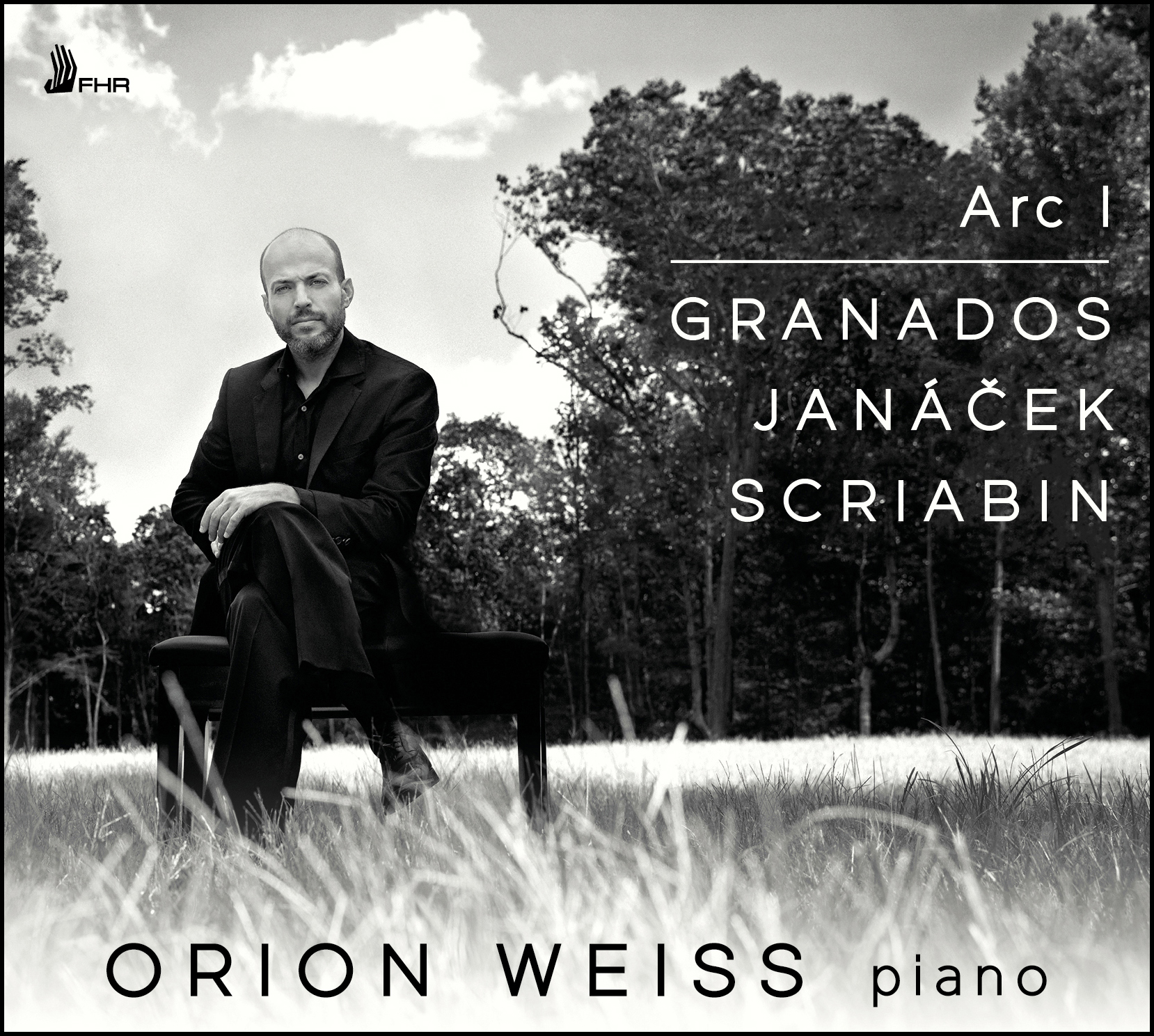
On Record – Orion Weiss: Arc 1: Granados, Janáček & Scriabin (First Hand Records)

Granados Goyescas Op.11 (1911)
Janáček In the Mists (1912)
Scriabin Piano Sonata no.9 in F major Op.68, ‘Black Mass’ (1913)

Orion Weiss (piano)

First Hand Records FHR127 [74’51”]
Producer David Frost; Engineer Silas Brown
Recorded 22-24 May 2014 at SUNY Purchase Performing Arts Center, New York

Reviewed by Richard Whitehouse

What’s the story?

First Hand Records issues the first instalment of another planned trilogy (see also The Future is Female with Sarah Cahill), the Arc series being a traversal by Orion Weiss across a century of piano music with intermittent forays into conceptually related pieces by earlier composers.

What’s the music like?

Focussing on music from before the First World War, this first volume is dominated (at least in terms of length) by Goyescas – the cycle of piano evocations in which Granados both paid homage to the illustrious Spanish artist, while extending the potential for large-scale formal design associated primarily with Liszt. That the composer subsequently transformed this into a one-act opera says much for the original’s motivic interconnections, such as Weiss further emphasizes throughout an interpretation in which characterization and cohesion are as one.

The listener is guided from teasing melodic interplay in Flattery, via the (mostly) confiding intimacy of Conversation at the Window then encroaching fear of separation in Fandango by Candlelight and its pained experiencing in Laments, or The Maiden and the Nightingale. A tragic climax arrives in the ballade Love and Death; after which, Serenade of the Ghost offers an ironic epilogue. Weiss renders this methodical yet visceral sequence with no mean insight, drawing out that pathos seldom far beneath the surface of Granados’s mature music.

If the Spanish composer was realizing his vision despite – or even because of – his success as composer and performer, In the Mists finds Janáček combating those vicissitudes of personal and professional failure. Hence the tonally and expressively oblique nature of its initial three sections, such as Weiss articulates with notable emphasis on their volatile mood-swings and frequent welling-up of emotion. All of this is duly thrown into relief by the final Presto with its gradual yet, as here, inexorable tendency towards ultimate fragmentation and dissolution.

Much has been written over the past century about those occult and even satanic connotations of Scriabin’s Ninth Sonata, whose Black Mass subtitle was only added after the event and at the prompting of another. Once again, it is the harnessing of such fluid and increasingly violent expression to a formal follow-through as precise as it is fastidious which gives this music its uniqueness. Weiss ensures an audibly cumulative build-up that, in the closing stages, achieves a claustrophobic intensity which could be considered liberating or annihilating as one prefers.

Does it all work?

Yes. Although it is not hard to locate alternative recordings for each of these pieces of at least comparable value, their juxtaposition within this context makes for a programme absorbing in its overt contrasts yet satisfying in its overall cohesion. Whether or not Weiss has performed this in recital, the trajectory towards an even greater self-absorption and inward intensity feels as inescapable as the presentiments of world conflict which lie behind much of what is heard here. Future volumes will doubtless offer a changing perspective and maybe a ‘way forward’.

Is it recommended?

It is. The sound has a lucidity and detail ideal for piano music from this period, with Weiss’s annotations succinct but also pertinent to his interpretations. This series is a notable addition to his extensive discography, further information about which can be accessed at his website.

Listen

For further information on this release, head to the First Hand Records website, and for more information on Orion Weiss, head to his website

In Appreciation – Lars Vogt

by Ben Hogwood

Yesterday we learned of the incredibly sad news that the pianist Lars Vogt had died, at the age of 51.

The warmth and appreciation of tributes paid to him from fellow artists yesterday evening testify to his warm personality, strength of character and great musicianship. Lars was diagnosed with cancer early in 2021, but even in his chemotherapy found that playing the piano channelled the most positive energy and feeling. Here, for instance, is a wonderful performance of Mozart’s Piano Concerto no.24 given as part of the Parnu Festival with the Estonian Festival Orchestra and Paavo Järvi.

Lars was an extremely versatile artist, either as a soloist, chamber musician or conductor. Regular partners included violinist Christian Tetzlaff and cellist Truls Mørk, while he took part in a formidable piano trio with Christian and cellist Tanja Tetzlaff. He also proved himself a conductor of some note from the keyboard, directing the Royal Northern Sinfonia from the piano in recordings of the concertos of Beethoven and Brahms, and the Orchestre de Chambre de Paris in the concertos of Mendelssohn.

His orchestral partners spoke of him with great warmth, and certainly his time in Newcastle with the Royal Northern Sinfonia was characterised by energetic, creative music making and seasonal planning. My own memories of solo performance run back to a spellbinding account of the Goldberg Variations at Wigmore Hall:

As a concerto soloist I also recall a memorable account of BrahmsPiano Concerto no.2 with the BBC Symphony Orchestra and Jiří Bělohlávek at the Proms:

At the same festival, I also recall a full-blooded account of the Bartók Violin Sonata no.1 with Christian Tetzlaff:

As a recording artist, Vogt enjoyed many peaks, mostly in the company of the Ondine label. The playlist below brings together just a section of these recordings, in the knowledge that a couple more are yet to be released.

He will be greatly missed, and we send condolences to all his family and friends. His lasting gift to us is in the form of recordings we will treasure greatly:

In concert – Soloists, CBSO Chorus, Czech Philharmonic Orchestra / Semyon Bychkov: Dvořák 8th symphony & Janáček Glagolitic Mass

220316_London_Barbican 2_WebRes_007_(c)_Petr Kadlec

Dvořák Symphony no.8 in G major Op.88 (1891)
Janáček Glagolitic Mass (1928 version)

Evelina Dobračeva (soprano), Lucie Hislcherová (alto), Aleš Briscein (tenor), Boris Prýgl (bass), Daniela Valtová Kosinová (organ), CBSO Chorus, Czech Philharmonic Orchestra / Semyon Bychkov

Barbican Hall, London
Wednesday 16 March 2022

Written by Ben Hogwood Photo credits Petr Kadlec

To hear the Czech Philharmonic Orchestra play Dvořák is surely one of classical music’s great pleasures. It was Dvořák who conducted them in their first ever concert, and for the second instalment of their Barbican visit Semyon Bychkov chose to programme his Symphony no.8, a work surely written with the spring season in mind.

The Eighth gets a slightly raw deal, sandwiched in Dvořák’s published output between the critically acclaimed Seventh and the ubiquitous Ninth, the New World. This is a shame because the joyous melodies and persuasive dance rhythms are a celebration of life itself, the composer glorying in the outdoor spaces of the Bohemian countryside. Melodic invention abounds throughout the four movements, and this performance gave room to the delightful swagger of the outdoor tunes, while retaining an elegant, almost Schubertian profile. Perhaps unexpectedly there were also pointers towards early Sibelius, the vivid natural scenes laden with intensity and fulsome orchestration.

The Czech Philharmonic wind section were the stars of this performance, with a sunny flute in the opening pages and some outstanding clarinet playing in the Adagio. Not to be outdone, the strings offered a cushion of sound as springy as the forest floor itself, while bright trumpets energised the fanfare at the start of the finale. The elegance of the cellos’ theme at the start of the first movement and the violins’ graceful way with the Intermezzo were two of many memorable moments from the strings. Bychkov judged the work’s profile to perfection, and there were many smiles among orchestra and audience alike as each new melody made itself known.

A very different mood prevailed for the second half, where celebration came at a cost. Janáček‘s Glagolitic Mass remains a work of extraordinary intensity, stretching its performers to the limits of their range and veering wildly between adulation and strife.

The CBSO Chorus were on heroic form throughout. Superbly marshalled and prepared by chorus director Simon Halsey, organist Julian Wilkins and conductor / pianist Lada Valesova, they sang as one, nailing the tricky ‘Old Church Slavonic’ pronunciations with apparent ease – in particular the distinctive ‘Amin, amin’ refrain of the Gloria. The Credo, the beating heart of this piece, had a white-hot intensity while leaving room for interpretation on the composer’s own religious feelings. By contrast the miraculous chord on which the Agnus Dei often hangs was truly celestial, ideally voiced and weighted. Its introduction was chilling indeed, strings and brass icy to the touch.

The Glagolitic Mass is a tough gig for its four vocal soloists, who have little room in which to make an impact, but the quartet here largely caught its operatic dimensions. If soprano Evelina Dobračeva seemed a little withdrawn initially she soon found her footing. Tenor Aleš Briscein, the highest of high priests, was commendably secure in his intonation but appropriately edgy as Janáček’s writing pushed the limits of the vocal range. Boris Prýgl offered fulsome support as bass soloist, as did alto Lucie Hislcherová in her brief appearance. Organist Daniela Valtová Kosinová, on the other hand, made the most of her instrument’s crucial role, launching into a Postludium of fearsome strength and wildly irregular rhythm. The instrument was well balanced through the Barbican speaker system, Kosinová’s feet a whirl as they kept up with Janáček’s demanding bass part, before those two damning final chords of the crucifixion. Bychkov encouraged the feverish violins through an Intrada that, while ultimately triumphant, only heightened the searing intensity of what had gone before.

Both these national statements felt so appropriate for the times, celebrating freedom of movement but also the power – and cost – of faith. As with the first night performances Bychkov eloquently dedicated the music to the people of Ukraine, before a performance of the country’s national anthem. It is hard to think of two more appropriate or contrasting accounts, and the Czech Philharmonic and their principal conductor deserve the utmost credit for two nights of unrivalled artistic brilliance.

You can listen to the repertoire in this concert by using the Spotify playlist below, which includes the Czech Philharmonic Orchestra‘s recent recordings of both works for Decca, made under their previous and sadly missed principal conductor Jiří Bělohlávek:

In concert – Laura van der Heijden & Jâms Coleman @ Wigmore Hall – Pohádka: Tales from Prague to Budapest

Laura van der Heijden (cello), Jâms Coleman (piano)

Janáček Pohádka (1910, rev. 1912-23)
Dvořák Gypsy Songs Op. 55: Songs my mother taught me (1880)
Kaprálová Navždy from Navždy Op. 12 (1936-7)
Mihály Movement for cello and piano (1962)
Kodály 3 Songs to Poems by Bela Balazs Op. posth.: Why are you saying that you do not love me (1907-9); Énekszó Op. 1: Slender is a silk thread (1907-9)
Sonatina for cello and piano (1909)
Janáček Violin Sonata (1914-15, rev.1916-22)

Wigmore Hall, London, 9 March 2022

reviewed by Ben Hogwood Pictures (c) Olivia Da Costa (Laura van der Heijden), Sim Canetty-Clarke (Jâms Coleman)

It bears repeating that times are tough for new artists in music. Competition is fierce, while opportunities for live performance and recording have been severely hampered over the last two years of lockdown and pandemic restrictions. How refreshing, then, to talk about two new artists, a long term agreement with Chandos and a chamber music album notable for its originality and depth of expression.

The new artists, cellist Laura van der Heijden and her musical partner, pianist Jâms Coleman, have been performing together since 2017. Their debut album, for which this concert was an official launch, looks at music from Central and Eastern Europe with its roots in folk, either written directly for cello and piano or falling naturally into a vocal range.

The album shares its title, Pohádka, with a three-part fairy tale for cello and piano by Janáček, based on a Russian tale. This began the concert, a picture book performance bringing the story to life with sharp characterisation and flair. Janacek used a good deal of his music to explore macabre storylines and this was no exception, though the lighter, more lyrical moments were good fun. van der Heijden’s tone was sonorous and projected easily to the back of the hall, while Coleman’s stylish playing was capped with limpid work in the second section.

We then heard arrangements of two songs from Dvořák and Vítězslava Kaprálová as an idea complement, the former transcribing beautifully from voice to cello, with tasteful ornamentation from the cello. It was good to hear more of Kaprálová, a talented Czech composer who tragically died from tuberculosis when she was just 25. Her music immediately cast a spell, Coleman’s mysterious chords matched by a remote but moving line from the cello in its higher register.

Different qualities were required for the music of Hungarian composer and conductor András Mihály. His Movement for cello and piano was a dramatic rollercoaster, and rather volatile at times – reflecting perhaps the differing styles at play in modern music when it was written in 1962. While there were undoubtedly elements of Bartók and even Webern in the music’s contours, which veered into atonality at times, there was a fierce expression suggesting Mihály’s music should be explored further. Both players responded with a terrific performance, mastering the technical demands.

Zoltán Kodály was also an influence on Mihály, and his music suits the cello hand in glove, whether in large-scale sonatas or shorter, folk-informed songs. We heard two songs here, the cello a doleful voice for Why are you saying that you do not love me, while Slender is a silk thread found Coleman beautifully spinning out the silvery tale. However the single-movement Sonatina for cello and piano, at just under 10 minutes, made a lasting impression with its passion, profound lyricism and subtle melancholy. The performers’ love for this piece was clear, and the high voltage account found them finishing each other’s musical sentences.

The same could be said for Janáček’s Violin Sonata, a pungent piece whose proximity to World War One is evident in the rapid fire of its phrases. The composer’s unusual musical language was once again wholly compelling, with broad lyrical statements countered by strange, abrupt full stops to his melodies. The parallels with the current situation in Ukraine were impossible to ignore, especially with the emotion both players brought to the second movement Ballada, its sweeping melodies reaching skyward. Ultimately the acidic third and fourth movements cast a cloud over the mood, the players vividly depicting the distant sound of gunfire alongside more thoughtful introspection. van der Heijden was commendably modest about her own arrangement of the Sonata, for cello and piano, an extremely successful version losing none of the intensity or fractious treble phrases. Both players were superb, their virtuosity and togetherness notable throughout.

This was an extremely rewarding concert, energetic and romantic in turn but also thought-provoking through its wartime undercurrents. Laura van der Heijden and Jâms Coleman deserve great credit for their refreshing take on a chamber music album, which bodes well for their ongoing relationship with one of Britain’s best classical independents. Theirs is a partnership to watch closely.

Watch and listen