Centenary post – Elgar: Cello Concerto

Today is the centenary of one of Sir Edward Elgar‘s best-loved works, first performed on this day in 1919. It was not always that way for the Cello Concerto in E minor, however, as an under-rehearsed premiere may well have contributed to a gap in London performances of more than a year.

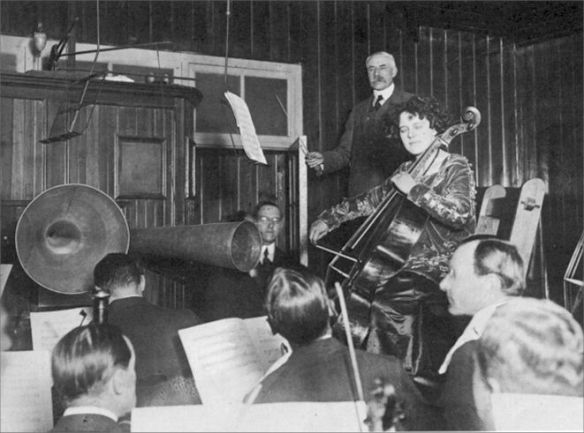
The first performance took place with soloist Felix Salmond, Albert Coates conducting the London Symphony Orchestra. The first cellist to really further the concerto’s cause was Beatrice Harrison, seen above with Elgar in an early recording from 1920. Her official recording with the composer from 1928 can be heard on the playlist below.

Again the work fell into disregard, possibly on account of its darker autumnal hues. The melodies came to Elgar in the aftermath of a painful operation on his tonsils, and while he could hear the sound of fighting in the First World War across the English channel.

It was not really until 1965 that the work reached regular public consumption, thanks to a searing recording by the young Jacqueline du Pre, with the London Symphony Orchestra this time under Sir John Barbirolli’s direction (also on the playlist). This recording preserved du Pré’s reputation as a cellist of great passion and technique, with the considerable help of a seasoned Elgarian in Barbirolli behind the orchestral ‘wheel’. It also apparently convinced a certain Mstislav Rostropovich not to become better acquainted with the piece.

More recently the Cello Concerto has become widespread, most recently with a first night performance at the Proms from Sol Gabetta and an appearance at this year’s season from Sheku Kanneh-Mason.

Gabetta’s recorded version is also on the playlist, with Mario Venzago conducting the Royal Danish National Orchestra. It appears along with two very fine accounts from Julian Lloyd Webber – with the Royal Philharmonic Orchestra and Yehudi Menuhin – and Steven Isserlis, his first recording of the work made with the London Symphony Orchestra and Sir Richard Hickox:

More recently Isserlis has revisited the work with Paavo Jarvi conducting the Philharmonia, a fine account about which he talked to Arcana here.

The Cello Concerto was Elgar’s last major work, completing an intriguing late set of compositions including the Violin Sonata and String Quartet, which share the concerto’s key of E minor, and the wonderful Piano Quintet in A minor. Those four works can be heard on the playlist below:

For a visual treat, though, you can enjoy Jacqueline du Pré’s playing here – not with Sir John Barbirolli but with her husband Daniel Barenboim, conducting the London Philharmonic Orchestra:

Live review – London Symphony Orchestra / Sir Simon Rattle: Stravinsky, Birtwistle & John Adams

London Symphony Orchestra / Sir Simon Rattle (above)

Barbican Hall, London
Thursday 2 May 2019

Stravinsky Symphonies of Wind Instruments (original version) (1920)
Birtwistle The Shadow of Night (2001)
John Adams Harmonielehre (1985)

Written by Ben Hogwood

These days attending a London Symphony Orchestra concert brings with it a guarantee of intriguing programming and breathtaking musicianship. This one had a real ‘darkness to light’ demeanour, moving from the blacker than black recesses of Sir Harrison Birtwistle to the wide open, sunlit panoramas created by John Adams.

Before that, a composer whose influence could be keenly felt in the music of both composers. Stravinsky made many innovations in pieces other than his celebrated Rite of Spring, and Symphonies of Wind Instruments could certainly be regarded as one of his most original. With the term ‘symphony’ interpreted through its original meaning, the ‘concord of sound’, Stravinsky proceeds to build an innovative one-movement piece that contrasts busy movement with still reflection.

The instrumentation is fascinating, especially in the original version, which uses alto clarinet and alto flute. It explains the simply wonderful sounds made by the 24-piece London Symphony Orchestra wind and brass, the rich chords often baleful and downcast (the piece is a memorial to Debussy) but the faster music sprightly and energetic. A better performance of this piece would be hard to imagine, energetically guided by Sir Simon Rattle.

The music of Sir Harrison Birtwistle continues to split opinion. For this particular listener it is not an easy prospect, and I confess to having developed headaches in previous performances of Earth Dances and Neruda Madrigales, while admiring The Moth Requiem and Silbury Air. I therefore approached The Shadows of Night with some trepidation, but found it an ultimately rewarding score, its heavy darkness punctuated by relieving solos of glittering light from bassoon and E-flat clarinet, where Chi Yu Mo was simply superb.

Birtwistle’s colouring of the lower regions of the string orchestra is particularly fine, and the first five minutes were a sonic wonder to behold, as though the Barbican had opened up into a monstrous cave. Then the piccolo stated a John Dowland song, In Darkness Let Me Dwell, after which the piece lumbered through a number of sections with gathering tension. Once this was released the clarinet worked its magic, and Rattle set us down in a heap for the interval.

Following Birtwistle with John Adams was like throwing open the curtains to greet a sun-splashed new morning, and the LSO sparkled with what seemed to be new-found freedom. Harmonielehre delights in tonality, politely rejecting Schoenberg’s treatise of the same name to power forward with terrific rhythmic impetus and walls of consonant harmonies. Within themselves these create some exquisite dissonance and colour, with the brass and percussion in particular shining through. Rattle has this piece under his skin, having recorded it with the CBSO in 1993, and if anything his interpretation has gained speed and electricity. as the composer himself noted on Twitter!

The audience were swept up in the cumulative power and energy of the piece, particularly in its closing section, which carried all before it. Of all the prominent exponents of minimalism, Adams has the most effective orchestral writing, and his clear signposts of influences (Sibelius Symphony no.4, Stravinsky, Debussy and even Britten) were all used to original effect. It was an invigorating close to a terrific concert.

Further listening

The music from this concert can be heard on the Spotify playlist below:

You can read Sir Harrison Birtwistle’s thoughts on The Shadow of Night at his publisher Boosey & Hawkes’ website, and John Adams talks about Harmonielehre on his own webpage

Live review – Leonidas Kavakos, LSO / Sir Simon Rattle: Brahms, Debussy & Enescu

Leonidas Kavakos (violin, above), London Symphony Orchestra / Sir Simon Rattle (below)

Barbican Hall, London
Sunday 16 December 2018

Brahms Violin Concerto in D major Op.77 (1878)
Debussy Images (1905-12)
Enescu Romanian Rhapsody no.1 in A major Op.11/1 (1901)

Written by Richard Whitehouse

Sir Simon Rattle and the London Symphony Orchestra tonight continued their ‘Roots & Origins’ project with a diverse programme ranging from the innate classicism of Brahms, through the refracted (post-)impressionism of Debussy then on to the unaffected nationalism of Enescu.

A change in the running order saw a first half devoted to Brahms’s Violin Concerto – easy to pigeon-hole as archetypally Austro-German, though fairly permeated with elements derived from popular and traditional sources. Nor did Leonidas Kavakos deliver a bland or uneventful account, maintaining palpable momentum across the expansive initial movement that carried through to an uncommonly perceptive take on Joachim’s monumental cadenza, followed by an easeful coda in which the symbiosis between soloist and orchestra was at its most tangible.

While there was no undue lingering in the Adagio, Kavakos brought out its gentle eloquence in full measure – abetted by playing of burnished warmth from the LSO’s woodwind, though there was no lack of agitation in the contrasting central section. The Hungarian overtones of the finale were then given full rein, Kavakos projecting the music’s rhythmic drive as surely as he propelled the coda to its effervescent close. Throughout this performance, Rattle was at one with his soloist in a work he has no doubt given many times during the past four decades.

A dynamic and vividly projected reading, then, from Kavakos (very different from the inward and almost self-communing one he gave during last year’s Enescu Festival), who returned for a predictably scintillating account of the Les furies finale from Ysaÿe’s Second Solo Sonata.


Debussy’s Images has long been a Rattle staple: his running-order differs from that published – though there is arguably no ideal sequence for such a contrasting assemblage. Certainly, the fatefully understated Gigues makes a plausible opening, its fugitive gestures and searching ambivalence more an evocation of the composer in his last years as of any English environs. Rondes de printemps is the positive corollary, its vernal freshness and simmering energy an indication of that renewal in French culture made explicit by the late sonatas. In both pieces, Rattle secured a superfine response from the LSO and if characterization in Ibéria was less acute, this may have been owing to the music’s broad-brush Spanish quality than to any lack of insight. Not in doubt was the cohesion that Rattle drew from this composite work overall.

Cohesion was also key to his performance of Enescu’s First Romanian Rhapsody. More than a medley of popular tunes, its integration is that of a borne symphonist and Rattle responded accordingly as he built momentum across the suave initial episodes before cutting loose with the bacchanal. The degree of detail lost was outweighed by the visceral excitement that held good through to the coda. A piece associated with Rattle since the early 1980s, and of which the LSO gave a memorable televised reading a decade earlier, ended this concert in fine style.

The question remains why Rattle has never added further Enescu to his repertoire. Perhaps he considers him lesser to Szymanowski, whom he has championed assiduously? Pieces such as the Second Symphony, Third Suite and Vox Maris cry out for his advocacy. Maybe one day?

For more information on forthcoming concerts from the London Symphony Orchestra in 2019, you can visit their website. Meanwhile you can enjoy Kavakos in a recent performance of the Brahms Violin Concerto below:

https://www.youtube.com/watch?v=V0mITH06iFs

On record: Magdalena Kozená, Christian Gerhaher, LSO / Sir Simon Rattle – Debussy: Pelléas et Mélisande (LSO Live)

Debussy Pelléas et Mélisande

Magdalena KozenáChristian Gerhaher, Gerald Finley, Bernarda FinkFranz-Josef Selig, Joshua BloomElias Madlër, London Symphony Chorus and Orchestra / Sir Simon Rattle

LSO Live LSO0790 (three SACDs and one Blu-ray, 160’46”)
Producer James Mallinson Engineers Jonathan Stokes, James Hutchinson
Dates Live performances at Barbican Hall, London on January 9th and 10th, 2016

Reviewed by Richard Whitehouse

What’s the story?

Sir Simon Rattle and the London Symphony Orchestra release their first opera collaboration on the LSO’s label. Debussy’s Pelléas et Mélisande is a work Rattle has conducted often (including London and Salzburg), and the present account confirms his identity with this most elusive of operas.

What’s the music like?

Premiered in 1902 after a genesis of almost a decade, Pelléas et Mélisande is Debussy’s only completed opera and his treatment of Maurice Maeterlinck’s symbolist drama is a high point of musical impressionism. This recording is derived from two performances at Barbican Hall, shorn of Peter Sellars’ ‘platform staging’ but its partial re-seating of the orchestra evident in numerous instances of balance. The result is to emphasize dramatic extremes, though without necessitating extremes of tempo in what is otherwise a finely integrated reading of real poise.

The cast is a strong one, and such reservations as there are centre on the title-roles. A model of clarity and lucidity, Christian Gerhaher is arguably too self-contained to convey fully the emotional eloquence of a figure whose actions can seem almost involuntary. No less secure technically, Magdalena Kožená is elegant if at times rather generalized in her assumption – rendering the notes with unerring accuracy yet not always conveying the inner radiance of one whose presence should be disconcerting through its very intangibility and equivocation.

Gerald Finley’s is among the finest recorded Golaud – conveying his moroseness and anxiety with palpable conviction though retaining a vital degree of empathy, while Franz-Josef Selig makes of Arkel a nobler and more substantial figure than is too often the case. Bernarda Fink brings warmth and pathos to the (too?) brief role of Geneviève, with Joshua Bloom shining in his cameos as the Doctor and Shepherd, but Elias Mädler is a little too mature in timbre to be ideal for Yniold – his exchanges with Golaud a heart-rending instance of innocence corrupted.

The London Symphony Chorus acquits itself admirably during its brief contribution, with the LSO playing as well as it has done for its new Music Director in terms of fastidiousness and subtlety; climactic peaks thereby feeling the more acute for their rarity. Compared to that of his Royal Opera staging, Rattle’s conducting is freer and less inhibited – touching on a wide expressive range without sacrificing attention to detail. Each of these five acts is shaped with scrupulous regard to the action at hand while being responsive to the emergent overall drama.

Does it all work?

Indeed, for all that Pelléas et Mélisande already has an extensive and impressive discography. Roger Desormière’s 1942 recording (Warner) remains the interpretative benchmark – while, among the more recent accounts, Claudio Abbado (DG), Bernard Haitink (Naïve) and Pierre Boulez’s DVD (DG) all have serious claims on the listener. Presentation over three SACDs and one Blu-ray, with the booklet containing a succinct introduction, synopsis and bilingual libretto, is unexceptionally fine – as also the sound, if with little sense of a tangible acoustic.

Is it recommended?

Yes, though the absence of a visual component on the Blu-ray might be thought something of a missed opportunity. Something LSO Live might like to reconsider before issuing Ligeti’s Le Grand Macabre, the next Rattle/Sellars/LSO project which is due in the coming months.

You can read more about this release at the LSO Live website, or you can listen on Spotify below:

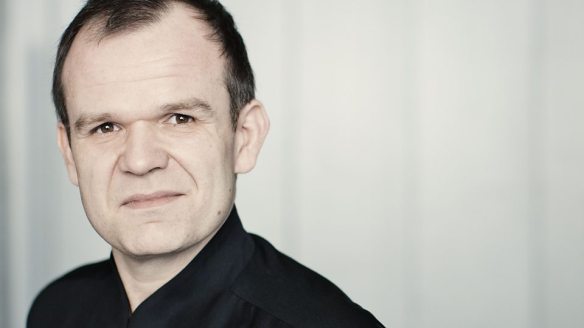
London Symphony Orchestra / François-Xavier Roth: Half-Six Fix – Stravinsky & Debussy

London Symphony OrchestraFrançois-Xavier Roth (above)

Half-Six Fix

Stravinsky Le chant du rossignol (1917)

Debussy La Mer (1903-1905)

Barbican Hall, London; Wednesday 28 March 2018

Written by Ben Hogwood

The London Symphony Orchestra’s new Half-Six Fix initiative went ‘live’ with this Stravinsky / Debussy double header; a concert full of colour and mutual appreciation for two of the 20th century giants.

A more relaxed approach was immediately evident on arrival at the Barbican for the early evening hour of music. Downloading the EnCue app gave audience members a stream of content at their disposal, with comprehensive notes on the two pieces as well as artwork and cues for the performances themselves.

Interestingly during the concert I did not witness anybody using their phone in this way – which in a sense was encouraging, for everyone was in thrall to the performers themselves. The other major disadvantage with reading concert notes on a mobile phone is the distraction of notifications from elsewhere. Surely one of the great advantages of live music is that it takes you to a special place away from everyday life! That said, the resources available do also give the option for reading between pieces, and were of a high quality to make them fully worthwhile.

Our compere for the evening was François-Xavier Roth and he was the ideal host, introducing the pieces with a nice line in respect and humour. The use of musical examples with the orchestra was helpful – flautist Gareth Davies showed off Stravinsky’s Le chant du Rossignol, while it was nice to see glockenspiel and cymbals promoted to the front line so that we could appreciate Debussy’s masterly use of the orchestra in La mer.

The performances were superb. Le chant du Rossignol had rhythmic precision and musical finesse, telling the story of the nightingale and the efforts of its Japanese imitators to emulate its song in vivid, widescreen technicolour. Stravinsky’s inspiration in this piece was revealed to be very close to Petrushka, and Roth conducted a performance that brought the melodies to the front but emphasised some wonderful textures conjured up in the middle foreground. There were visuals, and fleeting glimpses of solos, but it seemed the LSO had not fully decided whether to show the orchestra in full or images derived from the piece, settling for a halfway approach which was fleetingly helpful.

Watching the orchestra was definitely enough – their standard these days is as high as ever, and if anything was even better for La mer. Clearly this is one of Roth’s first loves, and from a seat near to the orchestra you could practically feel the spray as the orchestra dived in.

Tempo choices were on the whole assertive but never at the expense of detail and expression, and when the final swell came in the third movement, Dialogue du vent et de la mer (Dialogue of the wind and the waves).

Roth is an ideal host for this sort of evening, which can be wholeheartedly recommended, a case of quality winning over quantity – and it is pitched at a level where everyone present, from the first time attendee to the hundredth, will learn something new and get a fresh perspective. A great initiative for opening the mind to classical music in a more relaxed setting.