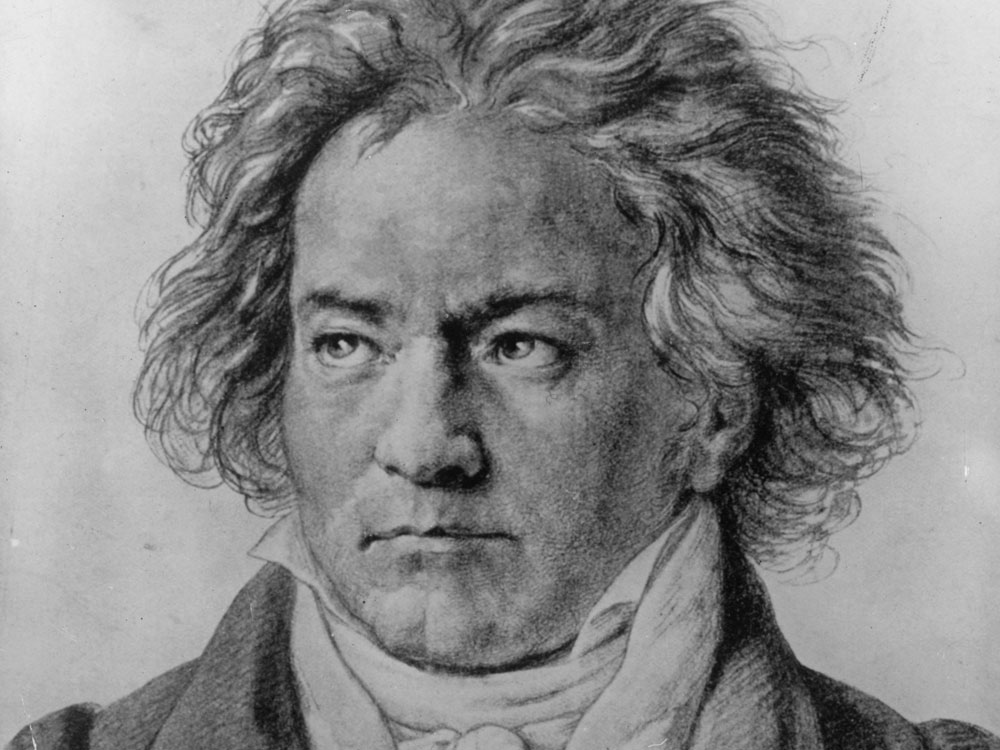
Listening to Beethoven #208 – Symphony no.3 in E flat major Op.55 ‘Eroica’


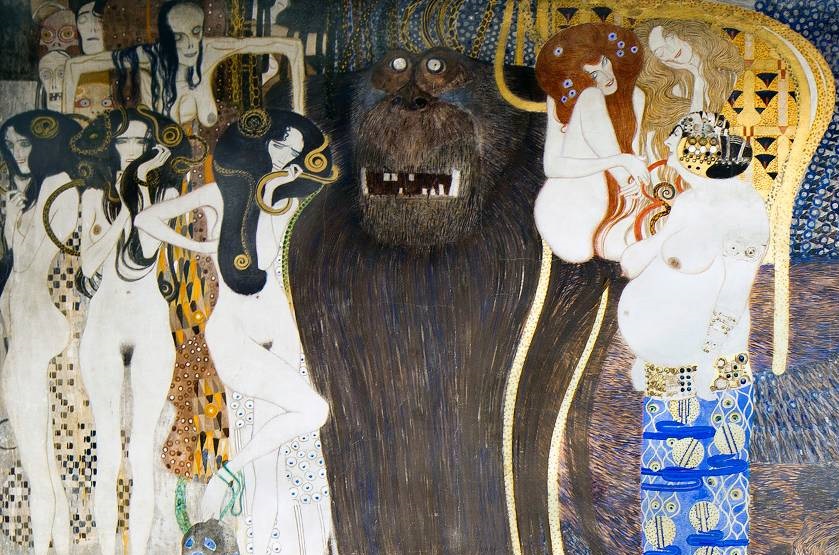
The Hostile Powers. Far wall, detail from the Beethoven-Frieze (1902) by Gustav Klimt

Symphony no.3 in E flat major Op.55 ‘Eroica’ for orchestra (1800-1802, Beethoven aged 31)

Dedication Prince Joseph Franz Maximilian Lobkowitz
Duration 48′

1. Allegro con brio
2. Marcia funebre: Adagio assai
3. Scherzo: Allegro vivace
4. Finale: Allegro molto

Listen

Background and Critical Reception

In October 1803, when Beethoven had completed his third symphony, his world was about to change. His friend, the composer Ferdinand Ries, declared, “In his own opinion, it is the greatest work he has yet written. Beethoven played it to me recently, and I believe that heaven and earth will tremble when it is performed.”

Jan Swafford dedicates a compelling chapter to this work, which was to be one of the very first ‘program’ symphonies. Its dedicatee was to be Napoleon Bonaparte, but in a daring step his heroic character and achievements were to be the subject of Beethoven’s symphonic thoughts, built as they were on thematic cells from music previously written to celebrate Prometheus. Rather than be called Bonaparte, however, the Third took the term Eroica, for Beethoven was horrified by Napoleon’s proclamation as Emperor in May 1804. This was the nickname applied when the symphony was published in October 1806, with the dedication changed to Prince Lobkowitz.

Swafford presents a thoroughly absorbing dissection of the piece in his book, showing how Beethoven’s seemingly innocent sketches and musical cells take wing, blossoming into seamless 20-minute sections of music. The fourth movement, a theme and variations, takes its lead from a melody already used in Die Geschöpfe des Prometheus, completed in 1801, and also from the Eroica Variations for piano.

As Swafford writes, Beethoven “is more interested in flow than in eighteenth-century formal clarity”. At the end of the Eroica’s first movement, “the hero has come into his own, but his task is unfinished”. The symphony is now telling its story about an explicit subject, not just looking to impress on musical terms.

This first movement has a scale and ambition not seen before, as does the second movement funeral march. Berlioz, writing of the whole work, surely had this movement in mind when he declared, “I know few examples in music of a style in which grief has been so consistently able to retain such pure form and such nobility of expression.” The third movement continues Beethoven’s move away from the classical minuet towards the full-blown symphonic scherzo of the 19th century, but it is the finale where all Beethoven’s thoughts are clearly headed.

Swafford explains how Beethoven’s thoughts always had this movement at the head of proceedings, with finale-weighted works still relatively rare at the time. He applauds Beethoven’s innovations for the orchestra, with writing for horns and cellos of a standing not previously experienced. Barry Cooper declares this movement “an extraordinary fusion of musical arts, including variation, fugue, march and slow procession, in a symphonic finale of unprecedented formal complexity despite the apparent simplicity and regularity of its main theme. No wonder Beethoven’s admirers were so thrilled by the work, and the general public so perplexed.”

They were indeed, as Alexander Thayer recounts the puzzlement of an early appraisal. “The reviewer belongs to Herr van Beethoven’s sincerest admirers, but in this composition he must confess that he finds too much that is glaring and bizarre, which hinders greatly one’s grasp of the whole, and a sense of unity is almost completely lost.” Swafford has its measure, however. “The final pages are what the unfulfilled end of the first movement was waiting for, the true victory, the completion of the Hero’s task.”

Thoughts

It is rare indeed to be able to pinpoint an exact moment where art moves from one chapter to the next. Beethoven’s Eroica symphony gives us one such moment, a pivot where the whole notion of the symphony changes for ever and the composer strides forward to a new plain.

So many things about this work are new, exciting, and – for the time – dangerous. The first change is length, for this work often clocks in at near to 50 minutes if the repeats are used, twice the length of a Haydn or Mozart symphony. The first two movements alone are half an hour, making Beethoven’s first two symphonies feel like mere warm-ups in comparison. We also have an increasingly large orchestra to go with the bigger structures, and instruments such as the horn, oboe and cello take on an unprecedented status for their time.

Something is up right from the two brisk chords at the start, a call to attention before the main theme itself. The cellos get their moment, setting the heroic nature of the music in E flat major – which is, as we have seen, one of Beethoven’s key centres for power and positivity. As the massive first movement progresses, the composer goes through intricate yet wholly logical forms of developing his material. There is a new level of emotion here too, for this is a symphony from the heart. Its resolve gives the listener a mental picture of Beethoven beating his chest, giving himself a motivational call to arms as part of an emergence from the terrible days and morale of the Heiligenstadt testament.

The second movement, a funeral march, is one of the most profound utterances we have yet heard from Beethoven. This is the first time he has used the orchestra for such sombre means, other than a few isolated passages in the early cantatas, and the depth of feeling is well beyond previous symphonic thought, bringing closely guarded emotions from the intimacy of the piano to the wide open canvas of the orchestra. This is also a long movement, but the tension is sustained throughout. We feel Beethoven’s grief, his wounds, and also, in the C major ending, a semblance of hope.

The Scherzo picks up on this, easing the tension with its initial subject. It packs a punch recalling the heroism of the first movement, especially with the no-nonsense syncopations. No notes are here for the sake of it, all are fulfilling what feels like an inevitable destiny.

The finale, as Jan Swafford observes, brings everything to a head in a climactic fourth movement not experienced since Mozart’s Jupiter symphony. Few symphonic finales are as thrilling, as Beethoven assembles his melodic material and the music grows in stature at every turn, coming to a peak with a triumphant horn theme. The theme ends with a cadence that shows how Beethoven’s harmonic thinking is advancing with every piece – and indeed caps the sharp dissonance experienced near the start of the first movement. With this and many other elements, you can only imagine what the first audience would have thought, having grappled with the sheer scope of the first three movements. Where was this composer going with his music? Can we take the plunge with him? We will soon find out!

Spotify playlist and Recordings used

NBC Symphony Orchestra / Arturo Toscanini (RCA)
Cleveland Orchestra / George Szell (Sony Classical)
Orchestra of the Eighteenth Century / Frans Brüggen (Philips)
Berliner Philharmoniker / Herbert von Karajan (Deutsche Grammophon)
Vienna Philharmonic Orchestra / Claudio Abbado (Deutsche Grammophon)
Danish Chamber Orchestra / Ádám Fischer (Naxos)
Minnesota Orchestra / Osmo Vänskä (BIS)
Berliner Philharmoniker / Rafael Kubelik (Deutsche Grammophon)
Anime Eterna Brugge / Jos Van Immerseel (ZigZag Territories)

The recorded history of the Eroica deserves a much longer article, but safe to say the versions included here represent part of the vast array of available recordings. The smaller scale takes, such as Dausgaard, have plenty to say, as do the lavish accounts from Karajan and dfgd, where the score’s latent power is always in evidence. Accounts from Vänska and dfgd forge a middle ground, while the ‘period instrument’ versions from Brüggen and Jos van Immerseel give us a sense of what the first audience might have experienced, with thrillingly rough edges to the sound and the melodies.

To listen to clips from the recording from the Scottish Chamber Orchestra conducted by Sir Charles Mackerras on Hyperion, head to their website

You can chart the Arcana Beethoven playlist as it grows, with one recommended version of each piece we listen to. Catch up here!

Also written in 1803 Haydn String Quartet in D minor Op.103 (unfinished)

Next up Notturno for viola and piano in D major, Op.42
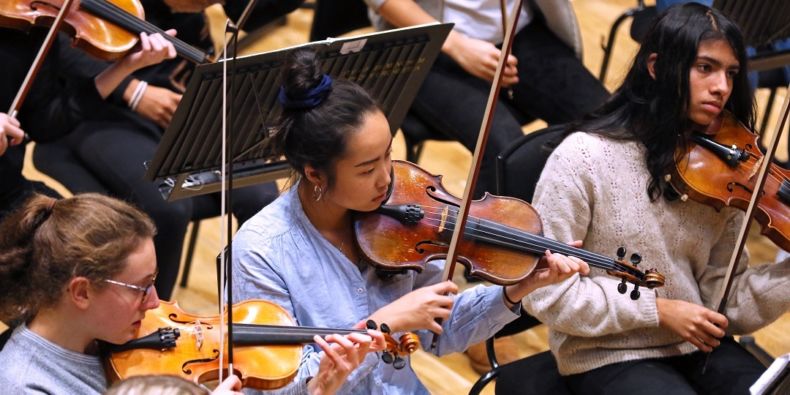
In concert – CBSO Youth Orchestra Academy: A Fist Full of Fives

cbso-youth

Sutton A Fist Full of Fives (2016)
Mozart
Violin Concerto no.5 in A major K219 ‘Turkish’ (1775)
Skalkottas
Five Greek Dances (1931-6, arr. 1936)
Beethoven
Symphony no.5 in C minor Op.67 (1804-8)

Irène Duval (violin), CBSO Youth Orchestra / Michael Seal

Royal Birmingham Conservatoire
Saturday 23 July 2022

Written by Richard Whitehouse

It may be the end of the main season, but that is no reason why the CBSO Youth Orchestra should not have had a concert scheduled for mid-July, with this judiciously contrasted and well-balanced programme assuredly playing to the collective strengths of its present line-up.

Although three of the works had a numerical connection with ‘five’, only the opening piece featured that number in its title. Written for an event featuring Beethoven’s Fifth and scored for similar forces, A Fist Full of Fives finds Adrian Sutton essaying a concert-opener whose interplay of vigorous (even a little martial) and more lyrical ideas evokes a mid-20th century American music evoking Piston or early Carter. Fluent and appealing if far from memorable, it duly put the orchestra through its paces to a degree which the CBSOYO met with alacrity.

Rather more memorable was the Five Greek Dances by Skalkottas which opened the second half. Admittedly the programme note led one to expect a selection from the overall 36 in the versions for full orchestra, rather than the present selection – from a set of seven – for strings. Yet the distinctive character of each dance is hardly diminished in these arrangements by the composer (a proficient violinist), and Michael Seal secured notably characterful playing in a sequence that proceeded from the swaggering Epirotikos, through the stealthy interplay of Kretikos and the bracingly astringent Tsamikos, to the gentle pathos of Arkadikos then the dashing Kleftikos. Fifty years after the CBSO’s world premiere of his First Symphonic Suite, it was good to hear these likely successors tackling Skalkottas with evident enjoyment.

In between those two pieces, Irène Duval gave Mozart’s Fifth Violin Concerto – not exactly underplayed these days, but worth hearing when rendered with such commitment. Not least an opening Allegro whose aperto marking (rightly) encouraged a deftness of phrasing that carried through to the closing bars. The Adagio was ingratiating without any hint of cloying, then the outer sections of the Rondeau an insouciance for which the lively Turkish music at its centre provided a bracing foil. The cadenzas (Duval’s own?) proved unfailingly apposite.

Closing the concert, Beethoven’s Fifth Symphony made a suitably unequivocal impression – not least an opening movement whose rhythmic trenchancy and purposeful rhetoric carried through to a forceful if never hectoring coda. Neither was there any hint of false grandeur in the Andante, its ruminative theme yielding subtlety and not a little humour as it wended its methodical yet never predictable course. Ensemble was a little ragged near the outset of the scherzo, but the transition into the finale had a simmering expectancy that made the latter’s blazing onset more visceral. This music’s familiarity tends to detract from its innovation of form and orchestration, but Seal pointed up such aspects in a reading that never risked losing focus as it headed to a coda whose reiterations of the home key made for a triumphal QED.

A worthwhile programme, then, with performances to match and exactly the sort of concert needed to inject needed impetus into the indolence of summer. The CBSOYO makes its first appearance next season with a programme of Verdi, Bruch and Lutosławski on October 30th.

For more information on the CBSO Youth Orchestra and their next concert, visit the dedicated page on their website. Click on the names for more information on Irène Duval and Michael Seal

Talking Heads – Jennifer Kloetzel

Arcana has an audience with cellist Jennifer Kloetzel, on Zoom from Nebraska. Kloetzel and pianist Robert Koenig have been spending a good deal of time with the music of Beethoven, and the fruits of their labours have just been released to critical acclaim by Avie. Beethoven: The Conquering Hero is a trible album bringing together all of the composer’s works for cello and piano. It is the completion of a long-held dream for the cellist, whose enthusiasm for her project bubbles over from the off.

“I’m still celebrating!” she says of Beethoven 250, the composer’s bicentenary having been cruelly cut up by the pandemic. “This album was supposed to be released right after the 250, but we got waylaid by the pandemic, and couldn’t get into the studio to finish. I don’t think Beethoven would care that we were late though!”

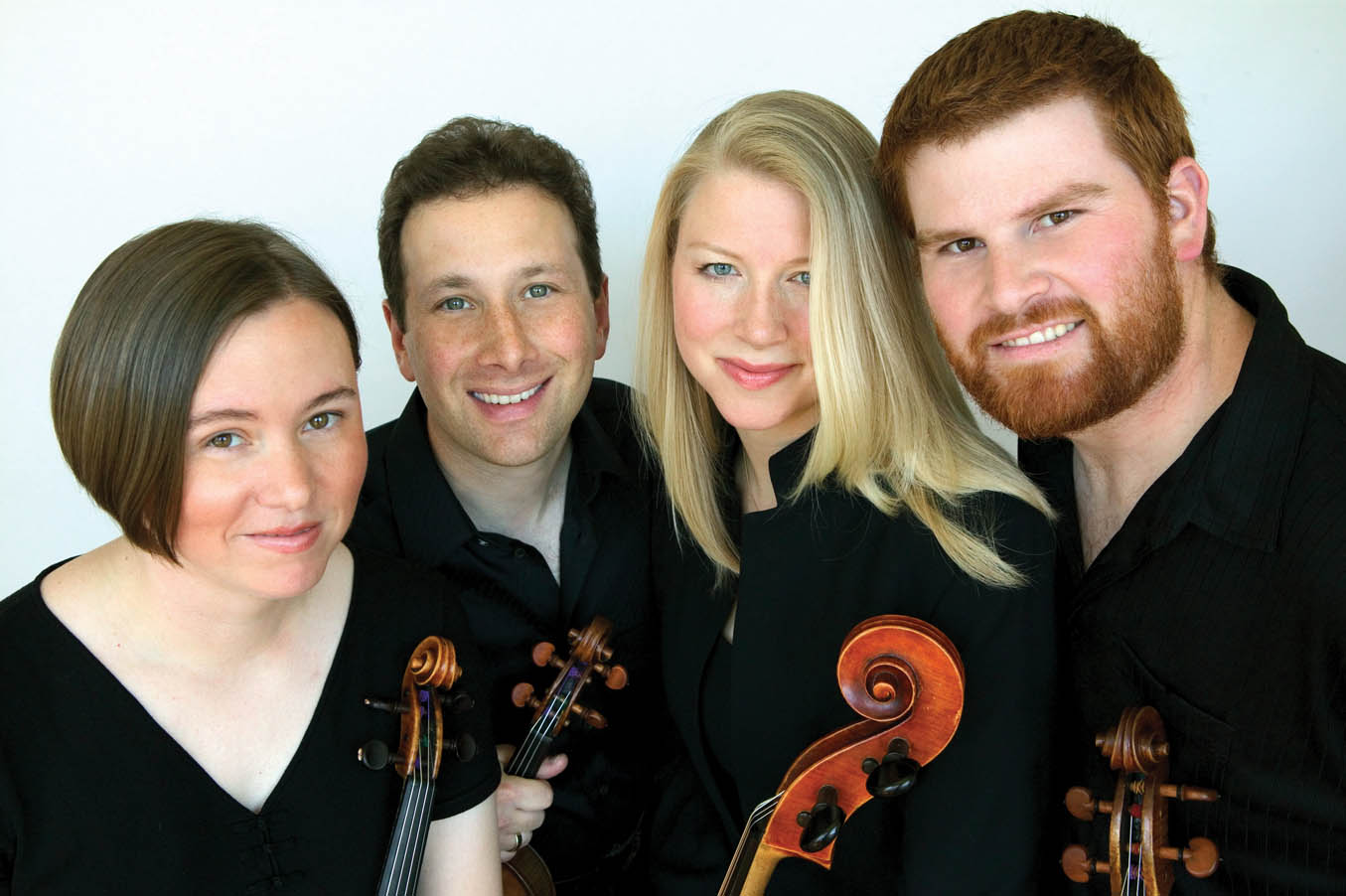
Kloetzel’s route to the Beethoven sonatas came by way of the complete string quartets, which she recorded as cellist of the Cypress String Quartet (below). “We recorded the late quartets first”, she remembers, “and then, many years later, we did the middles, and then, finally, just a quick two years before we disbanded, we did the earlies. It was fascinating to go backwards through his string quartet writing. If I had started the other way I would have thought the Op.18 quartets sound Mozartian, but seeing them from that way I saw everything that was going to happen later early on. It’s like when you look at a baby picture of somebody, it’s hard to tell what they’re going to look like as someone older, but later when you look back, you see them.”

She thought carefully of the ordering on the new cello release. “I didn’t record them straight from beginning to end, but I decided to put them in that listening order. If someone wants to sit down for three hours, they can go from 1796 to 1815, and have the experience of his writing for cello and piano with that little fun arrangement of the Horn Sonata thrown in. The thing that made me pause when I was doing that was the third, fourth and fifth sonatas, which are considered the biggest ones, and you have to wait for the entire third disc.”

Kloetzel includes the variations Beethoven wrote for piano and cello, and the ‘Conquering Hero’ title of the disc takes its name from the source of the first set of variations – Handel’s chorus See The Conquering Hero Comes, from the oratorio Judas Maccabaeus. “I had a lot of pushback on that title from people”, she says. “It’s more about Beethoven being the conquering hero, and what he conquered and became – the deafness, the lack of love. Everything after the battle with his nephew, and the fact he kept turning to music to write and express himself. That’s why I decided on the title, because in my mind, he is a conquering hero.”

Throughout the three discs, Kloetzel and Koenig (below) give off a pure enjoyment of Beethoven’s work. “I love the way things are put together, and I was reminded as I was doing this project, how clever Beethoven is. One of my favourite traits in all humans is cleverness, and Beethoven has it in spades. He’ll do something where the cello is in a certain range, and he’ll make sure that the piano parts are really not anywhere near that. When I was studying it for the recording, I would look to see where the piano part was. It is really interesting and thoughtful orchestration, carefully done. There is something perfect about that endless cleverness, and the dialogue back and forth. I was telling someone the other day that I was working on the Handel Variations, and it cracked me up that Beethoven doesn’t even give the cello the main theme until the tenth variation! Even then the piano has it in canon, low in the left hand.”

The sonatas are laced with feeling. “The G minor sonata, Op.5 no.2, has some serious drama, and I hear the Op.69 A major sonata with a degree of wistfulness and sadness, which I think brings something a little different to my interpretation, that it’s not all conquering joy. The music is so varied, too – he never does anything twice! When I was in college, I wrote a paper about the last two sonatas and how they are the turning point. They contain the hallmarks, the trills, the canons and the fugues.”

She agrees that the opening of the first of Beethoven’s two Op.102 sonatas feels like the opening of a new door. “I think so. One of the things that I find fascinating is that with both the third and fourth sonatas, he begins with solo cello. I read that Beethoven said, “Art demands of us that we never stand still.” And so he never does that same thing twice. In this case, he kind of does except it’s a really different type of melody, but it definitely is a signpost towards equal partnerships. The earlier works have a bit more weight to the piano, but of course it would have been him playing it! For almost all of that early stuff, up until about 1802, that’s the case, but after that, it’s not implied anymore. Part of the reason I find this music endlessly fascinating is that it’s always surprising, even to me, or in the way the contrast and the content is set up. If you follow the markings on his music, you find that buried treasure. So many people add in crescendos and the like, but I think he knew what he was doing!”

Kloetzel also follows Beethoven’s markings for repeats, whereby sections of the sonata movements are heard for the second time. “I included every repeat in all of these works, as I am a believer in the form, and I think that he knew what he was doing. In the G minor Sonata, the first movement has a double repeat. Now I know it makes the movement 21 minutes long, but I think it’s fascinating. I never performed it that way, but as I was studying it for the recording, I realised that he meant this!”

She confesses to playing the Second Sonata when just eight years old, which begs the question – at what age did Kloetzel actually start playing the cello? “I started at age six”, she says. “My mother is an opera singer, and in my family, I’m one of four children. You had to play piano and one other instrument. When I was five I heard the sound of the cello and I said, “I want to play”. My parents were like, “You’re too young, too little.” I begged for an entire year to play the cello, and so they finally rented a half-sized cello. After about six weeks, I get my first recital, which we have a tape of, by the way!” I did my own variations on Twinkle, Twinkle Little Star, but I couldn’t quite tune the cello, so it sounds a little modern! A few weeks later my teacher came to my mother and said, “She’s scaring me, she’s learning so fast. Please take her to Baltimore and find a teacher for her there. That’s where I did 10 years in the pre-college there, before going to the Juilliard School.”

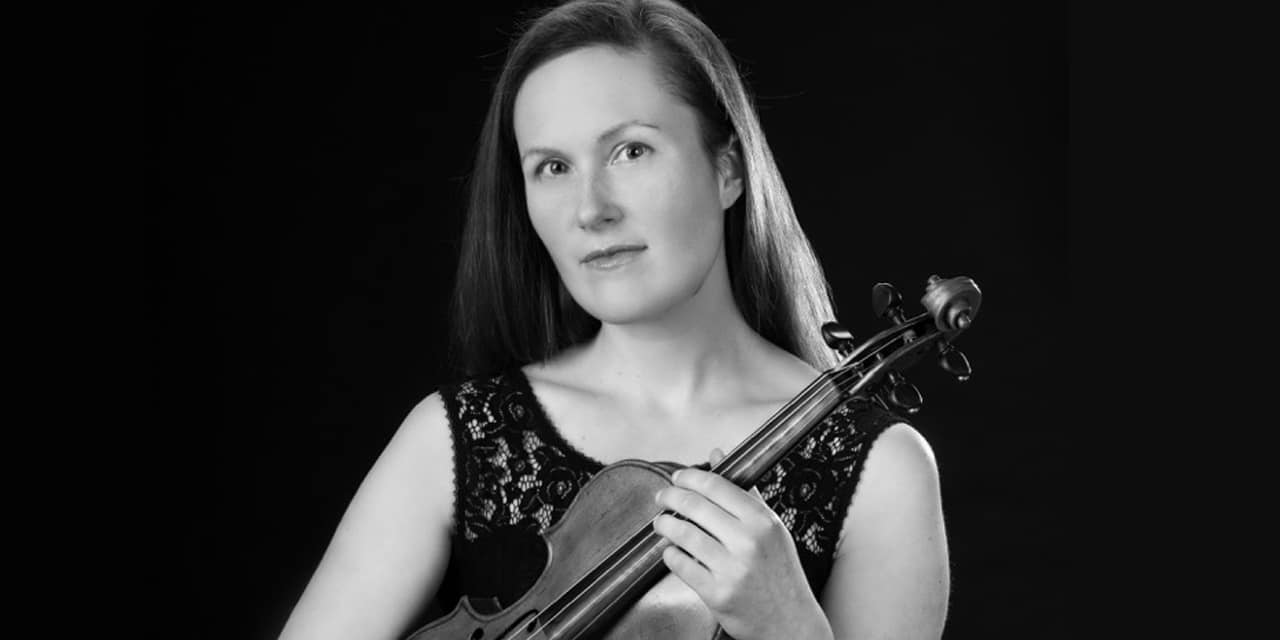
Kloetzel and Koenig both met at Juilliard. “Bob and I were there around the same time. He was one of the collaborative pianists, playing mostly with violins. Then six years ago when I got the job at University of California in Santa Barbara, he was the person to reach out to me and say, “Hey, we have a job opening. I see your quartet is just ending.” So I applied, and as part of the audition we actually played the Third Sonata together, because he played with me for the audition. That’s six years ago, and we started playing together right away. We played the G minor Sonata just a few months later, and my mother said how she was blown away by the two of us, it was like ‘hand in glove’. I think the two of us come from a similar background of making chamber music and really listening and responding, which makes it a very special partnership. I just knew he was the person to do this with me!”

Kloetzel has two points of reference for running through Beethoven’s output from early to late – the string quartets and now the sonatas for piano and cello. Is there a noticeable development in his writing for cello? “Let’s look at Opus 59 no.1”, she says a little unexpectedly, turning to the first of the Razumovsky Quartets. “A middle period work, one of my favourite quartets – it’s such a cello quartet, with the Russian theme. It’s like the Op.69 sonata, we’re right in that same middle, heroic period where he’s using all the voices equally. When we get to the later quartets, some of the cello parts are extremely high. When we get to Op.132 there’s a whole passage where the cello is way up high, soaring in octaves with the first violin, versus Op.131 where it’s very low.”

Mention of Beethoven’s Op.131 quartet, in C# minor no less, prompts a discussion on his use of keys. “It is fiendishly difficult, outrageous!”, Kloetzel agrees. “I remember really studying the key relationships, and how many he had written in each. F major is important, with three works, and E flat major too. I don’t see that as much in the cello sonatas. My friend Will Meredith, who wrote the booklet notes, he has given lectures on what keys mean to Beethoven. That’s like the language of flowers! His point though was that these things mattered. E flat was the heroic key – and you think of Op.127.”

Jennifer has a sudden realisation. “You know what I need to do next, right? The piano trios!” It would be a wholly logical step. “I have played them all, and the string trios too! We’ll see though. Stay tuned!”

Speaking from my own perspective as a part time cellist, I am curious to find out the technical demands as the cycle of cello sonatas progresses. “I don’t find they are as demanding as the quartets because of the length of the pieces”, she says. “With the quartets you can sometimes feel like you are about to climb a mountain when you start the piece. When you have a great pianist in the cello sonatas, you don’t have to fight to get your sound out – and that’s partly Beethoven’s writing. The hardest thing in a way is making sure all the ranges make sense. I read once that Beethoven didn’t think the cello could really be a solo instrument, because it couldn’t cut through. That is fascinating to me given they were playing with a fortepiano.”

Kloetzel is convinced that Beethoven knew the right people – particularly two cellists he met at an opportune time. “I think when he met the Duport brothers, in the Prussian court, that changed his opinion. I think we have them to thank for this body of work, and with the Mozart Prussian Quartets, freeing up the cello a little bit. In between the Duport brothers and Antonin Kraft, Beethoven heard very good cellists and knew what was possible. Interestingly we don’t have a fully-fledged slow movement in the sonatas, or the Triple Concerto. It’s a very short slow movement, and he puts the cello very high, like a violin. The Fifth Sonata has the closest thing to a slow movement, it spins and then goes into the fugue. The arc of that work is difficult, because it’s a short first movement and then you have to make it work. With the fugue, I’ve heard it played wildly fast. For my masters recital at Juilliard, I did all five sonatas on one programme, with two intermissions. It was such a great journey.”

Kloetzel has received advice on the sonatas from a close friend, Steven Isserlis, who has himself recorded the sonatas. “I adore him”, she says warmly. “He’s crazy and wonderful. He gave a class to my students a couple of years ago, and we reconnected after. I met him a while back, and he gave me a very difficult lesson on the fourth sonata many years ago, when I was a student living in Prague and he came through. Boy did he read me the riot act, for not doing my homework better – but out of that was born a friendship, so that was wonderful!”

Kloetzel and Koenig’s new recording complement Isserlis and Robert Levin, on the fortepiano, rather nicely. “I purposely didn’t listen to his recording of the Horn Sonata before ours”, says Jennifer, “as I didn’t want to be influenced by it. It’s hard when you’re preparing for a big project like this. I have multiple versions of the pieces, and favourite versions for sure, but one is elegant, one is passionate, one is exciting.” As to the piano, she says, “You realise how much Beethoven was playing with textures in the five sonatas”. The Horn Sonata is rather different. “There are more long lines within the cello / horn part, and moments where it’s like ‘No, he didn’t write anything like that for the cello. That is why I loved including it. There is a version of the Kreutzer Sonata played on cello, but I’m not so sure! It’s in a different key, and Bob was not sure about the piano part either. When I was trying to put this together I wanted it to be what Beethoven himself wrote”.

Although Beethoven is a huge part of Kloetzel’s work, especially recently, so too is contemporary music. It is clearly important for her to manage a balance between the different established and new classical works. “Absolutely, because in a way we’re only playing older music. We’re historians, right? We’re putting a fresh look at a moment in history, so I feel it is very important to look at the music of today, so that we not only continue to start but when people look back, they see what’s being written today. I also I have a whole passion of finding what I like to call the ‘living Beethovens’, composers whose music is interesting, thoughtful and clever – all the elements I love in Beethoven. Only yesterday I was on the phone with a composer who’s writing a Cello Concerto for me, and she’s just at the very beginning of writing so we were talking about ideas. She likes to have inspiration from something I’m thinking about, so it becomes a personal thing. I definitely think it’s important to play, and then not only to premiere works, but to champion them, so they get recorded.”

This approach has stayed with her. “When I was in the quartet, we had a whole process for choosing composers to commission which involved three of us not knowing where the music had come from. We would listen to the pieces on a playlist, and had a voting system to give our verdict, and then we would find out the composer. We called it ‘blind listening’ and it was great; it was about listening to the core of the music.”

“Just like I get obsessed with Beethoven I get obsessed with new music too, and the same thing happened with the string quartet he himself was writing for, the Schuppanzigh Quartet! Over the pandemic I was of course playing a lot of Bach, because I could, and that was a part of what kept me going when all the concerts went away. It was difficult, when what you are destined to do is gone, and live streaming was not the same. I said to myself “If nothing else, let’s play a little bit of Bach!” I made sure I played it every day, and I started to craft a project where I was commissioning companion pieces for each of the suites. I have five of the commissioned works so far. I went to my ‘go tos’ first but then I wanted to go further afield. That’s the old and the new again.”

She elaborates on the composers writing alongside the Bach. “There is Elena Ruehr, who wrote with the First Suite, and then a French composer Philippe Berson, he is amazing. He wrote a piece titled Sarabande for the Second Suite. For the Third Suite I turned to the very first composer I commissioned for the quartet, Dan Coleman, who was a colleague of mine at Juilliard and lives in Arizona. For lives in Arizona, and then for the fourth a colleague of mine from Santa Barbara, Sarah Gibson, a young female composer and pianist, I love the piece she wrote! The Fifth Suite is proving a little difficult, that’s the one I’m still waiting for, the person I wanted to do it was just too busy. I’m going to give that a little space, but then for the Sixth Suite I commissioned Aaron Clay, an African-American bass player from Virginia who is a very fine composer. Four of those are unperformed, and I hope not too much time goes by before they are.

There are other pieces that have been postponed. “There is a concerto by Joel Friedman that was supposed to be premiered during 2020 but has been postponed for another year or so. It is a Double Concerto, Inferno, for viola and cello – based on Dante’s Inferno. It has a political theme of what was happening, you know, in our country there for a while. It’s electrified, and we have to do all sorts of insane things – there’s a whole Skrillex effect I have to do. I’ve spent a lot of time figuring out pedals, with delay and looping. I’m excited about this piece, and art demands of us that we never stand still! There are too many things I would like to do but not enough hours in the day.”

You can listen to Jennifer Kloetzel and Robert Koenig’s Beethoven: The Conquering Hero at the Avie Records website where you can also explore purchase options.

In concert – Zoë Beyers, English Symphony Orchestra / Kenneth Woods: Celebrating the Queen’s Platinum Jubilee

Beethoven Egmont, Op. 84 – Overture (1809-10)
Elcock Violin Concerto, Op. 13 (1996-2006) [UK premiere]
Vaughan Williams The Lark Ascending (1914/20); Symphony no.5 in D major (1938-43)

Zoë Beyers (violin), English Symphony Orchestra / Kenneth Woods

Routh Hall, Bromsgrove School
Friday 27 May 2022

There will be many concerts over the next fortnight celebrating Queen Elizabeth II’s Platinum Jubilee, but few (if any) of more substance than that given tonight by the English Symphony Orchestra with its principal conductor Kenneth Woods, taking place on the attractive campus of Bromsgrove School some miles from Birmingham.

It might not have been written for this occasion, but the Violin Concerto by the ESO’s current composer-in-association Steve Elcock (above) was no less impressive for that. This marks something of a transition from those less ambitious pieces written for local musicians and the symphonic works now being recorded to great acclaim. It opens with an Allegro vivo whose rhythmic energy is maintained throughout, yet with enough expressive contrast for its second theme to assume greater expressive emphasis in the reprise. The highlight is a Molto tranquillo whose haunting main theme, initially unfolded by the soloist over undulating upper strings in a texture inspired by change-ringing techniques, is a memorable inspiration. A pavane-like idea later comes into focus and the closing stage, opening onto an eloquent plateau before evanescing into silence, lingers in the memory. The finale is a Passacaglia whose theme accelerates in five variations from Andante to Presto, culminating in a ‘cadenza’ for violin and timpani then a decisive pay-off.

A tough challenge, indeed, for any soloist and one which Zoë Beyers met with assurance over its 30-minute course. Aside from its sheer velocity the first movement is notable for a close-knit interplay between soloist and orchestra that was brought off with admirable precision, while the modal subtleties of the slow movement were rendered as enhancements to its overall tonal trajectory. Aside from a slight falling away of tension toward its centre, the finale saw the piece to a forceful close. Good to hear these performers recorded it prior to this performance, as a coupling to the Eighth Symphony that the ESO premiered last year, and which should be released over the coming months.

Beyers returned after the interval to launch a Vaughan Williams second-half (this year being the 150th anniversary of his birth) with The Lark Ascending. Easy to take for granted now that it is so frequently performed, the piece can still work its magic in an attentive rendering such as this. The underlying tempo might have been on the slow side, but the elegance and poise invested into the solo line were not to be gainsaid, nor was the translucency of orchestral textures which Kenneth Woods shaped with due restraint through the folk-like central section then into the easeful closing pages. Suffice to add that the unaccompanied final bars held those present spellbound with their artlessness.

There was at least as much to admire in the reading of VW’s Fifth Symphony which here followed on inevitably. A steady overall tempo for the Preludio did not exclude a palpable accumulation of energy in its development, nor a build-up of real fervency with the thrilling re-entry of its second theme. Understated it may be, but the Scherzo is replete with rhythmic quirks and while these were not always ideally negotiated, the music’s sardonic humour and ultimate evaporation were tellingly rendered. Doubtless this work’s emotional heart, the Romanza was admirably realized in its gradual coalescing of hymnal and folk-inflected elements towards a nobly wrought apex, but Woods kept enough in reserve so the final Passacaglia never risked becoming an anti-climax. It earlier stages conveyed  an emotional release as is countered by the ensuing anxiety then fateful reappearance of the work’s opening theme, subsiding into a coda which feels as much a benediction now as when it was first heard almost eight decades ago.

Beethoven‘s overture to Goethe’s Egmont might have seemed anomalous in this context but, as Woods pointed out in his opening remarks, the heroes and villains of 16th-century ‘Spanish Netherlands’ were not so far removed from those of today and, as the heady closing pages reminded us, triumph over adversity can never be taken for granted.

For further information on Steve Elcock, click here to visit his dedicated site, and for more on Vaughan Williams click here. To find out more about the artists, click on the names for more on Zoë Beyers, Kenneth Woods and the English Symphony Orchestra.

Listening to Beethoven – normal service will be resumed shortly!

from Ben Hogwood

Regular readers of these pages may have wondered what has happened to Arcana’s Beethoven listening project. I am very pleased to say that it has not finished, merely been put on pause – and will resume with the mighty Eroica symphony very soon! To whet your appetite, here is a 2016 concert performance from the Frankfurt Radio Symphony Orchestra, conducted by Andrés Orozco-Estrada: