Listening to Beethoven #133 – Sonata for piano and violin no.1 in D major Op.12/1

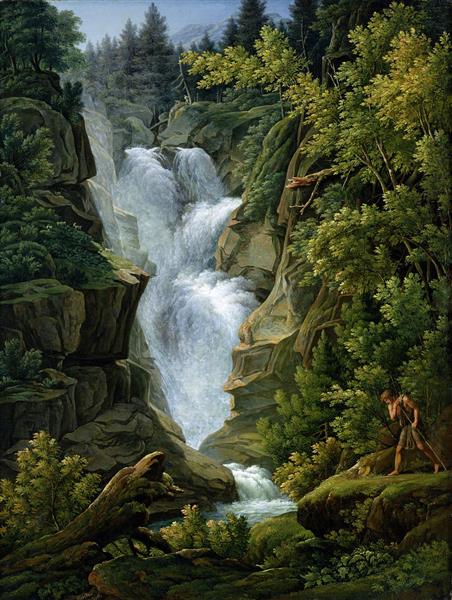
joseph-anton-koch-wasserfall-im-berner-oberland-1796
Waterfall in the Bern Highlands (1796) by Joseph Anton Koch

Sonata no.1 for piano and violin in D major Op.12/1 (1798, Beethoven aged 27)

1. Allegro con brio
2. Tema con variazioni. Andante con moto
3. Rondo. Allegro

Dedication Antonio Salieri
Duration 20′

Listen

by Ben Hogwood

Background and Critical Reception

Beethoven’s first venture into the world of the violin sonata needs a few qualifiers. Firstly, the three works collected together as Op.12 were published in 1798 as Three Sonatas for keyboard with a violin, dedicated to his teacher Salieri. They were following Mozart’s convention where the keyboard is still given primary billing – but as the music shows, the tables were definitely beginning to turn in favour of the stringed instrument, just as they were in the two sonatas for keyboard and cello published as Op.5.

The verdict among musicologists is generally that Beethoven is sticking closely to Mozart’s style of writing in these pieces – and indeed that they might be playing it too safe. Daniel Heartz certainly thinks so, and given the detail he invests in Beethoven’s works it is surprising to see them dismissed with a relatively curt verdict. For him the Op.12 sonatas are ‘comparatively tame’. They are said to be indebted to Mozart’s works in the genre. Nevertheless they lack gripping ideas’.

Elsewhere praise is more forthcoming. Richard Bratby, writing for the recording on Signum Classics from Tasmin Waley-Cohen and Huw Watkins, declares that ‘far from being constrained by Mozart’s model, Beethoven had given it Romantic wings’. He enjoys the ‘winsome theme’ given to the second movement, on which the composer writes four variations, and the ‘jig-like finale’ with its ‘subversive rhythmic games worthy (though Beethoven would never have conceded it) of Haydn himself.

Thoughts

A new form for Beethoven – and one that he approaches with characteristic vigour. The first of what would be twelve published sonatas for the combination of piano and violin is enjoyably upbeat and full of melodies – and concise, too, as the composer keeps his musical arguments to the point.

That said, the first movement is quite a sizable structure, beginning with a flourish from both instruments that sets a sunny mood and the close musical relationship between the two instruments. Beethoven, who played the piano with violinist Ignaz Schuppanzigh (quartet leader for Prince Lichnowsky) in the early performances, is immediately at home

The theme and variations of the second movement are a familiar tactic but freshly employed, especially when the third of the four variations moves into an explosive section in the minor key. Beethoven, an acknowledged master of the variation form, is still finding new ways of pushing himself.

The third movement has the best tune, and it’s a surprisingly angular one, with big melodic leaps – but it stays in the head, helped by the repetitions demanded by the Rondo form. Beethoven is off and running in the violin sonata form, and though Mozart is undoubtedly an influence, the overall voice is unique.

Recordings used and Spotify playlist

Midori Seiler (violin), Jos van Immerseel (fortepiano) (Zig Zag Classics)
Yehudi Menuhin (violin), Wilhelm Kempff (Deutsche Grammophon)
Josef Suk (violin), Jan Panenka (piano) (Supraphon)
Alina Ibragimova (violin), Cédric Tiberghien (Wigmore Hall Live)
Tasmin Little (violin), Martin Roscoe (piano) (Chandos)
Frank Peter Zimmermann (violin), Martin Helmchen (BIS)
Paul Barritt (violin), James Lisney (piano) (Woodhouse Editions)

The above is only a snapshot of a remarkably high-level discography for these sonatas, with a wide variety of approaches. Yehudi Menuhin and Wilhelm Kempff have a wonderfully close rapport and obvious enjoyment of the music. Josef Suk and Jan Panenka are brightly lit on an older Supraphon recording, which is brilliantly played if a little too ‘full-on’ at times.

The newest recording, from Frank Peter Zimmermann and Martin Helmchen, has a youthful vigour while the only period instrument example here, from Midori Seiler and Jos van Immerseel, has an exciting cut and thrust.

The Spotify playlist below does not contain the Barritt / Lisney version, but does include a highly powered account by Gidon Kremer and Martha Argerich, recorded for Deutsche Grammophon:

You can chart the Arcana Beethoven playlist as it grows, with one recommended version of each piece we listen to. Catch up here!

Also written in 1798 Haydn – Solo e pensoso, Hob.XXIVb:20

Next up Sonata for piano and violin no.2 in A major Op.12/2
Listening to Beethoven #132 – String Trio in C minor Op.9/3

string-trio-op93

Man reading at lamplight, by Georg Friedrich Kersting (1814)

String Trio in C minor Op.9/3 (1798, Beethoven aged 27)

Dedication Count Johann Georg von Browne
Duration 24′

1. Allegro con spirito
2. Adagio con espressione
3. Scherzo: Allegro molto e vivace
4. Finale: Presto

Listen

All of Beethoven’s mature writing for string trio can be seen in this wonderful set of live performances from the Wigmore Hall, given by Daniel Sepec (violin), Tabea Zimmermann (viola) and Jean-Guihen Queyras (cello).

Background and Critical Reception

Whenever publishing a trio of works, Beethoven looks to include one in a minor key. The Op.1 piano trios, the Op.2 piano sonatas, the Op.10 piano sonatas and now the Op.9 string trios – each includes a work in the minor, in this case another outing in C minor. It is, as you might expect, a very different piece to the other two, but reception is decidedly mixed.

Stephen Daw, writing for the Leopold String Trio recordings on Hyperion, is surprisingly dismissive, declaring ‘there is little of the drama of either Haydn’s Sturm und Drang symphonies, or even the opening of Mozart’s Die Zauberflöte about this music, and much of its character seems to spring from its short-phrased gruffiness – a characteristic far more essential to this work, and later almost unique to Beethoven’s music’.

Daniel Heartz notes that the music can still sound positive when in the minor, and shows how the density of Beethoven’s writing for strings could easily fool the ear into thinking four instruments are playing. ‘Like the end of the Piano Trio in C minor Op.1/3’, he writes, ‘the final moments are in hushed C major, a pianissimo with the violin climbing up to the heavens (Jacob’s Ladder?)’. This would be Beethoven’s last contribution to the string trio – his aim was squarely at the string quartet.

Thoughts

Whereas the first two works in this trilogy are sunny, optimistic works, the third has a different air from the outset. There is a pensive anxiety to the tune and the way it is developed, and as Daniel Heartz notes the lack of a rest for either instrument means the sound is congested. The edginess runs throughout the first movement, its arguments tense and unrelenting.

The second movement relents, introducing some light to the shade by moving to the major key. There is still an element of tension in the pauses between the phrases, but its reflections are generally more positive. The development challenges this – the ‘gruff’ exterior spoken of above – before the relative serenity returns.

The third movement is equal parts minuet and scherzo. It would be pretty quick to dance to but its springy rhythms generate a good deal of momentum. Again the mood is nervy, and there is no let up in the trio sections, despite a move towards sunnier climbs. The fourth movement continues in this air, with the violin’s unnerving twists and turns an ever-present doubt. Beethoven has searching questions here, but just when it seems they will not be answered he finds peace in a rather beautiful resolution, the major key arriving just in time – as it does at the end of the Piano Trio no.1, in the same key.

There is a restless air about this piece, suggesting Beethoven is on a quest and has not found answers to the darker thoughts currently circulating. Perhaps we will get more clues to his thinking when the string trios of Op.9 become the string quartets of Op.18.

Recordings used and Spotify links

L’Archibudelli (Vera Beths (violin), Juergen Kussmaul (viola), Anner Bylsma (cello)
The Grumiaux Trio (Arthur Grumiaux (violin), Georges Janzer (viola), Eva Czako (cello) (Philips)
Anne-Sophie Mutter, Bruno Giuranna and Mstislav Rostropovich (Deutsche Grammophon)
Leopold String Trio Isabelle Van Keulen (violin), Lawrence Power (viola), Kate Gould (cello) (Hyperion)
Trio Zimmermann (Christian Tetzlaff (violin), Antoine Tamestit (viola), Christian Poltéra (cello) (BIS)

Anybody looking for a version of the Op.9 trios has a wealth of treasures from which to choose. The C minor trio brings out the dramatists in the superpower trio of Mutter, Giuranna and Rostropovich, while Arthur Grumiaux’s tone in the second movement is magical, the trio interwoven beautifully throughout the piece. The Leopold, Zimmermann and L’Archibudelli versions are all excellent, the latter benefiting from the leaner sound of instruments of the period.

You can chart the Arcana Beethoven playlist as it grows, with one recommended version of each piece we listen to. Catch up here!

Also written in 1798 Haydn The Creation

Next up Sonata for piano and violin in D major Op.12/1

Listening to Beethoven #131 – String Trio in D major Op.9/2

string-trio-op92

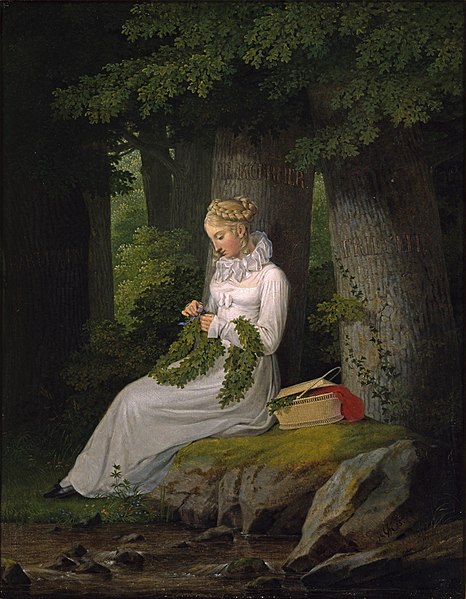
The wreath maker, by Georg Friedrich Kersting (1815)

String Trio in D major Op.9/2 (1798, Beethoven aged 27)

Dedication Count Johann Georg von Browne
Duration 22′

1. Allegretto
2. Andante quasi allegretto
3. Menuetto: Allegro
4. Rondo: Allegro

Listen

Background and Critical Reception

This second trio of Beethoven’s Op.9 set is in D major – the same key as the Piano Sonata Op.10/3, on which the composer was working at the same time. Stephen Daw, in his booklet notes for the Leopold String Trio’s recording on Hyperion, notes similarities between the two works – not least the scale of their technical challenges. ‘The solo part is in fact frighteningly difficult’, he writes of Beethoven’s violin writing. ‘We are led to contemplate whether the composer (who was certainly, in Op.10, still composing music to play himself) was aware of all the problems he was presenting to his violinist’.

Daniel Heartz spots a couple of pointers towards the Symphony no.2 of four years later – also to be in D major – and is relatively critical of the fourth movement Rondo, highlighting the ‘none-too-promising’ melody begun by the cello…too sectionalized into little segments to be of much interest’.

Thoughts

The start of this piece has an appealing warmth and is deceptively laid back – soon, Beethoven is bringing more energy to the table. The scoring for string trio is once again effortless, a form where the composer feels happy.

For the slow movement we move to the minor key, but the mood remains quite upbeat, the music still quite lively at a walking pace. The Minuet is bright and breezy, given in a quick triple time, the first violin with some technically tricky melodies to play. The final movement is quite stop start, led off quickly by the cello with a melody that becomes its relatively catchy calling card.

This trio is an attractive piece, if not quite as memorable as the first in the set, and with fewer contrasts between the movements. Beethoven’s mastery of writing for stringed instruments, however, gains an even firmer foothold.

Recordings used and Spotify links

L’Archibudelli (Vera Beths (violin), Juergen Kussmaul (viola), Anner Bylsma (cello)
The Grumiaux Trio (Arthur Grumiaux (violin), Georges Janzer (viola), Eva Czako (cello) (Philips)
Anne-Sophie Mutter, Bruno Giuranna and Mstislav Rostropovich (Deutsche Grammophon)
Leopold String Trio Isabelle Van Keulen (violin), Lawrence Power (viola), Kate Gould (cello) (Hyperion)
Trio Zimmermann (Christian Tetzlaff (violin), Antoine Tamestit (viola), Christian Poltéra (cello) (BIS)

The Leopold and Zimmermann trios offer very strong digital versions, while L’Archibudelli bring an attractively grainy tone to their version. Arthur Grumiaux leads his trio with a singing tone, especially in the second movement.

You can listen to the versions from L’Archibudelli, the Grumiaux Trio, the Mutter-Giuranna-Rostropovich trio and Trio Zimmermann on this playlist:

You can chart the Arcana Beethoven playlist as it grows, with one recommended version of each piece we listen to. Catch up here!

Also written in 1798 Eybler Clarinet Concerto in B flat major

Next up String Trio in C minor Op.9/3

Listening to Beethoven #130 – String Trio in G major Op.9/1

string-trio-op91

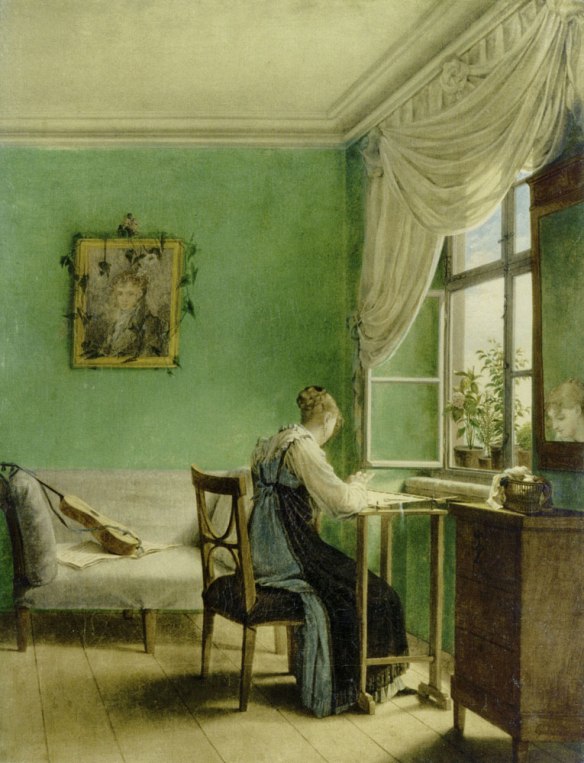
Woman embroidering, by Georg Friedrich Kersting

String Trio in G major Op.9/1 (1798, Beethoven aged 27)

Dedication Count Johann Georg von Browne
Duration 25′

1. Adagio – Allegro con brio
2. Adagio, ma non tanto e cantabile
3. Scherzo: Allegro
4. Presto

Listen

Background and Critical Reception

Seemingly preoccupied with units of three, Beethoven returned to the string trio around the same time that he was working on the three Op.10 piano sonatas – just before writing the three sonatas for violin and piano Op.12. The trios are dedicated to Count von Browne, husband of the dedicatee for Op.10 – and there are several parallels between the two sets. D major and C minor are used for a work in each – while G major, seldom used until now, is used for this first piece.

Robert Simpson, writing in The Beethoven Companion, argues persuasively that the trios are overlooked. ‘His three Op.9 trios are rightly quoted as the locus classicus for astonishing weight and richness of sound in this medium’. He notes how Beethoven’s writing for the three instruments is so inclusive that the ‘missing’ second violin that would make up a string quartet is not evident.

Thoughts

Beethoven has already shown an impressive mastery of the string trio in the Op.3 and Op.8 works, but with the first work of Op.9 he goes up another level. The grand introduction for the first movement is imposing, almost orchestral in its conception given that there are only three instruments in play. It leads to a main theme where Beethoven is really pushing the ranges of the three instruments, the cello down low and the violin up high. It gives a strong sense of pushing boundaries – but there is a lot of fun to be had in the process.

The second movement is a beauty, a tender reflection in E major, a stream of consciousness. The third movement is bright, a quick dance that is much more scherzo than minuet, while the fourth movement rushes forward impatiently, each of the instruments bristling with energy.

Beethoven’s ambition here is clear, taking the string trio to a new level of technical prowess while expanding the form.

Recordings used and Spotify links

L’Archibudelli (Vera Beths (violin), Juergen Kussmaul (viola), Anner Bylsma (cello)
The Grumiaux Trio (Arthur Grumiaux (violin), Georges Janzer (viola), Eva Czako (cello) (Philips)
Anne-Sophie Mutter, Bruno Giuranna and Mstislav Rostropovich (Deutsche Grammophon)
Leopold String Trio Isabelle Van Keulen (violin), Lawrence Power (viola), Kate Gould (cello) (Hyperion)
Trio Zimmermann (Christian Tetzlaff (violin), Antoine Tamestit (viola), Christian Poltéra (cello) (BIS)

You can listen to the versions from L’Archibudelli, the Grumiaux Trio, the Mutter-Giuranna-Rostropovich trio and Trio Zimmermann on this playlist:

Heifetz and co are expansive in the slower music but enjoy tripping along in the third movement, relishing the music’s positive energy. The Grumiaux Trio are satin-smooth, Arthur’s violin taking the lead in an affectionate account. The Leopold String Trio give an elegant first movement but keep the freshness of the new discoveries as the work progresses.

You can chart the Arcana Beethoven playlist as it grows, with one recommended version of each piece we listen to. Catch up here!

Also written in 1798 Kozeluch Sinfonia Concertante in E-flat major

Next up String Trio in G major Op.9/2

Listening to Beethoven #129 – Clarinet Trio in B flat major Op.11

clarinet-trio

The Kaunitz Palace and Garden, Vienna by Bernardo Bellotto

Trio in B flat major Op.11 for clarinet, cello and piano (1797-8, Beethoven aged 27)

Dedication Countess Maria Wilhelmine von Thun
Duration 22′

1. Allegro con brio
2. Adagio
3. Tema con variazioni ‘Pria ch’io l’impegno’: Allegretto

Listen

Background and Critical Reception

The combination of clarinet, cello and piano was a relatively rare one when Beethoven wrote his trio in 1798. It is thought to have been written for the Viennese clarinettist Joseph Bähr, but was dedicated to Countess Maria Wilhelmine von Thun. Richard Wigmore, writing in his booklet note for Hyperion on the piece, thinks Bähr suggested a theme for the variations Beethoven wrote in the finale – on Josef Weigl’s new comic opera L’amor marinaro which was premiered late in 1797 – and which gives the trio its sometimes-used Gassenhauer nickname.

Daniel Heartz dubs the piece ‘very entertaining’, but Lewis Lockwood is less convinced. ‘Of the lesser works, designed for popularity and little more, the most developed are the Clarinet Trio Op.11 and the Quintet for Piano and Winds Op.16. On its publication in 1798 Beethoven dedicated it to a Countess Thun, presumably the oldest one of several by that title, who a few years earlier had gone on her knees to implore him to play. For her pains she now received a light and flashy reward that moved from a glittering first movement and slow movement to the circus style of its finale, made up of variation on the hit tune Pria ch’io l’impegno from a recent comic opera by Josef Weigl. In once more forcing an inevitable comparison with Mozart, whose E flat major Clarinet Trio, with viola, had been another quiet masterpiece, Beethoven did well to make his piece attractive to audiences and performers, especially cellists, but he was fully aware that instead of attempting a really serious work that could stand up to Mozart’, he was trolling the surface for easy dividends.’

Lockwood’s relative disdain for the piece has not carried over to audiences, nor artists – for as you will read below there are many fine versions of the piece. This in spite of the critic in 1798 who declared that the work was ‘difficult’ and that Beethoven wrote ‘unnaturally’.

Thoughts

What a charming piece this is.

The first theme we hear is an unlikely one. Given that the piece is in B flat major Beethoven seems to want nothing to do with the home key initially, arriving there as though by accident. The second theme is nice, too, given out by the clarinet after a simple and quite dreamy aside in D major. The tone of clarinet, cello and piano is lovely – and while the piano often takes the lead there is plenty for the other two instruments.

The second movement is sublime, a lovely period of reflection with a lyrical theme made for cello. This is also the ideal point to enjoy the colour combination of cello and clarinet in particular which Beethoven clearly relished.

The composer has a great deal of fun with the ‘Gassenhauer’ theme, which has a wide set of variations. The perky theme is taken for a run first by the piano, then through a canon between cello and clarinet, then another upright exchange with brilliant high notes from the clarinet. The fourth variation finds minor key stillness, deep in thought, but is completely swamped by tempestuous scales from the piano, blasted out fortissimo. Variation 7 returns to the minor key, in a mock-stern funeral march, then we hear a glorious high cello and clarinet unison for the eighth. The ninth and final variation goes far and wide, allowing the piano room to roam before a bracing coda.

Recordings used and Spotify links

Sabine Meyer (clarinet), Heinrich Schiff (cello), Rudolf Buchbinder (piano) (EMI)

Gervase de Peyer (clarinet), Jacqueline du Pré (cello), Daniel Barenboim (piano) (EMI)

Karl Leister (clarinet), Pierre Fournier (cello), Wilhelm Kempff (piano) (Deutsche Grammophon)

The Nash Ensemble (Virgin Classics)

Jon Manasse (clarinet), Clive Greensmith (cello), Jon Nakamatsu (piano) (Harmonia Mundi)

Paul Meyer (clarinet), Claudio Bohórquez (cello), Eric Le Sage (piano) (Alpha)

The trio led by Jon Manasse give a sparkling performance, of which you can hear half on Spotify due to time restrictions. Sabine Meyer and her trio are also superb, with Heinrich Schiff excelling in the slow movement. Karl Leister, Pierre Fournier and Wilhelm Kempff had a great rapport, as do Eric Le Sage and his trio – all of them emphasising how much pleasure this work can bring as pure chamber music to be enjoyed together.

You can listen to these versions on the playlist below:

You can chart the Arcana Beethoven playlist as it grows, with one recommended version of each piece we listen to. Catch up here!

Also written in 1798 Eybler Clarinet Concerto in B flat major

Next up String Trio in G major Op.9/1